
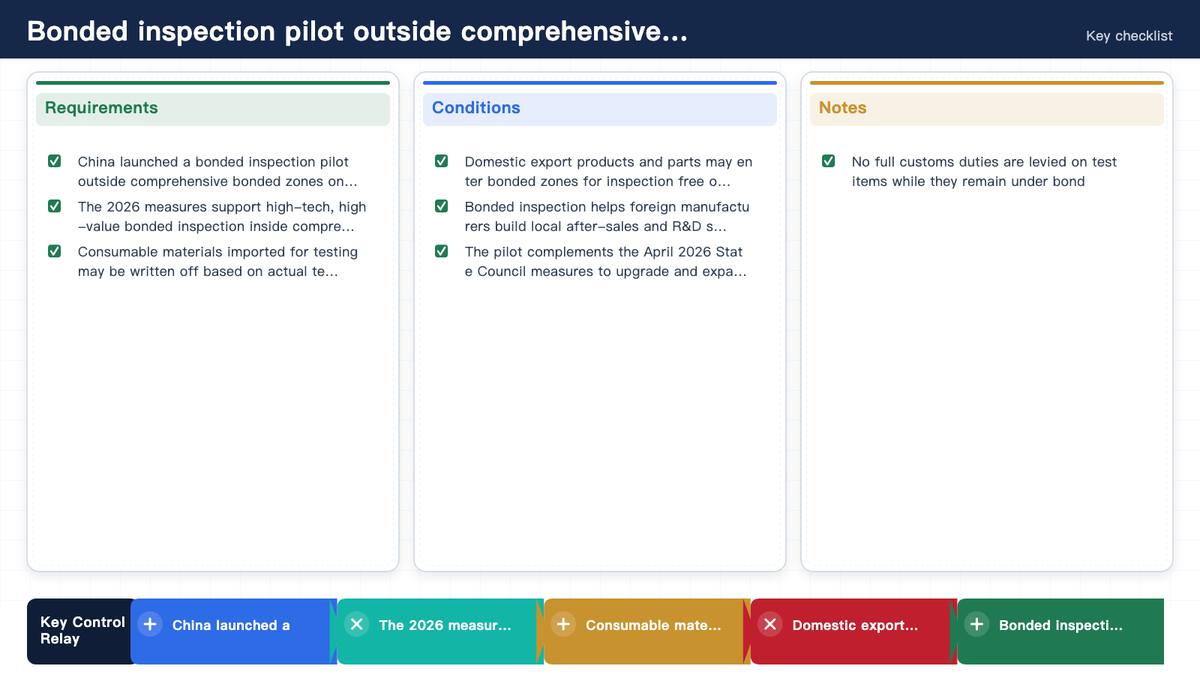
- China launched a bonded inspection pilot outside comprehensive bonded zones on 2 July 2026. 中国于2026年7月2日启动了综合保税区外的保税检测试点。
- The 2026 measures support high-tech, high-value bonded inspection inside comprehensive bonded zones under a positive-list approach. 2026年的措施以正面清单方式,支持综合保税区内高技术、高价值保税检测业务。
- Consumable materials imported for testing may be written off based on actual testing consumption. 检测用进口消耗性物料可按实际耗用据实核销。
- Domestic export products and parts may enter bonded zones for inspection free of the used-machinery import ban. 国产出口产品及零部件进入保税区检测,可豁免旧机电进口禁令限制。
- Bonded inspection helps foreign manufacturers build local after-sales and R&D service centres. 保税检测有助于外国制造商在华设立本地售后与研发服务中心。
- The pilot complements the April 2026 State Council measures to upgrade and expand comprehensive bonded zones. 该试点与2026年4月国务院促进综保区扩能提质的措施形成配套。
- No full customs duties are levied on test items while they remain under bond. 检测物品在保税状态下无需缴纳全额关税。
Bonded inspection pilot outside comprehensive bonded zones | 综合保税区外保税检测试点
Overview
On 2 July 2026, the General Office of the Ministry of Commerce (MOFCOM) and the General Office of the General Administration of Customs (GACC) issued the *Notice on Launching the Pilot for Bonded Inspection Outside Comprehensive Bonded Zones* (《关于开展综合保税区外保税检测试点工作的通知》). The pilot lets qualifying foreign manufacturers and service providers conduct bonded inspection activities—examining, testing and calibrating goods—without those items being physically inside a comprehensive bonded zone (CBZ), while still enjoying bonded (duty-suspended) treatment.
This article explains the pilot, how it fits with the April 2026 State Council measures on CBZ upgrading, and what it means for foreign investors building after-sales and R&D centres in China.
What is bonded inspection?
Bonded inspection means imported goods used for inspection, testing, calibration or after-sales service can be stored and handled under bond—that is, customs duties and import VAT are suspended rather than paid up front, as long as the items remain within a supervised bonded arrangement. When the items are re-exported or otherwise disposed of in line with customs rules, no duty is ultimately levied; only if they are released into the domestic market do normal duties apply.
Traditionally, bonded inspection in China was confined to the geographic boundaries of a comprehensive bonded zone. The July 2026 pilot extends the bonded treatment outside the zone fence for qualifying inspection operations.
The July 2026 pilot: scope and logic
The MOFCOM/GACC notice establishes a controlled pilot that:
- Authorises bonded inspection outside CBZ boundaries for approved enterprises and locations.
- Keeps the items under customs supervision through inventory and process tracking, not physical zone walls.
- Targets foreign manufacturers that need local inspection, repair, calibration and after-sales service capacity but do not want to pay full duties on every test unit, fixture or sample.
For a foreign investor, the practical benefit is the ability to set up an in-country inspection or service centre in a normal industrial park or自有 facility, while still enjoying bond treatment on the goods moving through it.
The April 2026 State Council measures (complement)
The pilot is the external counterpart to domestic CBZ reforms. On 14 April 2026, the State Council issued *Several Measures to Promote the Capacity-Building and Quality Upgrade of Comprehensive Bonded Zones* (国办函〔2026〕40号). Its relevant points:
- Supports high-tech, high-value bonded inspection inside CBZs under a positive-list approach (eligible categories are listed; everything on the list qualifies).
- Allows consumable materials imported for testing to be written off based on actual consumption rather than rigid per-unit accounting.
- Permits domestic export products and parts to enter CBZs for inspection, free of the used-machinery import ban that would otherwise block returned or re-imported equipment.
Together, the April measures widen what can happen *inside* zones, and the July pilot pushes bonded inspection *outside* them.
Key operational reliefs
| Relief | Where | Effect |
|---|---|---|
| Positive-list bonded inspection | Inside CBZ | High-tech/high-value testing eligible by list |
| Consumption-based write-off | Inside CBZ | Test consumables settled on actual use |
| Used-machinery ban waiver | Inside CBZ | Domestic export goods inspected without ban |
| Bonded inspection outside zone | Outside CBZ (pilot) | In-country centres get bond treatment |
Why foreign manufacturers should care
- Local after-sales without duty penalty. A foreign OEM can hold spare parts, samples and test units in China for service work without paying duties on every item, as long as they stay under bond.
- R&D and calibration centres. Testing and calibration of imported components for product development can proceed locally, speeding time-to-market.
- Reverse-flow flexibility. Domestic-produced goods sent abroad and returned for inspection are not trapped by the used-machinery import restriction when handled inside a CBZ.
- Site choice. The outside-zone pilot means you are not forced to locate inside a CBZ fence to get bonded inspection; a suitable普通 facility may qualify.
Compliance essentials
- Items under bond must remain traceable; expect inventory, usage and re-export reporting to customs.
- Consumable write-off requires documented actual consumption—keep testing records.
- Released-to-market items trigger normal duty and VAT; separate bonded and domestic flows clearly.
- Pilot eligibility and locations are designated—confirm your site and product category are covered before relying on it.
Related reading
- GACC rules on bonded zones and supervised processing
- MOFCOM guidance on trade-in-services and inspection pilots
- State Council measures on comprehensive bonded zone upgrading
Sources
- State Council — 国办函〔2026〕40号《关于促进综合保税区扩能提质的若干措施》(2026-04-14)
- Ministry of Commerce (MOFCOM) — homepage; note the 2026-07-02 MOFCOM/GACC notice on the bonded-inspection pilot outside comprehensive bonded zones by title
综合保税区外保税检测试点
概述
2026年7月2日,商务部办公厅与海关总署办公厅联合发布《关于开展综合保税区外保税检测试点工作的通知》。该试点允许符合条件的外国制造商与服务机构在综合保税区(综保区)物理范围之外开展保税检测活动——即对货物进行检验、测试与校准——同时仍享受保税(暂缓征税)待遇。
本文说明该试点的内容、其与2026年4月国务院综保区扩能提质措施的配套关系,以及对外国投资者在华设立售后与研发中心的意义。
什么是保税检测?
保税检测是指用于检验、测试、校准或售后服务的进口货物,可在保税状态下存储与处理——即在海关监管安排下,关税与进口环节增值税暂缓缴纳而非先期付清。只要物品留在受监管的保税安排内,最终复出口或按海关规定处置时即不征税;仅当物品放行进入国内市场时,才按正常规定征税。
传统上,中国的保税检测被限制在综合保税区的地理边界之内。2026年7月试点将保税待遇延伸至区外,适用于符合条件的检测业务。
2026年7月试点:范围与逻辑
商务部与海关总署的通知确立了一项受控试点:
- 对获批企业与场所,授权在综保区区外开展保税检测。
- 通过库存与流程追踪(而非物理区围栏)使物品处于海关监管之下。
- 面向需要在本地具备检测、维修、校准与售后能力,又不希望为每台检测样机、工装或样品缴纳全额关税的外国制造商。
对外国投资者而言,实际好处是能够在普通工业园或自有场所设立在岸检测或服务中心的,同时就流经其中的货物享受保税待遇。
2026年4月国务院措施(配套)
该试点是区内改革的区外对应安排。2026年4月14日,国务院发布《关于促进综合保税区扩能提质的若干措施》(国办函〔2026〕40号),相关要点包括:
- 以正面清单方式,支持综保区内高技术、高价值保税检测(清单内品类即符合条件)。
- 允许检测用进口消耗性物料按实际耗用据实核销,而非僵化的逐件核算。
- 允许国产出口产品及零部件进入综保区检测,豁免原本会限制退回或复进口设备的旧机电进口禁令。
综上,4月措施放宽了区内可从事的业务,7月试点则将保税检测推向区外。
关键操作便利
| 便利 | 适用地 | 效果 |
|---|---|---|
| 正面清单保税检测 | 综保区内 | 高技术/高价值检测按清单准入 |
| 按耗用核销 | 综保区内 | 检测耗材按实际用量结算 |
| 旧机电禁令豁免 | 综保区内 | 国产出口货物检测不受禁令限制 |
| 区外保税检测 | 综保区外(试点) | 在岸中心享受保税待遇 |
为何外国制造商应关注
- 本地售后免关税惩罚。 外国整机厂可在华持有备件、样机与检测单元用于服务工作,只要保持保税状态,无需对每件物品缴税。
- 研发与校准中心。 为产品开发而对进口零部件进行的测试与校准可在本地进行,加快上市速度。
- 逆向流转灵活性。 国产货物出境后回流入区检测的,在综保区内处理时不受旧机电进口限制掣肘。
- 选址自由。 区外试点意味着不必被迫选址在综保区围栏内才能获得保税检测,合适的普通场所亦可能符合条件。
合规要点
- 保税物品须保持可追溯;预期需向海关报送库存、使用与复出口情况。
- 耗材核销需有实际耗用记录支撑——妥善留存检测台账。
- 放行进入市场的物品将触发正常关税与增值税;须清晰区分保税与国内流转。
- 试点资格与场所为指定制——在依赖该政策前,先确认所在场所与产品品类是否在列。
相关阅读
- 海关总署综保区及保税监管加工规则
- 商务部服务贸易与检测试点指引
- 国务院综保区扩能提质措施
来源