
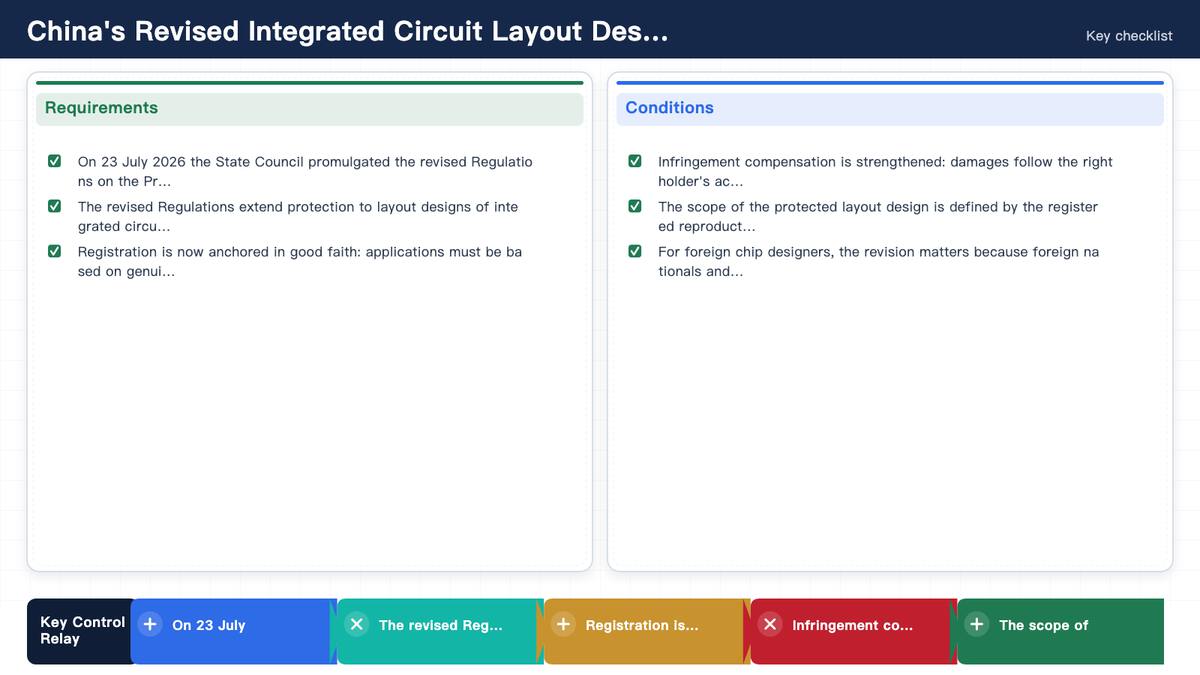
- On 23 July 2026 the State Council promulgated the revised Regulations on the Protection of Integrated Circuit Layout Designs (State Council Order No. 842), the first systematic revision in more than 20 years, effective 15 October 2026.
2026 年 7 月 23 日国务院公布修订后的《集成电路布图设计保护条例》(国务院令第 842 号),这是该条例 20 余年来首次系统性修订,自 2026 年 10 月 15 日起施行。- The revised Regulations extend protection to layout designs of integrated circuits with photonic, quantum and other emerging functions, closing a gap that mattered as chip designs move beyond conventional CMOS processes.
修订后的条例将集成光子、量子等功能的集成电路布图设计纳入保护范围,弥补了芯片设计迈向传统 CMOS 工艺之外时出现的保护空白。- Registration is now anchored in good faith: applications must be based on genuine creative activity, a declaration of originality is required, clearly non-compliant applications are rejected, and rights lost through force majeure or other justified grounds can be restored.
登记制度以诚信为锚:申请须基于真实创作活动,须提交独创性声明,明显不符合规定的申请将被驳回,因不可抗力等正当事由延误期限导致权利丧失的可请求恢复。- Infringement compensation is strengthened: damages follow the right holder’s actual loss or the infringer’s gains, reasonable multiples of the licence fee where these are hard to determine, and punitive damages apply to intentional infringement with serious circumstances.
侵权赔偿力度加大:赔偿额按权利人实际损失或侵权人获利确定,难以确定的参照许可使用费倍数合理确定,故意侵权且情节严重适用惩罚性赔偿。- The scope of the protected layout design is defined by the registered reproduction or drawings, with the originality declaration usable to interpret originality — bringing China’s regime closer to international practice.
受保护布图设计范围以登记的复制件或图样为准,独创性声明可用于解释布图设计的独创性——使中国制度进一步贴近国际实践。- For foreign chip designers, the revision matters because foreign nationals and enterprises whose layouts are first commercially exploited in China, or whose states have an agreement or common treaty with China, enjoy protection under the Regulations — the rules on foreign rights-holders and on transfers, licensing and pledge registration have all been modernised.
对外国芯片设计企业,本次修订意义重大:首先在中国境内商业利用其布图设计的外国人、外国企业,或其所属国与中国签订协议或共同参加国际条约的,可依条例获得保护——关于外国权利人以及转让、许可、出质登记等规则均已现代化。
China’s Revised Integrated Circuit Layout Design Regulations: Protection, Registration and Implications for Foreign Chip Designers | 中国修订后的集成电路布图设计保护条例:保护、登记与对外国芯片设计企业的影响
The context and what changed
The Regulations on the Protection of Integrated Circuit Layout Designs (State Council Order No. 300 of 2001) were revised by the State Council on 23 July 2026 under Order No. 842, following adoption at the 91st executive meeting of the State Council on 10 July 2026, and take effect on 15 October 2026. This is the first systematic revision in more than two decades. The revision was driven by three forces: the rapid development of integrated-circuit technology and industry, the need to bring practice-proven measures up to administrative-regulation level, and alignment with other Chinese IP laws and with international treaties. The new text modernises registration procedures, sharpens the definition of the protected layout design, strengthens infringement remedies and adds provisions on the exploitation of layout designs. For a foreign chip designer, the most practical question is how these changes affect filing a Chinese registration, defending the design against copying, and exploiting it through transfer or licensing.
Extended subject matter: photonic and quantum circuits
The most forward-looking change is the express extension of protection to layout designs of integrated circuits “with photonic, quantum and other functions”. As conventional transistor processes approach physical and manufacturing limits, photonic chips (which route light rather than electrons) and quantum processors are emerging, and their design activity increasingly lies in the arrangement of waveguides, qubits and interconnects — precisely the kind of three-dimensional configuration that a layout-design regime is meant to protect. The revision removes the risk that a cutting-edge design falls outside the statutory subject matter because it is not a “semiconductor-based” circuit in the traditional sense. For foreign firms developing photonic or quantum designs, this is a meaningful expansion of the protected subject matter in China and should be reflected in IP strategy.
Registration in good faith
The revised Regulations tighten the integrity of registration. Applications must be based on genuine creative activity and may not be fabricated; a declaration of originality is required and the submitted reproduction or drawings must clearly show the original parts; applications that are obviously non-compliant are rejected; after registration, any person may request revocation where the registration should not have been granted, and a revoked registration is treated as if the exclusive right never existed; and where rights are lost because the applicant missed a prescribed period due to force majeure or other justified reasons, the right may be restored on application. These provisions mirror the integrity requirements of the patent and trademark systems and give examiners and courts a cleaner basis for policing false claims of authorship.
Scope of protection and infringement remedies
Under the revision, the protected layout design is defined by the registered reproduction or drawings; the originality declaration may be used to interpret originality. This is a significant clarification: previously the boundaries of the protected design could be contested at length; now the registration record itself fixes the reference. On remedies, the Regulations now provide: damages are calculated by the right holder’s actual loss or the infringer’s gains; where these are hard to determine, a reasonable multiple of the licence fee may be used; for intentional infringement with serious circumstances, punitive damages apply (consistent with the Civil Code); and the compensation includes the right holder’s reasonable expenses in stopping the infringement. A good-faith acquirer who bought and commercially exploited a chip containing an infringing layout without knowing is not treated as an infringer, but after receiving notice may continue to use existing stock or prior orders upon payment of a reasonable fee.
Exploitation: transfer, licensing, pledge and rewards
The revised Regulations add provisions promoting the exploitation of layout designs. The IP administrative authority under the State Council must, with other departments, take measures to strengthen public services and promote exploitation. Where a legal person or unincorporated organisation organises the creation of a layout design, it should, in accordance with the Law on Promoting the Transformation of Scientific and Technological Achievements and other rules, give reasonable rewards and remuneration to qualifying personnel. Rules on assignment, licensing, pledge registration and the exercise of rights by co-owners are modernised. For foreign licensors, the modernised transfer and pledge provisions mean that a Chinese subsidiary or licensee can register security interests over layout-design rights, and that licence arrangements have clearer statutory footing.
How foreign parties are protected
The nationality provisions are preserved: Chinese natural persons, legal persons and other organisations enjoy protection under the Regulations; foreigners, foreign enterprises and other foreign organisations whose layout designs are first commercially exploited in China enjoy protection; and foreigners whose states have signed an agreement with China on layout-design protection, or which participate with China in a relevant international treaty, also enjoy protection. Under reciprocity provisions, where a foreign state or region takes discriminatory prohibitive or restrictive measures against China in layout-design protection, China may take corresponding measures against that state or region. For a foreign designer, the practical route is to file a registration with the IP authority (through the electronic system), typically via a Chinese patent agency or a local subsidiary; the registration application and fee system are administratively light compared with patents.
What foreign chip companies should do now
First, audit current layouts: designs already in commercial use in China but unregistered can be registered before the Regulations take effect, and designs newly commercialised after 15 October 2026 should be registered promptly. Second, for photonic and quantum designs, confirm eligibility under the expanded subject matter and register them to secure priority dates. Third, review supply-chain and licensing documentation: update licence agreements to reflect the modernised transfer, pledge and reward rules, and check that Chinese subsidiaries hold the registrations for designs they exploit locally. Fourth, update internal records to satisfy the good-faith registration requirements — genuine creative activity documentation and originality declarations will now be expected. Fifth, where disputes arise, note that the strengthened damages and punitive-damages provisions apply, and that administrative enforcement through the IP authority remains a first-line option alongside litigation. The 2001 Regulations served the industry well for two decades; the 2026 revision is designed to keep China’s layout-design protection credible as the industry moves into photonic and quantum territory.
Sources
- 中国政府网 — 《中华人民共和国国务院令(第842号) 集成电路布图设计保护条例》(2026年第23号国务院公报):https://www.gov.cn/gongbao/2026/issue_12926/202608/content_7078438.html
- 定西市人民政府 — 司法部、国家知识产权局负责人就《集成电路布图设计保护条例》修订答记者问(2026-08-13):http://www.dingxi.gov.cn/art/2026/8/13/art_16260_1907664.html
- 抚州市司法局 — 司法部、国家知识产权局负责人就《集成电路布图设计保护条例》修订答记者问(2026-08-14):https://sfj.jxfz.gov.cn/art/2026/8/14/art_21674_4469094.html
- 中国产业经济信息网 — 《规制虚假申请 加强专有权保护〈集成电路布图设计保护条例〉首次系统性修订》(2026年8月,转载自经济参考报):https://cinic.org.cn/xw/zcdt/1647240.html
中国修订后的集成电路布图设计保护条例:保护、登记与对外国芯片设计企业的影响
背景与变化
《集成电路布图设计保护条例》(2001 年国务院令第 300 号)经 2026 年 7 月 10 日国务院第 91 次常务会议审议通过修订,2026 年 7 月 23 日以国务院令第 842 号公布,自 2026 年 10 月 15 日起施行。这是该条例 20 余年来首次系统性修订。修订由三股力量推动:集成电路技术与产业的快速发展、把实践证明行之有效的做法上升为行政法规、以及与国内其他知识产权法律和国际条约的衔接。新文本现代化了登记程序、锐化了受保护布图设计的界定、强化侵权救济,并新增促进布图设计运用的条款。对外国芯片设计企业,最实际的问题是新规如何影响在华登记、对抗仿制,以及通过转让或许可进行运用。
扩展客体:光子与量子电路
最具前瞻性的变化是明确将”集成光子、量子等功能的集成电路的布图设计”纳入保护范围。随着传统晶体管制程逼近工艺与物理边界,光子芯片(以光而非电子传输信号)与量子处理器兴起,其设计活动日益集中于波导排布、量子比特与互连的三维配置——这正是布图设计制度所拟保护的三维构型。修订消除了前沿设计因非传统意义上的”半导体基片”而落入客体之外的隐患。对开发光子或量子设计的外国企业,这是中国受保护客体的一次实质性扩展,应反映在知识产权战略中。
诚信登记
修订后的条例收紧登记诚信。申请应当以真实创作活动为基础,不得弄虚作假;须提交独创性声明,提交的复制件或图样应清楚显示独创部分;明显不符合规定的申请应当驳回;登记后任何人发现登记不符合规定可请求撤销,被撤销的专有权视为自始不存在;因不可抗拒事由或其他正当理由延误期限致权利丧失的,可请求恢复权利。这些规定与专利、商标制度的诚信要求相衔接,为审查与司法打击虚假作者主张提供了更清晰的依据。
保护范围与侵权救济
修订后,受保护的布图设计以登记的复制件或图样所显示的为准,独创性声明可用于解释布图设计的独创性。这是重要澄清:此前保护边界可被长期争辩,如今登记档案本身固定参照系。救济方面,条例现规定:赔偿额按权利人实际损失或侵权人获利确定;难以确定的,参照许可使用费倍数合理确定;故意侵权且情节严重适用惩罚性赔偿(与民法典衔接);赔偿还包含权利人为制止侵权行为所支付的合理开支。不知情且无合理理由应知而购入并商业利用含侵权布图设计芯片的善意取得者不视为侵权,但收到明确通知后可继续利用现有存货或此前订货,并应支付合理使用费。
运用:转让、许可、出质与奖酬
修订后的条例新增促进布图设计运用的条款。国务院知识产权行政部门应会同有关部门加强公共服务、促进布图设计运用。法人或非法人组织主持创作布图设计的,应依促进科技成果转化法等对符合条件人员给予合理奖励和报酬。转让、许可、出质登记与共有人权利行使规则实现现代化。对外国许可人,现代化后的转让与出质条款意味着中国子公司或被许可人可就布图设计权登记担保权益,许可安排的法定基础更清晰。
外国当事人如何受保护
国籍条款保留:中国自然人、法人和其他组织依条例享有专有权;首先在中国境内投入商业利用的外国人、外国企业和其他外国组织享有专有权;所属国与中国签订保护协议或共同参加相关国际条约的外国人享有专有权。依对等条款,外国国家或地区在布图设计保护方面对中国采取歧视性禁止、限制等类似措施的,中国可采取相应措施。对外国设计者,实务路径是向国务院知识产权行政部门申请登记(通过电子系统),通常经由中国专利代理机构或本地子公司办理;登记申请与缴费体系较专利更轻。
外国芯片企业现在应做什么
其一,审计现有布图设计:已在中国商业利用但未登记的设计,可在条例生效前补办登记;2026 年 10 月 15 日之后新商业利用的设计应及时登记。其二,光子与量子设计:按扩展客体确认适格并尽早登记锁定申请日。其三,审阅供应链与许可文件:按现代化后的转让、出质与奖酬规则更新许可协议,确认中国子公司持有所在区域利用设计的登记。其四,更新内部记录以符合诚信登记要求——真实创作活动文件与独创性声明将成为审查预期。其五,发生争议时注意强化后的损害赔偿与惩罚性赔偿条款,并记得知识产权行政部门的行政保护仍是与诉讼并行的第一线选项。2001 年条例为产业服务了二十余年;2026 年修订的设计意图是让中国布图设计保护在产业迈向光子与量子时代时继续保持可信。
Sources
- 中国政府网 — 《国务院令(第842号) 集成电路布图设计保护条例》(2026年第23号国务院公报):https://www.gov.cn/gongbao/2026/issue_12926/202608/content_7078438.html
- 定西市人民政府 — 司法部、国家知识产权局负责人就《集成电路布图设计保护条例》修订答记者问(2026-08-13):http://www.dingxi.gov.cn/art/2026/8/13/art_16260_1907664.html
- 抚州市司法局 — 司法部、国家知识产权局负责人就《集成电路布图设计保护条例》修订答记者问(2026-08-14):https://sfj.jxfz.gov.cn/art/2026/8/14/art_21674_4469094.html
- 中国产业经济信息网 — 《〈集成电路布图设计保护条例〉首次系统性修订》(2026年8月):https://cinic.org.cn/xw/zcdt/1647240.html