
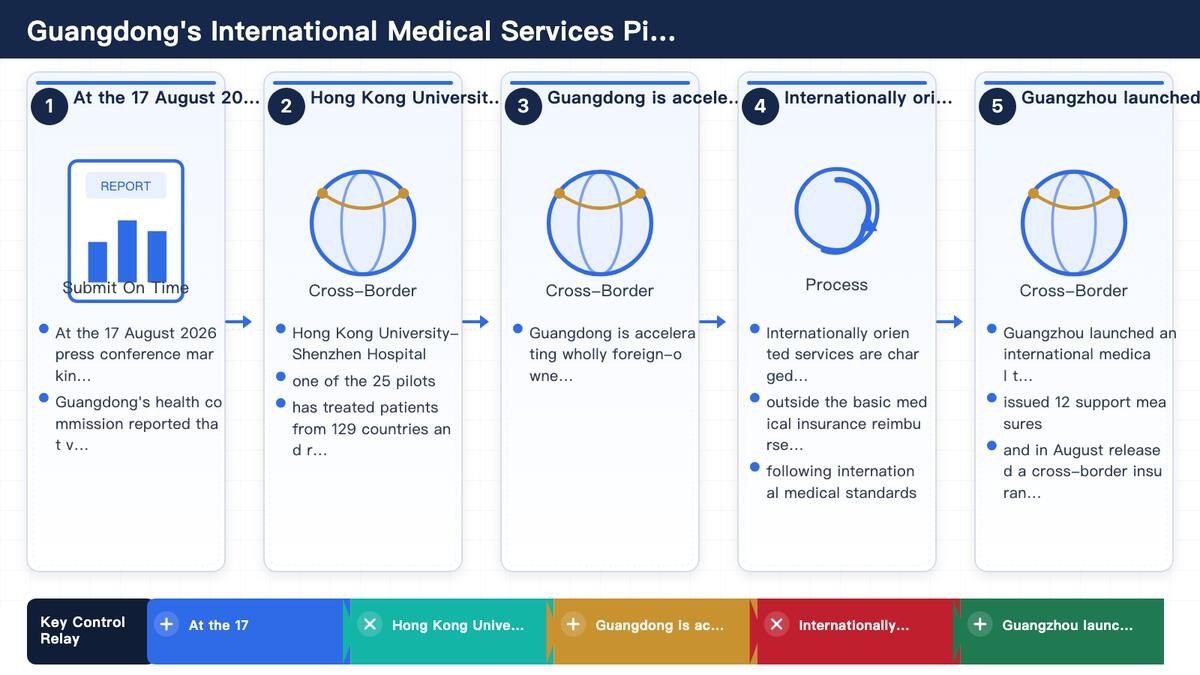
- At the 17 August 2026 press conference marking China’s Doctors’ Day, Guangdong’s health commission reported that visits by foreign patients at the 25 pilot international-medical-service hospitals grew 95.6% year on year since the pilot launched in February 2026.
2026 年 8 月 17 日广东医师节新闻发布会上,省卫健委通报:自 2026 年 2 月国际医疗服务试点启动以来,25 家试点医院外籍人士就医人次同比增长 95.6%。- Hong Kong University-Shenzhen Hospital, one of the 25 pilots, has treated patients from 129 countries and regions and served 720,000 foreign patients in the past three years; in 2026 its international medical centre business grew 17.8% year on year from January to July.
试点之一的香港大学深圳医院已接诊来自 129 个国家和地区的患者,近三年服务境外患者 72 万人次;2026 年 1—7 月其国际医疗中心业务量同比增长 17.8%。- Guangdong is accelerating wholly foreign-owned hospital pilots in Guangzhou and Shenzhen: six projects have reached landing intention and three have passed setting approval.
广东正加快推进广州、深圳外商独资医院试点:已有 6 家项目达成落地意向,其中 3 家已通过设置审批。- Internationally oriented services are charged by the patient or their international commercial insurance, outside the basic medical insurance reimbursement scope, following international medical standards, processes and payment models.
国际医疗服务按国际通行医疗技术标准、服务流程、管理体系和支付模式运营,费用由患者自付或国际商业保险支付,不纳入基本医保报销。- Guangzhou launched an international medical tourism service centre in April, issued 12 support measures, and in August released a cross-border insurance settlement platform enabling one-stop no-advance-payment settlement for foreign patients.
广州 4 月揭牌国际医疗旅游服务中心并发布 12 条支持措施,8 月上线国际医疗跨境支付平台,实现境外患者就医免垫付一站式结算。- At national level, the National Health Commission confirmed in August that a second batch of wholly foreign-owned hospital pilot cities is being selected and that high-end specialist medical, rehabilitation and nursing are now in the encouraged catalogue nationwide.
国家层面,国家卫生健康委 8 月确认正遴选第二批外商独资医院试点城市,并将高端专业医疗、康复、护理纳入全国鼓励范围。
Guangdong’s International Medical Services Pilot: Foreign-Patient Growth, Wholly Foreign-Owned Hospitals and What It Means for Healthcare Investors | 广东国际医疗服务试点:外籍患者增长、外商独资医院与医疗投资者的机会
The pilot and its early results
On 17 August 2026 the Guangdong Provincial Health Commission held its press conference for China’s Doctors’ Day and released the first substantive data on the province’s international medical services pilot. The pilot began in February 2026 when the provincial health commission, the medical security bureau and the drug administration jointly announced the first batch of 25 pilot hospitals, including Guangdong Provincial People’s Hospital, the First Affiliated Hospital of Sun Yat-sen University, Hong Kong University-Shenzhen Hospital and Zhuhai People’s Hospital. Since the launch, visits by foreign patients to the international and special-need medical departments of the 25 hospitals grew 95.6% year on year. The business model is explicitly international: services follow internationally accepted medical technical standards, service processes, management systems and payment models, targeting residents of Hong Kong, Macao and Taiwan, foreign nationals and overseas Chinese who pay out of pocket or through international commercial insurance, outside the scope of basic medical insurance reimbursement.
The scale and shape of demand
The pilot data show a large and growing cross-border patient pool. HKU-Shenzhen Hospital has treated patients from 129 countries and regions and served 720,000 foreign patients over three years; since joining the pilot, its international medical centre business grew 17.8% year on year in January–July 2026, with outpatient and check-up volumes up 16.4% and discharges up 33.5%, and Hong Kong patients accounting for 30% of outpatient and 20% of inpatient volumes. Guangdong’s position in the Greater Bay Area gives it a unique catchment: cross-border commuting workers, Hong Kong and Macao residents, and a deep stock of manufacturing-linked expatriate communities across the Pearl River Delta. For healthcare investors, the demand signal is that international-standard care priced outside the public insurance pool is a viable commercial segment in Guangdong, not a marginal one.
Wholly foreign-owned hospital acceleration
The most important development for foreign investors is the acceleration of wholly foreign-owned hospital pilots in Guangzhou and Shenzhen. Guangdong’s health commission reported that six projects have reached landing intention and three have passed setting approval. This follows the national framework: the September 2024 pilot notice and the November 2024 Plan for Expanding the Wholly Foreign-Owned Hospital Pilot, which set the conditions, requirements and procedures, and under which four wholly foreign-owned hospitals have already landed in Tianjin, Shanghai, Boao and Fuzhou. The National Health Commission confirmed in August 2026 that it is selecting a second batch of pilot cities, expanding from “point pilots” to regional rollout, and that the encouraged catalogue for foreign investment (2025 edition) now includes high-end specialist medical, rehabilitation and nursing nationwide. For a foreign hospital operator, Guangdong’s Guangzhou and Shenzhen are the most active frontier.
The stem-cell and gene-technology opening
A further dimension of the medical opening is technological. The National Health Commission confirmed in August 2026 that, in the Beijing, Shanghai and Guangdong free trade zones and the Hainan Free Trade Port, foreign-invested enterprises are permitted to conduct R&D and application of human stem-cell and gene-diagnosis and therapy technologies for the purpose of product registration and marketing, with approved products usable nationwide. For foreign biotech and cell-therapy companies, this converts the FTZ and Hainan pilots into a route to develop, register and market advanced therapies in China — subject to the full regulatory chain of human genetic resource administration, clinical trials (including international multicentre trials), drug registration and production licensing and ethics review. This is a significant expansion of the addressable market for foreign cell and gene therapy developers.
Guangzhou’s ecosystem building
Beyond the hospital pilots, Guangzhou is building the surrounding service ecosystem. In April 2026 the Guangzhou International Medical Tourism Service Centre was inaugurated, integrating the resources of 17 pilot hospitals in the city with the cultural-tourism and exhibition group; on the same day the city health commission issued 12 support measures for international medical services covering benchmark projects, resource clustering, talent attraction, payment convenience and TCM internationalisation. In August 2026, at the international medical innovation exchange and the Guangzhou Medical and Health Industry Expo, the Guangzhou Hospital Association’s International Medical Services Management Branch was established — the first industry management platform of its kind in the city — and a cross-border medical payment platform was released, enabling one-stop settlement for foreign patients without out-of-pocket advance payments through bank and insurer coordination. The city reports that foreign patients now come from 133 countries and regions, up from 90-plus before the tourism service centre opened, and that foreign patient volumes grew over 30% in the first half of the year to 260,000.
Practical guidance for healthcare investors
First, assess the pilot structure: wholly foreign-owned hospital entry requires setting approval, hospital licensing and alignment with the 2024 pilot conditions; the accelerated pace in Guangzhou and Shenzhen means the window is now. Second, understand the payment model: international services sit outside basic insurance, so pricing, insurance networks and cross-border settlement platforms are the commercial core. Third, for cell and gene therapies, evaluate the FTZ route in Guangdong (or Beijing, Shanghai, Hainan) for R&D and registration, and map the full regulatory chain early. Fourth, consider partnership with the 25 pilot hospitals — many are state-owned and are building international departments and tourism-service links, which offers a lighter entry than greenfield ownership. Fifth, monitor the second batch of pilot cities nationally and the encouraged-catalogue benefits (import duty, land, tax) that attach to encouraged categories. The Guangdong data prove the demand; the policy framework proves the intent; the remaining question for investors is execution speed and structure.
Outlook
Guangdong’s international medical pilot is the clearest demonstration yet that China’s healthcare opening has moved from policy text to commercial reality. Foreign-patient growth of nearly double in six months, wholly foreign-owned hospitals passing setting approval in Guangzhou and Shenzhen, a cross-border payment platform in operation and a provincial data trail — each of these would have been difficult to imagine two years ago. For foreign healthcare and biotech investors, the region is now a serious candidate for first entry into China’s mainstream private healthcare market.
Sources
- 国家卫生健康委员会 — 对全国政协十四届四次会议第01461号(医疗卫生类141号)提案的答复函(2026年8月,外商独资医院第二批试点城市、医疗领域负面清单动态调整机制、自贸试验区人体干细胞与基因诊断治疗技术应用):https://www.nhc.gov.cn/wjw/tia/202608/4feffbd3b943432d83a8f344dcf05545.shtml
- 广州市人民政府门户网站 — 《广州打造数智化健康服务新范式》(2026-08-21,广州国际医疗旅游服务中心、12条支持措施、国际医疗跨境支付平台、133个国家和地区境外患者来源):https://www.gz.gov.cn/zwfw/zxfw/ylfw/content/post_10974935.html
- 中国新闻网 — 《广东国际医疗试点成效显现 外籍人士就医人数同比增逾95%》(2026-08-17,广东省卫健委第九个中国医师节新闻发布会):https://www.chinanews.com.cn/sh/2026/08-17/10679326.shtml
- 中国经济信息网(转自医药网)— 《增幅95.6%!广东国际医疗试点交出亮眼成绩单》(2026-08-20):https://www.cei.cn//defaultsite/s/article/2026/08/20/4b4ff607-9d914745-01a0-1ca7e14b-69a3_2026.html
广东国际医疗服务试点:外籍患者增长、外商独资医院与医疗投资者的机会
试点与早期成果
2026 年 8 月 17 日,广东省卫生健康委员会举行第九个中国医师节新闻发布会,公布国际医疗服务试点首批实质性数据。试点始于 2026 年 2 月,省卫健委、省医保局、省药监局联合公布首批 25 家试点医院名单,包括广东省人民医院、中山大学附属第一医院、香港大学深圳医院、珠海市人民医院等。启动以来,25 家医院国际医疗和特需医疗板块外籍人士就医人次同比增长 95.6%。业务模式明确国际化:按国际通行的医疗技术标准、服务流程、管理体系和支付方式运营,面向港澳台居民、外籍人士、海外华人等自费或持有国际商业保险的人群,费用不纳入基本医保报销。
需求的规模与形态
试点数据显示庞大且增长的跨境患者池。港大深圳医院已接诊来自 129 个国家和地区的患者,近三年服务境外患者 72 万人次;纳入试点后,2026 年 1—7 月国际医疗中心业务量同比增长 17.8%,门急诊和体检业务量增长 16.4%,出院量增长 33.5%,香港患者门急诊占比 30%、住院占比 20%。广东在大湾区的位置带来独特客源:跨境通勤人群、港澳居民、以及珠三角制造业沉淀的庞大外派社区。对医疗投资者,需求信号是:定价在公共医保池之外的国际标准医疗服务,在广东是可行的商业细分,而非边缘。
外商独资医院提速
对外国投资者最重要的进展是广州、深圳外商独资医院试点的加快。广东省卫健委通报,已有 6 家项目达成落地意向,其中 3 家已通过设置审批。这延续全国框架:2024 年 9 月开放试点通知与 2024 年 11 月《独资医院领域扩大开放试点工作方案》设定条件、要求与程序,首批 4 家外商独资医院已在天津、上海、博鳌、福州落地。国家卫生健康委 2026 年 8 月确认正遴选第二批试点城市,从”点状试点”向”区域推广”拓展;《鼓励外商投资产业目录(2025 年版)》已把高端专业医疗、康复、护理纳入全国鼓励范围。对外国医院运营者,广东的广州、深圳是最活跃的前沿。
干细胞与基因技术的开放
医疗开放的另一个维度是技术层面。国家卫生健康委 2026 年 8 月确认,在北京、上海、广东自贸试验区和海南自由贸易港,允许外商投资企业从事人体干细胞、基因诊断与治疗技术开发和应用,以用于产品注册上市和生产,经注册上市和批准生产的产品可在全国使用。对外国生物技术与细胞治疗企业,这使自贸试验区与海南试点转化为在中国开发、注册与上市先进疗法的路径——前提是走完整监管链:人类遗传资源管理、临床试验(含国际多中心临床试验)、药品注册上市、生产许可与伦理审查。这是外国细胞与基因治疗开发商可及市场的重大扩展。
广州的生态建设
在医院试点之外,广州正在建设周边服务生态。2026 年 4 月,广州国际医疗旅游服务中心揭牌,联动全市 17 家试点医院资源与文旅会展集团;同日市卫健委发布 12 条支持国际医疗服务创新举措,覆盖标杆打造、资源集聚、人才引育、支付便利与中医药国际化。2026 年 8 月,在国际医疗创新发展交流会暨广州医疗与健康产业博览会上,广州市医院协会国际医疗服务管理分会成立——全市首个专注国际医疗服务的行业管理平台——并发布国际医疗跨境支付平台,经政府、银行与保险机构协调实现境外患者就医免垫付一站式结算。广州报告境外患者来源地已从服务中心成立前的 90 多个国家和地区升至 133 个,上半年境外患者增长超 30%、达 26 万人次。
医疗投资者实操指引
其一,评估试点结构:外商独资医院进入须通过设置审批、医疗机构执业登记并符合 2024 年试点条件;广州、深圳提速意味着窗口期就在当下。其二,理解支付模式:国际服务在基本医保之外,定价、保险网络与跨境结算平台是商业核心。其三,细胞与基因疗法:评估广东(或北京、上海、海南)自贸试验区研发与注册路径,尽早梳理完整监管链。其四,考虑与 25 家试点医院合作——多数为公立,正在建设国际部与旅游服务链接,比绿地自有更轻的进入方式。其五,关注全国第二批试点城市与鼓励目录红利(进口关税、用地、税收)。广东数据证明了需求,政策框架证明了意图,留给投资者的问题是执行速度与结构。
展望
广东国际医疗试点是中国医疗开放从政策文本走向商业现实迄今最清晰的例证。六个月内外籍患者近翻倍增长、广州深圳外商独资医院通过设置审批、跨境支付平台投入运营、省级数据链条成形——每一项在两年前都难以想象。对外国医疗与生物科技投资者,该区域现已成为进入中国主流私立医疗市场的严肃首选地。
Sources
- 国家卫生健康委员会 — 对全国政协十四届四次会议第01461号提案的答复函(2026年8月):https://www.nhc.gov.cn/wjw/tia/202608/4feffbd3b943432d83a8f344dcf05545.shtml
- 广州市人民政府门户网站 — 《广州打造数智化健康服务新范式》(2026-08-21):https://www.gz.gov.cn/zwfw/zxfw/ylfw/content/post_10974935.html
- 中国新闻网 — 《广东国际医疗试点成效显现 外籍人士就医人数同比增逾95%》(2026-08-17):https://www.chinanews.com.cn/sh/2026/08-17/10679326.shtml
- 中国经济信息网(转自医药网)— 《增幅95.6%!广东国际医疗试点交出亮眼成绩单》(2026-08-20):https://www.cei.cn//defaultsite/s/article/2026/08/20/4b4ff607-9d914745-01a0-1ca7e14b-69a3_2026.html