
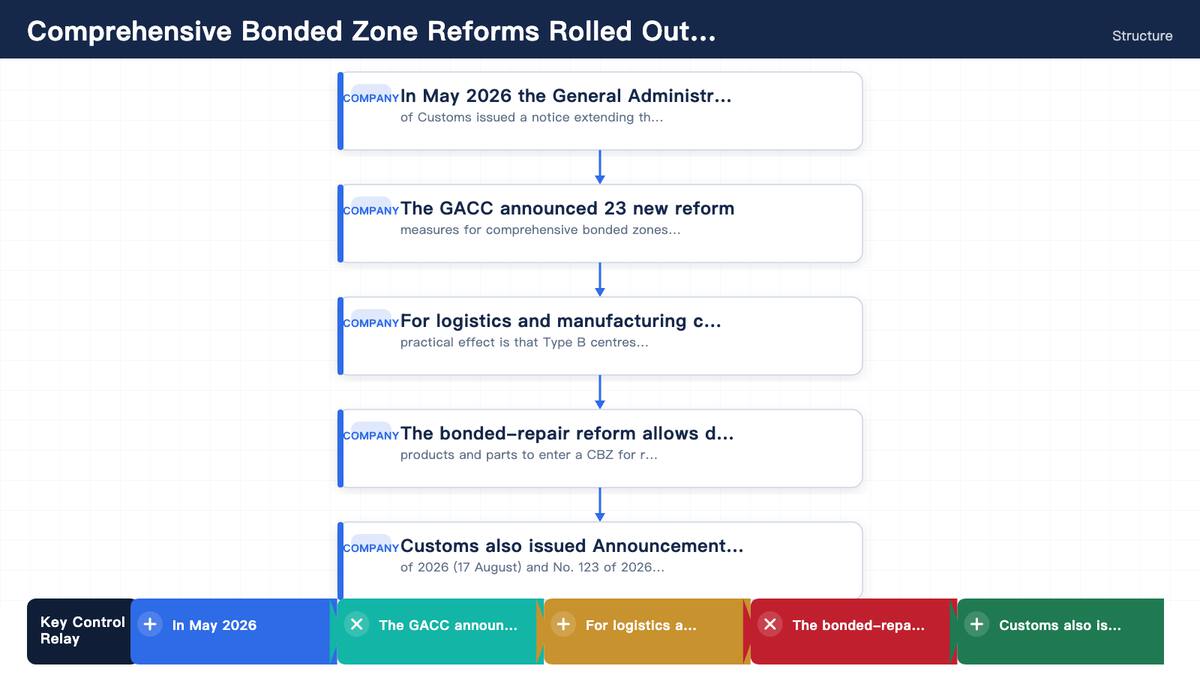
- In May 2026 the General Administration of Customs issued a notice extending the comprehensive bonded zone (CBZ) reform measures to bonded logistics centres (Type B), and in August 2026 the first pilot transactions — including “optimised gate-registration cargo management” and “cargo classified supervision” — were completed in Jiangxi and Shandong.
2026 年 5 月海关总署印发通知,将综合保税区改革措施推广至保税物流中心(B 型);2026 年 8 月,江西龙南、山东济宁等地完成首批落地业务——包括”优化卡口登记货物管理”与”货物按状态分类监管”。- The GACC announced 23 new reform measures for comprehensive bonded zones on 16 August 2026, covering inspection and quarantine optimisation, simplified release-from-supervision procedures for production equipment, tiered gate management, better return-goods supervision and an expanded bonded-repair catalogue.
2026 年 8 月 16 日海关总署宣布对综保区推出 23 条新改革举措,涵盖检验检疫模式优化、简化生产用设备解除监管手续、卡口分类分级管理、优化境外退运货物监管与扩大保税维修目录。- For logistics and manufacturing companies, the practical effect is that Type B centres can now offer functions previously reserved for comprehensive bonded zones, including goods-by-status classified supervision and streamlined gate registration, cutting logistics cost and entry time.
对物流与制造企业,实际效果是 B 型中心现可提供此前综保区专属的功能,包括货物按状态分类监管与简化卡口登记,降低物流成本并缩短入区时间。- The bonded-repair reform allows domestic export products and parts to enter a CBZ for repair and re-export without the former positive-list and used-machinery import catalogue restrictions, supporting global after-sales service networks.
保税维修改革允许国内出口产品及零配件进入综保区维修后复运出境,不再受综保区维修产品正面目录和禁止进口旧机电产品目录限制,支撑企业依托国内产能建立全球售后服务体系。- Customs also issued Announcement No. 121 of 2026 (17 August) and No. 123 of 2026, deleting references to “solid waste usable as raw material” in the Yangshan and Yangpu special-zone rules to align with the Ecological Environment Code.
海关总署 2026 年 8 月还发布第 121 号、123 号公告,删除洋山特殊综保区与洋浦保税港区监管办法中”可用作原料的固体废物”相关表述,与《生态环境法典》衔接。- Foreign-invested manufacturers with bonded-zone operations should review their logistics structure against the expanded function set and the new 23-measure framework before the year end.
有保税业务的外资制造商应在年内对照扩展后的功能集合与 23 条新框架,重新审视其物流结构。
Comprehensive Bonded Zone Reforms Rolled Out to Type B Bonded Logistics Centres: The 2026 Expansion and What It Means | 综合保税区改革向 B 型保税物流中心推广:2026 年的扩展及其意义
The reform sequence in 2026
China’s special customs supervision zones have been through an intense year of policy recalibration. In April 2026 the State Council’s General Office forwarded the GACC’s Measures for Promoting the Expansion and Quality Upgrade of Comprehensive Bonded Zones (Guobanhan [2026] No. 40), which set out 24 reform measures in four areas — what the GACC summarises as “four conversions, four upgrades”. In May 2026 the GACC followed with a notice extending the CBZ reform measures to bonded logistics centres (Type B), so that facilities outside the 161 CBZs can also use the convenience measures. On 16 August 2026 the GACC announced a further 23 measures at a regular press briefing, focusing on policy supply, function expansion, procedure simplification, process optimisation and institutional improvement. And in the same month, Announcements No. 121 and No. 123 of 2026 cleaned up the Yangshan special comprehensive bonded zone and Yangpu bonded port area rules to align with the Ecological Environment Code. For logistics and manufacturing operators, the message is clear: the functions of China’s bonded infrastructure are being both deepened and extended beyond the CBZ fence.
The 23 new measures announced on 16 August
The August measures address the practical bottlenecks that operators feel daily. On procedures: inspection and quarantine working models are adjusted and optimised; release-from-supervision procedures for production-use equipment are simplified; gate management moves to a classified, tiered model; and supervision of returned goods from abroad is improved, with a lower share of on-site and documentary investigations. On cargo flows: the logic of verifying goods entering and leaving the zone is optimised to support consolidated cargo of multiple types; the “one document, multiple vehicles” flow is streamlined, allowing certain cargo to be declared as a whole and delivered in batches, with single-vehicle entry and exit; and returning-goods supervision is made more flexible. On functions and business formats: the bonded-repair catalogue will be dynamically adjusted to bring in more high-technology, high-value-added, environmentally compliant low-risk products; CBZs may carry out bonded-training businesses for aviation flight simulators and large medical equipment; and duty-free shop goods may be imported from abroad through CBZs, connecting duty-free and bonded operations.
The Type B rollout: what actually happened on the ground
The extension to bonded logistics centres (Type B) is the reform most directly relevant to companies using logistics centres rather than full CBZs. In August 2026 the first pilot transactions were completed: at Longnan Bonded Logistics Centre in Jiangxi, a truck loaded with packaging materials passed through the “gate-registration cargo channel” with simplified declaration — the first “optimised gate-registration cargo management” transaction for a Type B centre in the province; at Jining High-tech Bonded Logistics Centre in Shandong, the “cargo classified supervision” business was formally launched, the first Type B centre in the province to offer it, with a container of 25 pallets of battery cells entering through the gate and 6,726 tonnes of goods entering in the first ten days. For operators, these two cases demonstrate the practical content of the rollout: simplified gate declarations (previously requiring line-by-line item codes and commodity codes), automatic gate lifting on licence-plate recognition, and the ability to segregate bonded, non-bonded and tax-paid goods in one warehouse, which materially improves warehouse utilisation and reduces logistics cost.
The bonded-repair opening
One of the highest-value changes, both in the April measures and the August announcements, is the bonded-repair reform. Under the new framework, domestic export products and parts may enter a comprehensive bonded zone for repair and re-export without the previous restrictions of the CBZ repair positive list and the catalogue of prohibited imported used machinery. This is a direct enabler of global after-sales service: a manufacturer can maintain its global service network from a China-based CBZ, receiving goods back for repair and re-exporting them, rather than running multiple regional repair centres. Combined with the bonded re-manufacturing business already operating in ports such as Tianjin Port and the expansion of the repair catalogue, the reform gives foreign-invested manufacturers a clear reason to consolidate repair and re-manufacturing activity in a CBZ or Type B centre.
What the Ecological Environment Code clean-up changed
Announcements No. 121 and No. 123 of 2026, both dated 17 August 2026, are technical but worth noting: they delete references to “solid waste usable as raw material” in the Yangshan special comprehensive bonded zone supervision measures (2019 No. 170) and the Yangpu bonded port area measures (2020 No. 73), and align three other documents (including the bonded-repair and CBZ bonded-R&D rules) with the domestic solid-waste management framework under the Ecological Environment Code, which took effect on 15 August 2026. For operators, the practical point is that solid-waste related to bonded operations is now governed by the unified domestic solid-waste regime, and any business previously relying on the “usable as raw material” route should re-check its compliance path.
Practical implications for foreign-invested manufacturers
For foreign-invested manufacturers using bonded logistics, the 2026 package calls for a structured review. First, map your logistics footprint against the full function set now available in CBZs and Type B centres — classified supervision, consolidated cargo, bonded training, duty-free-bonded connection and the expanded repair catalogue. Second, if you currently use only an ordinary warehouse or a Type B centre, assess whether upgrading to additional bonded functions reduces duty and VAT cash flow or shortens lead times. Third, for after-sales service, quantify the benefit of a China-based bonded repair hub versus offshore repair centres, including the re-export and return-goods rules. Fourth, if your operations involve any solid-waste streams, verify compliance under the unified domestic regime. Fifth, watch the GACC’s “one measure at a time, as each matures” implementation: further announcements and system upgrades are expected through late 2026, and early movers tend to capture the operational advantage.
Outlook
The 2026 reforms consolidate China’s bonded infrastructure as a serious logistics platform for regional and global supply chains. The direction of travel is unmistakable: simplify procedures, expand functions, extend CBZ benefits to Type B centres and connect bonded operations with duty-free and re-manufacturing. For companies that operate in or near China’s special customs supervision zones, the question is no longer whether to use bonded logistics, but how deeply to integrate it into the supply chain before the next wave of measures lands.
Sources
- 海关总署 — 海关总署公告2026年第121号(关于修改海关总署公告2019年第170号、2020年第73号部分条款的公告,2026-08-17):http://www.customs.gov.cn/customs/2026-08/18/article_2026081812061071839.html
- 海关总署 — 海关总署公告2026年第123号(关于修改部分规范性文件的公告,2026-08-17):http://www.customs.gov.cn/customs/2026-08/19/article_2026081918055713032.html
- 长春海关(转载自青岛海关)— 《济宁高新保税物流中心扩容对外开放新载体》(2026-07-29,济宁海关推进保税物流中心B型分类监管等综保区优惠推广):http://changchun.customs.gov.cn/qingdao_customs/406496/406497/7276192/index.html
- 上海市浦东新区人民政府 — 《综保区扩能提质,上海海关在行动(第二期)》(2026-08-03,介绍国办函〔2026〕40号24项改革举措与差异化合格评定等案例):https://www.pudong.gov.cn/china-shftz/qydt/20260803/830979.html
- 赣南日报 — 《龙南海关推动综合保税区改革措施落地见效》(2026-08-19,江西省首票保税物流中心B型”优化卡口登记货物管理”业务通关):https://szb.gnrbs.cn/h5/html5/2026-08/19/content_95762_19798322.htm
综合保税区改革向 B 型保税物流中心推广:2026 年的扩展及其意义
2026 年的改革序列
中国的海关特殊监管区域经历了密集的政策重校之年。2026 年 4 月,国务院办公厅转发海关总署《关于促进综合保税区扩能提质的若干措施》(国办函〔2026〕40 号),从四个方面提出 24 项改革举措——海关总署概括为”四转四提升”。2026 年 5 月,海关总署再发通知,将综保区改革措施推广至保税物流中心(B 型),使 161 个综保区之外的中心也能享受便利措施。2026 年 8 月 16 日,海关总署在例行记者通报会上宣布再推 23 条举措,聚焦政策供给、功能拓展、手续简化、流程优化与制度健全。同月,2026 年第 121 号、123 号公告清理洋山特殊综保区与洋浦保税港区监管办法,与《生态环境法典》衔接。对物流与制造经营者,信息明确:中国保税基础设施的功能正同时深化并延伸到综保区围网之外。
8 月 16 日宣布的 23 条新举措
8 月举措直击经营者日常感受的瓶颈。程序方面:调整优化检验检疫作业模式;简化生产用设备解除监管手续;实施卡口分类分级管理;优化境外退运货物监管,降低现场调查和书面调查比例。货物流动方面:优化进出综保区货物核放逻辑,支持多类型货物集拼入出区;优化”一票多车”流程,允许特定货物整报分送、单车进出区;退运货物监管更灵活。功能业态方面:推动保税维修目录动态调整,纳入更多高技术、高附加值、符合环保要求的低风险产品;支持综保区开展航空飞行模拟器、大型医疗设备保税培训;允许免税店货物经综保区从境外进口,促进免税保税衔接。
B 型推广:实地发生了什么
对使用物流中心而非完整综保区的企业,向保税物流中心(B 型)的推广是最直接相关的改革。2026 年 8 月首批试点业务落地:江西龙南保税物流中心,一辆满载包装材料的货车经”卡口登记货物通道”快速验放入区——全省首票 B 型中心”优化卡口登记货物管理”业务;山东济宁高新保税物流中心”货物按状态分类监管”业务正式落地,成为省内首家开通该业务的 B 型中心,25 板电芯集装箱经卡口入区,落地前 10 天入区货物 6726 吨。对经营者,两个案例展示了推广的实质内容:简化卡口申报(此前须逐项填报料号、商品编码等要素)、车牌识别自动抬杆、在一个仓库内分状态存放保税、非保税与已完税货物——实质改善仓储利用率并降低物流成本。
保税维修的开放
无论 4 月措施还是 8 月公告,价值最高的变化之一是保税维修改革。新框架下,国内出口产品及零配件可进入综保区维修后复运出境,不再受综保区维修产品正面目录与禁止进口旧机电产品目录限制。这是全球售后服务的直接支撑:制造商可从中国综保区维护全球服务网络,回收产品维修后复运出境,而无须运营多个区域维修中心。叠加天津港等口岸已开展的保税再制造业务与维修目录扩大,改革给外资制造商一个明确理由把维修与再制造活动整合进综保区或 B 型中心。
《生态环境法典》清理改变了什么
2026 年第 121 号、123 号公告(均为 2026 年 8 月 17 日)属技术性但值得注意:删除洋山特殊综保区监管办法(2019 年第 170 号)与洋浦保税港区监管办法(2020 年第 73 号)中”可用作原料的固体废物”表述,并把其余三份文件(含保税维修与综保区保税研发规则)与 2026 年 8 月 15 日施行的《生态环境法典》国内固体废物管理框架对齐。对经营者,实务要点是保税业务相关固体废物现按统一国内固体废物制度管理,此前依赖”可用作原料”通道的业务应重新核验合规路径。
对外资制造商的实操意义
对使用保税物流的外资制造商,2026 年政策包要求结构化审视。其一,把物流足迹对照综保区与 B 型中心现可获得的完整功能集合——分类监管、集拼、保税培训、免税保税衔接与扩大后的维修目录。其二,若目前仅用普通仓库或 B 型中心,评估增用保税功能能否改善关税与增值税现金流或缩短前置时间。其三,售后服务:量化以中国为基地的保税维修枢纽与海外维修中心之间的收益,含复运出境与退运规则。其四,业务含固体废物流的,按统一国内制度核验合规。其五,关注海关”成熟一项推进一项”的实施节奏:2026 年底前预计还有公告与系统升级,先行者通常占得运营先机。
展望
2026 年改革把中国保税基础设施巩固为区域与全球供应链的严肃物流平台。方向无可置疑:简化程序、扩展功能、把综保区红利延伸到 B 型中心、把保税业务与免税和再制造相连接。在海关特殊监管区域或其周边运营的企业,问题已不再是”是否使用保税物流”,而是”在下一波措施落地前把保税物流整合到供应链多深”。
Sources
- 海关总署 — 海关总署公告2026年第121号(2026-08-17):http://www.customs.gov.cn/customs/2026-08/18/article_2026081812061071839.html
- 海关总署 — 海关总署公告2026年第123号(2026-08-17):http://www.customs.gov.cn/customs/2026-08/19/article_2026081918055713032.html
- 长春海关(转载自青岛海关)— 济宁高新保税物流中心扩容对外开放新载体(2026-07-29):http://changchun.customs.gov.cn/qingdao_customs/406496/406497/7276192/index.html
- 上海市浦东新区人民政府 — 综保区扩能提质,上海海关在行动(第二期)(2026-08-03):https://www.pudong.gov.cn/china-shftz/qydt/20260803/830979.html
- 赣南日报 — 龙南海关推动综合保税区改革措施落地见效(2026-08-19):https://szb.gnrbs.cn/h5/html5/2026-08/19/content_95762_19798322.htm