
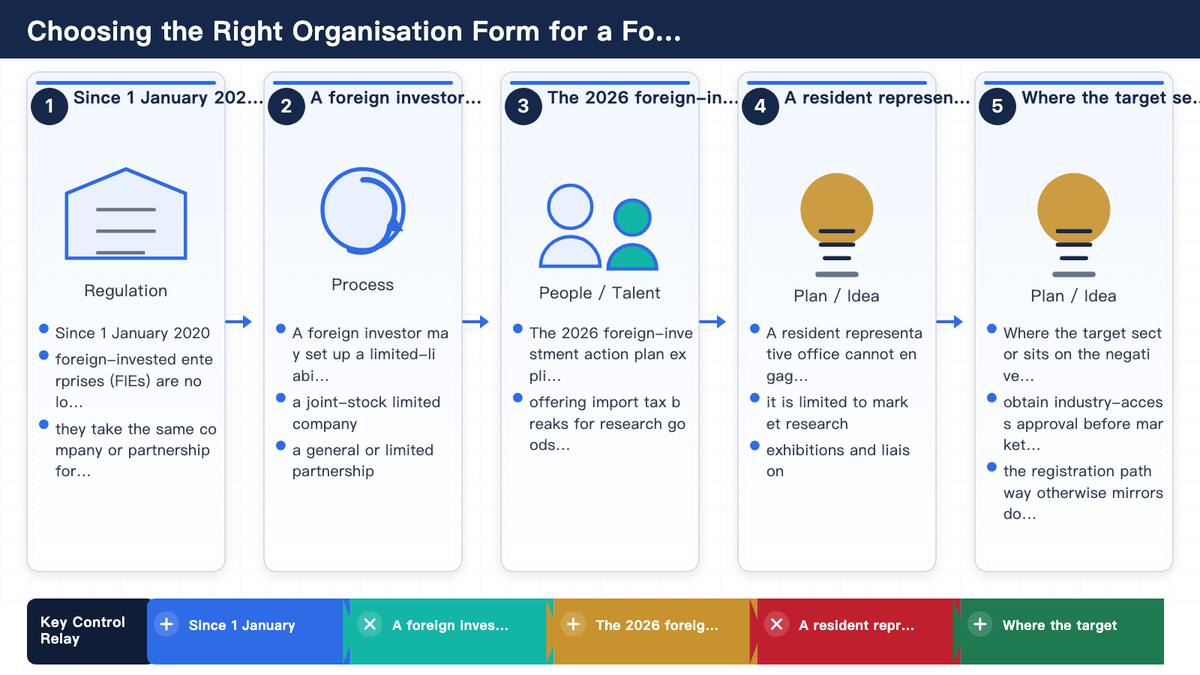
- Since 1 January 2020, foreign-invested enterprises (FIEs) are no longer carved into CJV/EJV/WFOE types; they take the same company or partnership forms as domestic firms under the Company Law and Partnership Law.
自2020年1月1日起,外商投资企业不再区分为中外合资、中外合作、外商独资三类,而是与内资企业一样适用《公司法》《合伙企业法》采取公司或合伙形式。- A foreign investor may set up a limited-liability company, a joint-stock limited company, a general or limited partnership, or a non-profit resident representative office (RO) — each with distinct liability and financing profiles.
外国投资者可设立有限责任公司、股份有限公司、普通或有限合伙企业,以及非营利性常驻代表机构(代表处),各自的责任与融资属性不同。- The 2026 foreign-investment action plan explicitly encourages foreign R&D centres, offering import tax breaks for research goods and easier high-level talent introduction.
2026年外资行动方案明确大力吸引外资在华设立研发中心,给予进口科研用品税收优惠并便利外籍高层次人才引进。- A resident representative office cannot engage in profit-making activity; it is limited to market research, exhibitions and liaison, suiting a pre-entry foothold.
常驻代表机构不得从事营利性活动,仅限于市场调研、展览与联络,适合进入市场前的本地落脚点。- Where the target sector sits on the negative list, obtain industry-access approval before market-entity registration; the registration pathway otherwise mirrors domestic firms.
若目标行业落入负面清单,须在市场主体的登记前取得行业准入审批;否则登记路径与内资一致。- Practical step: choose the form by scale, risk appetite and exit plan — LLC for most, JSC for listings, partnership for funds, RO for scouting — then align with the negative list and licensing.
实操建议:按规模、风险偏好与退出计划选型——多数选有限责任公司,拟上市选股份,基金选合伙,前期试探选代表处,再对齐负面清单与许可。
Choosing the Right Organisation Form for a Foreign-Invested Enterprise in China: Companies, Partnerships and Representative Offices | 外资企业在华组织形式选择:公司制、合伙企业与代表处(新外商投法体系)
The legal architecture of a foreign-invested enterprise (FIE) in China changed fundamentally with the *Foreign Investment Law*, effective 1 January 2020. The old trichotomy of Chinese-foreign equity joint ventures (EJVs), contractual joint ventures (CJVs) and wholly foreign-owned enterprises (WFOEs) was abolished. Today an FIE is simply a Chinese company or partnership, governed by the *Company Law* or the *Partnership Law*, with foreign investment adding only the negative-list and national-treatment overlay.
Company forms
A foreign investor may establish a limited-liability company (LLC) — 1 to 50 shareholders, each liable to the company within its subscribed capital, the company liable for its debts with all its assets. The LLC is the default for SMEs and greenfield projects: low setup threshold, flexible governance. A joint-stock limited company (JSC) has capital divided into equal shares and stronger financing and liquidity; it suits large projects and pre-IPO structures (advanced manufacturing, new energy). Both register under the *Regulations on the Registration and Administration of Market Entities*.
Partnership forms
A general partnership has partners jointly and severally liable without limit — suited to close-knit, risk-sharing ventures. A special general partnership is designed for professional services (foreign accounting, law or technical-advisory firms), allocating liability by fault. A limited partnership mixes general partners (unlimited liability) with limited partners (liable within subscribed capital) — the standard vehicle for private equity and industry funds. Foreign-invested partnerships register like domestic ones.
Representative offices
A resident representative office (RO) of a foreign enterprise is a non-legal-person, non-profit entity: it may conduct market research, exhibitions, product publicity, and liaison for sales, service delivery, local sourcing and local investment. It cannot invoice, sign commercial contracts or earn profit in China. The RO fits the pre-entry phase — a local foothold before committing to a full operating entity.
The 2026 R&D-centre impetus
The 2026 *Stabilise and Improve Foreign Investment Action Plan* (商资发〔2026〕97号) explicitly encourages foreign-invested enterprises to set up R&D centres in China, improving support policies, facilitating high-level foreign talent introduction, and allowing import tax breaks for research goods. For a foreign group weighing an innovation footprint, the LLC (or a JSC with an open platform) is the natural host, with the RO sometimes retained as a liaison shell.
Registration and the negative list
FIEs are registered by the market-regulation authority, exactly like domestic entities. Because foreign investment is negative-list managed, if the project falls under the *Foreign Investment Access Negative List* or another approval/filing regime, the investor must obtain industry-access approval before registration. Practically, confirm with the competent authority whether approval, filing or neither applies before filing the articles of association.
Practical steps
- Match form to purpose. LLC for control and flexibility; JSC for capital markets; partnership for funds; RO for scouting.
- Decide liability profile. Unlimited (general partner) vs limited (shareholder/limited partner) drives risk allocation.
- Screen the negative list early. If the sector is restricted, secure access approval before incorporation.
- Use the R&D incentive. If establishing an innovation centre, claim import-tax and talent facilitation under the 2026 plan.
- Prepare clean constitutional documents. Submit articles, identity and (if required) approval documents; inaccurate filings delay registration.
外资企业在华组织形式选择:公司制、合伙企业与代表处(新外商投法体系)
随着2020年1月1日《外商投资法》施行,外商投资企业的法律架构发生根本变化。中外合资、中外合作、外商独资”外资三法”下的类型划分被废除。如今的外商投资企业就是一家中国公司或合伙企业,适用《公司法》或《合伙企业法》,外资仅叠加负面清单与国民待遇的层。
公司形式
外国投资者可设立有限责任公司——股东1至50人,以认缴出资额为限对公司负责,公司以全部资产对债务负责。有限责任公司是中小企业与绿地项目的默认选择:设立门槛低、治理灵活。股份有限公司资本划分为等额股份,融资与流动性更强,适合大型项目与拟上市架构(如先进制造、新能源)。二者均依《市场主体登记管理条例》登记。
合伙形式
普通合伙企业由合伙人对债务承担无限连带责任,适合风险共担、紧密协作的小型项目。特殊普通合伙专为专业服务机构(外资会计师事务所、律所、技术咨询)设立,按过错分配责任。有限合伙企业由承担无限连带责任的普通合伙人与以认缴出资为限的有限合伙人组成,是股权投资基金与产业基金的标准载体。外资合伙企业与内资合伙企业的登记方式一致。
代表处
外国企业常驻代表机构是不具法人资格、非营利性的办事机构:可从事与外国企业产品服务有关的市场调查、展览、宣传,以及与销售、服务交付、境内采购、境内投资有关的联络。它不能在中国境内开票、签订商业合同或营利。代表处适合进入市场前的阶段——在正式落地运营实体前建立本地落脚点。
2026年研发中心导向
2026年《利用外资固稳促优行动方案》(商资发〔2026〕97号)明确大力吸引外资企业在华设立研发中心,完善支持政策、便利外籍高层次人才引进,并给予进口科研用品税收优惠。对外国集团而言,若考量创新布局,有限责任公司(或以开放平台形式设立的股份公司)是天然的承载主体,代表处有时保留为联络壳。
登记与负面清单
外商投资企业由市场监管部门登记,与内资企业完全一致。由于外资实行负面清单管理,若项目落入《外商投资准入负面清单》或其他核准、备案领域,投资者须在登记前取得行业准入审批。实务上,应在提交章程前先向主管部门确认是需要审批、备案,还是皆无。
实操步骤
- 按目的选型。 求控制与灵活选有限责任公司;走资本市场选股份;基金选合伙;前期试探选代表处。
- 确定责任属性。 无限(普通合伙人)与有限(股东/有限合伙人)决定风险分配。
- 尽早筛查负面清单。 若行业受限,须在设立前取得准入批复。
- 用足研发激励。 若设立创新中心,可依据2026方案享受进口税收优惠与人才便利。
- 备齐章程文件。 提交章程、身份证明及(如需)批准文件;材料不实将延误登记。
Practitioner Quick Reference
- LLC first: the limited-liability company fits most SMEs and greenfield projects.
有限责任公司优先:适合多数中小企业与绿地项目。 - JSC for capital markets: the joint-stock company suits large or pre-IPO structures.
股份公司为资本市场:适合大型或拟上市架构。 - Partnership for funds: limited partnerships are the standard PE/industry-fund vehicle.
合伙承载基金:有限合伙是股权/产业基金的标准载体。 - RO is non-profit: the representative office is for scouting only — no invoicing, no contracts.
代表处非营利:仅用于前期试探,不可开票、不可签商业合同。 - Negative list first: secure industry-access approval before registration if the sector is restricted.
先查负面清单:受限行业须在登记前取得准入审批。
Common Pitfalls
- Defaulting to WFOE thinking: the old trichotomy is gone; choose the form by liability and purpose.
还按外商独资思维:旧三类划分已废除,应按责任与目的选型。 - Using an RO to operate: invoicing through a representative office is unlawful.
用代表处经营:借代表处开票属违法。 - Registering before approval: incorporating a restricted-sector FIE without access approval stalls the filing.
未批先登:受限行业外资未完成准入审批即登记将卡住申请。
Sources