
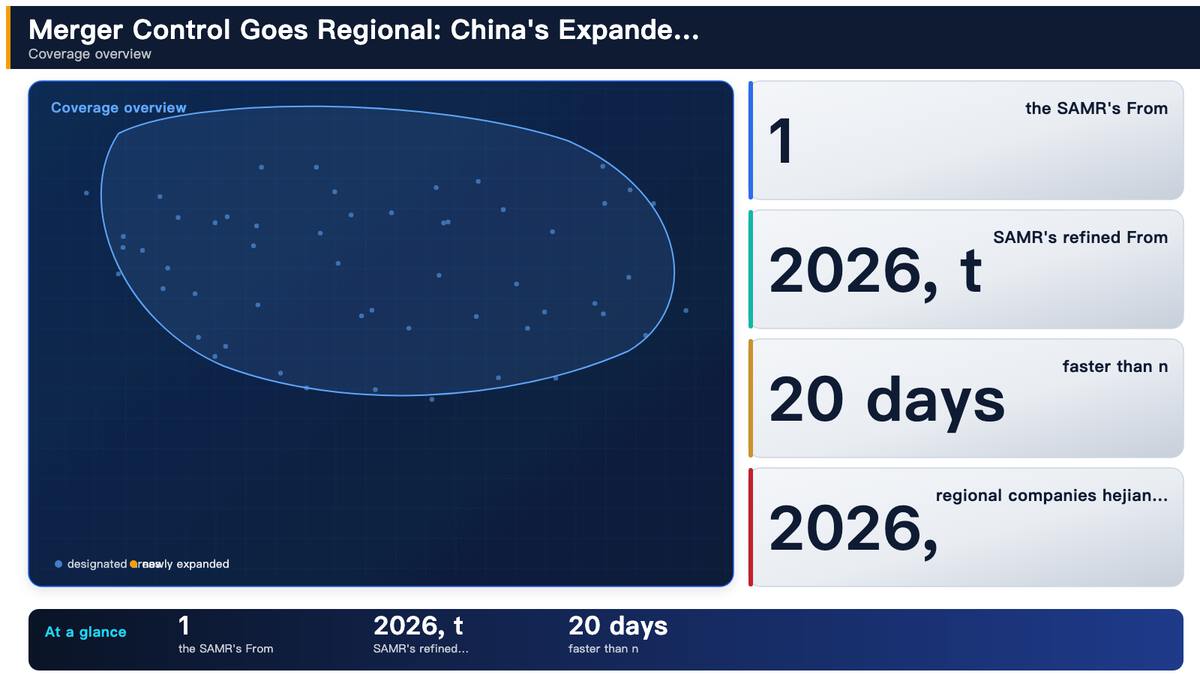
- From 1 August 2026, the SAMR’s refined delegated-review system adds review of certain non-simple concentration cases by the five original provincial bureaus and adds Liaoning, Zhejiang and Sichuan as delegated bureaus for simple cases.
自 2026 年 8 月 1 日起,市场监管总局完善后的经营者集中委托审查制度在原 5 个省级市场监管部门审查部分简易案件的基础上,增加部分非简易案件委托审查,并新增辽宁、浙江、四川 3 个受委托部门。
- Delegated simple-case bureaus now total eight, and the delegated average acceptance and completion times have both stayed within roughly 20 days, materially faster than national review.
简易案件受委托省级部门增至 8 个;受委托部门平均受理与审结时间均在约 20 天内,明显快于全国审查。
- Zhejiang handles simple cases for Zhejiang, Fujian and Jiangxi from August 2026, giving regional companies near-by filing and review.
2026 年 8 月起,浙江受委托承担浙江、福建、江西三省区域内经营者集中简易案件审查,区域企业可就近申报办理。
- The SAMR also published six typical concentration cases on 21 August 2026, showing how review supports restructuring in platforms, PV, batteries, auto parts and coal logistics while curbing “involutionary” competition.
市场监管总局 2026 年 8 月 21 日公布六起经营者集中审查典型案例,展示审查如何在平台、光伏、锂电池、汽车零部件与煤炭物流领域支持整合重组、遏制”内卷式”竞争。
- For foreign-invested groups, the changes affect where and how quickly qualifying deals are cleared, but the mandatory prior-filing threshold and substantive standards are unchanged.
对外资集团而言,变化影响合格交易的审查地点与速度;强制事先申报门槛与实体标准不变。
Merger Control Goes Regional: China’s Expanded Delegated Review System and New Typical Cases (August 2026) | 经营者集中委托审查扩容:区域化并购审查与新典型案例(2026 年 8 月)
Why this matters now
On 1 August 2026, the SAMR’s Announcement on Further Improving the Delegated Review System for Concentrations of Undertakings took effect. The system, which began as a pilot in August 2022 and was formalised in July 2025, now adds review of certain non-simple concentration cases by the five original delegated provincial bureaus — Beijing, Shanghai, Guangdong, Chongqing and Shaanxi — and adds Liaoning, Zhejiang and Sichuan as delegated bureaus for simple cases. A week later, on 21 August 2026, the SAMR published six typical cases of concentration review used to support restructuring in platform, solar-PV, battery, auto-parts and coal-logistics sectors while curbing “involutionary” competition. For foreign-invested enterprises and their advisers, the combination of wider delegation, faster regional clearance and clearer enforcement signals changes the practical geography of merger control in China.
What the expanded delegation changes
The delegated-review system is a division of work within China’s unitary concentration-review regime: the SAMR remains the reviewing authority, receives filings through the central business system, and delegates qualifying cases to provincial bureaus, which conduct the review and report back. The August 2026 changes operate on three axes. First, scope: in addition to simple cases, certain non-simple cases may now be delegated to the five original bureaus. The delegation criteria for non-simple cases include a combined market share of 15–25% in the same relevant market; or 25–35% shares in upstream and downstream markets respectively; or 25–35% shares in each relevant market for parties without horizontal or vertical relationships. Second, coverage: Liaoning, Zhejiang and Sichuan join as delegated bureaus for simple cases, bringing the total to eight, each responsible for a defined regional territory. Zhejiang, for example, reviews simple cases for Zhejiang, Fujian and Jiangxi. Third, procedure: the SAMR has upgraded its concentration-review business system, revised the working handbook for provincial bureaus, and retained the rule that non-simple delegated cases must still have documents such as clearance decisions issued under the SAMR’s authority, while decisions with conditions or prohibitions are issued centrally by the SAMR.
Operationally, the delegated bureaus report average acceptance and completion times of about 16 and 18 days respectively — both within roughly 20 days — under the “double twenty” working standard, and simple cases account for about 90% of all concentration filings. For companies in the covered regions, the practical effect is faster, closer review: the Zhejiang bureau published a consultation phone line and a pre-filing consultation mechanism, and the entire process runs online.
The typical cases and enforcement signals
The six typical cases published on 21 August 2026 illustrate how the SAMR balances support for restructuring with restraint on harmful competition. Tencent’s acquisition of Ximalaya was approved with five restrictive conditions (May 2026) to protect competition in online-audio and online-music markets; TCL Zhonghuan’s acquisition of Yidao New Energy was cleared unconditionally to consolidate solar-PV capacity; Hubei Jingjiang’s acquisition of East Group was cleared to support transformation into an “AI + new energy” services provider; and joint-venture cases in battery separators, automotive air-suspension components and coal logistics were cleared to integrate regional capacity and reduce low-level duplication. For foreign-invested companies, the enforcement posture is double-sided: genuine restructuring that improves efficiency and quality is supported, but transactions that entrench dominance or enable coordinated “involutionary” behaviour will attract conditions or prohibition — and the delegated bureaus apply the same substantive standards as the SAMR.
Practical steps
- Check whether delegation affects your filing. Determine whether your transaction meets the simple-case thresholds and whether the relevant market or parties sit in a delegated bureau’s territory; if so, expect local filing and faster clearance.
- Use pre-filing consultation. The business system and delegated bureaus (for example Zhejiang’s published hotline) allow pre-filing discussion of whether a filing is needed and how to frame the transaction.
- Plan the timeline around the “double twenty” standard. For qualifying cases, acceptance and completion are each targeted within 20 days; align signing, closing and financing steps accordingly.
- Treat simple-case status carefully. Simple-case filing is faster but still requires full and accurate notification; mischaracterisation invites correction and delay.
- Watch the substantive lines. The typical cases show that restrictive conditions and prohibitions are live tools for platform and network effects; conduct a realistic competition assessment before filing.
- Maintain group-wide notification discipline. The delegation does not lower the mandatory filing thresholds — turnover-based thresholds remain — and failure to file before closing (“gun-jumping”) remains a serious violation.
Compliance notes
The delegated-review system is administrative division of work, not decentralisation of substantive standards. The SAMR still issues conditional-approval and prohibition decisions; delegated bureaus act within their mandates and under the SAMR’s supervision. For foreign investors, the important practical change is speed and location of review, plus a clearer picture of how the SAMR treats sector restructuring. Nothing in the August 2026 changes alters the prior-filing obligation, the notification thresholds, or the penalties for closing before approval. Keep the transaction diary, engage the business system early, and treat the six typical cases as a practical guide to how restructuring proposals will be framed and assessed.
经营者集中委托审查扩容:区域化并购审查与新典型案例(2026 年 8 月)/ Merger Control Goes Regional: China’s Expanded Delegated Review System and New Typical Cases (August 2026)
为什么当下重要
2026 年 8 月 1 日,《市场监管总局关于进一步完善经营者集中委托审查制度的公告》正式施行。这一始于 2022 年 8 月试点、2025 年 7 月转正的制度,如今在原北京、上海、广东、重庆、陕西 5 个省级市场监管部门审查部分简易案件的基础上,增加部分非简易案件的委托审查,并新增辽宁、浙江、四川 3 个简易案件受委托部门。一周后,市场监管总局于 2026 年 8 月 21 日公布六起经营者集中审查典型案例,展示审查如何在平台、光伏、电池、汽车零部件与煤炭物流领域支持整合重组、遏制”内卷式”竞争。对外资企业及其顾问而言,委托扩容、区域快速审结与更清晰的执法信号,共同改变了中国经营者集中的实务版图。
扩容改变了什么
委托审查制度是中国单一集中的审查体制内的分工:市场监管总局是审查机关,通过全国经营者集中业务系统统一接收申报,将符合条件的案件转受委托省级部门办理,后者审查并报告,总局作出决定。2026 年 8 月的调整沿三条轴展开。其一,范围:除简易案件外,部分非简易案件现在可委托原 5 个省级部门审查。非简易案件委托标准包括:同一相关市场合计份额 15%–25%;上下游市场份额均 25%–35%;无横向纵向关系者在每个相关市场份额均 25%–35%。其二,覆盖面:辽宁、浙江、四川加入简易案件受委托名单,受委托部门增至 8 个,各负责相应区域。例如,浙江受理浙江、福建、江西三省的简易案件。其三,程序:总局升级经营者集中反垄断业务系统、修订省级审查工作手册;非简易案件委托仍以总局名义出具批准文书,附条件批准或禁止的由总局统一发布决定。
运营层面,受委托部门在”双二十”工作标准下,平均受理约 16 天、审结约 18 天,均不超过约 20 天;简易案件约占全部申报的九成。对覆盖区域内的企业,实际效果是更快、更近的审查:浙江省局公布咨询电话并实行申报前商谈机制,全流程线上办理。
典型案例与执法信号
2026 年 8 月 21 日公布的六起典型案例展示总局如何在支持重组与遏制有害竞争之间平衡。腾讯收购喜马拉雅股权案于 2026 年 5 月附加五项限制性条件批准,以保护在线音频、网络音乐市场竞争;TCL 中环收购一道新能源案无条件批准,以整合光伏产能;湖北荆江收购易事特案批准,支持转型”AI+新能源”综合服务商;电池隔膜、汽车空气悬架部件与煤炭物流的新设合营案均无条件批准,以整合区域产能、减少低水平重复。对外资企业,执法姿态是双面的:改善效率与质量的真实重组受到支持,但固化支配地位或促成协同性”内卷”的交易将面临条件或禁止——受委托部门适用与总局一致的实体标准。
操作步骤
- 核验委托是否影响申报。 判断交易是否满足简易案件门槛,以及相关市场或当事方是否位于受委托部门辖区;若是,将属地申报并更快审结。
- 利用申报前商谈。 业务系统与受委托部门(如浙江公布的咨询电话)支持申报前讨论是否需要申报及如何构架交易。
- 按”双二十”标准排期。 合格案件受理与审结各目标 20 天内;据此安排签约、交割与融资节点。
- 审慎对待简易地位。 简易申报更快,但仍需完整准确申报;错误定性将招致更正与延误。
- 关注实体红线。 典型案例显示,对平台与网络效应,限制性条件与禁止是活跃工具;申报前应作现实竞争评估。
- 保持集团申报纪律。 委托不降低强制申报门槛——营业额门槛不变——交割前未申报(抢跑)仍是严重违规。
合规提示
委托审查是行政分工,不是实体标准的分散化。总局仍统一作出附条件批准与禁止决定;受委托部门在其职责内、在总局监督下行事。对外资投资者,实际变化主要是审查速度与地点,以及对总局如何处理行业重组的更清晰图景。2026 年 8 月的调整不改变事先申报义务、申报门槛或未批先交的处罚。保留交易台账、尽早接入业务系统,并将六起典型案例视为理解重组方案如何被构架与评估的实务指南。
Sources
- 市场监管总局《市场监管总局进一步完善经营者集中委托审查制度》(2026-08-01 施行):https://www.samr.gov.cn/xw/mtjj/art/2026/art_27e8c938a82544808ef1f6e4fca0b159.html
- 浙江省人民政府《明日起,浙江受理浙闽赣三省企业并购审查》:https://www.zj.gov.cn/col/col1229823372/art/2026/art_ccc719812149464e95849ceab876c47d.html
- 中国市场监管报《浙江获批开展经营者集中反垄断审查 浙闽赣企业并购可就近办理》(2026-08-05):http://pc.cmrnn.com.cn/shtml/zggsb/20260805/152377.html
- 中国网《市场监管总局公布六起经营者集中审查助力整治”内卷式”竞争典型案例》(2026-08-21):https://big5.china.com.cn/txt/2026-08/21/content_118658950.shtml