
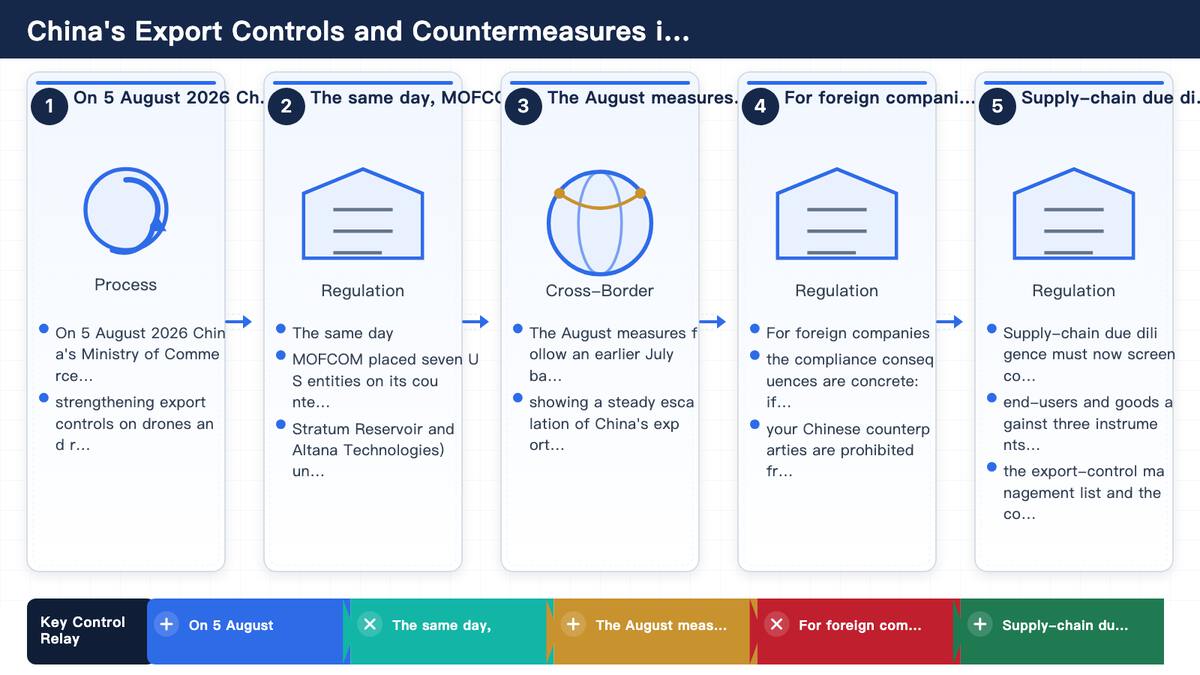
- On 5 August 2026 China’s Ministry of Commerce issued Announcement No. 34 of 2026, strengthening export controls on drones and related dual-use items to the United States: every export is now subject to case-by-case strict review and license-preference measures do not apply.
2026 年 8 月 5 日,商务部发布 2026 年第 34 号公告,加强对美国出口无人机相关两用物项的管制:列入《中华人民共和国两用物项出口管制清单》的无人机及关键零部件、相关技术对美国出口,逐案从严审核,不适用许可便利措施。- The same day, MOFCOM placed seven US entities on its countermeasures list — six entities (including Applied DNA Sciences, Stratum Reservoir and Altana Technologies) under Order No. 2 of 2026 and Compliance Testing LLC under Order No. 3 of 2026 — banning Chinese organisations and individuals from transacting or cooperating with them.
同一天,商务部依据反外国制裁法将 7 家美国实体列入反制清单——2026 年第 2 号令将应用 DNA 科学公司等 6 家美国实体列入,第 3 号令将美国合规性测试公司列入——禁止我国境内组织、个人与其进行交易、合作等活动。- The August measures follow an earlier July batch (Order No. 30 of 2026 placing 14 EU entities on the export-control management list) and a June 2026 customs announcement tightening drone export declarations, showing a steady escalation of China’s export-control enforcement.
8 月措施紧随此前批次:7 月第 30 号公告将 14 家欧盟实体列入出口管制管控名单,2026 年 6 月海关公告收紧无人机出口申报——显示中国出口管制执法的稳步升级。- For foreign companies, the compliance consequences are concrete: if you are a US or EU entity on the lists, your Chinese counterparties are prohibited from dealing with you; if you buy or re-export controlled drone components, you face case-by-case review and must not rely on licensing-preference pathways.
对外国企业,合规后果具体而直接:若你是在列的美欧实体,你的中国对手方被禁止与你交易;若你采购或转口受管制无人机零部件,将面对逐案审查且不能依赖许可便利通道。- Supply-chain due diligence must now screen counterparties, end-users and goods against three instruments: the Dual-Use Items Export Control List, the export-control management list and the countermeasures list, under the Export Control Law, the Dual-Use Items Export Control Regulations and the Anti-Foreign Sanctions Law.
供应链尽调现须对照三份清单筛查对手方、最终用户与货物:《两用物项出口管制清单》、出口管制管控名单与反制清单,依据《出口管制法》《两用物项出口管制条例》与《反外国制裁法》。- The Foreign Trade Law, revised and effective 1 March 2026, adds a further layer: it prohibits any person or organisation from providing agency, freight, customs, warehousing or platform services to evade measures against listed foreign persons or organisations.
2026 年 3 月 1 日施行的新修订《对外贸易法》增加一层:禁止任何个人、组织为规避针对在列境外个人、组织的措施提供代理、货运、寄递、报关、仓储、第三方交易平台服务等支持。
China’s Export Controls and Countermeasures in August 2026: The New Compliance Landscape for Global Supply Chains | 中国 2026 年 8 月出口管制与反制措施:全球供应链的新合规图景
The 5 August package
On 5 August 2026 the Ministry of Commerce issued three measures on a single day. Announcement No. 34 of 2026 strengthens export controls on drones and related dual-use items to the United States: for drones, their key components and related technology listed in the Dual-Use Items Export Control List, every export to the US is subject to case-by-case strict review, and license-preference measures do not apply. Order No. 2 of 2026 places six US entities on the countermeasures list — Applied DNA Sciences, Stratum Reservoir, Altana Technologies, Responsible Business Alliance, Verite Group and Human Rights in China — and Order No. 3 of 2026 places Compliance Testing LLC on the list. For entities on the countermeasures list, Chinese organisations and individuals are prohibited from transacting or cooperating with them. The legal basis is the Export Control Law and the Dual-Use Items Export Control Regulations for the first measure, and the Anti-Foreign Sanctions Law and its implementing regulations for the latter two.
The escalation context
The August package is the latest step in a sequence that global supply-chain teams should read as a pattern, not a one-off. On 24 July 2026, MOFCOM announced (Announcement No. 30 of 2026) that 14 EU entities were placed on the export-control management list. In June 2026, the GACC issued Announcement No. 78 of 2026 strengthening supervision of drone and other dual-use exports at the declaration stage: exports through express delivery or cross-border e-commerce channels may not use simplified declarations, and for goods whose technical parameters approach control standards, exporters must proactively declare that the goods are not controlled items. On 5 August the drone-specific US controls and the countermeasures against seven US entities followed. The cumulative picture: China’s export-control and countermeasure apparatus is being used with increasing frequency, and the dual-use control list, the management list and the countermeasures list are being updated as operational instruments, not as dormant legislation.
What the drone controls mean for global buyers
For companies that source drone components, drones or related technology from China, or that re-export such goods to the US, the practical changes are: (1) exports of listed items to the US now go through case-by-case strict review — no license-preference pathway; (2) exporters must verify the final destination and end-use more rigorously, which will slow down and add compliance cost to US-bound shipments; (3) for non-US destinations, controls continue to apply under the general dual-use regime, but the “no simplified declaration” rule for express and e-commerce channels announced in June applies regardless of destination; (4) buyers should expect Chinese suppliers to ask for more end-user and end-use documentation and to decline orders where the chain is unclear. For a global buyer, the lesson is to treat drones and dual-use electronics as controlled goods with a destination-sensitive compliance profile.
The countermeasures list and counterparty screening
The countermeasures list under the Anti-Foreign Sanctions Law has direct commercial teeth: Chinese organisations and individuals must not transact or cooperate with listed entities. For a foreign company, the question is not whether it agrees with the listings but whether it or any subsidiary appears on the list, and whether its Chinese counterparties will be forced to terminate relations. Compliance steps include: screen the company, its subsidiaries, its beneficial owners and its key counterparties against the countermeasures list and the export-control management list on a continuous basis; monitor updates to the lists (MOFCOM publishes them via announcements and the countermeasures list annex); and where a listed entity is involved anywhere in the transaction chain, assume the Chinese leg will be blocked. The revised Foreign Trade Law adds a service-layer prohibition: no one may provide agency, freight, forwarding, customs, warehousing or third-party trading-platform services to circumvent measures against listed foreign persons or organisations. This matters for freight forwarders, customs brokers, warehouses and platforms that handle transactions with listed entities — even non-US service providers routing through China face the prohibition.
The interplay with US sanctions and compliance dual-use
Foreign multinationals now operate in a genuinely two-way sanctions environment. US sanctions and export controls restrict what US persons and goods may do with Chinese entities; China’s export-control management list and countermeasures list restrict what Chinese entities may do with US and EU entities. A multinational that is simultaneously subject to US export controls (e.g., ITAR, EAR) and dealing with Chinese suppliers must map both regimes onto every transaction. Practical friction points include: US-origin components embedded in goods bought from Chinese suppliers; US persons serving on boards that approve transactions with listed Chinese entities; and Chinese suppliers refusing to route shipments through US-sanctioned logistics chains. The compliance function must therefore maintain a dual sanctions map and run both US and Chinese list screening in parallel.
Practical due-diligence framework
For foreign companies sourcing from or selling into China, the 2026 framework suggests a four-layer screen. Layer one, goods: confirm whether the product is on the Dual-Use Items Export Control List (and the annual licence-management catalogue), whether it approaches control thresholds, and what declaration obligations apply under the June 2026 customs announcement. Layer two, parties: screen counterparties, end-users and end-use against the export-control management list, the countermeasures list and, for completeness, China’s unreliable-entity list and the MOFCOM guidance. Layer three, services: verify that no Chinese freight, customs, warehousing or platform provider would be violating the Foreign Trade Law service prohibition by handling your transaction. Layer four, jurisdictions: map both US and Chinese control regimes onto the transaction chain and identify any conflict that makes a deal unexecutable. Documentation of the screening is itself a compliance asset — Chinese regulators increasingly expect written evidence that exporters and their counterparties verified end-users and end-use.
What to watch next
Several indicators will shape the next six months. First, whether the drone-specific US controls extend to other dual-use categories or other destinations. Second, whether the management list and countermeasures list grow further in response to foreign measures — the pattern since mid-2026 suggests regular additions. Third, the implementation guidance for the new Foreign Trade Law’s service-prohibition provisions, which may come through MOFCOM Q&As or administrative rules. Fourth, whether Chinese customs deepens declaration-level scrutiny of dual-use goods through further announcements in the 2026 series. For global supply-chain and compliance teams, the operating assumption should be that China’s export-control and countermeasure regime is now a routine, frequently updated component of cross-border trade compliance — to be screened continuously, not reviewed annually.
Sources
- 商务部(中国外经贸企业服务网 12335)— 《近期出口管制政策汇总》(2026年8月,含商务部公告2026年第34号、商务部令二〇二六年第2号、第3号全文):https://12335.mofcom.gov.cn/article/zcxx/dwmy/202608/65066.html
- 山东省商务厅 — 《商务部发布最新对美国出口管制和制裁措施》(2026-08-18,转发商务部8月5日三项措施):http://commerce.shandong.gov.cn/art/2026/8/18/art_16083_10374275.html
- 商务部 — 商务部政务公开·政策发布(2026年8月,含公告第34号、商务部令第2号、第3号、第30号):https://www.mofcom.gov.cn/zwgk/
- 贸法通 — 《当前我国两用物项出口管制制度分析——以无人机及相关设备为例》(2026年8月,梳理2024-2026年无人机出口管制脉络与海关2026年第78号公告):https://www.ctils.com/articles/27442
中国 2026 年 8 月出口管制与反制措施:全球供应链的新合规图景
8 月 5 日一揽子措施
2026 年 8 月 5 日,商务部同日发布三项措施。2026 年第 34 号公告加强对美国出口无人机相关两用物项的管制:列入《中华人民共和国两用物项出口管制清单》的无人机及关键零部件、相关技术对美国出口,逐案从严审核,不适用许可便利措施。2026 年第 2 号令将应用 DNA 科学公司、地层水库公司、阿尔塔纳技术公司、责任商业联盟、维泰集团、”人权在中国组织”等 6 家美国实体列入反制清单;第 3 号令将美国合规性测试公司列入反制清单。对在列实体,我国境内组织、个人禁止与其交易、合作。法律依据:第一项依《出口管制法》与《两用物项出口管制条例》,后两项依《反外国制裁法》及其实施规定。
升级的脉络
8 月一揽子是序列中的最新一步,全球供应链团队应视为模式而非一次性事件。2026 年 7 月 24 日,商务部公告(2026 年第 30 号)将 14 家欧盟实体列入出口管制管控名单。2026 年 6 月,海关总署发布 2026 年第 78 号公告,在申报环节强化无人机等两用物项出口监管:经快件、跨境电商渠道出口的不得简化申报,技术指标接近管制标准的物项,出口经营者申报时应主动声明其不属于管制物项。8 月 5 日,无人机对美专项管制与对 7 家美实体反制接踵而至。累积图景:中国出口管制与反制体系正被更频繁地启用,两用物项管制清单、管控名单与反制清单作为操作性工具持续更新,而非沉睡立法。
无人机管制对全球买家的意义
对从中国采购无人机零部件、无人机或相关技术、或向美国转口此类货物的企业,实际变化是:(1)清单物项对美出口现走逐案从严审核——无许可便利通道;(2)出口商须更严格核验最终目的地与最终用途,对美运输将变慢并增加合规成本;(3)对非美目的地,一般两用物项管制继续适用,但 6 月公告的”快件与电商渠道不得简化申报”规则不分目的地适用;(4)买家应预期中国供应商索取更多最终用户与最终用途文件,并在链条不清时拒绝订单。对全球买家,教训是无人机与两用电子产品须作为受管制货物、按目的地敏感性配置合规。
反制清单与对手方筛查
《反外国制裁法》下的反制清单具有直接的商业约束力:中国境内组织、个人不得与在列实体交易、合作。对外国企业,问题不在于是否认同列名,而在于自身或任何子公司是否在列、以及中国对手方是否被迫终止关系。合规步骤包括:对公司、子公司、受益所有人及关键对手方连续筛查反制清单与出口管制管控名单;持续跟踪名单更新(商务部经公告与反制清单附件发布);交易链任何环节涉在列实体的,按”中国一侧将被封堵”预判。新修订《对外贸易法》增加服务层禁令:任何个人、组织不得为规避针对在列境外个人、组织的措施提供代理、货运、寄递、报关、仓储、第三方交易平台服务等支持、协助、便利。这对处理与在列实体交易的货代、报关行、仓库与平台意义重大——即便非美服务商经中国中转也面临禁令。
与美国制裁的相互作用与双重合规
跨国企业如今身处真正的双向制裁环境。美国制裁与出口管制限制美国主体与货物可与中国实体做什么;中国的出口管制管控名单与反制清单限制中国实体可与美欧实体做什么。同时受美国出口管制(如 ITAR、EAR)约束又与中国供应商交易的多国公司,必须把两套制度映射到每笔交易。实际摩擦点包括:从中国供应商采购货物中嵌入的美国原产部件;参与批准与在列中国实体交易的董事会的美国人士;以及中国供应商拒绝经美国制裁物流链转运。合规职能因此须维护双向制裁地图,并行运行美国与中国清单筛查。
实务尽调框架
对从中国采购或对华销售的外国企业,2026 年框架建议四层筛查。第一层,货物:确认产品是否在《两用物项出口管制清单》(及年度许可管理目录)之上、是否接近管制阈值、按 2026 年 6 月海关公告承担何种申报义务。第二层,主体:对照出口管制管控名单、反制清单,以及中国不可靠实体清单与商务部指引,筛查对手方、最终用户与最终用途。第三层,服务:核实无中国货代、报关、仓储或平台提供者会因处理你的交易而违反《对外贸易法》服务禁令。第四层,法域:把美中两套控制制度映射到交易链,识别使交易不可执行的冲突。筛查留痕本身即是合规资产——中国监管者日益期待出口商及对手方留存书面证据证明已核验最终用户与最终用途。
下一步看点
若干指标将塑造未来半年。其一,无人机对美专项管制是否扩展到其他两用物项类别或其他目的地。其二,管控名单与反制清单是否随外国措施进一步扩大——2026 年年中以来的模式提示将定期增列。其三,新《对外贸易法》服务禁令的实施指引,或经商务部问答或行政规则出台。其四,中国海关是否以 2026 年序列后续公告深化两用物项申报级审查。对全球供应链与合规团队,运营假设应是:中国出口管制与反制体系现已是跨境贸易合规的常规、高频更新组成部分——应持续筛查,而非年度复核。
Sources
- 商务部(中国外经贸企业服务网 12335)— 《近期出口管制政策汇总》(2026年8月):https://12335.mofcom.gov.cn/article/zcxx/dwmy/202608/65066.html
- 山东省商务厅 — 《商务部发布最新对美国出口管制和制裁措施》(2026-08-18):http://commerce.shandong.gov.cn/art/2026/8/18/art_16083_10374275.html
- 商务部 — 商务部政务公开·政策发布(2026年8月):https://www.mofcom.gov.cn/zwgk/
- 贸法通 — 《当前我国两用物项出口管制制度分析——以无人机及相关设备为例》(2026年8月):https://www.ctils.com/articles/27442