
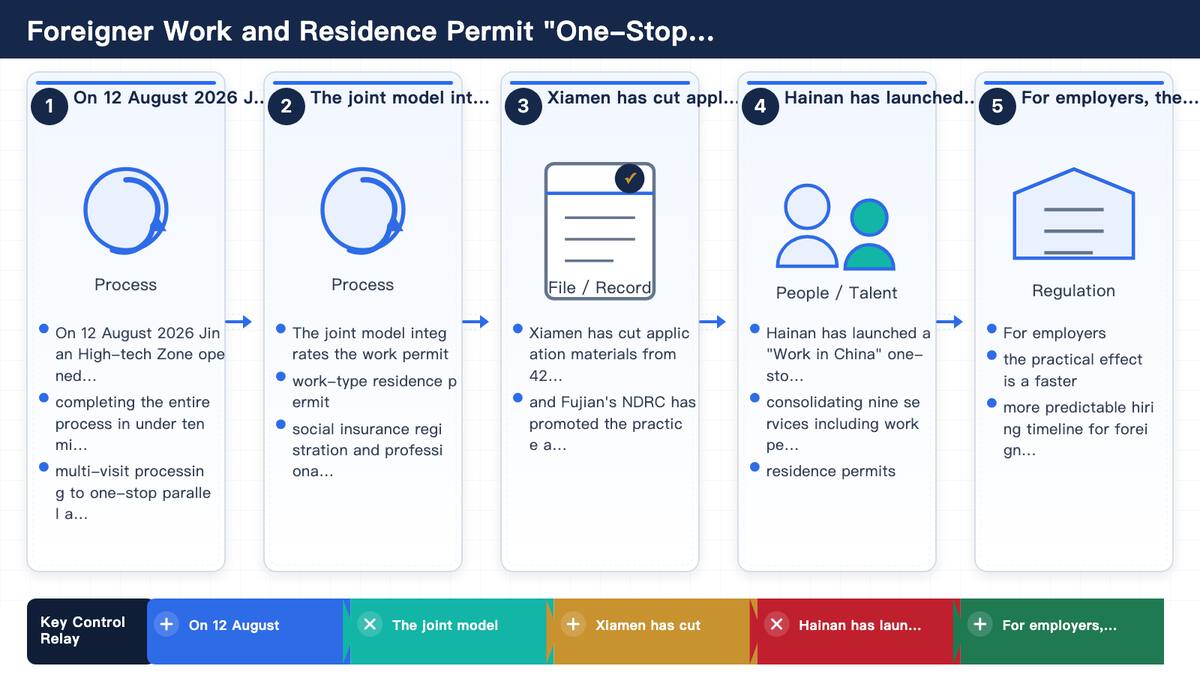
- On 12 August 2026 Jinan High-tech Zone opened the city’s first joint window for foreigner work permits and residence permits, completing the entire process in under ten minutes for its first applicant — a shift from multi-window, multi-visit processing to one-stop parallel approval.
2026 年 8 月 12 日,济南高新区启用全市首个”外国人来华工作许可、居留许可联办窗口”,首位申请者不到十分钟完成全部手续——从”多窗跑多次”变为”一次提交、并联审批、一站式办结”。- The joint model integrates the work permit, work-type residence permit, social insurance registration and professional title review in one service zone, compressing processing from 35 working days to about 10 working days — an efficiency gain of over 70%.
联办模式把工作许可、工作类居留证件、社保登记与职称评审整合到同一服务专区,办理时限从 35 个工作日压缩至约 10 个工作日,效率提升超 70%。- Xiamen has cut application materials from 42 to 21 items (a 50% reduction) for foreigner work-related matters, and Fujian’s NDRC has promoted the practice as a province-wide best-practice case for improving the business environment.
厦门将外国人工作相关事项申请材料从 42 份精简至 21 份(精简率 50%),福建省发改委将其作为优化营商环境典型经验在全省推广。- Hainan has launched a “Work in China” one-stop solution on the provincial international services website, consolidating nine services including work permits, residence permits, social insurance registration and overseas professional qualification recognition into a single online entryway.
海南在省级国际服务平台上线”Work in China”一站式解决方案,把外国人来华工作许可、工作类居留许可、社保登记、境外职业资格认可等 9 项服务整合进单一在线入口。- For employers, the practical effect is a faster, more predictable hiring timeline for foreign staff, lower compliance workload and clearer points of contact — but work-permit eligibility (A/B/C classification) and the underlying application requirements remain unchanged.
对外资雇主,实际效果是招聘外籍员工的时间线更快、更可预期,合规工作量与对接点更清晰——但工作许可 A/B/C 分类与底层申请条件未变。
Foreigner Work and Residence Permit “One-Stop” Reforms Across China: Jinan, Xiamen, Hainan and the 2026 Joint-Processing Wave | 外国人来华工作与居留许可”一件事”改革:济南、厦门、海南与 2026 年联办浪潮
The joint window opens in Jinan
On 12 August 2026 the Jinan High-tech Zone administrative service centre opened the city’s first “foreigner work permit and residence permit joint window”. The first applicant, a Russian national completing a residence-permit renewal for his role as a sales manager at a Jinan import-export company, finished the entire process in under ten minutes. Under the previous arrangement, foreign staff and their employers shuttled between different windows — the work permit with the science and technology department, the residence permit with the public security entry-exit authority, social insurance elsewhere — with the whole sequence reportedly taking around 35 working days. The joint window compresses the process to about ten working days through parallel approval, an efficiency gain of more than 70%. The high-tech zone’s service area also integrates social insurance registration and information changes, professional title review coordination and, through third-party resources, notarisation services and talent-policy interpretation — what the zone describes as a complete “foreign-related HR administration package” for employers.
The Xiamen template and the Fujian promotion
Xiamen has gone furthest in quantifying the simplification. The city’s human resources and social security bureau, together with the public security bureau and the tax bureau, restructured four matters involved in foreigner work — work-permit issuance, change and extension; work-type residence permit issuance; and tax-registration-related items — from a serial, three-department process into an integrated “one window, parallel approval” model. The result: application materials were cut from 42 to 21 items, a 50% reduction. Fujian’s Development and Reform Commission has promoted the Xiamen practice as a province-wide best-practice case for business-environment improvement (the second batch of 2026). For employers, the Xiamen case demonstrates that the joint-processing reform is not a single-city experiment but a template being propagated at provincial level.
The Hainan “Work in China” platform
Hainan has taken the reform online. The province launched a “Work in China” one-stop solution on the Hainan International Service Website (wssp.hainan.gov.cn) and the Haiyiban platform, consolidating nine services — including foreigner work permits, work-type residence permits, employee social insurance registrations and overseas professional qualification recognition — into a single online entryway with automated data sharing. Applicants and companies log in with individual or corporate accounts under the “Efficient One-Stop Services” section, complete forms, submit applications and track progress in real time. The online model matters for employers because it removes the need to know which department handles which step: one platform, one account, one application record.
The wider pattern
The Jinan, Xiamen and Hainan cases sit within a broader national pattern. Songshan Lake in Dongguan has run a joint work-permit and residence-permit window since July 2026 through the city’s immigration services sub-centre; Foshan publishes a “foreigner work in China, one thing” guide covering work permits, residence documents, social security cards, and professional title review; and multiple provinces are converting the “one thing” reform from a convenience into a standard for foreign-related government services. The reform is administrative, not legal: the underlying regime remains the work permit classification system (Category A high-level talent, Category B professionals, Category C ordinary workers), the invitation-letter requirement and the point-based evaluation, and the validity periods of work permits and residence permits are unchanged. What has changed is the procedural interface.
Why the reform matters for foreign employers
For a foreign-invested company hiring expatriate staff, the practical gains are substantial. First, hiring timelines shrink: a joint process of about ten working days versus a serial process of over a month materially shortens the gap between offer and start date. Second, administrative burden falls: one set of documents, one submission, one point of contact, instead of multiple departments and repeated filings. Third, predictability improves: with clearly defined windows and online tracking, employers can plan onboarding around a reliable calendar. Fourth, the extension and renewal path is smoother: renewal — the case type of Jinan’s first applicant — benefits most from the joint model because the same documents are needed by both authorities. Fifth, integration with adjacent services (social insurance, tax registration, professional title review, notarisation) reduces the number of separate visits an employee must make in the first months of employment.
Practical guidance for employers
First, before recruiting, confirm the job’s work-permit category (A/B/C) and that the foreign candidate meets the salary, education and experience thresholds, since the joint window speeds up processing, not eligibility. Second, in the four cities and provinces with joint windows, prepare a single document package aligned to the window’s checklist; in other locations, continue to prepare the department-by-department packages but watch for local “one thing” reforms. Third, use the online platforms where available (Hainan’s “Work in China”, local government service networks) and keep employer account details ready. Fourth, plan social insurance and tax registration at the same time as the permit applications, since the integrated service zones now handle them in parallel. Fifth, monitor provincial business-environment case lists — the Xiamen case shows that local reform innovations are being catalogued and propagated, and the next joint-window city may be the one you operate in.
Outlook
The 2026 joint-processing wave is converting China’s foreigner work and residence administration from a multi-department burden into a streamlined, increasingly online process. The underlying eligibility rules are unchanged, but the procedural interface — one window, parallel approval, reduced materials, online tracking — is being normalised city by city and province by province. For foreign employers and their HR teams, the practical message is to audit which joint services are available in each operating location and to build the hiring calendar around them, because the direction of reform is unambiguous: faster, simpler and more predictable.
Sources
- 济南高新技术产业开发区管理委员会 — 《济南首个!外国人来华工作、居留许可一站办结窗口启用》(2026-08-12):https://innovation.jinan.gov.cn/col/col127084/art/2026/art_1dd2837897724aa08da7dcf267ebbe83.html
- 海南省人民政府(英文版)— Infographic: Hainan launches ‘Work in China’ one-stop solution(2026年8月):https://en.hainan.gov.cn/englishsite/WEditor/202608/3e272582b7694719ae724e3133c59fe9.shtml
- 佛山市人民政府门户网站 — 外国人来华工作”一件事”办事指引(佛山市):https://www.foshan.gov.cn/zsk/?kCode=CFS00014568&parent=
- 涉丰商务咨询(整理报道)— 《外国人来华工作”一件事”再提速,多地”一窗办结”压缩至10天》(2026-08,含济南联办窗口、东莞松山湖”一窗办理、并联审批”、厦门材料精简50%并被福建省发改委作为营商环境典型经验推广):https://www.chinasfbc.com/article-item-1345.html
外国人来华工作与居留许可”一件事”改革:济南、厦门、海南与 2026 年联办浪潮
联办窗口在济南启用
2026 年 8 月 12 日,济南高新区政务服务中心启用全市首个”外国人来华工作许可、居留许可联办窗口”。首位申请者——一名在济南进出口企业任销售经理、办理居留许可延期的俄罗斯青年——不到十分钟完成全部手续。此前,外籍员工与雇主需在不同窗口之间奔波:工作许可找科技部门、居留许可找公安出入境、社保又另寻他处,全程据称约需 35 个工作日。联办窗口通过并联审批把时限压缩至约 10 个工作日,效率提升超 70%。高新区服务专区还整合社保登记及信息变更、职称评定对接,并经第三方资源提供涉外公证与人才政策解读——用园区的话说,为雇主提供一整套”涉外 HR 政务集成方案”。
厦门模板与福建推广
厦门在量化简化方面走得最远。市人社局牵头,联合市公安局、市税务局,把外国人工作涉及的 4 个事项——工作许可签发、变更、延期,工作类居留证件签发,税务登记关联事项——从”串联跑三部门”改造为”一窗受理、并联审批”集成模式。结果:申请材料从 42 份精简至 21 份,精简率 50%。福建省发改委已把厦门做法作为 2026 年第二批优化营商环境典型经验在全省推广。对雇主,厦门案例表明联办改革不是单城试验,而是省级推广的模板。
海南”Work in China”平台
海南把改革搬上线上。该省在国际服务网站(wssp.hainan.gov.cn)与”海易办”平台上线”Work in China”一站式解决方案,把外国人来华工作许可、工作类居留许可、员工社保登记、境外职业资格认可等 9 项服务整合进单一在线入口,自动数据共享。申请人与企业以个人或企业账户登录”高效办成一件事”专栏,在线填表、提交、实时跟踪进度。在线模式对雇主的意义在于不必再知道哪一步归哪个部门:一个平台、一个账户、一份申请记录。
更大范围的模式
济南、厦门、海南案例属于更广的全国模式。东莞松山湖自 2026 年 7 月起依托东莞移民事务服务中心松山湖分中心实现工作许可与居留许可”一窗办理、并联审批”;佛山发布”外国人来华工作一件事”办事指引,覆盖工作许可、居留证件、社保卡与职称评审;多省正把”一件事”改革从便利升级为涉外政务标准。改革是行政性的,而非法律性的:底层制度未变——工作许可 A(高层次人才)、B(专业人才)、C(普通人员)分类、邀请函要求与积分评估、工作许可与居留许可有效期均不变。变化的是程序界面。
改革对外资雇主的意义
对招聘外籍员工的外资企业,实际收益可观。其一,招聘周期缩短:约 10 个工作日的联办流程对比一个多月的串联流程,实质缩短从录用通知到入职的空档。其二,行政负担下降:一套材料、一次提交、一个对接点,取代多部门与重复申报。其三,可预期性提高:窗口与在线跟踪明确,雇主可围绕可靠日历规划入职。其四,延期与续办更顺:续办——济南首位申请者的案件类型——最受益于联办,因为两部门需要同一套文件。其五,与相邻服务(社保、税务登记、职称评审、公证)的整合减少员工入职头几个月须单独跑的次数。
雇主实操指引
其一,招聘前确认岗位工作许可类别(A/B/C)与候选人薪酬、学历、经验门槛——联办提速的是办理,不是资格。其二,在已设联办窗口的四城/省份,按窗口清单准备单一文件包;其他地区继续按部门分套准备,但留意本地”一件事”改革。其三,可用处善用在线平台(海南”Work in China”、各地政务网),备好雇主账户。其四,在提交许可申请的同时规划社保与税务登记——集成服务专区现已并联办理。其五,跟踪省级营商环境案例清单——厦门案例表明地方创新正被建档推广,下一个联办窗口城市可能正是你运营之地。
展望
2026 年联办浪潮正把中国外国人工作与居留管理从多部门负担转化为精简、日益在线的流程。底层资格规则未变,但程序界面——一窗、并联、减材料、在线跟踪——正逐城逐省常态化。对外国雇主与 HR 团队,实务信息是审计各运营地可用联办服务,并围绕它们构建招聘日历——改革方向无可置疑:更快、更简、更可预期。
Sources
- 济南高新技术产业开发区管理委员会 — 《济南首个!外国人来华工作、居留许可一站办结窗口启用》(2026-08-12):https://innovation.jinan.gov.cn/col/col127084/art/2026/art_1dd2837897724aa08da7dcf267ebbe83.html
- 海南省人民政府(英文版)— Hainan launches ‘Work in China’ one-stop solution(2026年8月):https://en.hainan.gov.cn/englishsite/WEditor/202608/3e272582b7694719ae724e3133c59fe9.shtml
- 佛山市人民政府门户网站 — 外国人来华工作”一件事”办事指引:https://www.foshan.gov.cn/zsk/?kCode=CFS00014568&parent=
- 涉丰商务咨询(整理报道)— 外国人来华工作”一件事”再提速(2026-08):https://www.chinasfbc.com/article-item-1345.html