
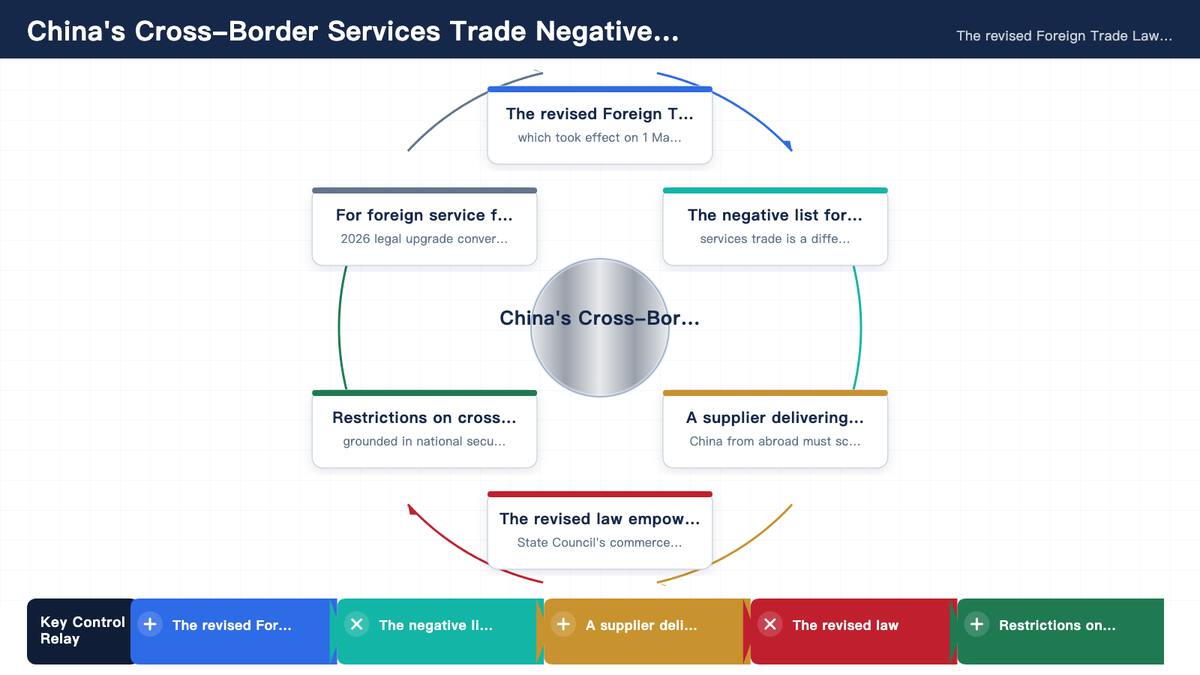
- The revised Foreign Trade Law, which took effect on 1 March 2026, is the first law to codify a cross-border services trade negative list at the national level, placing cross-border delivery, consumption abroad and movement of natural persons under a “everything not listed is permitted” regime.
2026 年 3 月 1 日起施行的新修订《对外贸易法》,首次在法律层面确立跨境服务贸易负面清单管理制度,将跨境交付、境外消费、自然人移动等模式下开展的跨境服务贸易置于”非禁即入”的清单管理之下。- The negative list for cross-border services trade is a different instrument from the foreign investment negative list: it governs services supplied across borders without a commercial presence, while the investment list governs services supplied through locally established entities.
跨境服务贸易负面清单与外商投资准入负面清单是两项不同工具:前者管理不设商业存在而跨境提供的服务,后者管理以在华设立实体方式提供的服务。- A supplier delivering services into China from abroad must screen its activities against both lists: the cross-border services list for its offshore supply model, and the foreign investment list if it sets up a local presence.
从境外向中国提供服务的外国服务提供者须对两张清单同时筛查:离岸供应模式对照跨境服务贸易清单,若在华设立商业存在则再对照外商投资准入清单。- The revised law empowers the State Council’s commerce department to formulate, adjust and publish the cross-border services negative list together with other departments, leaving room for pilot zones and the Hainan FTP to test broader opening first.
修订后的法律授权商务部会同有关部门制定、调整并发布跨境服务贸易负面清单,为自贸试验区与海南自由贸易港先行先试更大开放留出空间。- Restrictions on cross-border services remain grounded in national security, public health and safety, domestic industry development and balance-of-payments grounds, mirroring GATS-style flexibilities.
对跨境服务贸易的限制仍以国家安全、公共健康安全、国内特定服务产业培育和外汇收支平衡等事由为依据,与 GATS 式灵活性安排相衔接。- For foreign service firms, the 2026 legal upgrade converts policy pledges into statutory certainty: digital trade, green trade and new business models are explicitly encouraged, and a service-supplier’s compliance burden becomes a checklist exercise rather than an open-ended approval process.
对境外服务企业而言,2026 年的法律升级把政策承诺转化为法律确定性:数字贸易、绿色贸易与新业态获明确鼓励,服务提供者的合规负担从开放式审批变为清单式核对。
China’s Cross-Border Services Trade Negative List: The New Legal Foundation and What It Means for Foreign Suppliers | 中国跨境服务贸易负面清单:新的法律基础与对外国服务提供者的意义
Why the new legal foundation matters
For decades, foreign suppliers of services to China faced an asymmetry: the goods trade was governed by tariffs and quota schedules, and investment was governed by the foreign investment negative list, but cross-border services — consulting, software, cloud services, engineering design, market research, payments and a wide range of business services supplied from abroad without a local entity — sat in a grey zone of sectoral licences and discretionary approvals. The revised Foreign Trade Law, adopted by the Standing Committee of the National People’s Congress on 27 December 2025 and in force since 1 March 2026, changes the architecture. Article 31 of the revised law establishes a “cross-border services trade negative list management system”: the State Council’s commerce department, together with other departments, formulates, adjusts and publishes the list, and any activity not on the list may be supplied cross-border without an item-by-item approval. The law itself does not enumerate the items — the list is a separate regulatory instrument — but it fixes the governing principle in legislation, giving foreign suppliers statutory predictability for the first time.
The list as distinct from the foreign investment negative list
It is important to keep the two negative lists separate. The foreign investment negative list (currently 29 national items, as the 2024 edition) applies to services supplied through a “commercial presence” in China — that is, a wholly foreign-owned enterprise, joint venture or branch. The cross-border services trade negative list applies to the other three modes of service supply recognised in trade-policy terms: cross-border delivery (mode 1, services transmitted from abroad), consumption abroad (mode 2, a Chinese consumer travelling or staying abroad and consuming a service there) and movement of natural persons (mode 4, an individual entering China to deliver a service without establishing an entity). Article 31 makes this division explicit: services supplied through commercial presence are governed by the Foreign Investment Law, while services supplied under the other three modes are governed by the cross-border services negative list. A foreign software company that sells licences remotely from its home office, for example, is regulated under the cross-border list; if it sets up a Chinese subsidiary to sell the same licences, the subsidiary is regulated under the investment list.
What the revised Foreign Trade Law adds beyond the list
The 2025 revision, the law’s most substantial since 2004, contains several provisions that matter for foreign service suppliers. First, the law explicitly encourages digital trade and green trade, and commits China to promoting mutual recognition of digital certificates and electronic signatures, which eases cross-border contracting. Second, it strengthens the trade policy compliance mechanism: government measures affecting trade must undergo a compliance assessment aligned with international rules, which disciplines local regulators from imposing ad hoc barriers. Third, it codifies countermeasures: where a foreign country or region takes discriminatory measures against Chinese persons or organisations in trade, or harms China’s sovereignty, security or development interests, China may restrict trade with the responsible foreign individuals or organisations — including by prohibiting Chinese persons and organisations from providing them agency, freight, customs, warehousing or platform services. Fourth, it reaffirms the services-trade relief framework, allowing safeguard measures where a surge in imported services causes serious injury to domestic service industries.
The relationship between the national list and pilot-zone liberalisation
China already operates a cross-border services negative list for the Hainan Free Trade Port, issued in 2021 with 70 items, later compressed, and the FTZ cross-border services negative list, which has been progressively trimmed in successive editions. The 2026 legal codification does not itself shorten these lists, but it provides the statutory anchor that allows the national list to be built by extending pilot-zone experiments nationwide. In practice, the reform path mirrors the investment-list experience: pilot zones test a compressed list, the Hainan port tests a freer regime, and successful items migrate to the national list. Foreign suppliers should therefore watch three layers: the national list (once issued in its post-2026 form), the FTZ list for pilot-zone entry, and the Hainan list for port-based services.
What restricted categories look like
Although the operative national list is still being updated, the structure of the existing FTZ and Hainan lists gives a clear picture of where restrictions concentrate: (1) financial services — cross-border insurance, securities brokerage, fund distribution and certain payment services are either prohibited or subject to establishment requirements; (2) professional services — legal practice, certain accounting and certification activities, and some consulting services require local qualification or establishment; (3) telecommunications and internet — cross-border provision of basic and some value-added telecom services is restricted; (4) medical and health services — remote diagnosis and certain medical activities face qualification conditions; (5) cultural and information services — internet content, news and publishing activities remain restricted; and (6) transport and logistics — certain cabotage and cross-border logistics activities are conditioned on licensed local operators. The general test for a foreign supplier is straightforward: if the activity is not listed, it may be supplied cross-border; if it is listed, the supplier must look for a licensed route, typically by establishing a commercial presence.
Practical steps for foreign service suppliers
First, map your service model to the four modes and confirm whether your activity is cross-border (list applies) or commercial-presence based (investment list applies). Second, review the current FTZ and Hainan cross-border services lists as the best available proxy for the direction of the national list. Third, screen for sectoral regulators’ rules even where the list permits supply: data localisation, personal information cross-border transfer rules, payment licences and professional qualification requirements sit outside the list and continue to apply. Fourth, where the activity is restricted, consider structuring via a licensed joint venture or a pilot-zone entity. Fifth, document the trade policy compliance of your entry plan — the new statutory regime rewards clean, checklist-based compliance and penalises grey-zone operations.
Outlook for 2026 and beyond
The Government Work Report for 2026 and the 15th Five-Year Plan both direct that the cross-border services negative list be further compressed, with services as the priority for market-access opening. The Commerce Ministry has continued to expand the comprehensive pilot programme for services trade opening, and the “Services China” data for the first half of 2026 show knowledge-intensive services trade growing strongly. For foreign suppliers, the direction of travel is unambiguous: China is converting its services-opening policy into codified, list-based regulation, and the winners will be the firms that screen against the list, structure their mode of supply deliberately, and keep their offshore and onshore compliance aligned.
Sources
- 全国人民代表大会(全国人大常委会)— 新修订《中华人民共和国对外贸易法》通过及实施(2025年12月27日通过,2026年3月1日施行):http://www.npc.gov.cn/npc/c2/c30834/202603/t20260323_453386.html
- 商务部 — 《中华人民共和国对外贸易法(2025修订)》全文(主席令第67号):https://policy.mofcom.gov.cn/claw/clawContent.shtml?id=104354
- 商务部 — 《对外贸易法(2025修订)》政策概览:https://www.mofcom.gov.cn/cms_files/filemanager/policySummary/viewcore_d71882d8e70e43e5a28f686c4f0b8db4.html
- 中国经济网 — 关铭闻《向前!中国开放的大门越开越大》(2026-08-14,论跨境服务贸易负面清单从政策上升为法律):https://www.ce.cn/xwzx/gnsz/gdxw/202608/t20260814_3148272.shtml
- 上海市人民政府外事办公室 —《上海资讯周报》涉外资讯一站式服务(2026年8月第2期,总第154期,2026-08-12):https://wsb.sh.gov.cn/ztzl/shzxzb/20260811/bd3b73a6e882435e92bd4f7213129b46.html
中国跨境服务贸易负面清单:新的法律基础与对外国服务提供者的意义
新的法律基础为何重要
数十年来,向中国提供服务的境外供应商面对一种不对称格局:货物贸易受关税与配额表约束,投资受外商投资负面清单约束,而跨境服务——咨询、软件、云服务、工程设计、市场调研、支付及各类不需在华设立实体的商业服务——长期处于部门许可与自由裁量审批的灰色地带。2025 年 12 月 27 日全国人大常委会表决通过、2026 年 3 月 1 日起施行的新修订《对外贸易法》改变了这一架构。修订后法律第三十一条确立”跨境服务贸易负面清单管理制度”:国务院对外贸易主管部门会同有关部门制定、调整并发布跨境服务贸易负面清单,凡未列入清单的活动即可跨境提供,无需逐项审批。法律本身不列举条目——清单是独立的监管文件——但它在立法层面固定了管理原则,首次给予境外供应商以法律层面的可预期性。
与外商投资准入负面清单的区别
必须把两张清单区分开来。外商投资准入负面清单(当前为 2024 年版,全国版 29 条)适用于以”商业存在”方式在华提供的服务——即外商独资企业、合资企业或分支机构。跨境服务贸易负面清单适用于贸易政策意义上另外三种服务供应模式:跨境交付(模式一,从境外传输服务)、境外消费(模式二,中国消费者出境在境外消费服务)与自然人移动(模式四,个人进入中国提供服务而不设立实体)。第三十一条明确划界:以商业存在提供的服务适用《外商投资法》,以其他三种模式提供的服务适用跨境服务贸易负面清单。例如,一家外国软件公司从境外总部远程销售许可,按跨境清单监管;若它设立中国子公司销售同样的许可,子公司按投资清单监管。
修订后的《对外贸易法》在清单之外增加了什么
2025 年修订是 2004 年以来最实质的一次修法,对外国服务提供者有多项相关条款。其一,法律明确鼓励数字贸易与绿色贸易,并承诺推动数字证书、电子签名国际互认,便利跨境缔约。其二,强化贸易政策合规机制:影响贸易的政府措施须按与国际规则衔接的标准开展合规评估,约束地方监管者不得随意设置障碍。其三,成文规定反制措施:外国国家或地区对中国个人、组织实施歧视性措施,或危害中国主权、安全与发展利益的,中国可对该境外个人、组织限制相关贸易——包括禁止中国境内组织、个人为其提供代理、货运、报关、仓储、平台等服务。其四,重申服务贸易救济框架:进口服务激增对国内服务产业造成严重损害的,可采取保障措施。
国家清单与试点开放的关系
中国已有一张海南自由贸易港跨境服务贸易负面清单(2021 年发布时 70 条,后经压缩)与自贸试验区跨境服务贸易负面清单(历经多版压缩)。2026 年的法律成文本身并不缩短这些清单,但它提供了让国家清单得以”先试点、后推广”的立法锚点。实践中,改革路径与投资清单经验一致:试验区试验压缩版清单,海南试验更开放制度,成功条目向全国迁移。境外供应商应关注三层:国家清单(2026 年后新版一旦发布)、自贸试验区版(试点区域进入)、海南版(港口型服务)。
受限类别的样貌
尽管现行国家清单仍在更新中,既有自贸试验区与海南清单的结构已清楚显示限制集中的领域:(1)金融服务——跨境保险、证券经纪、基金销售及部分支付服务或被禁止或要求设立机构;(2)专业服务——法律执业、部分会计与认证活动、部分咨询服务要求本地资质或设立;(3)电信与互联网——基础电信及部分增值电信服务的跨境提供受限;(4)医疗卫生——远程诊疗及部分医疗活动有资质条件;(5)文化与信息服务——互联网内容、新闻与出版活动仍受限;(6)运输物流——部分国内运输与跨境物流活动须由持证本地经营者承接。对外国供应商的通用测试很简单:未列入清单即可跨境提供;列入清单则须寻找持牌路径,通常以设立商业存在实现。
外国服务提供者的实操步骤
其一,把服务模式映射到四种模式,确认属跨境(适用清单)还是商业存在(适用投资清单)。其二,研读现行自贸试验区与海南跨境服务贸易清单,作为国家清单方向的最近代理。其三,即便清单允许供应,仍须筛查行业主管部门规则:数据本地化、个人信息跨境传输规则、支付牌照与职业资质要求均在清单之外继续适用。其四,活动受限时,考虑以持牌合资或试验区主体结构进入。其五,让准入方案经得起贸易政策合规检验——新的成文制度奖励清晰、清单式的合规,惩戒灰色经营。
2026 年及之后展望
2026 年《政府工作报告》与十五五规划《纲要》均要求进一步压缩跨境服务贸易负面清单,并以服务业为扩大开放重点。商务部持续推进服务业扩大开放综合试点,2026 年上半年服务贸易数据显示知识密集型服务进出口强劲增长。对境外供应商,方向毋庸置疑:中国正把服务业开放政策转化为成文、清单式监管,胜者将是那些对照清单筛查、刻意设计供应模式、使离岸与在岸合规保持一致的机构。
Sources
- 全国人民代表大会(全国人大常委会)— 新修订《中华人民共和国对外贸易法》通过及实施(2025年12月27日通过,2026年3月1日施行):http://www.npc.gov.cn/npc/c2/c30834/202603/t20260323_453386.html
- 商务部 — 《中华人民共和国对外贸易法(2025修订)》全文(主席令第67号):https://policy.mofcom.gov.cn/claw/clawContent.shtml?id=104354
- 商务部 — 《对外贸易法(2025修订)》政策概览:https://www.mofcom.gov.cn/cms_files/filemanager/policySummary/viewcore_d71882d8e70e43e5a28f686c4f0b8db4.html
- 中国经济网 — 关铭闻《向前!中国开放的大门越开越大》(2026-08-14):https://www.ce.cn/xwzx/gnsz/gdxw/202608/t20260814_3148272.shtml
- 上海市人民政府外事办公室 —《上海资讯周报》涉外资讯一站式服务(2026年8月第2期,总第154期,2026-08-12):https://wsb.sh.gov.cn/ztzl/shzxzb/20260811/bd3b73a6e882435e92bd4f7213129b46.html