
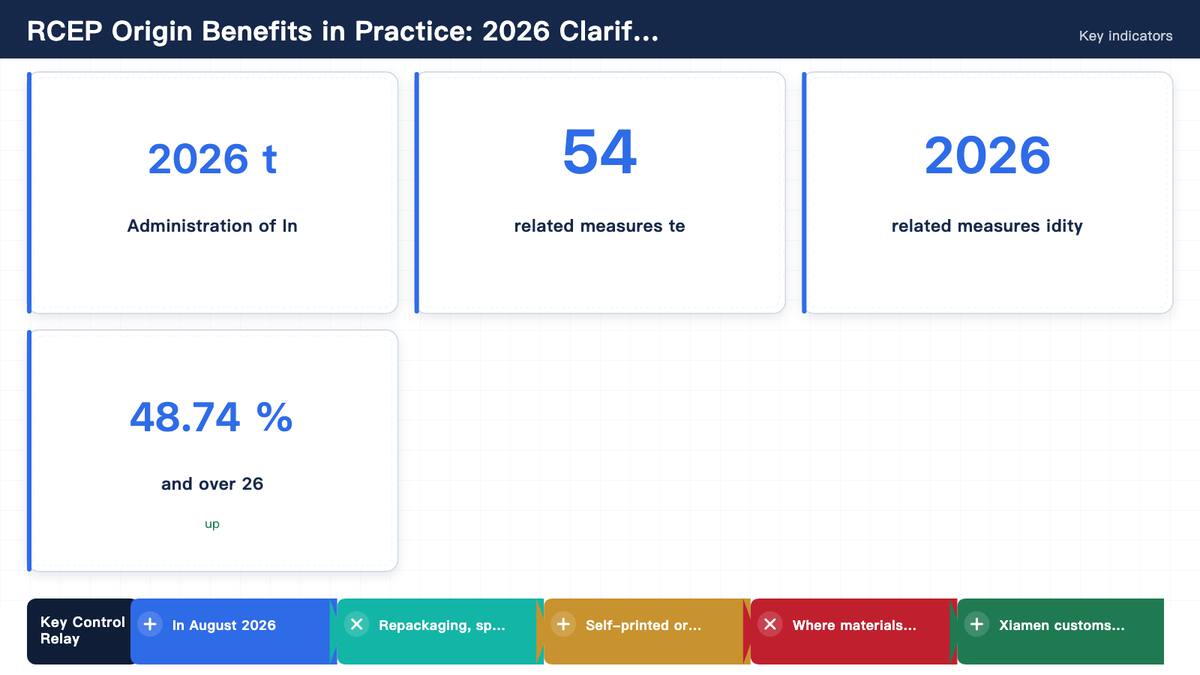
- In August 2026 the General Administration of Customs ran policy Q&A sessions on preferential origin rules, clarifying the micro-content (de minimis) rule, accumulation, direct transport and certificate validity under GACC Announcement No. 54 of 2026 and related measures.
2026 年 8 月,海关总署就优惠原产地规则开展政策问答,结合海关总署 2026 年第 54 号公告等文件明确微小含量规则、累积规则、直接运输与证书有效期等要点。
- Repackaging, splitting or re-labelling goods in a third country is only minor processing and does not confer originating status, so goods thus handled cannot enjoy preferential tariff treatment.
货物在第三方国家更换包装、分拆后贴上新标签仅属微小加工或处理,不能赋予原产资格,不能享受优惠关税。
- Self-printed origin certificates obtained via the China International Trade Single Window carry official electronic seals and have the same legal effect as certificates issued at customs.
通过国际贸易单一窗口自助打印的原产地证书带官方电子签章,与海关现场申领签发的证书具同等法律效力。
- Where materials or processing undergo major changes, exporters should update product registration on the origin platform in time to avoid clearance refusal and origin verification.
出口产品原材料构成或加工工艺发生重大变化的,应及时登录原产地综合服务平台更新产品备案,避免清关无法享惠或遭进口方海关核查。
- Xiamen customs data for the first half of 2026 shows RCEP import duty reductions up 48.74% year-on-year and over 170,000 export origin certificates issued, up 12.85%, confirming strong utilisation growth.
厦门海关 2026 年上半年数据显示,RCEP 项下进口税款减让金额同比增长 48.74%、出口原产地签证超 17 万份同比增长 12.85%,享惠利用持续高增长。
- For foreign-invested importers and exporters in China, RCEP utilisation is now a routine trade operation: verify the applicable concession, obtain a valid certificate (or use exemption tracks), file the origin elements correctly and keep transport documents for the direct-transport rule.
对在华外资进出口企业,RCEP 享惠已是常规贸易操作:核实适用税率、取得有效原产地证明(或适用免提交情形)、正确填报原产地要素并留存直接运输单证。
RCEP Origin Benefits in Practice: 2026 Clarifications from China Customs | RCEP 原产地优惠实操:2026 年海关政策澄清
Why this matters now
In August 2026 the General Administration of Customs (GACC) published a policy Q&A session (“Customs Policy Express”, No. 34) explaining preferential origin rules under the Regional Comprehensive Economic Partnership (RCEP) and other free trade agreements, responding to enterprise questions on the de minimis rule, accumulation, certificate validity and direct transport. Around the same period, the Jitong Sub-Customs of Xiamen Customs held its first RCEP and ECFA briefing for the Xiamen Taiwan Business Association on 24 July 2026 (reported 13 August 2026), and Dalian Customs reported first-half utilisation results on 18 August 2026. For foreign-invested companies trading into and out of China, these clarifications matter because RCEP preference is no longer a niche planning tool: with the 2026 second-round tariff cuts applying to more goods, correct origin declaration is now a daily operational discipline. This article sets out the rules as clarified and the practical filing steps.
What the August 2026 clarifications say
GACC’s August Q&A addressed five recurring questions. First, when can a back-dated certificate be issued? A preferential origin certificate should be issued before or at the time of shipment, valid for one year from issue. If it could not be issued in time because of force majeure, unintentional error, negligence or other reasonable cause, a back-issued certificate can be obtained within one year of shipment, valid for one year from shipment. Second, does repackaging, splitting or re-labelling in a transit country preserve preference? No. Under Article 9 of GACC Announcement No. 54 of 2026, these operations are only minor processing or handling and do not confer originating status; the goods cannot enjoy preference. Third, are self-printed certificates valid? Yes — certificates printed through the Single Window carry official electronic seals and have the same legal effect as those issued at a customs counter. Fourth, when materials change, must the exporter update registration? If the composition of materials or processing technology changes materially and may change originating status, the exporter should update product registration on the origin platform promptly and re-assess compliance with the FTA origin standard. Fifth, what is the de minimis (micro-content) rule? Where the value or weight of non-originating materials in a product falls below the threshold set by the agreement, the product may still be treated as originating even if the tariff-classification-change rule is not met; the de minimis rule supplements, but does not replace, substantial processing.
Accumulation and direct transport in practice
The accumulation rule remains the most powerful origin tool under RCEP: originating materials from any RCEP member accumulate with domestic content when determining whether a product meets the regional value content threshold (typically 40%). The GACC Q&A confirmed that, in practice, goods produced in one member using originating materials from other members can benefit. The direct transport rule requires that goods be transported directly between members; where transit through a third country is unavoidable, only operations necessary for the transit are permitted, and transport documents and, where required, a certificate of non-manipulation must be available. Enterprises should keep the full set of transport documents because customs may verify the direct-transport condition.
Utilisation results and regional practice
Xiamen Customs reported that in the first half of 2026, import duty savings under all FTAs in its jurisdiction rose 22.20% year-on-year, with RCEP import duty reductions up 48.74%; more than 170,000 export origin certificates were issued, up 12.85%. Dalian Customs reported that in January-July 2026, Dalian’s trade with APEC economies reached RMB 191.6 billion, up 4.3%, with imports up 13.3%; it promoted the China Customs Preferential Origin Service Platform and self-print certificates, and guided a bearing exporter to self-print 620 certificates for zero-tariff clearance in Korea. These results illustrate that origin preference flows through routine trade operations, not one-off applications.
Practical filing steps for importers and exporters
For an importer claiming preference, the steps are: identify the applicable agreement and code (RCEP agreement code is 22); obtain the origin certificate from the supplier or confirm a certificate exemption applies; declare the origin elements on the customs declaration — preference trade agreement code, origin certificate type, certificate number, originating status and corresponding item numbers; where electronic data exchange is not implemented for the issuing country (e.g. Malaysia-issued RCEP certificates), submit electronic data through the Preferential Trade Agreement Origin Elements Declaration System first; and prepare the transport documents proving direct transport. For exporters, register the product on the origin platform, obtain a certificate (or self-print it), and update the registration whenever materials or processing change materially. Both sides can query applicable rates on the China Customs Preferential Origin Service Platform.
Compliance notes
The de minimis rule does not replace the substantial-processing test; it is a supplementary convenience. “Minor processing” exceptions are narrow — repackaging, splitting and re-labelling in a third country do not preserve origin. Certificate validity and back-issuance windows are fixed and are not extendable. Enterprises should also note that the 2026 second-round tariff cuts apply to specified goods lists; confirming whether a product is within the list is a precondition for planning. Finally, keep origin records for at least the period customs may demand in verification, as documentation gaps can undo an otherwise valid claim.
RCEP 原产地优惠实操:2026 年海关政策澄清
为什么当下重要
2026 年 8 月,海关总署通过”海关政策直通车”第 34 期发布优惠原产地规则政策问答,就《区域全面经济伙伴关系协定》(RCEP)等自贸协定项下的微小含量规则、累积规则、证书有效期与直接运输等企业高频问题作出解答。同期,厦门海关所属集同海关于 2026 年 7 月 24 日首次面向厦门台商协会开展 RCEP、ECFA 等专题宣讲(8 月 13 日报道);大连海关 8 月 18 日公布上半年享惠成效。对在华开展进出口业务的外资企业,这些澄清之所以重要,是因为 RCEP 享惠不再是边缘规划工具:随着 2026 年第二轮关税减让覆盖更多商品,正确申报原产地已成为日常操作纪律。本文梳理已澄清的规则与具体申报步骤。
2026 年 8 月澄清要点
海关 8 月问答回应了五个高频问题。其一,原产地证书何时可补发?优惠原产地证书应在货物装运前或装运时签发,自出口方签证机构签发之日起 1 年内有效;因不可抗力、非故意错误、疏忽或其他合理原因未能及时签发的,可在货物装运之日起 1 年内补发,补发证书自装运之日起 1 年内有效。其二,货物在中转国更换包装、分拆、贴新标签能否享惠?不能。依海关总署 2026 年第 54 号公告第九条,这些操作均属仅微小加工或处理,不能赋予原产资格。其三,自助打印证书是否有效?有效——通过单一窗口自助打印的证书带官方电子签章,与海关现场申领的证书具同等法律效力。其四,原材料发生变化是否需更新备案?构成原材料或加工工艺发生重大变化、可能改变原产资格的,应及时登录原产地综合服务平台更新产品备案,重新评估是否符合协定原产地标准。其五,什么是微小含量规则?产品中非原产原材料价值或重量低于协定阈值,即使不满足税则归类改变,仍可判定具备原产资格;微小含量是配套便利条款,不能替代实质性加工。
累积规则与直接运输实操
累积规则仍是 RCEP 下最有力的原产地工具:任一成员的原产材料可与本地成分累积计算,以判定是否达到区域价值成分门槛(通常 40%)。海关问答确认,实务中一个成员境内生产的货物使用其他成员原产材料,可正常享惠。直接运输规则要求货物在成员之间直接运输;确需经第三国中转的,只允许必要的转运操作,并须留存运输单证、必要时提供未再加工证明。企业应完整保留运输单证,因为海关可能核查直接运输条件。
享惠成效与区域实践
厦门海关数据显示,2026 年上半年辖区各自贸协定项下进口享惠金额同比增长 22.20%,其中 RCEP 项下进口税款减让金额同比增长 48.74%;出口原产地签证超 17 万份,同比增长 12.85%。大连海关数据显示,2026 年 1—7 月大连与 APEC 其他经济体贸易额达 1916 亿元、同比增长 4.3%,进口增长 13.3%;大连海关推广”中国海关优惠原产地服务平台”与自助打印,指导轴承企业自助打印 620 份证书实现韩国零关税通关。这些结果说明,原产地优惠是通过日常贸易操作兑现的,而非一次性申请。
进出口企业申报步骤
进口企业申报享惠的步骤:确定适用协定及代码(RCEP 协定代码为 22);向供应商取得原产地证书或确认适用免提交情形;在报关单填报原产地要素——优惠贸易协定代码、原产地证明类型、原产地证明编号、优惠贸易协定项下原产地、对应商品项号;对未实现电子信息交换的出证国(如马来西亚签发的 RCEP 证书),先通过”优惠贸易协定原产地要素申报系统”填报电子数据;备齐证明直接运输的全程运输单证。出口企业则须在原产地平台登记产品、申领或自助打印证书,并在原材料或工艺发生重大变化时更新备案。双方都可在”中国海关优惠原产地服务平台”查询适用税率。
合规提示
微小含量规则不替代实质性加工测试,只是配套便利。微小加工例外范围很窄——在第三国更换包装、分拆、贴标签不能保留原产资格。证书有效期与补发窗口固定,不可延长。企业还应注意,2026 年第二轮关税减让适用于指定商品清单,确认产品是否在清单内是规划前提。最后,原产地记录至少应留存至海关核查可能要求的期限,单据缺口可能使本可成立的享惠主张落空。
Sources
- 海关总署《海关政策直通车㉞:对非零关税,这泼天的富贵,还愣着干啥,快接》(2026-08-12):http://www.customs.gov.cn/customs/2026-08/12/article_2026081223251179070.html
- 厦门海关《”政策礼包”直达台企——集同海关首次走进台商协会开展政策宣讲》(2026-08-13):http://guangzhou.customs.gov.cn/xiamen_customs/491073/491074/7291804/index.html
- 海关总署(大连海关)《前 7 月大连与 APEC 其他经济体贸易额达 1916 亿元》(2026-08-18):http://www.customs.gov.cn/customs/2026-08/18/article_2026081815291037347.html