
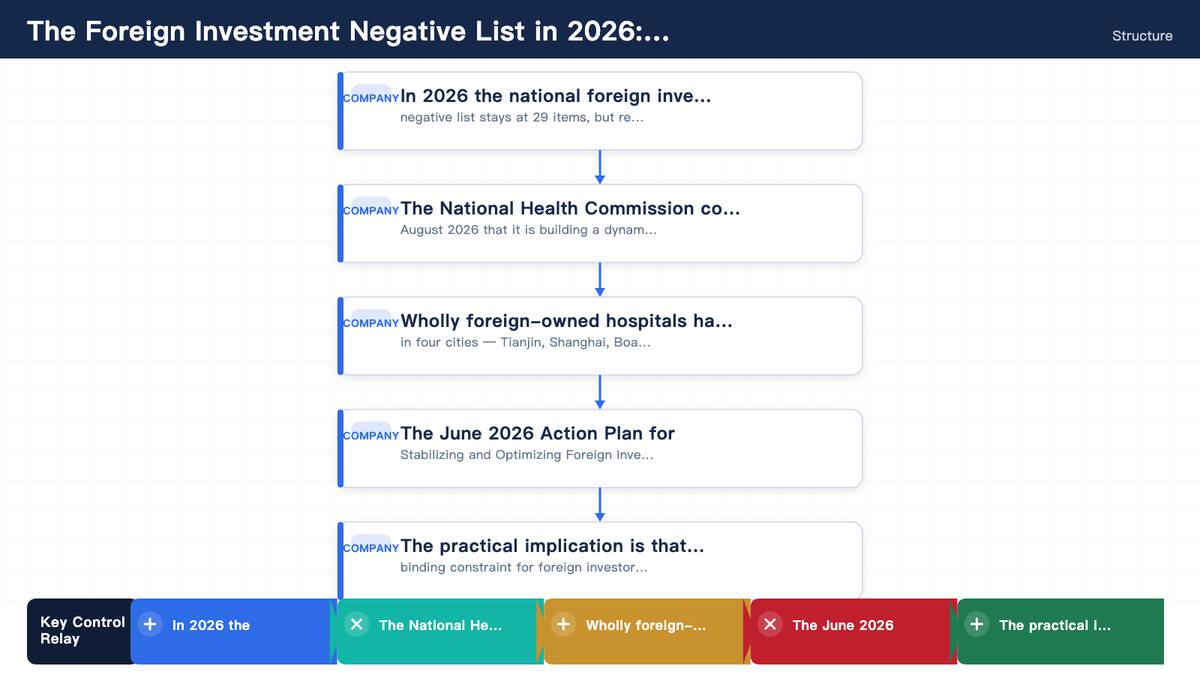
- In 2026 the national foreign investment negative list stays at 29 items, but regulators have committed to “timely reduction”, with services as the priority and telecom, internet, education, culture and healthcare named as the next opening fronts.
2026 年全国版外商投资准入负面清单保持 29 条,但主管部门明确承诺”适时缩减”,以服务业为重点,增值电信、互联网、教育、文化、医疗被列为下一步开放前沿。- The National Health Commission confirmed in August 2026 that it is building a dynamic adjustment mechanism for a foreign investment negative list specific to medical projects, alongside a second batch of wholly foreign-owned hospital pilot cities.
国家卫生健康委 2026 年 8 月确认,正在建立外商投资医疗项目负面清单动态调整机制,并同步遴选第二批外商独资医院试点城市。- Wholly foreign-owned hospitals have now landed in four cities — Tianjin, Shanghai, Boao and Fuzhou — under the 2024 pilot scheme, and pilot-zone policy now allows foreign-invested firms to develop human stem-cell and gene-diagnosis technologies for product registration.
2024 年试点方案落地后,外商独资医院已先后在天津、上海、博鳌、福州 4 地落地;自贸试验区与海南自由贸易港已允许外商投资企业从事人体干细胞、基因诊断与治疗技术开发应用,以用于产品注册上市和生产。- The June 2026 Action Plan for Stabilizing and Optimizing Foreign Investment adds education and finance opening and pilots the removal of equity caps for app stores and internet-access services in the telecom sector.
2026 年 6 月《利用外资固稳促优行动方案》新增教育与金融领域开放,并在电信领域试点取消应用商店、互联网接入等服务业务的外资股比限制。- The practical implication is that the binding constraint for foreign investors is shifting from “access” (准入) to “operation permission” (准营): the negative list is no longer the only gate, and sector-specific licensing, registration and standards now do most of the screening work.
对境外投资者的实际含义是约束重心正从”准入”转向”准营”:负面清单不再是唯一门槛,行业许可、产品注册与标准合规承担了大部分筛选工作。- Investors should track four watchpoints: a possible 2026/2027 national list revision, the second batch of hospital pilots, the first items migrated from the medical negative-list adjustment mechanism, and the actual telecom equity-cap pilots in designated zones.
投资者应跟踪四个看点:2026/2027 年全国清单可能的修订、第二批外商独资医院试点、医疗负面清单动态调整机制产出的首批条目,以及指定区域电信股比试点实际落地情况。
The Foreign Investment Negative List in 2026: “Timely Reduction” Commitments and the Shift to Post-Access Regulation | 2026 年外商投资准入负面清单:适时缩减承诺与”准入后监管”转向
The state of the list in 2026
The operative national foreign investment negative list remains the 2024 edition — NDRC and MOFCOM Order No. 23 — with 29 items, the shortest version in the instrument’s history. Manufacturing restrictions have been fully “zeroed out”, and the list now concentrates on services and a narrow set of security-sensitive sectors: news and publishing, culture, education, telecom, mining, agriculture breeding and a few others. Through 2026 no new national edition has been issued, and in August 2026 no formal revision has been gazetted. What has changed is the policy conversation around the list. At the June 2026 State Council Information Office press conference on foreign investment, the NDRC’s foreign investment department explicitly promised a “timely reduction” of the negative list and named telecom, internet, education, culture and healthcare as the sectors where orderly opening will be pursued. The 2026 Government Work Report and the 15th Five-Year Plan repeat the same commitment.
The medical negative list: a new mechanism in the making
The most concrete new development in August 2026 comes from the health sector. In a reply to a CPPCC proposal published in August 2026, the National Health Commission confirmed several steps: (1) steadily expanding the hospital pilot from “point trials” to regional rollout and accelerating the selection of a second batch of wholly foreign-owned hospital pilot cities; (2) including high-end specialist medical, rehabilitation and nursing in the national encouraged-catalogue scope; (3) building a dynamic adjustment mechanism for the foreign investment negative list specific to medical projects, and revising departmental rules that are inconsistent with the opening policy; and (4) in the Beijing, Shanghai and Guangdong FTZs and the Hainan FTP, permitting foreign-invested enterprises to conduct R&D and application of human stem-cell and gene-diagnosis and therapy technologies for the purpose of product registration and marketing, with approved products usable nationwide. The first four wholly foreign-owned hospitals — in Tianjin, Shanghai, Boao and Fuzhou — are already operating under the 2024 scheme. The phrase “dynamic adjustment mechanism” for a medical negative list signals that healthcare opening will be managed by a sector-specific, frequently updated instrument rather than by waiting for the next full national revision.
Beyond the list: the “access to operation permission” shift
The strategic shift that frames all of 2026’s policy documents is the move from “access” (准入) to “operation permission” (准营). MOFCOM officials have repeatedly described the current phase as solving the “big door open, small door closed” problem: the negative list no longer blocks most foreign entry, but operating licences, product registration, data compliance and standards certification now do the screening that the list used to do. For a foreign investor, this means the compliance map is broader than the list: an auto manufacturer must handle catalogue and emission rules; a pharma firm must navigate drug registration and clinical trials; a telecom operator must secure the sectoral licence; a hospital must pass setting approval, medical institution licensing and insurance network access. The negative list is the first checkbox, not the last.
Education and finance: the new opening fronts
The June 2026 Action Plan for Stabilizing and Optimizing Foreign Investment (MOFCOM, NDRC and MOF published as Shangzi Fa [2026] No. 97, approved by the State Council) goes beyond the medical sector. It commits to expanding opening in education and finance, supports qualified foreign-invested equity investment institutions to participate as strategic investors in securities issuance of listed companies in non-affiliated industries, and in the telecom field pilots the removal of foreign equity caps for app stores, internet access and similar service businesses. For the negative-list conversation, the significance is that the next revision is likely to delete or soften precisely these service items: value-added telecom caps, education cooperative restrictions and finance-related conditions are the most probable candidates for the next trimming round.
What has not changed: security carve-outs
It would be a mistake to read the 2026 signals as unconditional liberalisation. The negative list’s security carve-outs remain firmly in place: news and internet information services, online publishing and broadcast-television production stay prohibited; education institutions remain limited to Chinese-foreign cooperative forms with Chinese dominance; basic telecom remains Chinese-controlled; and the countermeasures framework in the revised Foreign Trade Law provides statutory authority to restrict trade with foreign persons or organisations that harm China’s sovereignty, security or development interests. Foreign investors in sensitive sectors should continue to plan on the basis of joint-venture or cooperative structures and should monitor the security review regime for mergers and acquisitions in critical areas.
Practical steps for investors in the 2026/2027 window
First, screen your business scope against the current 29-item national list and, if entering a pilot zone, the FTZ list. Second, for medical investments, watch the second batch of wholly foreign-owned hospital pilot cities and the medical negative-list dynamic adjustment mechanism; the first four pilots show that the practical route runs through setting approval and hospital licensing, not just the list. Third, for education and telecom, treat the June Action Plan as a strong directional signal and prepare structures that can convert to higher ownership if the caps are lifted. Fourth, keep the encouraged catalogue in view: high-end specialist medical, rehabilitation and nursing are now encouraged nationwide, with associated import-duty, land and tax benefits. Fifth, maintain documentation that demonstrates trade policy compliance — the “timely reduction” commitment cuts both ways, and regulators will scrutinise scope wording, sector licences and data flows more, not less.
Outlook
The negative list in 2026 is best understood as a stable floor with a sliding ceiling: no new national edition has been published, but every major policy document of the year commits to further service-sector trimming, and the health, education, telecom and finance fronts are each being prepared through pilots and mechanism-building. For foreign investors the strategy is to build around the current list, structure for upside optionality, and treat the post-access operating permit journey as the real competitive battlefield.
Sources
- 国家卫生健康委员会 — 对全国政协十四届四次会议第01461号提案的答复函(2026年8月,关于加大医疗健康产业开放、外商独资医院第二批试点、医疗领域负面清单动态调整机制、自贸试验区人体干细胞与基因诊断技术应用):https://www.nhc.gov.cn/wjw/tia/202608/4feffbd3b943432d83a8f344dcf05545.shtml
- 乌兰察布市商务局转载 — 商务部副部长凌激、国家发展改革委外资司负责人荆琴出席国新办发布会介绍利用外资固稳促优有关政策措施(2026-06-22,发改委承诺”适时缩减外资准入负面清单”):https://swj.wulanchabu.gov.cn/zxft/1994919.html
- 上海市人民政府外事办公室 —《上海资讯周报》涉外资讯一站式服务(2026年8月第2期,总第154期,解读外资政策从”准入”向”准营”转型,2026-08-12):https://wsb.sh.gov.cn/ztzl/shzxzb/20260811/bd3b73a6e882435e92bd4f7213129b46.html
- 中国政府网 —《政府工作报告》(2026年3月):https://www.gov.cn/zhuanti/2026qglh/
- 商务部 — 商务部等9部门关于进一步激发下沉市场活力 活跃县域消费的意见(2026-08-18,作为服务业开放政策的配套参考):https://www.mofcom.gov.cn/zcfb/index.html
2026 年外商投资准入负面清单:适时缩减承诺与”准入后监管”转向
2026 年清单现状
现行有效的全国版外商投资准入负面清单仍是 2024 年版(国家发展改革委、商务部第 23 号令),共 29 条,为制度设立以来最短版本。制造业限制已全面”清零”,清单现集中于服务业与少数安全敏感领域:新闻出版、文化、教育、电信、采矿、农业育种等。2026 年全年尚未发布新版全国清单,截至 2026 年 8 月亦无正式修订公告。变化发生在围绕清单的政策语境。2026 年 6 月国新办利用外资发布会,国家发展改革委外资司负责人明确承诺”适时缩减外资准入负面清单”,并点名电信、互联网、教育、文化、医疗为有序扩大开放的方向。2026 年《政府工作报告》与十五五规划《纲要》重申同一承诺。
医疗负面清单:一项新机制的形成
2026 年 8 月最具体的新进展来自医疗领域。国家卫生健康委 2026 年 8 月公开的政协提案答复函确认多项部署:(1)稳步推动医院试点从”点状试点”向”区域推广”拓展,加快遴选第二批外商独资医院试点城市;(2)将高端专业医疗、康复、护理纳入全国鼓励范围(落实《鼓励外商投资产业目录(2025年版)》);(3)建立外商投资医疗项目负面清单动态调整机制,并修订与开放政策不相适应的部门规章;(4)在北京、上海、广东自贸试验区和海南自由贸易港,允许外商投资企业从事人体干细胞、基因诊断与治疗技术开发应用,以用于产品注册上市和生产,经注册上市与批准生产的产品可在全国使用。2024 年试点方案下的首批 4 家外商独资医院——天津、上海、博鳌、福州——已先后落地。医疗领域负面清单”动态调整机制”的提法意味着医疗开放将交由一张行业专属、高频更新的清单管理,而不必等待下一轮全国清单全面修订。
清单之外:”准入”到”准营”的转向
贯穿 2026 年全部政策文件的战略转向,是从”准入”到”准营”。商务部官员多次将当前阶段描述为解决”大门开、小门不开”问题:负面清单不再阻挡多数外资进入,但经营许可、产品注册、数据合规与标准认证现在承担了清单原先的筛选职能。对外国投资者,合规地图比清单更宽:整车厂要应对目录与排放规则,药企要面对药品注册与临床试验,电信运营商要取得行业牌照,医院要通过设置审批、医疗机构执业登记与保险网络准入。负面清单是第一个勾选项,而不是最后一个。
教育与金融:新的开放前沿
2026 年 6 月《利用外资固稳促优行动方案》(商务部、国家发展改革委、财政部印发,商资发〔2026〕97 号,经国务院同意)超出医疗领域。它承诺扩大教育与金融开放,支持符合条件的外资股权投资机构以战略投资者身份参与非相关行业上市公司证券发行,并在电信领域试点取消应用商店、互联网接入等服务业务的外资股比限制。对负面清单讨论的意义在于:下一轮修订最可能删除或放松的正是这些服务条目——增值电信股比上限、教育中外合作限制与金融相关条件,是下一轮压缩的最大候选。
未变之处:安全保留
把 2026 年信号读作无条件开放将是误读。负面清单的安全保留依旧坚固:新闻与互联网信息服务、网络出版、广播电视节目制作保持禁止;教育机构仍限于中方主导的中外合作办学;基础电信仍须中方控股;修订后《对外贸易法》的反制框架为限制危害中国主权、安全与发展利益的境外个人、组织的贸易活动提供了法定依据。敏感行业的外国投资者应继续按合资或合作结构规划,并关注关键领域并购安全审查制度。
2026/2027 窗口期的投资者实操
其一,将经营范围对照现行 29 条全国清单,进入试点区域再对照自贸试验区版。其二,医疗投资关注第二批外商独资医院试点城市与医疗负面清单动态调整机制;首批 4 家试点表明实际路径走的是设置审批与医院执业登记,而非单纯清单。其三,教育与电信领域把 6 月《行动方案》作为强方向信号,若股比上限放开,准备可转换为更高持股的结构。其四,别忘鼓励目录:高端专业医疗、康复、护理现为全国鼓励类,附带进口设备关税、用地与税收优惠。其五,留存证明贸易政策合规的文件——”适时缩减”承诺是一把双刃剑,监管机构对经营范围表述、行业牌照与数据流的审查只多不少。
展望
2026 年的负面清单最适合理解为”稳定的地板 + 滑动天花板”:全年未发布新版全国清单,但年度每份重大政策文件都承诺进一步压减服务业条目,医疗、教育、电信与金融前沿各自以试点和机制建设推进。对外国投资者的策略是围绕现行清单搭建结构、为上行期权预留弹性,并把”准入后准营”许可旅程当作真正的竞争战场。
Sources
- 国家卫生健康委员会 — 对全国政协十四届四次会议第01461号提案的答复函(2026年8月):https://www.nhc.gov.cn/wjw/tia/202608/4feffbd3b943432d83a8f344dcf05545.shtml
- 乌兰察布市商务局转载 — 国新办发布会介绍利用外资固稳促优有关政策措施(2026-06-22):https://swj.wulanchabu.gov.cn/zxft/1994919.html
- 上海市人民政府外事办公室 —《上海资讯周报》涉外资讯一站式服务(2026年8月第2期,2026-08-12):https://wsb.sh.gov.cn/ztzl/shzxzb/20260811/bd3b73a6e882435e92bd4f7213129b46.html
- 中国政府网 —《政府工作报告》(2026年3月):https://www.gov.cn/zhuanti/2026qglh/
- 商务部 — 商务部政策发布(2026年8月):https://www.mofcom.gov.cn/zcfb/index.html