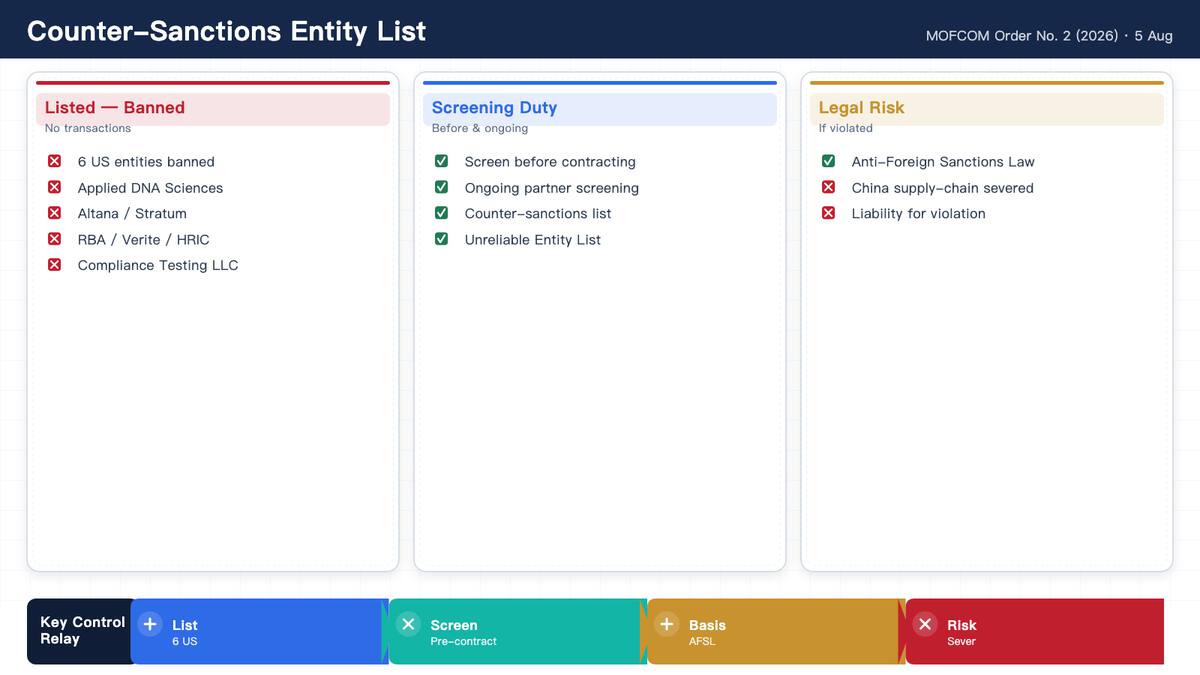
- On 5 August 2026 MOFCOM enacted Order No. 2 (2026), placing six US entities on a counter-sanctions list and banning domestic organisations and individuals from transactions or cooperation with them.
2026年8月5日,商务部令第2号将6家美国实体列入反制清单,禁止境内组织、个人与其交易或合作。- The listed entities include Applied DNA Sciences, Stratum Reservoir, Altana Technologies, the Responsible Business Alliance (RBA), Verite Group and Human Rights in China.
被列入的实体包括应用DNA科学公司、地层水库公司、阿尔塔纳技术公司、责任商业联盟(RBA)、维泰集团与人权在中国组织。- A separate action the same day also listed Compliance Testing LLC, and the US drone-related dual-use export control was tightened — broadening the sanctions perimeter.
同日另一行动还将美国合规性测试公司列入清单,并收紧对美无人机相关两用物项出口管制,拓宽制裁边界。- Foreign-invested firms must screen suppliers and partners against MOFCOM’s counter-sanctions and Unreliable Entity lists before contracting and on an ongoing basis.
外商投资企业必须在签约前及持续地对供应商与合作伙伴对照商务部的反制清单与不可靠实体清单进行筛查。- The legal basis is the Anti-Foreign Sanctions Law; violating a counter-sanctions listing can sever a company’s China supply chain and trigger liability.
法律依据为《反外国制裁法》;违反反制清单可能切断企业在华供应链并引发责任。- Practical step: build a sanctioned-entity screening clause into procurement and partner contracts, with audit rights and termination triggers.
实操建议:在采购与合作伙伴合同中嵌入受制裁实体筛查条款,含审计权与终止触发条件。
MOFCOM’s 2026 Counter-Sanctions List and Supplier Due Diligence for Foreign Firms | 商务部2026反制清单与外资企业供应商尽调
On 5 August 2026 the Ministry of Commerce (MOFCOM) enacted Order No. 2 (2026) — the *Decision on Countermeasures Against Six US Entities Including Applied DNA Sciences, Inc.* The order, approved by the National Counter-Foreign Sanctions Coordination Mechanism, places six US entities on a counter-sanctions list and prohibits organisations and individuals within China from engaging in related transactions or cooperation with them. For any foreign-invested company with a China supply chain, this is a due-diligence event, not just a geopolitical headline.
What Order No. 2 does
The order responds to US sanctions against Chinese entities. Citing the *Anti-Foreign Sanctions Law* and its implementation provisions, MOFCOM decided to list the following six US entities and ban transactions/cooperation with them within China:
- Applied DNA Sciences, Inc.
- Stratum Reservoir, LLC
- Altana Technologies, Inc.
- Responsible Business Alliance (RBA)
- Verite Group, Inc.
- Human Rights in China (HRIC)
The prohibition is broad: “related transactions or cooperation” covers procurement, sales, licensing, auditing, certification and other commercial engagement. The effect is to cut the listed entities off from economic activity with China-based parties.
The widening sanctions perimeter
The same 5 August wave was not limited to the six. Reporting indicated a parallel listing of Compliance Testing LLC, and a tightening of US drone-related dual-use export controls. Together these show a broadening perimeter: certification bodies, audit/assurance groups, testing labs and supply-chain organisations can be drawn in, not only manufacturers. For foreign firms, the practical risk is that a trusted auditor, certifier or standards body in your supply chain quietly becomes a listed entity.
Why supplier due diligence must adapt
Traditional supplier due diligence focuses on financial health, quality and ESG. China’s counter-sanctions regime adds a sanctions-screening layer that foreign-invested firms cannot ignore:
- Direct exposure. Buying from, selling to, or partnering with a listed entity is prohibited.
- Indirect exposure. Using a listed entity as an auditor, certifier (e.g., RBA-style labour audits), testing lab or standards body can constitute “cooperation.”
- Continuity risk. A previously-clean supplier or partner can be listed overnight, severing a production line or certification path.
MOFCOM also operates the Unreliable Entity List (UEL), a separate but related mechanism targeting foreign entities that harm Chinese sovereignty, security or development interests. Prudent supply-chain teams should screen against both the counter-sanctions list and the UEL.
Practical steps
- Screen at onboarding. Run every new supplier, distributor, auditor, certifier and lab against the current counter-sanctions and UEL lists before contracting.
- Screen continuously. Lists change fast; re-screen the active base on a set cadence and upon any geopolitical trigger.
- Contractualise it. Insert a sanctions-screening representation, audit right and termination-for-listing clause in procurement and partner agreements.
- Map dependencies. Identify where a single auditor/certifier (e.g., a labour-audit body) is mission-critical and build a fallback.
- Train procurement. Ensure buyers understand that “cooperation” includes certification and audit services, not just goods.
- Keep evidence. Document screenings and decisions to show compliance if challenged.
商务部2026反制清单与外资企业供应商尽调
2026年8月5日,商务部发布第2号令——《关于对应用DNA科学公司等6家美国实体采取反制措施的决定》。该令经国务院国家反外国制裁工作协调机制批准,将6家美国实体列入反制清单,并禁止境内组织、个人与其进行有关交易、合作。对任何拥有中国供应链的外商投资企业而言,这是一起尽调事件,而非仅是地缘政治新闻。
第2号令的内容
该令回应美国对中国实体的制裁。依据《反外国制裁法》及其实施规定,商务部决定将以下6家美国实体列入清单,并禁止境内与其交易、合作:
- 应用DNA科学公司(Applied DNA Sciences, Inc.)
- 地层水库公司(Stratum Reservoir, LLC)
- 阿尔塔纳技术公司(Altana Technologies, Inc.)
- 责任商业联盟(Responsible Business Alliance, RBA)
- 维泰集团(Verite Group, Inc.)
- 人权在中国组织(Human Rights in China, HRIC)
禁令范围很广:”有关交易、合作”涵盖采购、销售、许可、审计、认证及其他商业往来。效果是切断被列实体与在华主体的经济活动。
拓宽的制裁边界
8月5日这一波并非仅限6家。报道显示同时列入了美国合规性测试公司(Compliance Testing LLC),并收紧对美无人机相关两用物项出口管制。共同显示边界正在拓宽:认证机构、审计/保证团体、检测实验室与供应链组织都可能被纳入,不仅是制造商。对外资企业,实际风险在于供应链中可信的审计方、认证方或标准机构悄然成为被列实体。
供应商尽调须随之调整
传统供应商尽调聚焦财务健康、质量与ESG。中国的反制制裁制度新增了一层制裁筛查,外商投资企业不可忽视:
- 直接敞口。 向被列实体采购、销售或与之合作均被禁止。
- 间接敞口。 使用被列实体作为审计方、认证方(如RBA式劳工审计)、检测实验室或标准机构,可能构成”合作”。
- 连续性风险。 原本清白的供应商或合作伙伴可能一夜之间被列,切断产线或认证路径。
商务部还运行不可靠实体清单(UEL)——一项针对损害中国主权、安全、发展利益的外国实体的独立但相关机制。审慎的供应链团队应同时对照反制清单与不可靠实体清单筛查。
实操步骤
- 准入即筛查。 签约前对每家新供应商、经销商、审计方、认证方与实验室对照现行反制清单与不可靠实体清单筛查。
- 持续筛查。 清单变化快;按固定节奏并在任何地缘触发时重新筛查活跃库。
- 合同化。 在采购与合作伙伴协议中嵌入制裁筛查陈述、审计权与”被列入即终止”条款。
- 梳理依赖。 识别单一审计/认证方(如劳工审计机构)为关键路径的环节,建立备用。
- 培训采购。 确保采购理解”合作”包括认证与审计服务,不止货物。
- 留存证据。 记录筛查与决策,以应对可能的合规质疑。
Practitioner Quick Reference
- MOFCOM Order No. 2 (2026), 5 August: six US entities listed; domestic transactions/cooperation banned.
商务部2026年第2号令(8月5日):6家美实体被列入;禁止境内交易合作。 - Six named: Applied DNA Sciences, Stratum Reservoir, Altana, RBA, Verite, HRIC.
六家名单:应用DNA科学、地层水库、阿尔塔纳、RBA、维泰、人权在中国。 - Perimeter widening: Compliance Testing LLC + drone dual-use controls added the same day.
边界拓宽:同日新增合规性测试公司与无人机两用物项管制。 - Screen two lists: counter-sanctions list AND the Unreliable Entity List.
筛查两份清单:反制清单与不可靠实体清单。
Common Pitfalls
- Thinking “goods only”: certification and audit services count as “cooperation” with a listed entity.
以为”仅货物”:认证与审计服务也算与被列实体的”合作”。 - One-time screening: lists move fast; a clean supplier today can be listed tomorrow.
一次性筛查:清单变动快;今日清白的供应商明日可能被列。 - Ignoring the UEL: the Unreliable Entity List is a separate, related risk many teams miss.
忽视不可靠实体清单:这是独立的关联风险,许多团队遗漏。
Sources