
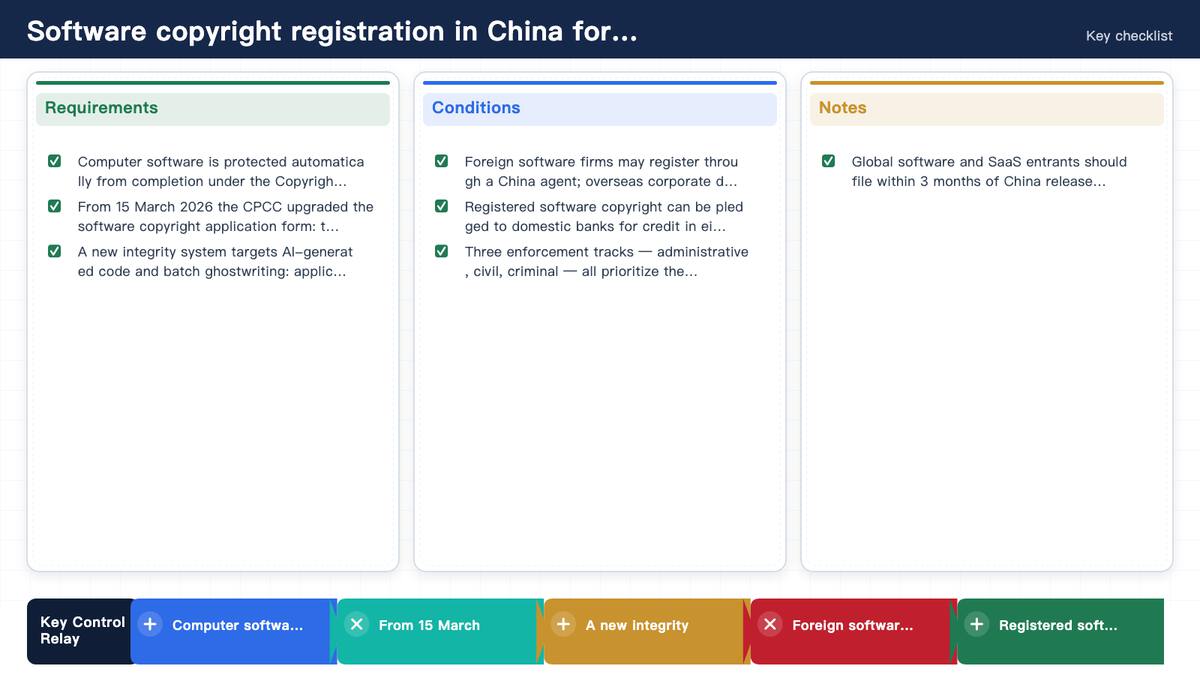
- Computer software is protected automatically from completion under the Copyright Law, but registration with the China Copyright Protection Center (CPCC) is the evidentiary cornerstone for enforcement and pledge financing.
计算机软件自开发完成依《著作权法》自动受保护,但向中国版权保护中心(CPCC)登记是维权与质押融资的证据基石。- From 15 March 2026 the CPCC upgraded the software copyright application form: the function description must be 500–1,300 characters, and the signature page adds a handwritten integrity statement plus ID number.
自2026年3月15日起,版权中心升级软著申请表:软件主要功能须500–1300字,签章页新增手抄诚信声明与身份证号。- A new integrity system targets AI-generated code and batch ghostwriting: applicants must certify no AI was used to write code or documents, with a bad-faith list and credit-record penalties.
新建诚信制度治理AI生成代码与批量代写:申请人须承诺未用AI编写代码或文档,违者列入失信名单并记入征信。- Foreign software firms may register through a China agent; overseas corporate documents need notarization, consular authentication and a certified Chinese translation.
外国软件企业可委托中国代理登记;境外主体资格文件须公证、领事认证并附认证中文译本。- Registered software copyright can be pledged to domestic banks for credit in eight pilot provinces — turning intangible IP into working capital.
已登记软件著作权可在八省试点向国内银行质押信贷,将无形IP转化为营运资金。- Three enforcement tracks — administrative, civil, criminal — all prioritize the CPCC registration certificate as ownership proof.
行政、民事、刑事三轨救济均优先采信CPCC登记证书作为权属证明。- Global software and SaaS entrants should file within 3 months of China release and preserve source excerpts and Chinese operation manuals.
全球软件与SaaS入华者应在国内发布后3个月内登记,并备妥源码节选与中文操作手册。
Software copyright registration in China for foreign firms (2026): the CPCC playbook | 外国企业的软件著作权登记(2026):中国版权保护中心实操手册
Overview: copyright, not patent, for code
For foreign software, SaaS and game developers entering China, the default protection for source and object code is copyright, not patent. Under the Copyright Law (2020 amendment), computer software is an enumerated work type, and protection arises automatically upon completion — no registration required to exist. Yet in practice, registration with the China Copyright Protection Center (CPCC, 中国版权保护中心) is decisive: it is the preliminary proof of ownership accepted across administrative, civil and criminal enforcement.
The legal basis
The Copyright Law of the PRC lists computer software as a protected work and grants authors publication, authorship, modification, reproduction, distribution, rental, information-network dissemination, translation and other rights, with punitive damages for infringement. The Regulations on the Protection of Computer Software (State Council Decree No. 339) provide the dedicated regime: software copyright arises on completion; registration is voluntary but the certificate is prima facie evidence of the registered matters. The CPCC is the national registration and copyright-pledge authority.
The 15 March 2026 upgrade
On 15 March 2026 the CPCC announced an optimized software copyright application form, effective immediately, with the old form retired the same day. Two changes matter for applicants:
- Function description lengthened from “under 200 characters” to a required 500–1,300 characters, demanding a complete, detailed account of R&D background, core architecture, function modules, technical implementation and application scenarios — curbing templated, thin filings.
- Signature page integrity additions: a handwritten statement that the applicant did not use AI to develop/write code, draft documents or generate application materials, plus the agent’s signature and ID number, pressing applicant accountability and targeting the “AI-code + batch-filing” gray market.
The new integrity system and AI scrutiny
Alongside the form, the CPCC established a software copyright application integrity system with a bad-faith penalty mechanism. False materials, abnormal filings and malicious repeated applications are sanctioned under a “trust rewarded, bad faith restricted” framework. Agencies face tighter supervision; template filings, batch ghostwriting and false certifications are cleaned up. Applicants and agencies that submit AI-generated code or documents face dual penalties, and serious offenders enter a copyright bad-faith list and a personal credit record.
Foreign-firm filing route
A foreign enterprise with no establishment in China files through a duly established China copyright agent. Required materials typically include the application form, identification of the software (source-code excerpts and documentation), and proof of ownership/assignment. Overseas corporate documents, developer assignment agreements and authorization papers must be notarized, consular-authenticated, and accompanied by a certified Simplified-Chinese translation — archive the authenticated hard copies for litigation. Keep daily development logs, developer contracts and version records to supplement ownership if the certificate is challenged.
Enforcement: three tracks, one proof
China offers a three-tiered, dual-track enforcement system for software piracy:
- Administrative: local NCAC (国家版权局) branches conduct inspections, confiscate cracked copies and tools, and fine from CNY 100 per pirated copy up to CNY 200,000 for circumvention — fast (1–2 months) with lower evidence thresholds.
- Civil: right holders may seek pre-litigation injunctions and claim actual losses or statutory damages up to CNY 5 million per infringement, plus attorney and notarization costs.
- Criminal: large-scale commercial piracy triggering copyright-infringement crimes draws fines and imprisonment for operators of cracking platforms and bulk distributors.
All three prioritize the CPCC registration certificate as core ownership proof; unregistered software struggles to enforce.
Pledge financing: IP into capital
A unique advantage of registration: under the Measures for Copyright Pledge Registration, registered software property rights can be pledged to domestic banks for credit via CPCC pledge filing. Foreign software enterprises with completed China registration may join national copyright-finance pilots across eight major provinces, converting intangible software IP into operating capital without fixed-asset collateral. Unregistered software cannot undergo valid pledge registration.
Practical steps for global software entrants
- File CPCC registration within 3 months of official China release.
- Prepare source excerpts and a Chinese operation manual meeting identification standards.
- Authenticate and translate all overseas corporate and assignment documents before filing.
- Separate ideas from code in R&D records; retain logs and contracts.
- File administrative complaints promptly when cracked copies appear, submitting the certificate for fast takedowns.
- Use pledge registration post-certificate to access IP-backed loans in pilot regions.
Related reading
Foreign companies’ general copyright registration, national treatment and the Apostille shortcut are covered in a separate article; this piece is the software-copyright briefing plus the action list.
外国企业的软件著作权登记(2026):中国版权保护中心实操手册
概览:代码靠著作权,而非专利
对外国软件、SaaS与游戏开发者入华而言,源代码与目标代码的默认保护是著作权而非专利。依2020年修正的《著作权法》,计算机软件列为受保护作品类型,保护自开发完成自动产生——无需登记即存在。但实践中,向中国版权保护中心(CPCC)登记具有决定性:它是行政、民事、刑事三轨救济均采信的权属初步证明。
法律依据
《中华人民共和国著作权法》将计算机软件列为受保护作品,赋予发表、署名、修改、复制、发行、出租、信息网络传播、翻译等权利,侵权引入惩罚性赔偿。《计算机软件保护条例》(国务院令第339号)提供专门制度:软件著作权自完成产生;登记自愿,但登记证书是登记事项的初步证明。版权中心为国家级登记与著作权质权登记机构。
2026年3月15日的升级
2026年3月15日,版权中心宣布优化后的软著申请表即时施行,旧表同日停用。两项变化关乎申请人:
- 功能描述由”200字以内”提至须500–1300字,要求完整详实说明研发背景、核心架构、功能模块、技术实现与应用场景——遏制模板化、简略填报。
- 签章页诚信增补:新增手抄声明,承诺申请人未使用AI开发编写代码、撰写文档或生成申请材料,并附经办人签名与身份证号,压实主体责任,直指”AI代码+批量申请”灰色产业链。
新建诚信制度与AI审查
随表单升级,版权中心建立软件著作权登记申请诚信制度并引入失信惩戒机制。对虚假材料、非正常申请、恶意重复申报在”守信便利、失信受限”框架下制裁。代理机构受更严监管;模板申报、批量代写、虚假承诺被清理。提交AI生成代码或文档的申请人及代理机构面临双处罚,严重者列入版权登记失信名单并记入个人征信。
外国企业登记路径
在中国无机构的外国企业须委托依法设立的中国版权代理机构办理。材料通常包括申请表、软件鉴别材料(源码节选与文档)及权属/转让证明。境外主体资格文件、开发者转让与授权协议须公证、领事认证并附认证中文译本——将认证纸质件归档备诉。保留每日开发日志、开发者合同与版本记录,以备证书受挑战时补强权属。
救济:三轨一证
中国对软件盗版提供三级双轨救济:
- 行政:地方版权局(国家版权局系统)实地检查、没收破解副本与工具,对规避技术措施处以每件100元至20万元罚款——1–2个月快速、证据门槛较低。
- 民事:权利人可申请诉前禁令,主张实际损失或法定赔偿每案最高500万元,外加律师费与公证费。
- 刑事:大规模商用盗版构成侵犯著作权罪的,对破解平台运营者与批量分销者判处罚金与有期徒刑。
三轨均优先采信CPCC登记证书作为核心权属证明;未登记软件难以维权。
质押融资:IP变资本
登记独有优势:依《著作权质权登记办法》,已登记软件财产权可经版权中心质押备案向国内银行信贷。完成中国登记的外国软件企业可参与八省国家版权金融试点,将无形软件IP转化为无需固定资产抵押的营运资金。未登记软件无法进行有效质押登记。
全球软件入华者的实操步骤
- 国内发布后3个月内完成CPCC登记。
- 备妥源码节选与中文操作手册,满足鉴别材料标准。
- 登记前公证、认证并翻译所有境外主体与转让文件。
- 研发记录中分离思想与代码,留存日志与合同。
- 破解副本出现即行政投诉,提交证书以快速下架。
- 获证后利用质押登记,在试点地区获取IP质押贷款。
延伸阅读
外国企业在华著作权登记、国民待遇与海牙认证捷径本站另有专文;本文为软件著作权简报加行动清单。
Sources