
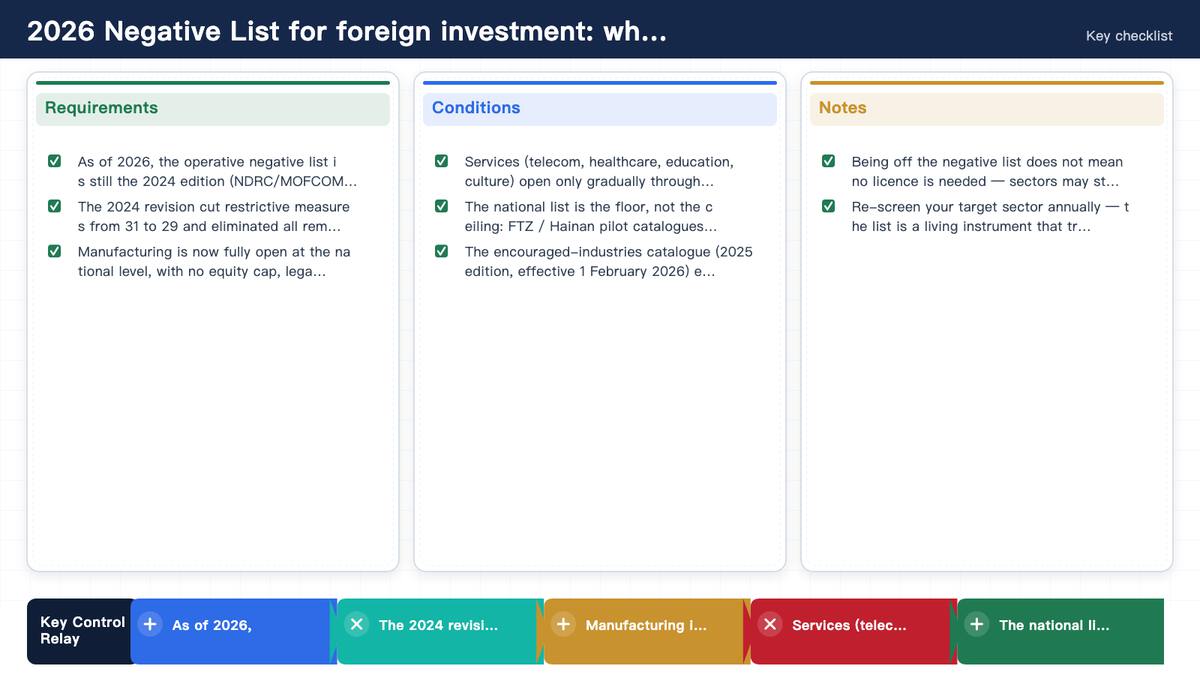
- As of 2026, the operative negative list is still the 2024 edition (NDRC/MOFCOM Order No. 23, effective 1 November 2024), not a newer “2026 list” — screen your sector against it.
截至 2026 年,现行有效的负面清单仍是 2024 年版(发改委、商务部第 23 号令,2024 年 11 月 1 日施行),而非更新的”2026 版清单”——请据此筛查目标行业。- The 2024 revision cut restrictive measures from 31 to 29 and eliminated all remaining manufacturing-sector foreign-access restrictions (“清零”).
2024 年修订将限制措施由 31 条压减至 29 条,并取消制造业领域全部剩余外资准入限制(”清零”)。- Manufacturing is now fully open at the national level, with no equity cap, legal-form requirement, or management-nationality rule.
制造业在全国层面现已完全放开,无股比上限、组织形式要求或管理人员国籍要求。- Services (telecom, healthcare, education, culture) open only gradually through FTZ / Hainan pilots, not the national list — check the pilot catalogue city by city.
服务业(电信、医疗、教育、文化)仅通过自贸区/海南试点渐进开放,而非全国清单——须按城市核对试点目录。- The national list is the floor, not the ceiling: FTZ / Hainan pilot catalogues can apply a more liberal rule inside the zone.
全国清单是开放的下限而非上限——自贸区/海南试点目录可在区内适用更宽松规则。- The encouraged-industries catalogue (2025 edition, effective 1 February 2026) expanded to 1,679 entries and offers preferences such as tilted corporate-income-tax for qualifying projects.
鼓励外商投资产业目录(2025 年版,2026 年 2 月 1 日施行)扩至 1,679 条,并为符合条件的项目提供如企业所得税倾斜等优惠。- Being off the negative list does not mean no licence is needed — sectors may still require an ordinary industry licence.
不在负面清单上不等于无需许可——相关行业仍可能需要普通行业许可。- Re-screen your target sector annually — the list is a living instrument that trends toward further narrowing.
每年重新筛查目标行业——清单是动态工具,趋势为持续收窄。
2026 Negative List for foreign investment: what changed | 2026 年外资准入负面清单:主要变化解读
Overview
The negative list for foreign investment (外商投资准入负面清单) is the single instrument that defines which sectors are restricted or prohibited for foreign capital. Anything outside the list is, in principle, open to foreign investment on the same terms as domestic capital — the “non-prohibited, free to enter” (非禁即入) principle enacted by the Foreign Investment Law. As of 2026, the operative list is the 2024 edition, published on 8 September 2024 by the National Development and Reform Commission (NDRC) and the Ministry of Commerce (MOFCOM) as Order No. 23 and in force since 1 November 2024. This article reviews what that revision changed, why it matters for an inbound investor, and where further liberalisation is headed.
The 2024 revision cut the number of restrictive measures from 31 to 29 and — most significantly — eliminated all remaining manufacturing-sector access restrictions (“清零”). This fulfilled the commitment announced at the third Belt and Road Forum in 2023 to fully remove manufacturing foreign-access limits, and it is the headline change an investor should understand before scoping entry. Beyond the headline, the revision is best read as one step in a decade-long, deliberate narrowing of the list, set against a parallel Market Access Negative List that applies equally to domestic and foreign investors.
Legal basis and how the list works
The negative list is authorised by the Foreign Investment Law, which provides that the list is “published or approved for publication by the State Council” and that foreign investment outside the list receives national treatment. The list itself is a unified catalogue of special access measures — equity caps, requirements on legal form, and management-personnel rules — that apply only to foreign-invested enterprises (FIEs). For fields outside the list, domestic and foreign capital are treated alike (内外资一致).
The list does not operate in isolation. Two other instruments frame access. First, the Market Access Negative List (市场准入负面清单) applies to all investors, domestic and foreign, and covers items where any market player needs a licence or approval; the foreign-investment list layers on the extra conditions that only foreign capital faces. Second, where a free-trade zone (FTZ) or the Hainan Free Trade Port pilots a more liberal rule, that rule applies within the zone. A practical consequence: the national list is the floor, not the ceiling, of openness for foreign capital.
Crucially, the list is not the whole of market access. Sectors not on the list may still require an ordinary business licence or an industry licence (a general permit, not a foreign-access restriction). The practical question for an investor is therefore rarely “is it allowed?” but “what licence applies, and is there a foreign-equity condition?”.
Manufacturing clearance
The defining feature of the 2024 revision is the removal of the last two manufacturing restrictions. The 2021 edition still limited “publication printing must be Chinese-controlled” and prohibited “the application of steaming, frying, roasting and calcining techniques for Chinese medicinal decoction pieces, and the production of products from confidential Chinese medicine prescriptions”. Both were deleted. Manufacturing is now the only broad sector in which foreign access is, at the national level, essentially unrestricted by equity or legal-form conditions.
This follows a steady multi-year liberalisation. The nationwide and FTZ foreign-investment negative lists were cut from 93 and 122 items (2017) to 31 and 27 items (2021), and the FTZ manufacturing list had already reached “zero” in 2021. For an investor, the message is unambiguous: greenfield or acquisition in manufacturing — advanced manufacturing, high-tech, new-energy vehicles, equipment, chemicals — faces the same corporate and product-quality rules as a domestic firm, with no prior approval for foreign access as such. The only residual condition is that any new manufacturing entity still complies with product-safety, environmental and other general regulation, exactly as a domestic peer would.
Services: where opening is advancing
The 2024 revision is primarily a manufacturing story; services opening is, by design, proceeding more gradually and largely through pilot channels rather than the national list. The NDRC has signalled that work will continue on telecom, internet, education, culture and healthcare, in line with the directives of the third plenum of the 20th Party Congress. Concrete moves already under way include pilot opening of value-added telecom services in designated areas and trial foreign-invested hospitals in selected cities.
Investors should treat services as a “watch the pilot catalogue” sector. A foreign hospital, for example, may be permitted in a pilot city under a filing path while remaining constrained elsewhere; education (pre-school, regular high school and higher-education institutions) remains limited to Chinese-led Sino-foreign cooperative schools; and a long list of cultural and internet-content services stays off-limits nationally. Because pilots are announced city-by-city and zone-by-zone, the national list and the relevant local pilot catalogue must be read together, and the more liberal local rule governs inside that zone.
Regional overlap and pilot openness
Free-trade zones and the Hainan Free Trade Port may pilot openings beyond the national list. Where they do, the more liberal rule governs inside the zone. This creates a two-layer map: the national 2024 list (29 items) sets the floor, and FTZ / Hainan pilot catalogues can lift specific restrictions further. An investor comparing Shanghai, Hainan, Guangdong’s cooperation zones and other pilot platforms should expect meaningful differences in, for example, telecom, medical, education and certain financial services — differences that can be decisive for a services business model.
The encouraged-industries catalogue (《鼓励外商投资产业目录》) is the complement to the negative list: it steers foreign capital toward sectors — advanced manufacturing, modern services, green tech, central and western regions — that enjoy preferential treatment such as tilted corporate-income-tax rates in qualifying circumstances. The 2025 edition (effective 1 February 2026) expanded the catalogue to 1,679 entries. Reading the negative list and the encouraged catalogue together gives the full picture: the list says what is closed or conditioned, the catalogue says where preferences apply.
Common misreads
Three misreads recur in practice. First, investors sometimes assume that because a sector is off the negative list, no licence is needed at all — but an ordinary industry licence may still apply, and the absence of a foreign-access restriction is not the absence of regulation. A factory still needs environmental and product-safety compliance exactly like a domestic peer. Second, some planners assume a newer “2026 list” has already superseded the 2024 edition; as of 2026 the 2024 list remains operative, and the correct move is to screen against it rather than await a revision that may or may not come. Third, teams compare only the national list and miss the FTZ / Hainan pilot catalogues, where a more liberal rule can be decisive for a services business model. Reading all three layers — national list, pilot catalogue, encouraged catalogue — avoids all three errors and prevents a structure from being designed around a restriction that has in fact been lifted locally.
What to do next
- Confirm your target sector against the 2024 negative list (29 items) and separately against the FTZ / Hainan pilot catalogue — the more liberal rule applies within the zone.
- For manufacturing, assume no foreign-access equity condition at the national level; plan around ordinary licences and product standards, not foreign-investment approval.
- For services (telecom, healthcare, education, culture), check the current pilot open list city-by-city before committing a structure, and expect the map to keep moving.
- Map the permitting pathway early — for restricted items, lead time on licences, not permission itself, is usually the binding constraint.
- Review the encouraged-industries catalogue (2025 edition, effective 2026-02-01) to see whether your project qualifies for preference.
- Re-screen your sector annually; the list is a living instrument that has trend-shrunk, and further narrowing is the stated policy direction.
Sources
- 2024 Negative List published; manufacturing restrictions “zeroed” (State Council / gov.cn)
- NDRC spokesperson Q&A on the 2024 Negative List (NDRC)
- MOFCOM interpretation of the 2024 Negative List (MOFCOM, Order No. 23)
- Full text: Special Measures for Foreign Investment Access (Negative List) (2024 Edition) (State Council / gov.cn)
Related reading
- see also: Industry restrictions by sector: a quick map
- see also: FIE admission rules: approval vs. filing
- see also: Negative list revision enters effect
2026 年外资准入负面清单:主要变化解读
概述
外资准入负面清单是界定外资限制或禁止行业的核心工具。清单之外,原则上外资与内资同等待遇——即《外商投资法》确立的”非禁即入”原则。截至 2026 年,现行有效清单为 2024 年版:由国家发展改革委、商务部于 2024 年 9 月 8 日以第 23 号令发布,自 2024 年 11 月 1 日起施行。本文梳理该版修订的主要变化、对拟进入投资者的实务意义,以及下一步开放方向。
2024 年版将限制措施由 31 条压减至 29 条,最具标志性的变化是制造业领域外资准入限制措施实现”清零”,落实了 2023 年第三届”一带一路”国际合作高峰论坛关于全面取消制造业领域外资准入限制措施的承诺,也是投资者在进入前必须理解的首要变化。除头条外,本版修订最好理解为十年间有意为之的清单收窄的一步,其背景是与对内资外资统一适用的《市场准入负面清单》并行。
法律依据与清单运作
负面清单由《外商投资法》授权,该法规定清单”由国务院发布或者批准发布”,清单之外外资享受国民待遇。清单本身是统一列明仅适用于外商投资企业的特别管理措施——包括股比上限、组织形式要求、管理人员国籍要求等。清单之外,内外资一致管理。
清单并非孤立运作。另有两项工具框定准入。其一,《市场准入负面清单》对所有投资者(内外资)适用,列明任何市场主体均需许可或审批的事项;外资负面清单叠加仅对外资施加的额外条件。其二,自由贸易试验区、海南自贸港试点更开放规则的,在区内适用更优待遇。实务后果:全国清单是外资开放的下限,而非上限。
需要强调的是,清单并非市场进入的全部。未列入清单的行业仍可能需要普通营业执照或行业许可(属一般许可,而非外资准入限制)。对投资者而言,真正的问题通常不是”是否允许”,而是”需要什么许可,是否存在外资股比条件”。
制造业清零
2024 年版最显著的特征是删除了最后两项制造业限制:2021 年版中”出版物印刷须由中方控股”,以及”禁止投资中药饮片的蒸、炒、炙、煅等炮制技术的应用及中成药保密处方产品的生产”。两项均被删除。制造业由此成为全国层面唯一基本不再以外资股比或组织形式设限的大类行业。
这是多年持续开放的结果:全国与自贸试验区外资准入负面清单已由 2017 年的 93 条、122 条分别压减至 2021 年的 31 条、27 条,且自贸试验区制造业清单已于 2021 年率先”清零”。对投资者而言含义明确——在制造业(先进制造业、高新技术、新能源汽车、装备制造、化工)设立企业或并购,适用与内资相同的公司与产品质量规则,不再就外资准入本身事前审批。唯一残余条件是任何新设制造实体仍须遵守产品安全、环保等一般监管,正如内资同行一样。
服务业:开放在持续推进
2024 年版主要是制造业的故事;服务业开放按设计更为渐进,主要通过试点渠道而非全国清单推进。国家发改委已明确,将依二十届三中全会部署,在电信、互联网、教育、文化、医疗等领域继续扩大开放。已有动作包括在特定区域启动增值电信业务开放试点,以及部分城市开展外资医院试点。
投资者应将服务业视为”紧盯试点目录”的行业。例如,外资医院可能在试点城市走备案路径,但在其他地方仍受约束;教育(学前、普通高中和高等教育机构)仍限于中方主导的中外合作办学;文化及互联网内容服务多项在全国层面仍禁止。由于试点按城市、按区域陆续公布,全国清单与对应地方试点目录须一并阅读,且区内适用更宽松的本地规则。
区域叠加与试点开放
自由贸易试验区与海南自贸港可试点清单之外开放。试点之处,以更宽松规则为准,但仅在区内适用。这形成两层地图:全国 2024 年版(29 条)设定底线,自贸区/海南试点目录可进一步放宽特定限制。比较上海、海南、广东合作区及其他试点平台时,在电信、医疗、教育及部分金融服务上应预期存在实质差异——这些差异对服务业商业模式可能具决定性。
鼓励外商投资产业目录是与负面清单互补的政策:引导外资投向先进制造业、现代服务业、绿色技术、中西部地区等可享受优惠(符合条件时适用倾斜的企业所得税等)的领域。2025 年版(2026 年 2 月 1 日施行)已将目录扩至 1,679 条。将负面清单与鼓励目录并读可得全貌:清单说明何处关闭或附条件,目录说明何处适用优惠。
常见误读
实务中三种误读反复出现。其一,投资者有时以为行业不在负面清单即无需任何许可——但一般行业许可仍可能适用,外资准入限制的缺失不等于无监管。一家工厂仍须像内资同行一样满足环保与产品安全要求。其二,部分规划者以为更新的”2026 版清单”已取代 2024 年版;截至 2026 年 2024 年版仍现行有效,正确动作是据此筛查而非等待未必到来的修订。其三,团队仅比全国清单,漏掉自贸区/海南试点目录——更宽松规则对服务业商业模式可能具决定性。读全三层(全国清单、试点目录、鼓励目录)可避免三类错误,并防止围绕实际已在地方放开的限制去设计结构。
下一步建议
- 对照 2024 年版负面清单(29 条)确认目标行业,并另行对照自贸区/海南试点目录——区内适用更宽松规则。
- 制造业:默认全国层面无外资股比条件;按普通许可与产品标准规划,而非外资准入审批。
- 服务业(电信、医疗、教育、文化):在确定架构前,按城市逐一核对现行试点开放清单,并预期地图持续变动。
- 尽早厘清许可路径——受限项的约束通常是许可耗时,而非许可本身。
- 查阅鼓励外商投资产业目录(2025 年版,2026-02-01 施行),判断项目是否适用优惠。
- 每年重新筛查行业;清单是动态工具且趋势收窄,进一步收窄为既定政策方向。
来源
- 2024 年版全国外资准入负面清单发布,制造业限制”清零”(国务院 / 中国政府网)
- 国家发展改革委有关负责同志就 2024 年版负面清单答记者问(国家发展改革委)
- 商务部有关负责人解读 2024 年版负面清单(商务部,第 23 号令)
- 《外商投资准入特别管理措施(负面清单)(2024 年版)》全文(国务院 / 中国政府网)
相关阅读
- 参见:分行业外资限制速览地图
- 参见:外资企业准入:审批与备案
- 参见:负面清单修订正式生效