
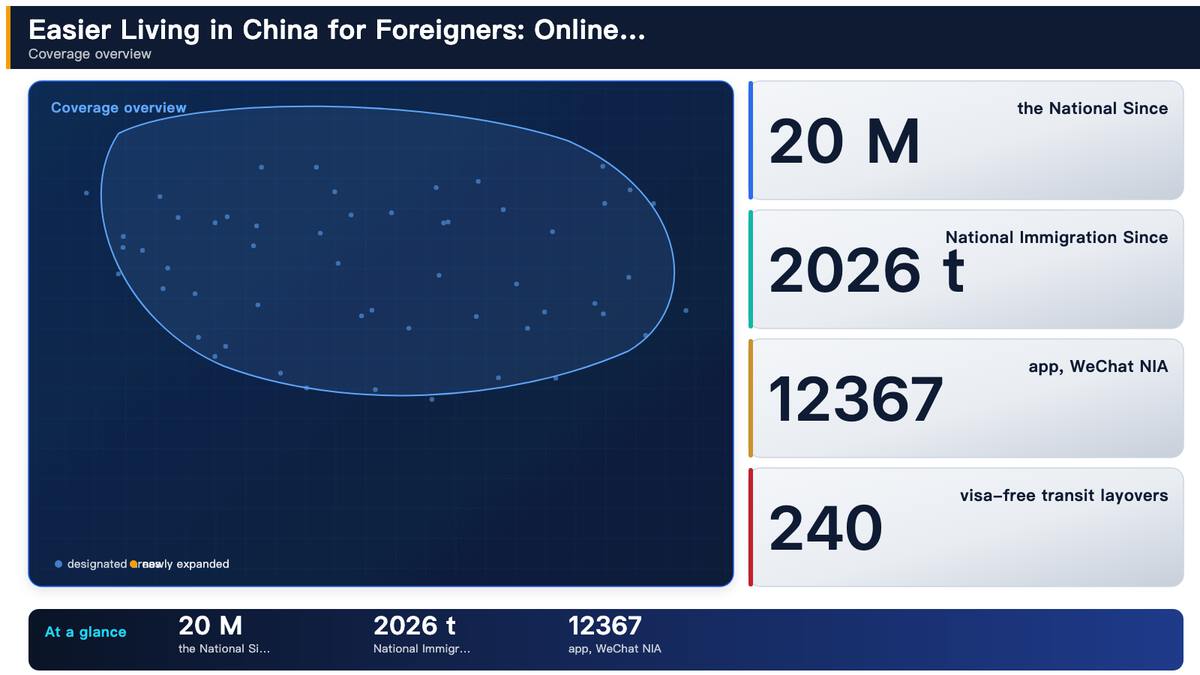
- Since 20 March 2026 the National Immigration Administration has piloted online lodging registration for foreigners staying at addresses other than hotels, and is rolling it out nationwide after a stable pilot.
自2026年3月20日起,国家移民管理局试点推行外国人在旅馆以外住宿登记网上办理服务,试点平稳后将逐步在全国推广。
- The online service is available through the NIA government-services platform, the “12367” mobile app, WeChat mini-program or Alipay mini-program, and has the same legal effect as registering at a public-security office.
网上办理可通过国家移民管理局政务服务平台、”移民局12367″应用程序、微信小程序或支付宝小程序进行,与到公安机关现场办理的住宿登记具有同等效力。
- Foreigners living in their own property, or residents holding residence permits or permanent-residence documents who return after travel, are exempt from repeat registration.
外国人居住自有住所的,以及持居留证件、永久居留证件在中国境内经常住所居住、同一证件有效期内境内外旅行后返回的,无需再次登记。
- The pilot covers Hebei, Liaoning, Zhejiang, Hubei, Guangxi, Chongqing and Sichuan; national promotion is the stated next step, with 12367 hotline support and police assistance available.
试点省份为河北、辽宁、浙江、湖北、广西、重庆、四川7省(区、市);下一步将逐步在全国推广,并提供12367服务热线与公安协助渠道。
- Under the Exit-Entry Administration Law, failure to register lodging as required can draw a warning and possibly a fine, so online registration removes a common compliance pain point for expatriate staff.
依据《出境入境管理法》,未按规定办理住宿登记的将给予警告并可处罚款;网上办理消除了外籍员工常见的合规痛点。
- Separately, Shenzhen Bao’an International Airport launched free city tours for transit passengers with layovers over six hours, enriching the 240-hour visa-free transit experience.
此外,深圳宝安国际机场为中转停留超过6小时的过境旅客推出免费城市游览服务,丰富了240小时过境免签的体验。
- For foreign companies, online lodging registration and transit-friendly services reduce HR administration and improve the experience of visiting executives, auditors and business travellers.
对外资企业而言,住宿登记网上办理与过境友好服务降低了人事行政负担,提升了来访高管、审计师与商务旅客的体验。
Easier Living in China for Foreigners: Online Lodging Registration and the 2026 Rollout | 外国人在华生活更便利:住宿登记网上办理与2026年全国推广
Why this matters now
One of the quieter but most practical changes for foreigners living in China took effect across several provinces on 20 March 2026. The National Immigration Administration (NIA) began piloting online lodging registration for foreigners staying at addresses other than hotels — covering rented apartments, company dorms and private homes — and after a stable pilot period, announced it would roll the service out nationwide. Combined with the free transit city tours that Shenzhen Bao’an International Airport began offering in August 2026, the change points to a broader trend: China is systematically removing the small administrative frictions that complicate expatriate life, alongside the headline visa-free and transit policies.
What the online registration actually means
Under the Exit-Entry Administration Law, a foreigner staying at a hotel has the hotel register their stay, but a foreigner staying elsewhere must register with the public security organ within 24 hours, either personally or through the host. The new online channel lets the guest or the host complete that registration through the NIA government-services platform, the “12367” mobile app, its WeChat or Alipay mini-program — without a trip to the police station. The registration has the same legal validity as an in-person filing. The service is designed with sensible simplifications: a person who has already registered once at the same address, or who owns the property, can register independently; a host who has registered in the past can help. Those who live in their own property, or who hold residence permits or permanent residence documents and return after travelling within the validity period, need not register again. The pilot covers Hebei, Liaoning, Zhejiang, Hubei, Guangxi, Chongqing and Sichuan, and NIA has stated it will extend the service gradually nationwide, with the 12367 hotline and police service windows available for assistance.
Why this matters for expatriates and employers
For a foreign employee renting an apartment in China, the 24-hour registration duty has long been a source of anxiety: miss the window and a warning or fine can follow under Article 76 of the Exit-Entry Administration Law. For HR teams at foreign-invested enterprises, the process was often a “shoe-leather” task — coordinating passports, addresses and police visits for every new arrival, short-term auditor or visiting executive. Online registration converts that into a same-day digital form. For companies running apartments or staff quarters, it also reduces the risk that a new hire or a visiting director fails to register on time. When combined with the expansion of visa-free entry — China now has unilateral visa-free access for citizens of 50 countries and 240-hour visa-free transit for 55 countries — the effect is a measurable reduction in the administrative cost of having foreigners on the ground.
The Shenzhen free transit tour as a signal
On 7 August 2026, Shenzhen Bao’an International Airport launched a free city tour for overseas transit passengers with layovers longer than six hours, offering itineraries such as a half-day visit to Nantou Ancient Town and coastal parks, or the Shenzhen Bay waterfront. The airport reported 567,000 inbound foreign travellers since the start of the year, up 31.3% year on year. The tour is open to passengers holding a valid visa or eligible for China’s 240-hour visa-free transit. For multinationals using Shenzhen as a regional hub, the service makes long layovers productive for first-time visitors and strengthens the city’s appeal for business-travel stopovers.
Practical steps for foreign companies and expatriates
- Stand up a registration process. Update your HR/relocation playbook so every foreign hire, auditor or visiting director completes online lodging registration within 24 hours of checking in at a non-hotel address.
- Choose the right channel. Use the NIA government-services website or the 12367 app/mini-program; keep a screenshot or reference number as proof of filing.
- Determine who registers. Let the host or the guest register, following the guidance: first-time registrations are typically completed with the host’s assistance; repeat stays at the same address or owner-occupied properties can be registered by the guest.
- Use the exemption. For staff holding residence permits or permanent residence documents who live in a regular residence, confirm the exemption applies after domestic or international travel and avoid duplicate filings.
- Watch the 24-hour clock. Even with online filing, the legal deadline remains 24 hours from check-in; build reminders so the window is never missed.
- Leverage transit conveniences. For visiting teams on 240-hour visa-free transit through hubs like Shenzhen, coordinate with the free city tour and other airport services to maximise the layover.
Risks and compliance notes
Online registration eases compliance but does not eliminate it. The 24-hour requirement and the warning-and-fine consequences of Article 76 remain in force. Registration data must be truthful: providing false information to immigration authorities is itself a violation. Companies should also remember that hotel stays are handled by the hotel and do not need guest action, while short-stay rentals, guesthouses and company quarters all fall under the non-hotel regime. Finally, because the pilot is still rolling out, confirm the online channel is actually available in the province where the foreigner is staying before relying on it; where not yet available, the in-person window remains the fallback.
外国人在华生活更便利:住宿登记网上办理与2026年全国推广
为什么当下重要
对在华生活的外国人来说,一个最实际、却相对低调的变化于2026年3月20日起在多个省份落地。国家移民管理局开始试点推行外国人在旅馆以外住宿登记网上办理服务——覆盖租赁公寓、公司宿舍与私人住宅——试点运行平稳后,宣布将逐步在全国推广。再结合深圳宝安国际机场2026年8月推出的免费中转城市游览,这一变化指向更宏观的趋势:中国正在系统性消除令外籍人士生活复杂化的小行政摩擦,与头条级的免签与过境政策并行推进。
网上办理究竟意味着什么
依据《出境入境管理法》,外国人在旅馆住宿的,由旅馆办理住宿登记;但外国人在其他住所居住或住宿的,应当在入住后24小时内由本人或留宿人向公安机关办理登记。新推出的网上渠道让住宿人或留宿人可以通过国家移民管理局政务服务平台、”移民局12367″应用程序或其微信、支付宝小程序完成登记,无需前往派出所。网上办理与现场办理的住宿登记具有同等法律效力。服务在设计上含合理的简化:在同一住所已办理过登记、或居住自有住所的,可以自行办理;此前协助办理过登记的留宿人亦可协助。居住自有住所的,以及持居留证件或永久居留证件、在同一证件有效期内境内外旅行后返回经常住所的,无需再次登记。试点覆盖河北、辽宁、浙江、湖北、广西、重庆、四川7省(区、市),国家移民管理局表示将逐步在全国推广,并提供12367热线与公安服务窗口协助。
为何外籍员工与雇主都受益
对在中国租房的外籍员工而言,24小时登记义务长期是一个焦虑来源:错过窗口,依据《出境入境管理法》第七十六条可能面临警告乃至罚款。对外资企业的人力资源团队而言,这一流程往往是”跑腿”任务——为每名新到员工、短期审计师或来访高管协调护照、地址与派出所拜访。网上办理将其转化为当天的数字化表单。对运营公寓或员工宿舍的企业,它也降低了新员工或来访董事未能按时登记的风险。再叠加免签入境扩大——中国现对50国公民单方面免签、对55国实施240小时过境免签——其效果是外籍人员落地行政成本的切实下降。
深圳免费中转游的信号意义
2026年8月7日,深圳宝安国际机场为中转停留超过6小时的境外过境旅客推出免费城市游览服务,提供诸如南头古城与滨海公园半日游、或深圳湾滨水线路等行程。机场报告今年年初以来入境外国旅客达56.7万人次,同比增长31.3%。该游览面向持有效签证或符合中国240小时过境免签条件的旅客。对以深圳为区域枢纽的跨国公司而言,这项服务让首次来访者高效利用长中转时间,也增强了深圳作为商务旅行中转站的吸引力。
外资企业与外籍人员的操作步骤
- 建立登记流程。 更新人力资源/外派安置手册,确保每位外籍员工、审计师或来访董事在非旅馆地址办理入住后24小时内完成网上住宿登记。
- 选择正确渠道。 使用国家移民管理局政务服务网站或12367应用程序/小程序;留存截图或受理编号作为办理凭证。
- 确定由谁办理。 按指引由留宿人或住宿人办理:首次登记通常由留宿人协助完成;同一住所再次登记或自有住所可由住宿人自行办理。
- 善用豁免。 对持居留证件或永久居留证件、居住在固定住所的员工,确认境内外旅行后的豁免情形,避免重复申报。
- 盯住24小时时限。 即使网上办理,法定时限仍是入住后24小时;设置提醒,确保窗口不落空。
- 善用中转便利。 对经深圳等枢纽、按240小时过境免签来访的团队,可协调免费城市游览与机场其他服务,最大化利用中转时间。
风险与合规提示
网上办理降低了合规难度,但并未消除合规义务。24小时要求以及第七十六条的警告与罚款后果仍然有效。登记信息必须真实:向移民管理机构提供虚假信息本身即属违法。企业还应记住,旅馆住宿由旅馆办理、无需客人操作;而短租、民宿与公司宿舍均属非旅馆情形。最后,由于试点仍在推广中,在依赖网上渠道前应确认外国人所在省份确已开通;尚未开通的地区,现场窗口仍是兜底方式。
Sources
- 鹤峰县人民政府官网《关于推行网上办理外国人旅馆以外住宿登记政策解读》(国家移民管理局2026-03-20起7省试点):<http://www.hefeng.gov.cn/ztfw/crjly/jwrylh/wyk/202608/t20260807_1824967.shtml>
- 来凤县人民政府官网《关于推行网上办理外国人旅馆以外住宿登记政策解读》:<http://www.laifeng.gov.cn/ztfw/crjly/jwrylh/wyk/202608/t20260811_1825956.shtml>
- 深圳市宝安区人民政府英文网《Airport offers free city tours to overseas transit passengers》(2026-08-07起免费中转游,上半年入境外籍旅客56.7万人次、同比+31.3%):<https://www.baoan.gov.cn/en/news/latestnews/content/post_12934999.html>
- 国务院新闻办英文网《The boom in China-Europe travel runs in both directions》(50国单免、55国240小时过境免签、上半年免签入境1781.5万人次):<https://english.scio.gov.cn/videos/2026-08/12/content_118643947.html>