
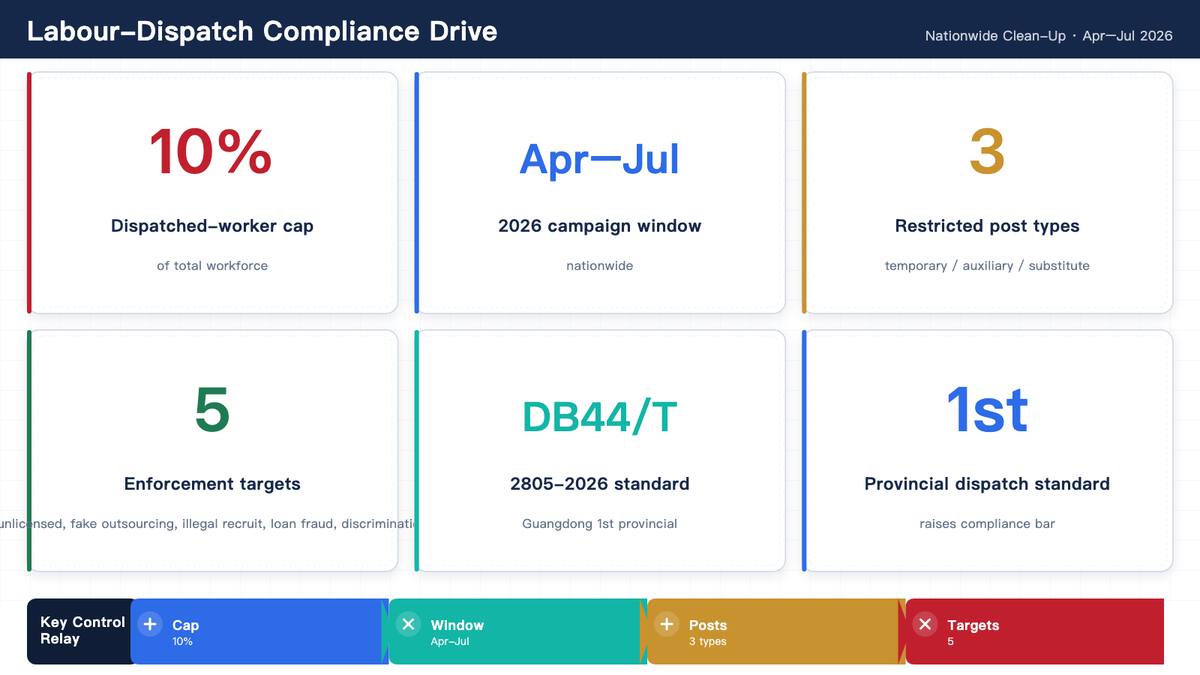
- A nationwide campaign to clean up the human-resources market ran from April to July 2026, with dispatch-rule violations a stated enforcement priority.
2026年4月至7月开展了全国清理整顿人力资源市场秩序专项行动,劳务派遣违规被列为明确的执法重点。- The campaign targets unlicensed dispatch, “fake outsourcing, real dispatch,” illegal recruitment intermediaries, “recruit-to-train” loan fraud and employment discrimination.
行动剑指未经许可经营劳务派遣、”假外包、真派遣”、非法职业中介、”招转培(贷)”欺诈与就业歧视。- The Interim Provisions on Labour Dispatch cap dispatched workers at 10% of a user employer’s total workforce and restrict them to temporary, auxiliary or substitute posts.
《劳务派遣暂行规定》将被派遣劳动者数量限制在用工单位总量的10%以内,并将其限定于临时性、辅助性或替代性岗位。- Guangdong’s first provincial dispatch service standard (DB44/T 2805-2026) raises the compliance bar for dispatch agencies operating in the province.
广东省首项劳务派遣省级地方标准(DB44/T 2805-2026)提高了在该省经营派遣机构的合规门槛。- Foreign-invested manufacturers and shared-service centres using dispatch at scale must re-test their agency licensing, ratios and post mix now.
大规模使用派遣的外资制造企业与共享服务中心,须立即重新核验合作机构资质、用工比例与岗位结构。- Practical step: audit every dispatch arrangement against the 10% cap and the temporary/auxiliary/substitute test before the next labour inspection.
实操建议:在下次劳动监察前,按10%上限与”三性”标准审计每一项派遣安排。
China’s 2026 Crackdown on Labour-Dispatch Abuses: Compliance Guide for Foreign-Invested Employers | 2026年劳务派遣违规整治:外资用人单位合规指引
In 2026 the human-resources market came under intensified scrutiny. The Office of the State Council’s Employment Promotion and Labour Protection Leading Group issued a notice deploying a nationwide campaign — running April to July 2026 — to clean up the human-resources market order. For foreign-invested manufacturers, call centres, shared-service centres and any employer leaning on dispatched labour, the campaign is a reminder that dispatch compliance is no longer a back-office formality.
What the campaign targets
The campaign concentrates on conduct that undermines fair employment and market order:
- Illegal recruitment intermediaries and unlicensed dispatch operators.
- “Fake outsourcing, real dispatch” — disguising employment relationships as service outsourcing to dodge dispatch rules.
- “Recruit-to-train (loan)” fraud — luring jobseekers into paid training under the guise of recruitment.
- False recruitment — fabricated “central/state-owned enterprise internal referrals” or “guaranteed placements.”
- Employment discrimination — improper restrictions on gender, age, region and the like.
- Network recruitment-order violations — unlicensed or non-compliant job-posting platforms.
Labour dispatch is explicitly named: the campaign requires regulating dispatch employment and investigating unlicensed dispatch and “fake outsourcing, real dispatch.” Enterprises are advised to audit network recruitment and postings, strictly review the qualifications of partner HR agencies, and keep dispatch ratios and post scopes compliant.
The legal baseline: Interim Provisions on Labour Dispatch
The *Interim Provisions on Labour Dispatch* (enforced since 2014) remain the core rule. Key points foreign employers must respect:
- Ratio cap. The number of dispatched workers used by a user employer shall not exceed 10% of its total workforce.
- “Three-nature” limit. Dispatched workers may only be assigned to temporary, auxiliary or substitute posts.
- Equal pay for equal work. Dispatched workers are entitled to the same remuneration and working conditions as directly-hired staff in comparable posts.
- Agency licensing. Only legally licensed dispatch agencies may supply dispatched labour; operating without a licence is a primary enforcement target.
Guangdong has raised the bar further. Its provincial standard *Specification for Labour Dispatch Services* (DB44/T 2805-2026) — the province’s first dispatch-specific provincial standard — covers the full dispatch lifecycle. It requires dispatch agencies to conclude written labour contracts of at least two fixed terms with dispatched workers (probation may be agreed only once), pay wages in full and on time per contract with records filed, and — for cross-region dispatch — apply the wage and working-condition standards of the user employer’s location. Agencies must also handle pension, medical (including maternity), work-injury and unemployment insurance and housing fund on time.
Why foreign employers are exposed
Foreign-invested groups often centralise headcount in China through dispatch or outsourced “managed services.” Three patterns draw scrutiny:
- Using dispatch to bypass headcount or headcount-ratio limits in a legal entity.
- Outsourcing a function that is, in substance, managed and directed in-house — the classic “fake outsourcing, real dispatch.”
- Relying on a low-cost agency without verifying its dispatch licence and social-insurance compliance.
Each can convert a routine commercial arrangement into a labour-enforcement finding, with back-pay, social-insurance arrears and penalties.
Practical steps
- Audit the 10% ratio. Count dispatched workers against total workforce per legal entity; remediate breaches before inspection.
- Test the “three-nature” post mix. Confirm dispatched roles are genuinely temporary, auxiliary or substitute; re-classify permanently embedded roles.
- Verify agency licensing. Obtain and retain the dispatch licence of every partner agency; confirm it is in scope and current.
- Close the equal-pay gap. Align dispatched-worker pay and conditions with directly-hired comparators.
- Fix cross-region dispatch. Apply the user-location wage and social-insurance standards where dispatch crosses regions.
- Document the genuine-outside nature of outsourcing. Keep governance evidence that outsourced functions are not merely in-house direction.
2026年劳务派遣违规整治:外资用人单位合规指引
2026年,人力资源市场受到更强监管。国务院就业促进和劳动保护工作领导小组办公室印发通知,部署自2026年4月至7月在全国范围开展清理整顿人力资源市场秩序专项行动。对于依赖劳务派遣的外资制造企业、呼叫中心、共享服务中心及各类用人单位而言,此次行动提醒:派遣合规已不再是后台琐事。
行动打击对象
行动聚焦破坏公平就业与市场秩序的行为:
- 非法职业中介与未经许可经营劳务派遣。
- “假外包、真派遣”——以服务外包之名掩盖劳动关系以规避派遣规则。
- “招转培(贷)”欺诈——以招聘为名诱骗求职者参与付费培训。
- 虚假招聘——虚构”央国企内推””保录直签”等。
- 就业歧视——对性别、年龄、地域等的不合理限制。
- 网络招聘秩序违规——无资质或不合规的招聘信息发布平台。
劳务派遣被明确点名:行动要求规范劳务派遣用工,重点查处未经许可擅自经营劳务派遣、”假外包、真派遣”。企业被建议全面排查网络招聘与信息发布、严格审查合作人力资源服务机构资质,并使派遣比例与岗位范围合规。
法律基线:《劳务派遣暂行规定》
《劳务派遣暂行规定》(2014年起施行)仍是核心规则。外资用人单位须遵守的要点:
- 比例上限。 用工单位使用的被派遣劳动者数量不得超过其用工总量的10%。
- “三性”限制。 被派遣劳动者只能被派遣至临时性、辅助性或者替代性的岗位。
- 同工同酬。 被派遣劳动者享有与用工单位同类岗位直接用工人员同等的劳动报酬与劳动条件。
- 机构许可。 仅依法取得许可的派遣机构可派遣劳动者;无许可经营是首要执法目标。
广东进一步抬高了门槛。其地方标准《劳务派遣服务规范》(DB44/T 2805-2026)是广东省首项劳务派遣省级地方标准,覆盖派遣全周期。它要求派遣单位与被派遣劳动者订立两年以上固定期限书面劳动合同(试用期仅可约定一次),按合同约定按时足额发放工资并归档,跨地区派遣的按用工单位所在地标准执行劳动报酬与劳动条件;派遣单位还须按时为被派遣劳动者办理养老、医疗(含生育)、工伤、失业等社会保险及住房公积金。
外资为何易被波及
外资集团常通过派遣或外包”托管服务”在华集中用工。三类情形易受关注:
- 借派遣规避法人实体内的编制或比例限制。
- 外包实质由内部管理与指挥的职能——典型的”假外包、真派遣”。
- 依赖低成本机构而未核验其派遣许可与社保合规。
任一情形都可能将常规商业安排转化为劳动执法认定,伴随补薪、社保补缴与处罚。
实操步骤
- 审计10%比例。 按法人实体统计被派遣劳动者占用工总量比例,在监察前整改超标。
- 测试”三性”岗位结构。 确认派遣岗位确属临时性、辅助性或替代性,将长期嵌入式岗位重新归类。
- 核验机构许可。 取得并留存每个合作派遣机构的派遣许可证,确认其在有效期内且范围匹配。
- 弥合同工同酬差距。 使派遣员工薪酬条件与直接用工对标岗位对齐。
- 规范跨地区派遣。 跨地区派遣时适用用工单位所在地工资与社保标准。
- 留存外包真实性证据。 保留证明外包职能非内部化指挥的治理证据。
Practitioner Quick Reference
- Campaign window April–July 2026: nationwide clean-up; dispatch is an explicit priority.
行动期2026年4—7月:全国清理;派遣为明确重点。 - 10% cap + three-nature posts: the two mechanical tests every dispatch arrangement must pass.
10%上限加”三性”岗位:每项派遣安排都须通过的两项机械测试。 - Licence is non-negotiable: only licensed agencies may supply dispatch labour.
许可不可妥协:仅持证机构可派遣劳动者。 - Guangdong DB44/T 2805-2026: provincial standard raises the agency bar (2-year contracts, on-time pay, cross-region standards).
广东DB44/T 2805-2026:省级标准抬高机构门槛(两年合同、按时发薪、跨地区标准)。
Common Pitfalls
- Assuming outsourcing avoids the rules: if you direct the work in-house, it may be re-characterised as “fake outsourcing, real dispatch.”
以为外包可规避规则:若由内部指挥工作,可能被重新定性为”假外包、真派遣”。 - Forgetting the 10% is per legal entity: group-wide averaging does not satisfy the per-entity cap.
忘记10%按法人实体计算:集团整体平均不能满足单体上限。 - Trusting the agency blindly: the user employer shares exposure for an unlicensed or non-compliant partner.
盲目信任机构:用工单位对无许可或不合规的合作方同样担责。
Sources