
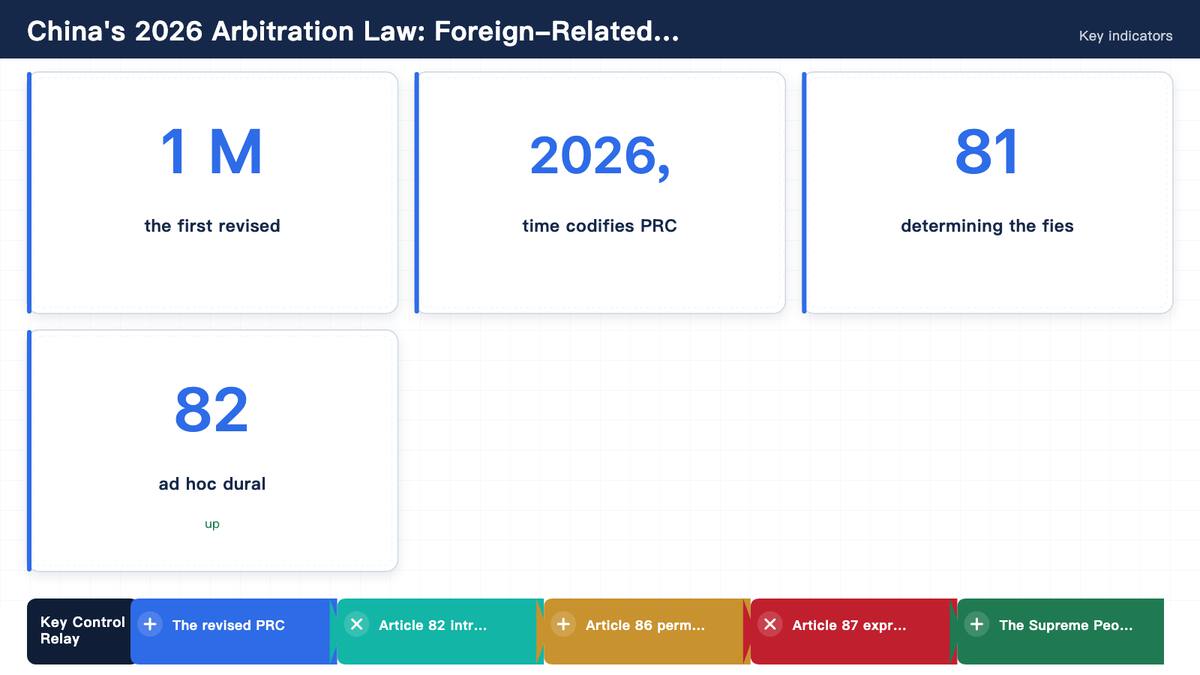
- The revised PRC Arbitration Law, effective 1 March 2026, for the first time codifies the “seat of arbitration” (Article 81), determining the applicable procedural law and supervisory court.
2026年3月1日施行的修订版《仲裁法》首次在法律上确立”仲裁地”概念(第八十一条),据以确定仲裁程序适用法及监督法院。- Article 82 introduces limited ad hoc (special) arbitration for foreign-related maritime disputes and for foreign-related disputes between enterprises registered in FTZs and the Hainan FTP.
第八十二条引入有限度的临时(特别)仲裁,适用于涉外海事纠纷及在自贸区、海南自贸港登记企业之间的涉外纠纷。- Article 86 permits qualified foreign arbitral institutions to set up offices and administer foreign-related arbitration in pilot FTZs and the Hainan FTP.
第八十六条允许符合条件的境外仲裁机构在自贸区、海南自贸港等试点区域设立机构并开展涉外仲裁。- Article 87 expressly encourages parties to choose China (including Hong Kong and Macau) as the seat and Chinese institutions as the forum — a signal of the “arbitration-friendly” policy.
第八十七条明确鼓励当事人选择中国(含港澳台)为仲裁地、选择中国仲裁机构,彰显”仲裁友好型”政策取向。- The Supreme People’s Court will issue supporting judicial interpretations and refine arbitration judicial-review and preservation mechanisms to support the new system.
最高人民法院将制定配套司法解释,完善仲裁司法审查与保全机制以支撑新制度。- FIEs can now design clauses that seat arbitration in China/FTZ/Hainan, use ad hoc tribunals in pilot zones, and even appoint foreign institutions — broadening dispute-resolution optionality.
外资企业如今可起草以中国/自贸区/海南为仲裁地、在试点区域采用临时仲裁、甚至指定境外机构的条款,拓展争议解决选择空间。
China’s 2026 Arbitration Law: Foreign-Related Innovations — Seat, Ad Hoc Arbitration and Foreign Institutions | 中国2026年新仲裁法:涉外仲裁制度创新——仲裁地、临时仲裁与境外机构
Why this matters now
On 12 September 2025, the Standing Committee of the 14th National People’s Congress adopted the first comprehensive revision of the PRC Arbitration Law since its 1995 enactment. The revised law — eight chapters and 96 articles, 16 more than before — takes effect on 1 March 2026. For foreign-invested enterprises (FIEs), the most consequential changes sit in Chapter VII (“Special Provisions on Foreign-Related Arbitration”), which imports three international-standard institutions into Chinese law: the seat of arbitration, ad hoc (special) arbitration, and the admission of foreign arbitral institutions. Together these remove long-standing reasons why parties avoided choosing China as a seat or a Chinese institution, and they directly affect how an FIE should draft its dispute-resolution clause.
This article explains each reform, the official sources behind it, and what FIEs should specify in their contracts.
The seat of arbitration (Article 81): the new anchor
The pre-revision law did not formally recognise the “seat.” Courts therefore linked an award’s nationality to the institution’s domicile — which is why, in the German Züblin matter, an ICC award rendered in Shanghai was treated as a foreign award needing New York Convention recognition. Article 81 now codifies the seat:
- Parties may agree the seat in writing. Unless they agree otherwise on the procedural law, the seat determines the lex arbitri (the law governing the arbitration procedure) and the competent supervisory court, and the award is deemed rendered at the seat.
- If the parties do not agree or are unclear, the seat is determined by the agreed arbitration rules; if the rules are silent, the tribunal fixes the seat under the principle of facilitating dispute resolution.
This aligns China with the UNCITRAL Model Law and resolves the long-standing uncertainty about an award’s “nationality.” For an FIE, the seat is now a deliberate, contractible choice — pick China, Hong Kong, Singapore or elsewhere — and it dictates which courts supervise and where the award is enforced.
Ad hoc
For the first time, China legislatively recognises ad hoc arbitration, but only in a limited, “special arbitration” (特别仲裁) form. Article 82 permits parties, by written agreement, to choose either an institution or — for two categories of disputes — to take the PRC as the seat and constitute a tribunal of qualified persons under the agreed rules:
- Foreign-related maritime disputes — ad hoc arbitration is widely used in shipping and fits the sector’s needs.
- Foreign-related disputes between enterprises registered in a State-Council-approved free-trade zone, the Hainan Free Trade Port, or other designated areas.
The ad hoc tribunal must file, within three working days of its constitution, the parties’ names, the seat, the tribunal’s composition and the rules with the arbitration association. Critically, the tribunal may refer a party’s application for property, evidence or conduct preservation to the people’s court, which must handle it promptly. This gives ad hoc proceedings a domestic enforcement backbone that pure party-to-party agreements previously lacked.
For an FIE incorporated in a pilot FTZ or the Hainan FTP, Article 82 means a future dispute with another locally-registered foreign-invested entity can be resolved by a bespoke tribunal seated in China, without mandating an institution — a flexibility previously unavailable on the mainland.
Foreign institutions entering China (Article 86) and the pro-China-seat policy (Article 87)
Article 86 opens the market in both directions. It supports Chinese institutions establishing offices abroad, and — subject to need and state regulations — permits qualified foreign arbitral institutions to set up offices and conduct foreign-related arbitration in pilot FTZs, the Hainan FTP and similar designated areas. Combined with the codified seat concept, this gives a clear statutory basis for an arbitration administered by, say, a foreign institution but seated in China, removing the previous ambiguity about such clauses’ validity and enforceability.
Article 87 then signals policy direction: it encourages foreign-related parties to choose a PRC institution (including those in the Special Administrative Regions) and to agree on the PRC as the seat. This is the legislative expression of the “international arbitration preferred venue” (国际仲裁优选地) ambition repeatedly stated by the Supreme People’s Court and the Ministry of Justice, and it backs the international commercial arbitration centre initiatives already underway in Beijing, Shanghai, Guangdong, Shenzhen and Hainan.
Judicial support: SPC interpretations and the “arbitration-friendly” environment
The Supreme People’s Court has committed to making the reforms work in practice. At the Ministry of Justice press conference on 29 September 2025, the SPC’s Fourth Civil Division (the chamber handling foreign-related commercial and maritime matters) set out three priorities:
- Accelerate supporting judicial interpretations. The SPC will draft provisions implementing the revised law, building on existing arbitration judicial-review rules and working with the Legislative Affairs Commission of the NPC Standing Committee and the Ministry of Justice, so the amendments land in practice.
- Refine judicial-review and preservation mechanisms. The SPC will detail the review workflow, optimise arbitration preservation, and improve the衔接 between set-aside review and award enforcement, raising consistency and professionalism.
- Build an arbitration-friendly environment. The SPC will clarify, for the new institutions (the seat system and ad hoc arbitration), the competent court for ad hoc proceedings in FTZs/Hainan and for awards rendered in China by foreign institutions, and will honour the New York Convention in recognising and enforcing foreign awards.
Two concrete statutory improvements also help FIEs: the period to apply to set aside an award is shortened from six months to three (urging parties to act promptly), and parties may, in urgent cases, apply to a court for preservation before even filing for arbitration, dovetailing with the civil procedure law.
What FIEs should put in their contracts
- Specify the seat deliberately. Choose China, Hong Kong, Singapore or another seat aligned with where assets and enforcement lie — do not leave it to default rules.
- Consider ad hoc for pilot-zone disputes. If both you and the counterparty are registered in an FTZ or the Hainan FTP, an Article 82 ad hoc clause seated in China is now a viable, enforceable option.
- Weigh a foreign institution in a pilot zone. Where sophisticated cross-border expertise is needed, an institution seated in China but administered by a foreign body is now statutorily permissible in designated areas.
- Pair with preservation. Where urgency exists, provide for pre-arbitration court preservation and for the tribunal to refer interim measures to court.
- Revisit old templates. Clauses drafted before March 2026 that assumed China did not recognise the seat or ad hoc arbitration should be updated to capture the new options.
A takeaway for the foreign parent
The 2026 revision does not merely tinker at the edges; it repositions China as a credible seat and a more open arbitration market. For an FIE, the dividend is optionality: a dispute clause can now seat arbitration in China with a clear supervisory court, use a bespoke tribunal in a pilot zone, or appoint a foreign institution — each with a defined enforcement path. The remaining task is contractual discipline: capture these choices in writing before a dispute arises, because the law now rewards parties who do.
中国2026年新仲裁法:涉外仲裁制度创新——仲裁地、临时仲裁与境外机构
为何此刻重要
2025年9月12日,第十四届全国人大常委会第十七次会议表决通过《仲裁法》自1995年颁布以来的首次全面修订。修订后的法律共八章96条,较修订前增加16条,自2026年3月1日起施行。对外商投资企业(FIE)而言,最具影响的修改集中于第七章”涉外仲裁的特别规定”,该章将三项国际通行制度写入中国法:仲裁地、临时(特别)仲裁,以及境外仲裁机构的准入。三者共同消除了当事人长期回避选择中国为仲裁地或中国机构的缘由,并直接影响外资企业应如何起草争议解决条款。
本文逐一解释每项改革、其官方依据,以及外资企业应写入合同的要点。
仲裁地(第八十一条):新的锚点
修订前的法律未正式承认”仲裁地”,法院因而以仲裁机构所在地链接裁决国籍——这正是在德国Züblin案中,ICC在上海作出的裁决被视为外国裁决、须依《纽约公约》承认的原因。第八十一条现确立仲裁地:
- 当事人可以书面约定仲裁地。除对仲裁程序适用法另有约定外,以仲裁地作为仲裁程序适用法及司法管辖法院的确定依据,裁决视为在仲裁地作出。
- 当事人未约定或约定不明确的,根据约定的仲裁规则确定;仲裁规则没有规定的,由仲裁庭依便利争议解决原则确定。
这使中国法与联合国国际贸易法委员会《示范法》接轨,并解决了裁决”国籍”的长期不确定性。对外资企业而言,仲裁地如今是一项可经合同自由选定的安排——选中国、香港、新加坡或其他——它决定由哪国法院监督、在何处执行。
自贸区与海南的临时(特别)仲裁(第八十二条)
中国首次以立法承认临时仲裁,但仅限于有限度的”特别仲裁”形式。第八十二条允许当事人书面约定,既可选定机构,也可对两类纠纷选择以中国为仲裁地、由符合条件的人员依约定规则组成仲裁庭:
- 涉外海事纠纷——临时仲裁在海运领域应用广泛,契合行业需求。
- 在国务院批准设立的自贸试验区、海南自由贸易港等区域内登记的企业之间的涉外纠纷。
临时仲裁庭须在组庭后三个工作日内,将当事人名称、仲裁地、仲裁庭组成及仲裁规则向仲裁协会备案。关键的是,仲裁庭可将当事人关于财产、证据保全及行为保全的申请提交人民法院,人民法院应依法及时处理。这为临时程序提供了此前所缺的境内执行支撑。
对注册于试点自贸区或海南自贸港的外资企业,第八十二条意味着其与另一本地注册外资企业未来的纠纷,可由设在中国、由专门人员组成的仲裁庭解决,而无需强制指定机构——这是此前内地所不具备的灵活性。
境外机构来华(第八十六条)与鼓励选择中国为仲裁地(第八十七条)
第八十六条实行双向开放。它支持中国仲裁机构到境外设立业务机构,并可根据经济社会发展和改革开放需要,允许符合条件的境外仲裁机构在国务院批准设立的自贸试验区、海南自贸港等区域内依规定设立机构、开展涉外仲裁。结合已确立的仲裁地概念,这为”由境外机构管理、但仲裁地在中国”的仲裁提供了清晰的制定法依据,消除了此前此类条款效力与可执行性的模糊。
第八十七条进而宣示政策取向:鼓励涉外仲裁当事人选择中华人民共和国(包括特别行政区)的仲裁机构、约定中华人民共和国(包括特别行政区)作为仲裁地进行仲裁。这是最高人民法院与司法部反复强调的”国际仲裁优选地”目标的立法表达,亦支撑已在北京、上海、广东、深圳、海南推进的国际商事仲裁中心建设。
司法支持:最高法院司法解释与”仲裁友好型”环境
最高人民法院已承诺使改革落地。在2025年9月29日司法部新闻发布会上,最高法院民四庭(审理涉外民商事及海事案件的审判庭)提出三项重点:
- 加快制定配套司法解释。最高人民法院将在梳理既有仲裁司法审查规则基础上,会同全国人大常委会法工委、司法部起草修订法配套司法解释,使修法内容在司法实践中落地。
- 完善司法审查与保全机制。细化审查规范与工作流程,优化仲裁保全,强化撤裁审查与裁决执行的衔接,提升一致性与专业化。
- 营造仲裁友好型环境。围绕仲裁地、特别仲裁等新设制度,尽快明确自贸区、海南适用特别仲裁及境外机构在华裁决的管辖法院,并依《纽约公约》承认和执行外国仲裁裁决。
两项具体的制定法改进亦惠及外资企业:申请撤销裁决的期限由六个月缩短为三个月(督促当事人及时行使权利);紧急情况下,当事人可在申请仲裁前直接向人民法院申请保全,与民事诉讼法相衔接。
外资企业应在合同中写入的要点
- 慎重指定仲裁地。选择中国、香港、新加坡或与资产及执行所在地相符的仲裁地——不要留由默认规则决定。
- 为试点区纠纷考虑临时仲裁。若你与对方均在自贸区或海南自贸港登记,第八十二条项下以中国为仲裁地的临时条款如今成为可行且可执行的选项。
- 权衡试点区内的境外机构。若需高水平的跨境专业力量,由境外机构管理、仲裁地设在中国,如今在指定区域已为法律所允许。
- 与保全相衔接。存在紧急性时,约定仲裁前法院保全及仲裁庭将临时措施提交法院。
- 重审旧模板。2026年3月前起草、假定中国不承认仲裁地或临时仲裁的条款,应更新以纳入新选项。
给外国母公司的要点
2026年修订并非修修补补,而是将中国重新定位为可信的仲裁地与更开放的仲裁市场。对外资企业而言,红利在于选择空间:争议条款如今可把仲裁地设于中国并明确监督法院、在试点区采用专门仲裁庭,或指定境外机构——每一项都有明确的执行路径。余下的任务是合同纪律:在争议发生前以书面形式锁定这些选择,因为新法如今奖励如此行事的当事人。
Sources
- 司法部:新修订的仲裁法对涉外仲裁的创新及重大意义(刘敬东):https://www.moj.gov.cn/pub/sfbgw/fzgz/fzgzggflfwx/fzgzggflfw/202601/t20260109_530387.html
- 司法部:把握机遇谱写中国海事仲裁新篇章:https://www.moj.gov.cn/pub/sfbgw/fzgz/fzgzggflfwx/fzgzggflfw/202602/t20260227_532017.html
- 中国法院网(最高人民法院):强化仲裁司法保障 促进仲裁高地建设:http://www.chinacourt.cn/article/detail/2026/01/id/9155691.shtml