
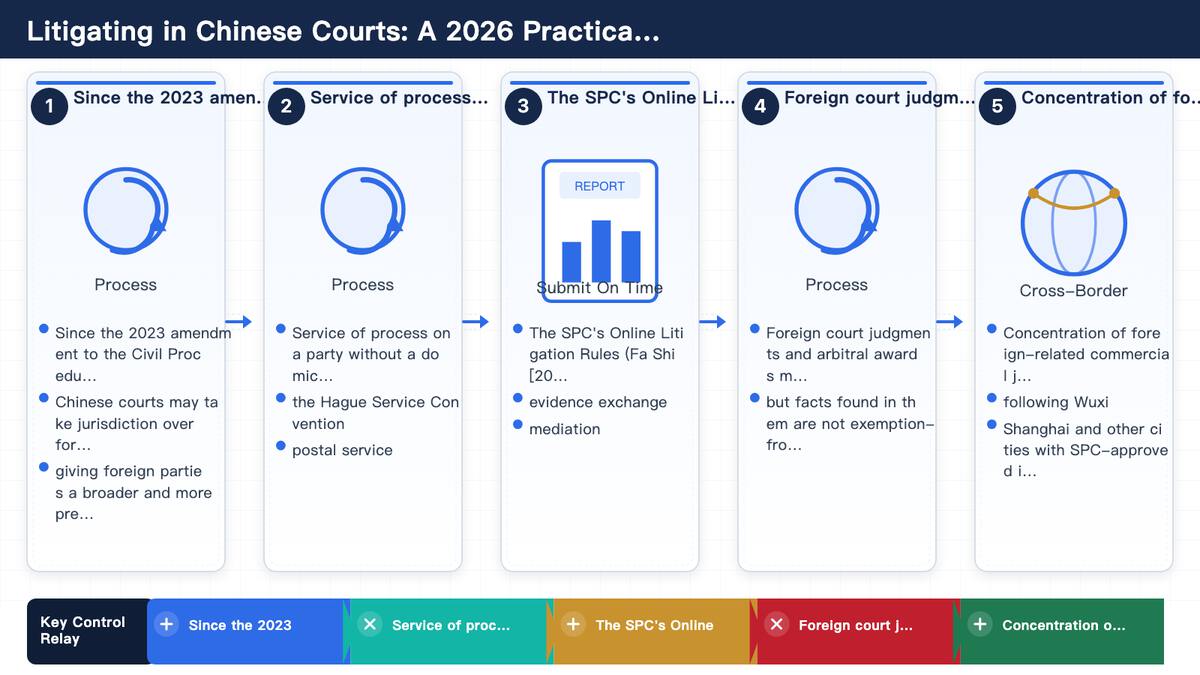
- Since the 2023 amendment to the Civil Procedure Law (in force 1 January 2024), Chinese courts may take jurisdiction over foreign-related disputes with “other proper connections” to China beyond the six traditional connecting factors, giving foreign parties a broader and more predictable door to Chinese litigation.
自 2023 年《民事诉讼法》修改(2024 年 1 月 1 日施行)以来,除六类传统连接点外,中国法院对与我国存在”其他适当联系”的涉外纠纷也可行使管辖权,为外国当事人提供了更宽、更可预期的中国诉讼之门。- Service of process on a party without a domicile in China runs through judicial-assistance agreements, the Hague Service Convention, postal service, service on authorised agents and public notice; electronic service through the court’s online platform is now expressly available with consent.
对在中国境内无住所当事人的送达,沿司法协助协定、海牙送达公约、邮寄送达、向授权代理人送达与公告送达等路径展开;经同意,还可通过法院在线平台进行电子送达。- The SPC’s Online Litigation Rules (Fa Shi [2021] No. 12) make online filing, evidence exchange, mediation, hearings and service legally valid, with an online-video witness mechanism allowing cross-border parties to authorise a lawyer without notarisation or consular authentication of the power of attorney.
最高法《人民法院在线诉讼规则》(法释〔2021〕12 号)使在线立案、证据交换、调解、庭审与送达具有法律效力,其在线视频见证机制允许跨境当事人不经公证、认证、转递即可委托律师。- Foreign court judgments and arbitral awards may be submitted as documentary evidence without prior recognition, but facts found in them are not exemption-from-proof facts and must still be examined through cross-examination.
外国法院判决与仲裁裁决可作为书证提交使用,无须先行承认,但其所认定事实不属于免证事实,仍须经质证并结合全案证据审查认定。- Concentration of foreign-related commercial jurisdiction is spreading: Fuzhou’s six districts will centralise first-instance foreign and Hong Kong/Macao/Taiwan commercial cases under RMB 40 million in Cangshan from 1 October 2026, following Wuxi, Shanghai and other cities with SPC-approved international commercial tribunals.
涉外商事集中管辖正在铺开:继无锡、上海等城市设立经最高法批准的国际商事法庭后,福州六城区 4000 万元以下一审涉外涉港澳台商事案件自 2026 年 10 月 1 日起集中至仓山区法院。- For foreign parties, the practical 2026 guide is: determine jurisdiction early, plan service and evidence strategy around the online platform, use the apostille route for notarised documents from Hague members, and keep translation and authentication ready before filing.
对外国当事人,2026 年实操指南是:尽早确定管辖、围绕在线平台规划送达与举证策略、海牙成员国公证文书走附加证明书通道、立案前备妥翻译与认证。
Litigating in Chinese Courts: A 2026 Practical Guide for Foreign Parties in Foreign-Related Civil and Commercial Cases | 在中国法院诉讼:涉外民商事案件外国当事人的 2026 年实务指南
The framework after the 2023 Civil Procedure Law amendment
The fifth amendment to the Civil Procedure Law, adopted on 1 September 2023 and in force since 1 January 2024, was the first to systematically revise the special provisions on foreign-related civil procedure. For foreign parties, the headline change is jurisdiction: in addition to the six traditional connecting factors (place of contract conclusion, place of contract performance, location of the subject matter, location of seizable property, place of the tort, and domicile of the representative office), Article 276(2) now provides that Chinese courts may hear a foreign-related dispute if there are “other proper connections” with China. This is the statutory codification of the “proper connection” doctrine first applied by the SPC in the 2019 ZTE v. Conversant standard-essential-patent case. In practice it means that disputes which do not map onto the six factors — for example, standard-essential patent global licensing disputes or disputes where China is the main market — can still be heard in China. Foreign parties negotiating contracts with Chinese counterparties should assume that Chinese courts may assert jurisdiction more readily than before, and should draft jurisdiction clauses accordingly.
Service of process
Service on a party without a domicile in China follows a hierarchy set out in the Civil Procedure Law: judicial-assistance agreements between China and the foreign state; the Hague Convention on the Service Abroad of Judicial and Extrajudicial Documents (China is a member); postal service where the receiving state permits it; service through the litigant’s authorised agent; and, as a last resort, public notice (a three-month period, with notice published in newspapers distributed domestically and abroad). Two 2026-relevant points: first, electronic service is available — under the SPC’s Online Litigation Rules, with the consent of the addressee, courts may serve documents to an e-mail address, instant-messaging account or the litigation platform account; second, the SPC’s December 2025 batch of judicial interpretation amendments (published as Fa Shi [2026] No. 16 and related instruments, effective 15 August 2026) updated the provisions on service through judicial-assistance channels and translation requirements, aligning the wording with the 2023 Civil Procedure Law. For a foreign company served in China, the practical response is the same as for any defendant: verify the authenticity of the service, check deadlines (answer period for foreign parties is 30 days, extendable), and instruct counsel immediately.
Evidence from abroad
Foreign-origin evidence raises authentication questions. Documents created outside China that are used as evidence in Chinese civil proceedings generally require notarisation in the country of origin and consular legalisation by the Chinese embassy or consulate, unless the state is a party to the Hague Apostille Convention — for the states that have joined, an apostille certificate issued by the competent authority suffices and no consular legalisation is needed. Translations into Chinese must be provided. Two nuances are worth stating: first, a foreign court judgment or arbitral award may be submitted as documentary evidence without a prior recognition proceeding; second, facts confirmed by a foreign judgment or award are not “exemption-from-proof” facts under the Civil Procedure Law interpretation — the opposing party may challenge them and the court will examine them through cross-examination together with the rest of the evidence. This means a foreign judgment can be persuasive, but it does not automatically prove its underlying facts in Chinese proceedings.
Online litigation and the video-witness mechanism
The SPC’s Online Litigation Rules (Fa Shi [2021] No. 12, effective 1 August 2021) established that online filing, mediation, evidence exchange, hearings and service have the same legal effect as offline equivalents, subject to party consent. For cross-border parties, the most useful mechanism is online video witnessing: a party outside China authorising a Chinese lawyer may, instead of notarising and legalising the power of attorney, apply for an online video witness session in which the judge, the foreign party and the entrusted lawyer appear simultaneously; the power of attorney is signed under the judge’s video supervision and no notarisation, authentication or forwarding is required. After the video witness, the lawyer may proceed with online filing and fee payment. In practice, foreign parties should still check with the specific court whether the video-witness route is available for their case type, and should have the entity’s identity documents and signatory authority ready in advance.
Which court and which procedure
Since the 2022 jurisdiction provisions (Fa Shi [2022] No. 18), first-instance foreign-related civil and commercial cases are generally handled by grassroots courts, with intermediate courts hearing cases above value thresholds or of particular types. Centralisation is the other trend: SPC-approved international commercial tribunals operate in Wuxi, Suzhou, Chengdu and other cities, Shanghai and Beijing run international commercial courts, and on 20 August 2026 the Fujian Higher People’s Court announced that from 1 October 2026 first-instance foreign, Hong Kong/Macao/Taiwan-related commercial cases under RMB 40 million in Fuzhou’s six urban districts will be centralised in Cangshan District People’s Court. For a foreign party, the practical question is not “which court is generally competent” but “which court is designated for this case type and amount” — check the local higher court’s announcements, which are increasingly specific.
Recognition and enforcement of foreign judgments and awards
Enforcement of a foreign judgment in China requires an application to the intermediate court, grounded in a judicial-assistance treaty or reciprocity, and recognition is granted only where the judgment is final, the rendering court had proper jurisdiction, no violation of China’s basic legal principles, sovereignty, security or public interest, and no conflict with an existing Chinese judgment or a previously recognised foreign judgment. Foreign arbitral awards are enforced under the New York Convention (China acceded in 1987), and the 2023 Civil Procedure Law amendment adopted the “seat of arbitration” standard for determining the nationality of foreign awards — an award made in the territory of a foreign state is a foreign award, to be enforced under the Convention. The practical message: enforcement is possible but procedurally exacting, and the strength of the underlying dispute-resolution clause (arbitration vs. litigation, seat, governing law) is decided at contract-drafting stage, not at enforcement stage.
Practical checklist for foreign parties in 2026
- Determine jurisdiction at the contract stage: specify the Chinese court or the arbitration institution, seat and governing law; be aware that “proper connection” gives Chinese courts broad jurisdiction where no clause exists.
- Before filing, plan service: if the defendant is abroad, estimate the route (treaty, Hague, postal, agent, public notice) and the time cost; consider electronic service with consent.
- Prepare evidence in advance: notarise and apostille (for Hague members) foreign documents, obtain certified Chinese translations, and do not rely on a foreign judgment as proof of facts without supporting evidence.
- Use the online platform: register for online filing, consider the video-witness mechanism for the power of attorney, and expect e-service once you consent.
- Check centralisation announcements: confirm the designated court for the case type and amount in the relevant province or city.
- For enforcement, confirm treaty or reciprocity grounds and the finality of the judgment before commencing the case in China.
Outlook
Chinese courts are consolidating their position as a serious forum for cross-border commercial disputes: broader jurisdiction, modernised service rules, online procedure and specialised tribunals. For foreign parties the practical implication is that careful drafting and early procedural planning now matter more than ever — the system is faster, more digital and more predictable than a decade ago, but it demands that foreign parties engage with its rules deliberately.
Sources
- 上海国际商事法庭(上海市第一中级人民法院)— 微课程《涉外民商事纠纷”适当联系”管辖规则的司法适用》(彭浩法官,介绍民事诉讼法第276条第2款”适当联系”管辖规则):https://shicc.a-court.gov.cn/xxfb/no1court_412/docs/202605/d_-9249.html
- 广州市司法局 — 《人民法院在线诉讼规则》(法释〔2021〕12号)全文:https://sfj.gz.gov.cn/attachment/6/6826/6826838/7374188.pdf
- 福建省高级人民法院 — 《福建省高级人民法院关于对福州六城区第一审涉外、涉港澳台商事案件实行集中管辖的公告》(2026-08-20):https://www.fjcourt.gov.cn/Page/Court/News/ArticleTradition/3f587167-53c3-4671-a217-b485c59b83e0.html
- 最高人民法院 — 最高人民法院关于修改《最高人民法院关于审理船舶油污损害赔偿纠纷案件若干问题的规定》等九件司法解释的决定(法释〔2026〕16号,2026-08-05公布、2026-08-15施行,含涉外送达与司法协助条款清理):https://www.court.gov.cn/fabu/xiangqing/508041.html
在中国法院诉讼:涉外民商事案件外国当事人的 2026 年实务指南
2023 年《民事诉讼法》修改后的框架
2023 年 9 月 1 日通过、2024 年 1 月 1 日起施行的《民事诉讼法》第五次修改,是首次系统完善第四编”涉外民事诉讼程序的特别规定”。对外国当事人,最醒目的变化是管辖:在六类传统连接点(合同签订地、合同履行地、诉讼标的物所在地、可供扣押财产所在地、侵权行为地、代表机构住所地)之外,第二百七十六条第二款规定,涉外民事纠纷与中华人民共和国存在”其他适当联系”的,可以由人民法院管辖。这是最高法 2019 年在”中兴诉康文森”标准必要专利案中确立的”适当联系”规则的法律化。实践中,无法对应六类连接点的纠纷——如标准必要专利全球许可纠纷或中国为主要市场的纠纷——仍可在华审理。与中国对手方缔约的外国当事人应意识到中国法院比以前更容易主张管辖,并相应起草管辖条款。
送达程序
对在中国境内无住所当事人的送达,依《民事诉讼法》确立的层级展开:中国与外国国家间的司法协助协定;海牙送达公约(中国为成员国);受送达国允许的邮寄送达;经授权代理人的送达;以及最后手段的公告送达(三个月期限,在国内外公开发行的报刊上刊登)。两点与 2026 年相关:其一,电子送达可用——依《人民法院在线诉讼规则》,经受送达人同意,法院可向电子邮箱、即时通讯账号或诉讼平台账号送达文书;其二,最高法 2025 年 12 月通过的一批司法解释修改(法释〔2026〕16 号及相关文件,2026 年 8 月 15 日施行)更新了司法协助送达与译文要求条款,与 2023 年《民事诉讼法》表述对齐。在华被送达的外国公司,实务应对与任何被告相同:核验送达真实性、核对期限(外国当事人答辩期为 30 日、可延长)、立即委托律师。
域外证据
域外形成证据存在认证问题。在中国民事诉讼中用作证据的中国境外形成文件,一般须在来源国公证,并经中国驻外使领馆领事认证;除非该国为海牙《取消外国公文书认证要求的公约》成员国——成员国主管机关签发的附加证明书(Apostille)即可,无须领事认证。须提供中文译文。两点值得强调:其一,外国法院判决或仲裁裁决可未经承认程序直接作为书证提交;其二,外国判决或裁决认定的事实不属于民事诉讼法司法解释所列”免证事实”——对方可提出异议,法院将组织质证并结合全案证据审查认定。这意味着外国判决有说服力,但并不能自动证明其认定的事实。
在线诉讼与视频见证机制
最高法《人民法院在线诉讼规则》(法释〔2021〕12 号,2021 年 8 月 1 日施行)规定,经当事人同意,在线立案、调解、证据交换、庭审与送达与线下具有同等法律效力。对跨境当事人,最有用的是在线视频见证:境外当事人委托中国律师时,可不必公证认证授权委托书,而是申请在线视频见证——法官、境外当事人与受委托律师三方同时在线,在法官视频见证下签署委托文件,无须再办理公证、认证、转递。视频见证后,律师可代为网上立案、网上交费。实践中,外国当事人仍应事先向具体法院确认视频见证通道是否适用其案件类型,并提前备好主体身份文件与签署权限证明。
管辖法院与程序
自 2022 年管辖规定(法释〔2022〕18 号)以来,一审涉外民商事案件一般由基层法院管辖,中级法院审理超标的额或特定类型案件。集中化是另一趋势:无锡、苏州、成都等城市设有经最高法批准的国际商事法庭,上海、北京设有国际商事法院;2026 年 8 月 20 日福建省高院公告,自 2026 年 10 月 1 日起福州六城区 4000 万元以下一审涉外涉港澳台商事案件集中至仓山区法院。对外国当事人,实际问题不是”哪个法院一般有管辖权”,而是”本案型与标的额指定哪个法院”——关注当地高院公告,这类公告日益具体。
外国判决与裁决的承认与执行
外国判决在华执行需向中级法院申请,依据司法协助条约或互惠,且仅在判决终局、作出法院有适当管辖、不违反中国法律基本原则与主权安全公共利益、不与既有中国判决或已承认外国判决冲突时准予承认。外国仲裁裁决依《纽约公约》(中国 1987 年加入)执行;2023 年《民事诉讼法》修改采纳”仲裁地”标准认定外国裁决国籍——在外国领域内作出的裁决为外国裁决,按公约执行。实务信息:执行可行但程序严格,底层争议解决条款(仲裁还是诉讼、仲裁地、准据法)在缔约阶段决定,而非执行阶段。
2026 年外国当事人实操清单
- 缔约阶段确定管辖:写明中国法院或仲裁机构、仲裁地、准据法;注意无条款时”适当联系”赋予中国法院宽泛管辖。
- 立案前规划送达:被告在境外的,估算路径(条约、海牙、邮寄、代理人、公告)与时间成本;考虑经同意电子送达。
- 提前备证:海牙成员国文件公证并办附加证明书,获取盖章中文译文;不依赖外国判决直接证明事实而无佐证。
- 善用在线平台:注册在线立案,考虑授权委托书视频见证通道,同意后接受电子送达。
- 核对集中化公告:确认所在省市的指定法院。
- 执行案件:立案前确认条约或互惠依据及判决终局性。
展望
中国法院正巩固其作为跨境商事争议严肃审判机构的地位:更宽的管辖、现代化的送达规则、在线程序与专门法庭。对外国当事人,实务含义是精心起草与早期程序规划比以往更重要——体系比十年前更快、更数字、更可预期,但它要求外国当事人刻意依其规则行事。
Sources
- 上海国际商事法庭(上海市第一中级人民法院)— 微课程《涉外民商事纠纷”适当联系”管辖规则的司法适用》:https://shicc.a-court.gov.cn/xxfb/no1court_412/docs/202605/d_-9249.html
- 广州市司法局 — 《人民法院在线诉讼规则》(法释〔2021〕12号)全文:https://sfj.gz.gov.cn/attachment/6/6826/6826838/7374188.pdf
- 福建省高级人民法院 — 福州六城区涉外涉港澳台商事案件集中管辖公告(2026-08-20):https://www.fjcourt.gov.cn/Page/Court/News/ArticleTradition/3f587167-53c3-4671-a217-b485c59b83e0.html
- 最高人民法院 — 修改九件司法解释的决定(法释〔2026〕16号,2026-08-05公布):https://www.court.gov.cn/fabu/xiangqing/508041.html