
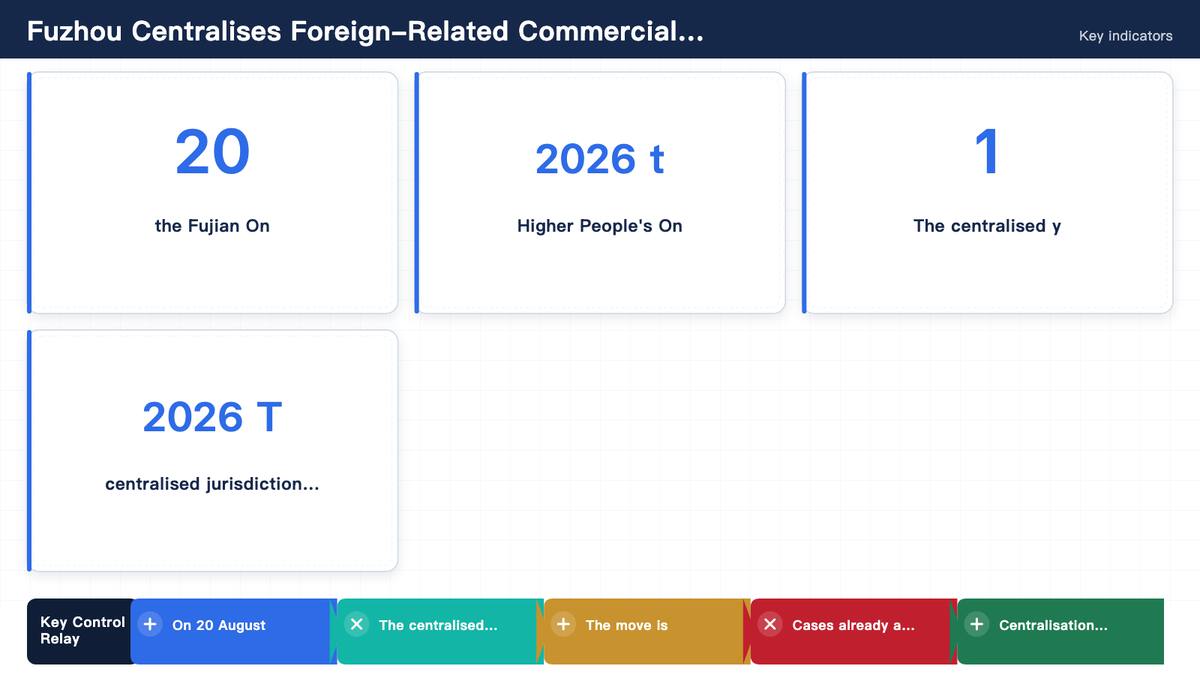
- On 20 August 2026 the Fujian Higher People’s Court announced that, with approval of the Supreme People’s Court, first-instance foreign-related, Hong Kong-, Macao- and Taiwan-related commercial cases from six urban districts of Fuzhou will be centrally handled by Cangshan District People’s Court from 1 October 2026.
2026 年 8 月 20 日,福建省高级人民法院公告,经最高人民法院批准,自 2026 年 10 月 1 日起,福州六城区第一审涉外、涉港澳台商事案件由仓山区人民法院集中管辖。- The centralised jurisdiction covers cases with a claim amount below RMB 40 million in the first instance, previously within the jurisdiction of Cangshan and the courts of Gulou, Taijiang, Jin’an, Mawei and Changle districts.
集中管辖覆盖标的额为人民币 4000 万元以下(不含本数)的第一审涉外、涉港澳台商事案件,含仓山区本辖区及原由鼓楼、台江、晋安、马尾、长乐五区法院管辖的案件。- The move is anchored in Article 4(1) of the SPC’s Provisions on Jurisdiction over Foreign-Related Civil and Commercial Cases (Fa Shi [2022] No. 18), which allows higher courts, with SPC approval, to centralise such cases in designated lower courts.
公告依据《最高人民法院关于涉外民商事案件管辖若干问题的规定》(法释〔2022〕18 号)第四条第一款作出,该条允许高级法院经最高法批准将此类案件集中到指定下级法院。- Cases already accepted but not yet concluded by the five district courts before 1 October 2026 will continue to be tried by the original courts; the new rule applies to filings on or after the effective date.
2026 年 10 月 1 日前鼓楼、台江、晋安、马尾、长乐五区法院已受理尚未审结的案件,仍由原审理法院继续审理;新规则适用于生效之日起的新立案。- Centralisation is part of a national trend: Cangshan hosts the Maritime Silk Road Court, and Fuzhou is building a “Maritime Silk Road Legal Services District” that integrates an international arbitration centre, notary services and lawyer services under one roof.
集中管辖是全国趋势的一部分:仓山区设有”海丝法庭”,福州正打造”海丝中央法务区”,把国际仲裁中心、公证中心与律师服务中心集于一处。- For foreign-invested companies litigating or contracting in Fujian, the practical effect is a more predictable forum: one court, one set of procedures and specialised judges for cross-border commercial disputes under RMB 40 million.
对在闽经营或缔约的外资企业,实际效果是更可预期的管辖法院:4000 万元以下的跨境商事争议将由一家法院、一套程序、专业法官集中处理。
Fuzhou Centralises Foreign-Related Commercial Jurisdiction in Six Urban Districts: What It Means for Cross-Border Dispute Resolution in Fujian | 福州六城区涉外涉港澳台商事案件集中管辖:对福建跨境争议解决的意义
The announcement
On 20 August 2026 the Fujian Higher People’s Court published a public notice on centralised jurisdiction over first-instance foreign-related, Hong Kong-, Macao- and Taiwan-related commercial cases in six urban districts of Fuzhou. With the approval of the Supreme People’s Court, and with effect from 1 October 2026, Fuzhou’s Cangshan District People’s Court will centrally handle such cases within its own jurisdiction and those previously handled by the district courts of Gulou, Taijiang, Jin’an, Mawei and Changle, where the amount in dispute in the first instance is below RMB 40 million (not including RMB 40 million itself). Cases already accepted but not yet concluded by the five district courts before 1 October 2026 remain with the original courts. The notice states that any earlier rules inconsistent with it are superseded.
The legal basis
The announcement cites Article 4(1) of the Supreme People’s Court’s Provisions on Jurisdiction over Foreign-Related Civil and Commercial Cases (Fa Shi [2022] No. 18), in force since 1 January 2023. That instrument reformed the old system under which first-instance foreign-related cases were concentrated in intermediate courts: it returned most first-instance foreign-related civil and commercial cases to grassroots courts, set standards based on case value and case type, and — relevant here — expressly permitted a higher people’s court, with SPC approval, to designate specific lower courts for centralised handling. Fuzhou’s Cangshan court is a designated court under exactly this authority. The legal effect is that parties no longer need to guess which of six urban-district courts will hear a cross-border commercial dispute; the forum is fixed by a single notice.
Why centralisation matters in practice
Centralised jurisdiction produces three practical benefits for foreign parties. First, predictability: a foreign investor or trading partner can determine the competent court in advance, which matters for drafting jurisdiction clauses and for estimating procedural timelines. Second, specialisation: concentrating cross-border commercial cases in one court builds judicial expertise in foreign contract law, letters of credit, guarantees, bills of lading, foreign-invested enterprise disputes and recognition and enforcement issues; consistent rulings reduce forum-shopping and legal risk. Third, procedural efficiency: one court applies one set of filing, service and evidence rules, reducing the risk of venue objections and transfers between district courts, which in cross-border cases are particularly costly in time. The RMB 40 million threshold also signals a division of labour: cases above the threshold continue to follow the standard jurisdiction rules, typically to the intermediate court.
The context: the Maritime Silk Road Legal Services District
The centralisation is not an isolated measure. Cangshan hosts the Maritime Silk Road Court (Haishi Fating), created by converting the Jinshan Tribunal into a specialised court for commercial, IP and property-related disputes in Cangshan. Fuzhou is simultaneously building the Fuzhou Section of the Maritime Silk Road Central Legal Services District, which relocated to a new site at the end of 2025 and integrates a lawyer services centre, an administrative reconsideration centre, a notary centre, an international arbitration centre and a “Maritime Silk Road Legal Services Development Centre” in a “front shop, back factory” model — unified intake at the front, professional service units at the back. The district brings together 633 law firms across 33 provincial regions online, with service coverage reaching 35 countries and regions. The district courts’ business is the judicial arm of this broader legal-services ecosystem: a company that contracts in Fuzhou can now litigate in Cangshan, arbitrate at the international arbitration centre and obtain notarisation and certification in the same legal-services cluster.
The national trend behind the local move
Fuzhou follows a pattern visible across China since the 2023 amendment to the Civil Procedure Law and the 2022 jurisdiction provisions: encouraging lower-court centralisation of foreign-related cases and the establishment of international commercial courts and tribunals in major cities. Wuxi, Shenzhen, Suzhou, Chengdu and other cities have set up international commercial tribunals approved by the SPC; Shanghai and Beijing have international commercial courts. The rationale is consistent: as cross-border dispute volumes rise, China’s courts are concentrating expertise, unifying procedure and signalling to foreign parties that Chinese courts are a professional, efficient forum for commercial disputes — a deliberate complement to the arbitration institutions that have long been the default for international parties.
Practical guidance for foreign companies
For a foreign-invested enterprise or trading counterparty with operations in Fujian, the practical checklist is: (1) review jurisdiction clauses in contracts governed by Chinese law to confirm whether Cangshan is the designated forum for disputes under RMB 40 million; (2) when drafting new contracts with Fujian counterparties, consider whether to elect Cangshan or the international arbitration centre in the legal services district; (3) for existing cases, confirm which court holds jurisdiction under the transitional rule — cases accepted before 1 October 2026 stay where they are; (4) use the legal services district for notarisation, authentication and translation services to keep evidence in order; and (5) monitor whether neighbouring regions adopt similar centralisation, which would further streamline cross-border dispute resolution in the province. The new regime does not change substantive law or the recognition and enforcement of foreign judgments — it changes which Chinese court hears a first-instance cross-border commercial case, and that change is, for most parties, a welcome simplification.
Outlook
Centralised foreign-related jurisdiction in Fuzhou will take effect on 1 October 2026. In the medium term, expect the Cangshan court to publish its own procedural guidance, for the volume of cross-border commercial cases in Fuzhou to concentrate in a single docket, and for the Maritime Silk Road legal-services ecosystem to deepen the integration of litigation, arbitration and notarial services. For foreign parties, the practical message is simple: cross-border dispute resolution in Fujian is becoming more specialised, more centralised and more predictable.
Sources
- 福建省高级人民法院 — 《福建省高级人民法院关于对福州六城区第一审涉外、涉港澳台商事案件实行集中管辖的公告》(2026-08-20):https://www.fjcourt.gov.cn/Page/Court/News/ArticleTradition/3f587167-53c3-4671-a217-b485c59b83e0.html
- 福建长安网 — 《福州六城区涉外涉港澳台商事案件将实行集中管辖》(2026-08-20):http://www.pafj.net/caw/f/2/viewPreview-1-797057.html
- 福州市人民政府 — 专访福州市行政服务中心管委会(2026-08-14,介绍海丝中央法务区福州片区”1法庭+5中心”布局、海丝法庭争取最高院授权集中管辖):https://www.fuzhou.gov.cn/zgfzhd/zxft/wqhg/202608/t20260814_5358929.htm
- 最高人民法院 — 《最高人民法院关于涉外民商事案件管辖若干问题的规定》(法释〔2022〕18号,2023年1月1日起施行,第四条第一款):https://www.court.gov.cn/
福州六城区涉外涉港澳台商事案件集中管辖:对福建跨境争议解决的意义
公告内容
2026 年 8 月 20 日,福建省高级人民法院发布关于对福州六城区第一审涉外、涉港澳台商事案件实行集中管辖的公告。经最高人民法院批准,自 2026 年 10 月 1 日起,福州市仓山区人民法院集中管辖其辖区以及原由鼓楼、台江、晋安、马尾、长乐五区人民法院管辖的、标的额为人民币 4000 万元以下(不含本数)的第一审涉外、涉港澳台商事案件。2026 年 10 月 1 日前五区法院已受理尚未审结的案件,仍由原审理法院继续审理。公告明确,此前规定与公告不一致的,按公告执行。
法律依据
公告援引《最高人民法院关于涉外民商事案件管辖若干问题的规定》(法释〔2022〕18 号,2023 年 1 月 1 日起施行)第四条第一款。该文件改革了旧的”涉外一审案件集中于中级法院”体系:将多数一审涉外民商事案件回归基层法院,按案件标的与类型设定标准,并在相关条款中明确允许高级人民法院经最高人民法院批准指定特定下级法院集中管辖。福州仓山区法院正是依据这一授权被指定。法律效果是:当事人不再需要猜测六城区中哪家法院审理跨境商事争议,管辖法院由一份公告一次性固定。
集中管辖的实践价值
集中管辖为外国当事人带来三项实际收益。第一,可预期性:外国投资者或贸易伙伴可预先确定管辖法院,这对起草管辖条款、估算程序周期至关重要。第二,专业化:将跨境商事案件集中于一家法院,可积累涉外合同法、信用证、保函、提单、外商投资企业纠纷与承认执行问题的审判经验;裁判尺度统一减少”择地行诉”与法律风险。第三,程序效率:一家法院适用一套立案、送达与证据规则,降低管辖异议与区际移送风险——跨境案件中此类程序消耗尤为昂贵。4000 万元门槛也显示分工:超门槛案件继续按标准管辖规则办理,通常进入中级法院。
背景:海丝中央法务区
集中管辖并非孤立措施。仓山区设有”海丝法庭”(由金山法庭整建制进驻升级而成),专业管辖仓山区商事、知识产权及涉房涉地纠纷。福州同时在建设”海丝中央法务区”福州片区,该片区 2025 年底迁入新址,按”前店后厂、线上线下结合”模式集成律师行业服务高质量发展中心、行政复议中心、公证中心、国际仲裁中心与海丝法务发展中心——前台统一收件、分类流转、跟踪督办,后台由各进驻单位提供专业服务。法务区线上”云平台”汇聚 33 个省级行政区 633 家律所资源,业务辐射全球 35 个国家和地区。仓山区法院的集中管辖正是这一更大法律服务生态的司法臂膀:在福州缔约的公司,如今可在仓山诉讼、在国际仲裁中心仲裁、在同一法务集群完成公证认证。
地方动作背后的全国趋势
福州的举措顺应了 2023 年《民事诉讼法》修改与 2022 年管辖规定以来全国可见的模式:鼓励涉外案件向基层集中,并在一线城市设立国际商事法庭与法庭。无锡、深圳、苏州、成都等城市已设立经最高法批准的国际商事法庭;上海、北京设有国际商事法院。逻辑一致:随着跨境争议量上升,中国法院集中专业力量、统一程序、向外国当事人传递”中国法院是专业高效的商事争议解决机构”的信号——这是对长期作为国际当事人默认选择的仲裁机构的刻意补充。
外资企业实操指引
对在福建经营或有交易对手的外资企业,实操清单是:(1)审阅适用中国法的合同管辖条款,确认 4000 万元以下争议是否落入仓山管辖;(2)与福建对手方起草新合同时,考虑选择仓山法院还是法务区国际仲裁中心;(3)既有案件确认过渡规则下的管辖——2026 年 10 月 1 日前已受理的维持原法院;(4)利用法务区获取公证、认证与翻译服务,保持证据有序;(5)关注邻近地区是否跟进同类集中管辖,进一步简化全省跨境争议解决。新制度不改变实体法,也不改变外国判决的承认与执行规则——它改变的是哪家中国法院审理一审跨境商事案件,而这一改变对多数当事人而言是受欢迎的简化。
展望
福州涉外集中管辖将于 2026 年 10 月 1 日生效。中期可预期:仓山法院将发布自身程序指引,福州跨境商事案件将集中于单一案卷,海丝法律服务生态将深化诉讼、仲裁与公证的一体化。对外国当事人,信息简洁:福建的跨境争议解决正变得更专业、更集中、更可预期。
Sources
- 福建省高级人民法院 — 《福建省高级人民法院关于对福州六城区第一审涉外、涉港澳台商事案件实行集中管辖的公告》(2026-08-20):https://www.fjcourt.gov.cn/Page/Court/News/ArticleTradition/3f587167-53c3-4671-a217-b485c59b83e0.html
- 福建长安网 — 《福州六城区涉外涉港澳台商事案件将实行集中管辖》(2026-08-20):http://www.pafj.net/caw/f/2/viewPreview-1-797057.html
- 福州市人民政府 — 专访福州市行政服务中心管委会(2026-08-14):https://www.fuzhou.gov.cn/zgfzhd/zxft/wqhg/202608/t20260814_5358929.htm
- 最高人民法院 — 涉外民商事审判与司法解释发布平台:https://www.court.gov.cn/