
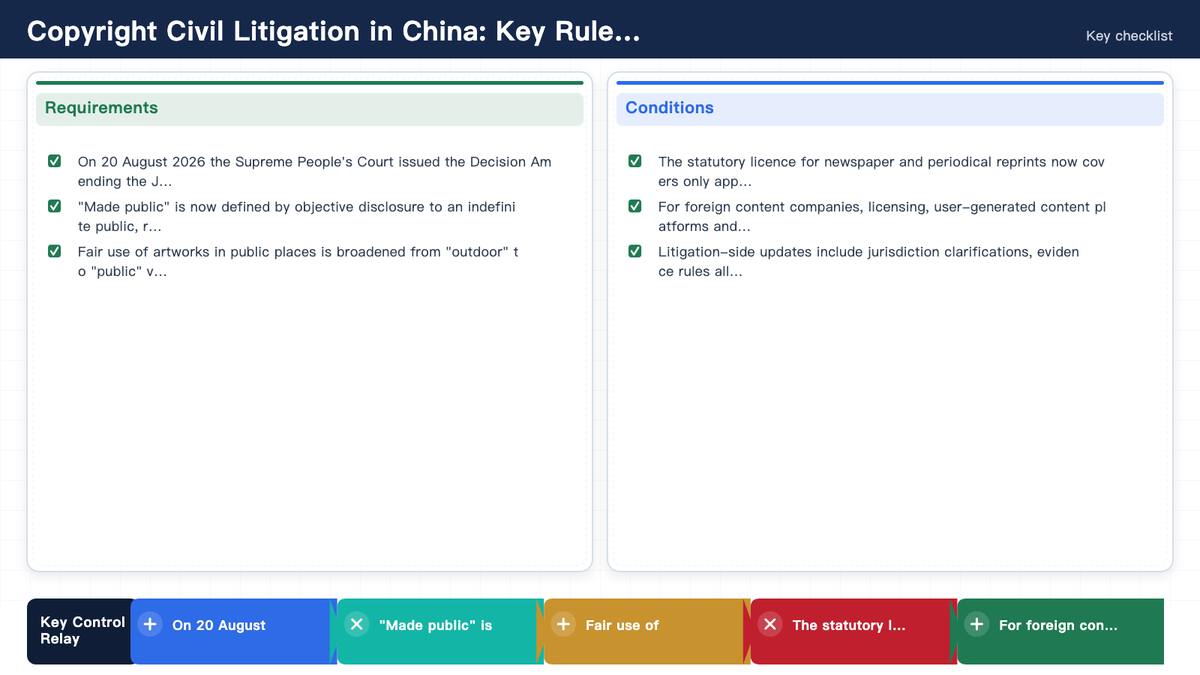
- On 20 August 2026 the Supreme People’s Court issued the Decision Amending the Judicial Interpretation on Copyright Civil Disputes (Fa Shi [2026] No. 18), effective 1 September 2026.
2026 年 8 月 20 日,最高人民法院发布《关于修改〈最高人民法院关于审理著作权民事纠纷案件适用法律若干问题的解释〉的决定》(法释〔2026〕18 号),自 2026 年 9 月 1 日起施行。
- “Made public” is now defined by objective disclosure to an indefinite public, removing the requirement that disclosure be made by or with the author’s permission; even infringing disclosure can trigger the standard.
“公之于众”的认定改为客观标准:只要将作品向不特定人公开即构成,删去了”著作权人自行或者经著作权人许可”的限定;因侵权行为而公开也属于公之于众。
- Fair use of artworks in public places is broadened from “outdoor” to “public” venues, with a proviso that re-use must be within a reasonable manner and scope and may not re-exhibit or publicly disseminate the work in the same way without permission.
合理使用中的”室外公共场所的艺术作品”修改为”公共场所的艺术作品”,并增加但书:临摹、绘画、摄影、录像人可合理再使用其成果,但未经许可不得以相同方式设置、陈列或公开传播。
- The statutory licence for newspaper and periodical reprints now covers only approved paper publications and their consistent digital versions; reprints between press entities and internet service providers require permission and payment.
报刊转载法定许可的适用范围收紧为”经主管部门批准出版的纸质报刊及其内容和版面格式相一致的数字化版本”;报刊与互联网信息服务提供者之间、互联网服务提供者之间的相互转载须经许可并支付报酬。
- For foreign content companies, licensing, user-generated content platforms and press aggregators should re-check their contract terms, moderation rules and takedown processes against the clarified boundaries before 1 September.
对外资内容企业,许可合同、UGC 平台与媒体聚合服务应在 9 月 1 日前对照新边界复核合同条款、审核规则与下架流程。
- Litigation-side updates include jurisdiction clarifications, evidence rules allowing certification or appraisal bodies, three-year limitation for continuing infringement, and damage calculation factoring in fault degree.
诉讼层面同步更新:管辖规则、认证或鉴定机构证明的证据效力、持续侵权的三年诉讼时效,以及综合过错程度确定赔偿数额。
Copyright Civil Litigation in China: Key Rule Changes Under the 2026 SPC Interpretation | 中国著作权民事诉讼:2026 年最高法司法解释要点变化
Why this matters now
On 20 August 2026, the Supreme People’s Court (SPC) published the Decision Amending the Judicial Interpretation on Several Issues Concerning the Application of Law in the Trial of Copyright Civil Dispute Cases (Fa Shi [2026] No. 18). The Decision was adopted by the SPC Judicial Committee at its 1976th session on 25 May 2026 and takes effect on 1 September 2026. It amends the interpretation originally issued as Fa Shi [2002] No. 31 and first revised in 2020, aligning judicial practice with the Copyright Law as amended in 2020. For foreign-invested companies operating content platforms, media services, online education, software, or licensing businesses in China, the clarified standards directly affect litigation risk, contract drafting and compliance workflows. This article explains the core changes and their practical consequences.
The three core boundary changes
The first change concerns the definition of “made public” (gong zhi yu zhong). The amended Article 8 provides that making a work public under Article 10(1)(1) of the Copyright Law means disclosing the work to an indefinite number of people, without requiring that the public actually becomes aware of it. The old wording that disclosure must be by the copyright owner or with the owner’s permission has been deleted. This means that even where a work first becomes publicly visible through infringing upload or distribution, the “made public” element is satisfied. Rights holders can therefore assert publication-related rights more easily in infringement cases.
The second change refines fair use of artistic works in public places. The former Article 18 referred to artistic works “in outdoor public places”; the amended Article 16 follows the 2020 Copyright Law by removing the word “outdoor”, so the rule now covers sculptures, paintings, calligraphy and other artistic works set up or displayed in places where the public engages in activities, including commercial galleries and exhibition halls. People who sketch, paint, photograph or record such works may use their own results within a reasonable manner and scope, but without the copyright owner’s permission they may not set up, display or publicly disseminate the work in the same way. This creates a clear “record first, distribute only under licence” rule for museums, exhibition spaces and content creators.
The third change tightens the statutory licence for press reprints. The amended Article 17 clarifies that “reprint” under Article 35(2) of the Copyright Law covers paper newspapers and periodicals approved by the competent authority and digital versions whose content and layout are consistent with the paper version. By contrast, reprints between newspapers/periodicals and internet service providers, and reprints between internet service providers, do not qualify for the statutory licence and require the copyright owner’s permission and payment. This directly affects media aggregators, news apps and UGC platforms that republish articles across the web.
Other litigation-relevant updates
Beyond the three headline changes, the Decision makes a series of procedural and remedial adjustments relevant to foreign claimants and defendants alike. Case scope now expressly includes confirmation of non-infringement actions and damage disputes arising from interim injunctions. Evidence rules allow certification or appraisal bodies to provide proof in copyright cases. The damages provision now covers “reasonable royalty for the right” alongside actual loss and unlawful gains, and courts are directed to consider the work type, the degree of fault of the alleged infringer and the nature and consequences of the infringement. The limitation period is three years from when the rights holder knows or should know of the harm; for continuing infringement within the protection period, damages are calculated for the three years before the filing date. Transitional rules apply the amended law to facts occurring after the amendment, while preserving the old law for prior facts unless otherwise provided.
Practical steps for foreign companies
Foreign content, media and platform companies should take four practical steps before 1 September 2026. First, audit content licences: confirm that licence scope covers digital reproduction, reprints across platforms and user-generated redistribution, and that press reprint clauses are renegotiated where they rely on the statutory licence. Second, review platform moderation rules: user-uploaded content that mirrors public artworks, press articles or brand assets should be checked against the new “made public” and fair-use boundaries, and takedown procedures updated accordingly. Third, update litigation preparation: documentary evidence, certification or appraisal reports, and records of first-publication dates will be central to enforcement; maintain publication logs and chain-of-custody for creative assets. Fourth, coordinate with local counsel on jurisdiction: the clarified rules on venue for infringement, storage of infringing copies and joint actions across multiple defendants help plan where to sue and how to aggregate claims.
Compliance notes
The Decision applies to disputes where the underlying facts occurred after the amended Copyright Law took effect; consult the transitional clause where conduct straddles the amendment date. The clarifications favour rights holders on the “made public” standard and courts on consistent damages assessment, but they also raise the cost of non-compliance for intermediaries that rely on lax reprint assumptions. Foreign companies should treat 1 September 2026 as the compliance deadline, not as the date when enforcement starts.
中国著作权民事诉讼:2026 年最高法司法解释要点变化
为什么当下重要
2026 年 8 月 20 日,最高人民法院发布《关于修改〈最高人民法院关于审理著作权民事纠纷案件适用法律若干问题的解释〉的决定》(法释〔2026〕18 号)。该决定经 2026 年 5 月 25 日最高人民法院审判委员会第 1976 次会议通过,自 2026 年 9 月 1 日起施行。它修改的是法释〔2002〕31 号、2020 年修正的司法解释,使裁判口径与 2020 年修正的《著作权法》保持一致。对在中国运营内容平台、媒体服务、在线教育、软件或授权业务的外资企业,这些明确的裁判标准直接影响诉讼风险、合同起草与合规流程。本文解释核心变化及其实务影响。
三处核心边界变化
第一处是”公之于众”的认定。修改后的第八条规定:著作权法第十条第一款第一项规定的”公之于众”,是指将作品向不特定的人公开,但不以公众知晓为构成条件。删去了旧解释中”著作权人自行或者经著作权人许可”的限定。这意味着,即便作品首次公开展示源于侵权上传或传播,”公之于众”要件也告满足,权利人主张发表类权利更容易获得支持。
第二处是公共场所艺术作品的合理使用。原第十八条限定”室外公共场所的艺术作品”;修改后的第十六条与 2020 年著作权法一致,删去”室外”,将规则覆盖范围扩展至设置或陈列在社会公众活动处所的雕塑、绘画、书法等艺术作品,包括公共及商业性的美术馆、展览馆。对这类作品进行临摹、绘画、摄影、录像的人,可在合理的方式和范围内使用其成果,但未经著作权人许可,不得以相同方式设置、陈列或公开传播。这为博物馆、展陈空间与内容创作者确立了”可记录、未经授权不可同方式再传播”的清晰规则。
第三处是报刊转载法定许可的范围。修改后的第十七条明确,著作权法第三十五条第二款规定的转载,指经主管部门批准出版的纸质报纸、期刊及其内容和版面格式相一致的数字化版本登载其他报刊已发表作品的行为。而报纸、期刊与互联网信息服务提供者之间相互转载、互联网服务提供者之间相互转载已发表作品的,不适用法定许可,应当经著作权人许可并支付报酬。这直接影响跨网络转载的媒体聚合平台、新闻客户端与 UGC 平台。
其他与诉讼相关的更新
除三大核心变化外,该决定还作出一系列与诉讼程序及救济相关、对外国原被告都有意义的调整。受案范围明确纳入确认不侵害著作权纠纷、因申请诉前或诉中行为保全引发的损害责任纠纷。证据规则允许认证或鉴定机构出具证明作为证据。赔偿条款在”实际损失、违法所得”之外加入”合理权利使用费难以计算”的情形,并要求考虑作品类型、被诉侵权人过错程度、侵权行为性质及后果综合确定赔偿数额。诉讼时效为权利人知道或应当知道权利受损及义务人之日起三年;对保护期内仍在持续的侵权行为,损害赔偿数额自起诉之日起向前推算三年计算。过渡条款规定修改后法律事实适用新法,此前发生的事实适用旧法,另有规定除外。
外资企业的实操步骤
外资内容、媒体与平台企业应在 2026 年 9 月 1 日前完成四件事。其一,审查内容许可:确认授权范围涵盖数字化复制、跨平台转载与用户生成内容再分发;依赖报刊转载法定许可的合同条款需重新谈判。其二,复核平台治理规则:对镜像公共场所艺术作品、报刊文章或品牌素材的用户上传内容,对照新的”公之于众”与合理使用边界检查,并更新下架流程。其三,更新诉讼准备:原始底稿、认证或鉴定报告、首发时间记录是维权重心,应保留创作资产的时间戳与完整链条。其四,与本地律师协调管辖策略:新的侵权实施地、侵权复制品储藏地及多被告共同诉讼规则,有助于规划起诉地点与聚合主张。
合规提示
该决定适用于修正后著作权法施行后发生的法律事实;跨修正时点的行为请对照过渡条款。新标准在”公之于众”上利好权利人、在损害赔偿上统一裁判尺度,但也提高了依赖宽松转载假设的中间平台的不合规成本。外资企业应把 2026 年 9 月 1 日视为合规截止日,而非执法起点。
Sources
- 最高人民法院《关于修改〈最高人民法院关于审理著作权民事纠纷案件适用法律若干问题的解释〉的决定》(2026-08-20):https://www.court.gov.cn/zixun/xiangqing/509271.html
- 天津海事法院网站转载(法释〔2026〕18 号修改后全文,2026-08-20):http://thzy.e-court.gov.cn/article/detail/2026/08/id/9461995.shtml
- 中国网《9月1日起施行 最高法发布著作权民事纠纷司法解释修改决定》(2026-08-20):https://big5.china.com.cn/gate/big5/news.china.com.cn/2026-08/20/content_118656507.shtml
- 法治日报·法治网《最高法修改审理著作权民事纠纷案件相关司法解释》(2026-08-20):https://www.legaldaily.com.cn/index/content/2026-08/20/content_9443720.html