
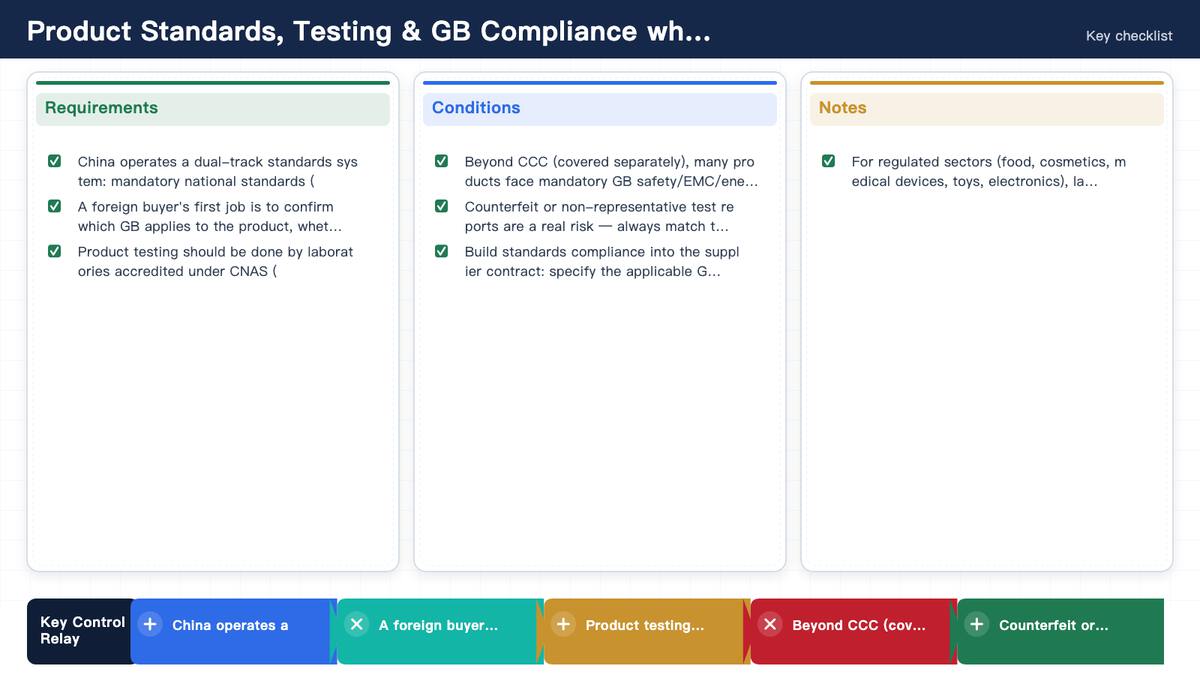
- China operates a dual-track standards system: mandatory national standards (强制性国家标准, “GB” without a slash) are legally binding, while recommended standards (推荐性, “GB/T”) are voluntary unless referenced by regulation or contract.
中国实行双轨标准体系:强制性国家标准(不带斜杠的”GB”)具法律约束力,推荐性标准(”GB/T”)原则上自愿,但若被法规或合同引用则须执行。- A foreign buyer’s first job is to confirm which GB applies to the product, whether it is mandatory, and which version is currently in force — using the official National Public Service Platform for Standards (全国标准信息公共服务平台).
外资买家的首要任务是确认产品适用哪项 GB、是否强制、现行版本为何——通过官方”全国标准信息公共服务平台”查询。- Product testing should be done by laboratories accredited under CNAS (中国合格评定国家认可委员会) and, for China-market release, by CMA-recognised inspection bodies (检验检测机构资质认定) — verify credentials on the national accreditation platform before relying on a report.
产品检测应由 CNAS(中国合格评定国家认可委员会)认可的实验室,以及面向中国市场的 CMA(检验检测机构资质认定)机构完成——在依赖报告前于国家认可平台核验资质。- Beyond CCC (covered separately), many products face mandatory GB safety/EMC/energy or food-contact requirements; the 2026 SAMR drive tightened CCC supervision and pushed “same line, same standard, same quality” for domestic and export goods.
除 CCC(另文专述)外,众多产品还须满足强制性 GB 安全/电磁兼容/能效或食品接触要求;2026 年市场监管总局强化 CCC 监管,并推进内外贸产品”同线同标同质”。- Counterfeit or non-representative test reports are a real risk — always match the laboratory’s scope (CNAS/CMA) to the exact standard and product, and keep the original, dated report in the file.
虚假或不具代表性的检测报告是真实风险——务必将实验室的 CNAS/CMA 范围与确切标准及产品对应,并留存带日期的原件。- Build standards compliance into the supplier contract: specify the applicable GB version, require valid test reports, and define incoming-inspection and recall responsibilities.
将标准合规写入供应商合同:明确适用 GB 版本、要求有效检测报告,并约定进货检验与召回责任。- For regulated sectors (food, cosmetics, medical devices, toys, electronics), layer GB compliance with the sector regulator’s filing/marketing-authorisation rules — standards are necessary but not sufficient.
对食品、化妆品、医疗器械、玩具、电子等受监管行业,须将 GB 合规与行业主管部门的备案/上市许可规则叠加——标准合规是必要非充分条件。
Product Standards, Testing & GB Compliance when Sourcing from China: a buyer’s checklist | 在华采购的产品标准、检测与国标(GB)合规:买家清单
Overview
When a foreign buyer sources from China, price and lead time matter — but a product that fails to meet Chinese (or destination) standards can mean rejected shipments, recalls, fines, and reputational damage. Compulsory Product Certification (CCC) grabs the headlines, yet the broader landscape of national standards (GB), mandatory versus recommended status, and third-party testing is where many sourcing compliance gaps actually hide.
This guide gives foreign-invested enterprises and procurement teams a practical map of China’s standards and testing regime, the official query tools, and a due-diligence checklist — grounded in the Standardization Law, SAMR/CNCA rules, and CNAS accreditation.
China’s standards hierarchy
China’s technical standards form a hierarchy:
- National standards (国家标准, “GB”): mandatory (强制性, “GB”) or recommended (推荐性, “GB/T”). Mandatory GB cover health, safety, environmental protection and fundamental matters and are legally binding.
- Industry standards (行业标准), local standards (地方标准), and group/enterprise standards (团体/企业标准) sit below national ones and cannot lower mandatory requirements.
The key buyer takeaway: a product may need to conform to a mandatory GB before it can be sold in China or, in some cases, before it can be exported (where the destination references the Chinese standard). Always confirm the current, in-force version — standards are revised, and using a superseded version is a common compliance miss.
Finding the right standard
Use the official, free platforms to identify applicable standards:
- National Public Service Platform for Standards Information (全国标准信息公共服务平台) — std.samr.gov.cn / www.samr.gov.cn: search mandatory and recommended national standards, see status (in force / to be abolished), and replacement relationships.
- Full-text open GB system (国家标准全文公开系统) — free access to most GB texts.
When screening a supplier, ask for the specific GB numbers and versions the product is built to, and cross-check them against the platform. Beware suppliers who answer only with “meets CE/FCC” — those are foreign certifications and do not substitute for applicable Chinese GB where one exists.
Testing and laboratory accreditation
A test report is only as good as the lab behind it. Two marks matter:
- CNAS (中国合格评定国家认可委员会, China National Accreditation Service): accreditation to ISO/IEC 17025 confirms the lab’s technical competence for specific tests. Check scope at www.cnas.org.cn.
- CMA (检验检测机构资质认定, China Inspection Body & Laboratory Mandatory Approval): required for reports used for China-market supervision, filing or release; a CMA mark is what makes a report legally effective domestically.
For products destined for the Chinese market, prefer a CNAS + CMA lab whose accredited scope explicitly covers your product’s standard and test items. For export-only goods, a CNAS-accredited (or foreign ILAC-MRA) lab is usually sufficient, but confirm the importing country’s acceptance.
Beyond CCC: mandatory GB requirements
CCC (covered in a separate guide) applies to a defined catalogue. But many products outside the CCC catalogue still face mandatory GB safety, EMC, energy-efficiency or food-contact requirements. In 2026 SAMR tightened CCC supervision — moving 16 products (e.g., small-power motors, motor-vehicle safety glass) from self-declaration to third-party certification, strengthening post-certification surveillance, and advancing the “same line, same standard, same quality” (同线同标同质) action so domestic and export goods meet comparable requirements. The lesson: CCC is not the whole of conformity — map the full set of mandatory GB that touch your product.
Common pitfalls
- Superseded versions: a report citing an old GB edition that has been replaced.
- Wrong scope: a CNAS/CMA certificate that does not cover your exact product or test method.
- “Factory self-test” passed off as independent: insist on an independent, accredited lab for conformity evidence.
- Representative-sample gaps: the tested sample differs from mass-produced units (factory vs. production line).
- Mismatch with destination rules: Chinese GB satisfied, but the destination market (EU/US/etc.) requires its own marks — plan for both.
A buyer’s due-diligence checklist
- Identify applicable standards via the national platform; note mandatory vs recommended and the in-force version.
- Require the supplier’s GB conformance matrix listing each applicable GB, version, and status.
- Demand independent test reports from CNAS (and CMA for China-market) labs whose scope matches.
- Verify lab credentials on CNAS/CNCA platforms before accepting reports.
- Check CCC scope — if the product is in the CCC catalogue, CCC is mandatory alongside GB.
- Contract the requirements: specify GB version, report validity, incoming inspection, and recall/rectification responsibility.
- Keep an audit file with dated originals; re-test on material or design change.
- Layer sector rules (food, cosmetics, medical devices, toys, electronics) on top of GB.
What to do next
- Build a standards register for your China-sourced product lines.
- Audit existing suppliers against the checklist; flag gaps.
- Specify GB conformance in new RFQs and contracts.
- Pre-shipment verification: independent re-test or document review for high-risk items.
- Monitor revisions of key GBs via the standards platform.
Sources
- Standardization Law of the PRC and SAMR rules on mandatory/recommended national standards — State Administration for Market Regulation: www.samr.gov.cn.
- National Public Service Platform for Standards Information: std.samr.gov.cn; Full-text open GB system via SAMR portal.
- China National Accreditation Service for Conformity Assessment (CNAS): www.cnas.org.cn; Certification and Accreditation Administration (CNCA) and the national accreditation platform: www.cnca.gov.cn.
- SAMR press conference transcript, “Strict supervision of compulsory product certification” (2026) — www.samr.gov.cn/hd/zxft/art/2026/art_28310b9611894f8b91d796811d15c416.html.
Related reading
- Compulsory Product Certification (CCC) & Sourcing Compliance for Foreign Buyers
- Supplier Due Diligence in China: a practical checklist
- Export Control & Dual-Use Items: what foreign buyers must check
在华采购的产品标准、检测与国标(GB)合规:买家清单
概述
外资买家在华采购,价格与交期固然重要;但不符合中国(或目的地)标准的产品,可能意味着退运、召回、罚款与声誉受损。强制性产品认证(CCC)最引人注目,然而更广阔的国家标准(GB)、强制与推荐属性,以及第三方检测版图,才是许多采购合规漏洞真正的藏身之处。
本指南为外商投资企业及采购团队提供中国标准与检测体系、官方查询工具及尽调清单的务实地图——依据《标准化法》、市场监管总局/国家认监委规则及 CNAS 认可体系。
中国标准体系层级
中国技术标准呈层级结构:
- 国家标准(”GB”): 分强制性(”GB”)与推荐性(”GB/T”)。强制性 GB 涉及健康、安全、环保与基础事项,具法律约束力。
- 行业标准、地方标准、团体/企业标准位于国标之下,且不得低于强制性要求。
买家要点:产品在中国销售前(某些出口情形亦同)可能须符合强制性 GB。务必确认现行有效版本——标准会修订,使用已被替代的旧版是常见合规疏漏。
找到适用的标准
使用官方免费平台识别适用标准:
- 全国标准信息公共服务平台——std.samr.gov.cn / www.samr.gov.cn:检索强制与推荐性国家标准,查看状态(现行/即将废止)及替代关系。
- 国家标准全文公开系统——免费查阅绝大多数 GB 文本。
审核供应商时,要求其提供产品所依具体 GB 编号与版本,并与平台交叉核对。警惕仅以”符合 CE/FCC”作答的供应商——这些是外国认证,在有适用中国 GB 时不能替代。
检测与实验室认可
检测报告的价值取决于出具它的实验室。两个标志至关重要:
- CNAS(中国合格评定国家认可委员会): 依据 ISO/IEC 17025 的认可,确认实验室对特定测试的技术能力,范围见 www.cnas.org.cn。
- CMA(检验检测机构资质认定): 用于中国市场监督、备案或放行的报告必须具备;CMA 标志使报告在国内具法律效力。
面向中国市场的产品,宜优先选择CNAS + CMA且认可范围明确覆盖你产品标准与测试项的实验室。纯出口货物通常 CNAS 认可(或外国 ILAC-MRA)实验室即可,但须确认进口国接受。
超越 CCC:强制性 GB 要求
CCC(另文专述)适用于既定目录。但目录外众多产品仍须满足强制性 GB 安全、电磁兼容、能效或食品接触要求。2026 年市场监管总局强化 CCC 监管——将小功率电动机、机动车安全玻璃等 16 种产品由自我声明转为第三方认证,加强获证后监督,推进”同线同标同质”行动,使内外贸产品满足可比要求。启示:CCC 不等于全部符合性——须梳理触及你产品的全部强制性 GB。
常见陷阱
- 版本被替代: 报告引用已被替代的旧版 GB。
- 范围不符: CNAS/CMA 证书未覆盖你的确切产品或测试方法。
- “工厂自检”冒充独立: 符合性证据应坚持由独立认可实验室出具。
- 代表性样本缺口: 受检样品与量产不一致(工厂样 vs 产线样)。
- 与目的地规则错配: 满足中国 GB,但目的地市场(欧盟/美国等)另有标志要求——须两者兼顾。
买家尽调清单
- 识别适用标准(经国家平台),注明强制/推荐与现行版本。
- 要求供应商提供 GB 符合性矩阵,列明每项适用 GB、版本与状态。
- 要求独立检测报告,来自范围匹配的 CNAS(中国市场另需 CMA)实验室。
- 在 CNAS/认监委平台核验实验室资质后再接受报告。
- 核查 CCC 范围——产品若属 CCC 目录,CCC 与 GB 须同时满足。
- 将要求写入合同:明确 GB 版本、报告有效期、进货检验与召回/整改责任。
- 留存带日期的原件审计档案;材料或设计变更时重测。
- 叠加行业规则(食品、化妆品、医疗器械、玩具、电子)于 GB 之上。
下一步建议
- 建立标准台账,覆盖在华采购的产品线。
- 按清单审计现有供应商,标注缺口。
- 在新 RFQ 与合同中明确 GB 符合性。
- 发货前验证: 高风险项做独立重测或文件复核。
- 通过标准平台监控关键 GB 的修订。
来源
- 《中华人民共和国标准化法》及市场监管总局关于强制性/推荐性国家标准的规定——国家市场监督管理总局:www.samr.gov.cn。
- 全国标准信息公共服务平台:std.samr.gov.cn;国家标准全文公开系统(经市场监管总局门户)。
- 中国合格评定国家认可委员会(CNAS):www.cnas.org.cn;国家认证认可监督管理委员会(CNCA)及国家认可平台:www.cnca.gov.cn。
- 市场监管总局”严格强制性产品认证监管”专题新闻发布会实录(2026)——www.samr.gov.cn/hd/zxft/art/2026/art_28310b9611894f8b91d796811d15c416.html。
相关阅读
- 在华采购的强制产品认证(CCC)与合规清单
- 在华供应商尽职调查:实操清单
- 出口管制与两用物项:从中国采购的外资买家必须核查什么