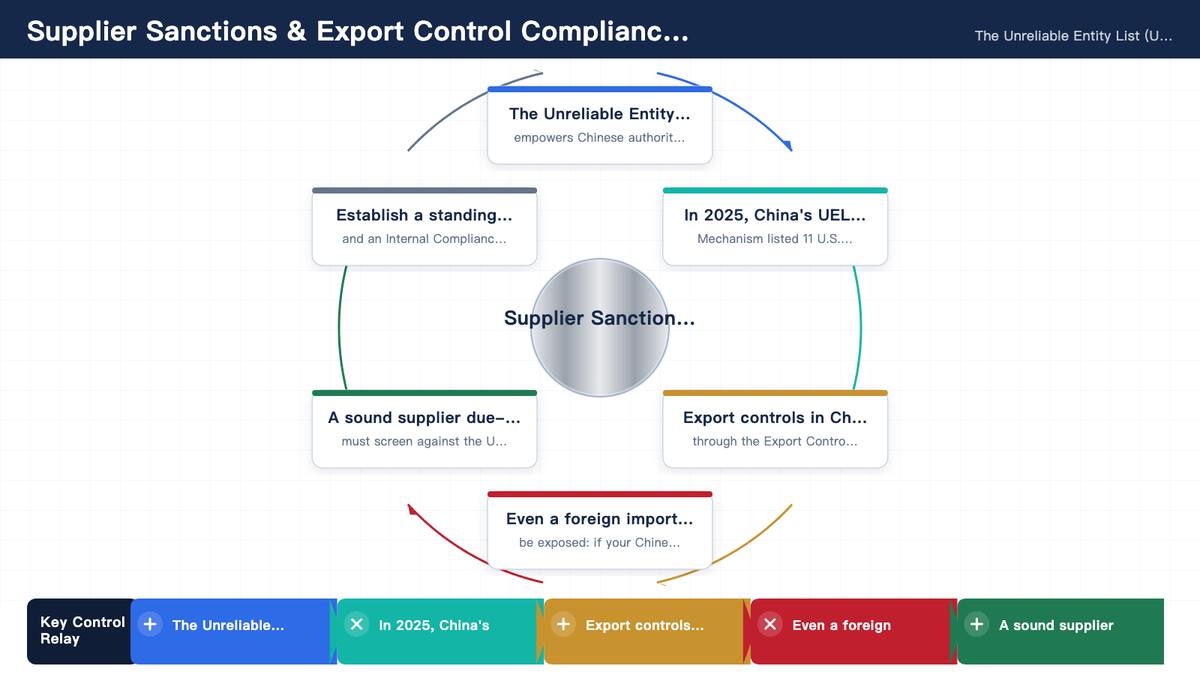
- The Unreliable Entity List (UEL) empowers Chinese authorities to restrict foreign entities that endanger China’s sovereignty, security, or development interests, through import/export bans, investment bans, and transaction/data-transfer prohibitions.
不可靠实体清单(UEL)赋予中国监管部门对危害中国主权、安全或发展利益的外国实体施加限制的权力,措施包括进出口禁令、投资禁令以及交易与数据传输禁令。
- In 2025, China’s UEL Working Mechanism listed 11 U.S. firms led by Skydio (Announcement 〔2025〕 No. 7, 4 Apr 2025) and later added entities including a counter-UAS technology company and TechInsights (Announcement 〔2025〕 No. 10, 9 Oct 2025), with strict domestic transaction and data-transfer bans.
2025年,中国不可靠实体清单工作机制将Skydio领衔的11家美国企业列入清单(公告〔2025〕7号,2025-04-04),随后又将某反无人机技术公司及TechInsights等列入(公告〔2025〕10号,2025-10-09),并禁止境内组织与个人与其交易、合作及传输数据。
- Export controls in China operate through the Export Control Law (2020) and the Regulations on Export Control of Dual-Use Items (State Council Order No. 792, effective 1 Dec 2024), which intersect directly with supplier due diligence.
中国的出口管制以《出口管制法》(2020)及《两用物项出口管制条例》(国务院令792号,2024-12-01施行)为框架,与供应商尽调直接交叉联动。
- Even a foreign importer can be exposed: if your Chinese supplier or in-country counterparty is listed or constrained by export controls, your supply, technology transfer, and cross-border data flows are directly affected.
即便是外资进口方亦难置身事外:若你的中国供应商或在华交易对手被列入清单或受出口管制约束,你的供货、技术转让与跨境数据流动都将受到直接影响。
- A sound supplier due-diligence program must screen against the UEL, entity/export-control lists, end-user and end-use reviews, and multilateral sanctions regimes (UN / U.S. / EU, etc.).
一套健全的供应商尽调程序必须比对不可靠实体清单、实体/出口管制清单、最终用户与最终用途审查,并交叉核对多边制裁名单(联合国、美国、欧盟等)。
- Establish a standing list-screening workflow and an Internal Compliance Program (ICP): screen before contracting, re-screen during performance, and retain records for inspection.
建立常态化名单筛查流程与内部合规程序(ICP):签约前查清单、履约中定期重筛、并保留筛查记录备查。
Supplier Sanctions & Export Control Compliance Screening: Navigating the Unreliable Entity List and Export Controls When Sourcing in China | 供应商制裁与出口管制合规筛查:在华采购面对不可靠实体清单与出口管制
Overview
For foreign companies sourcing from, manufacturing in, or partnering with suppliers in China, the compliance perimeter is no longer defined only by the destination country’s rules. China has built its own sanction-style toolkit — the Unreliable Entity List (UEL) and a modern export-control regime — that reaches foreign entities and, crucially, the Chinese counterparties you rely on. This article explains how these mechanisms work, what the 2025 enforcement cases show, and how foreign buyers should embed sanctions and export-control screening into supplier due diligence.
The core message is simple: compliant, law-abiding entities have nothing to fear, but ignorance is not a defense. A foreign buyer that fails to screen its Chinese suppliers against the UEL and export-control lists can find a key supply line severed, a technology transfer blocked, or a data-transfer arrangement rendered unlawful overnight. Screening is now a baseline obligation, not a luxury.
The Unreliable Entity List Mechanism
The UEL is established under the *Regulations on the Unreliable Entity List* (《不可靠实体清单规定》), issued by the Ministry of Commerce (MOFCOM). It targets foreign entities — not individuals in the ordinary sense, but companies, other organizations, and senior responsible persons — whose conduct endangers China’s sovereignty, security, or development interests.
Listing is triggered by activities such as: (1) endangering China’s national security or interests in international economic, trade, or scientific activities; (2) violating normal market transaction principles by boycotting or cutting off supplies to a Chinese entity; or (3) taking discriminatory measures against a Chinese entity that cause serious damage.
Once listed, an entity may face a graduated set of measures, individually or in combination:
- Prohibition or restriction on import/export activities related to China;
- Prohibition or restriction on new investment in China;
- Prohibition or restriction on transactions, cooperation, or related activities with domestic organizations and individuals, including the transmission of data;
- Entry restrictions or visa bans for responsible persons; and
- Other necessary measures as specified by the authorities.
The UEL Working Mechanism, coordinated by MOFCOM’s Bureau of Security and Control, publishes the listings and the specific measures attached to each. The regime is deliberately flexible: the state can calibrate the response to the perceived threat, from a targeted data-transfer ban to a full import/export and investment freeze.
2025 Case Practice
The UEL moved from framework to active enforcement in 2025, and the cases are directly relevant to supply-chain and sourcing decisions.
Announcement 〔2025〕 No. 7 (4 April 2025). The UEL Working Mechanism added 11 U.S. entities, with Skydio Inc. as the most prominent name, to the Unreliable Entity List. The measures imposed included a prohibition on import/export activities related to China and a prohibition on new investment in China. For buyers, the signal was clear: drone and certain dual-use supply chains touching these named entities face hard legal barriers inside China.
Announcement 〔2025〕 No. 10 (9 October 2025). The Working Mechanism added further entities, including a counter-unmanned-aerial-system (counter-UAS) technology company and TechInsights Inc., to the list. The attached measures went further: domestic organizations and individuals were prohibited from transacting or cooperating with the listed entities and were explicitly prohibited from transmitting data to them. This is the first cluster of cases where the data-transfer prohibition was foregrounded, underscoring that “cooperation” under the UEL is read broadly to cover information and data flows, not just physical goods.
The trajectory matters: the UEL is expanding in scope (from export/interdiction conduct to analysis, technology, and data services) and in instrument (from trade and investment bans to transaction and data-flow bans). Foreign buyers whose suppliers, sub-suppliers, or service providers have any affiliation with listed entities inherit that risk.
Export Control Interplay
China’s export-control system is the second pillar. The *Export Control Law* (《出口管制法》), in force since 2020, provides the overarching legal basis. It is implemented in detail for dual-use items by the *Regulations on Export Control of Dual-Use Items* (《两用物项出口管制条例》, State Council Order No. 792), which took effect on 1 December 2024. Together they require licensing for the export of controlled items, technologies, and related technical data, and they impose end-user and end-use verification obligations.
For a foreign buyer, the linkage is two-way:
- If your Chinese supplier exports controlled dual-use items or technologies to you, the supplier needs a license and must confirm the end user and end use. As the overseas recipient, you become part of the control chain: you may be asked to provide end-user statements and to accept no-rediversion undertakings.
- If your supplier is itself constrained — by being a listed UEL entity, or by restrictions on certain transactions — the export or technology transfer to you may simply be unlawful for them, regardless of your own jurisdiction’s permissions.
A dedicated treatment of the export-control and dual-use framework is provided in this library’s companion article, *Export Control and Dual-Use Items* (see 采购供应-供应商尽调-66). The two compliance lenses — sanctions-style UEL screening and export-control licensing — should be run as one integrated workflow.
Why This Matters for Foreign Buyers
A common misconception is that these tools are aimed at Chinese exporters, so an overseas importer is safe. That is incorrect for three reasons:
- Your supply risk is your counterparty’s legal risk. If a Chinese supplier is on the UEL or is barred from a transaction, it cannot lawfully ship to you, transfer the technology, or even exchange the data needed to fulfill the contract. Your production line, not theirs, stops.
- Data and technology are in scope. The UEL’s transaction and data-transfer prohibitions mean that routine activities — sharing design files, sending test data, engaging in joint R&D, or even certain cloud-based collaboration — can become prohibited when a listed entity is anywhere in the chain.
- Multilateral exposure compounds. A supplier may be clean under Chinese law but sanctioned by the U.S. or EU, or vice versa. A buyer caught between overlapping regimes can face secondary-sanction or compliance conflicts that require careful structuring, not avoidance.
The reassuring corollary: entities that operate lawfully, respect market principles, and have no disqualifying affiliations are not targets. The system is designed to screen out bad actors, not to obstruct genuine trade. The practical task is therefore to *prove* you have screened — through process, not just intent.
Building a Supplier Due-Diligence Screening Program
An effective program integrates sanctions and export-control screening into the ordinary procurement lifecycle rather than treating it as a one-off checkbox. The minimum screening layers are:
- UEL screening. Check every Chinese (and where relevant, foreign) supplier, sub-supplier, and key service provider against the current Unreliable Entity List published by MOFCOM’s Bureau of Security and Control.
- Entity / export-control list comparison. Cross-reference suppliers against China’s export-control controlled-item and end-user lists, and, for completeness, against the U.S. Entity List, the EU and UN sanctions lists that may bear on your supply chain.
- End-user and end-use review. For any controlled or sensitive item, obtain and verify the ultimate consignee and intended use; reject transactions where the end use is military, unauthorized, or rediversion-prone.
- Multilateral sanctions cross-check. Confirm suppliers are not on UN, U.S., or EU sanctions rosters, and map any conflicts between regimes before contracting.
- Data-export and sensitive-information controls. Identify which contractual activities involve transmitting data to or from China, classify the data, and gate those flows on the screening result — especially where a listed entity could be involved.
Operational Recommendations
- Stand up an Internal Compliance Program (ICP). Document your screening methodology, risk appetite, escalation paths, and record-keeping. A written ICP is what regulators and counterparties will expect to see.
- Screen before you sign. Make list screening a hard gate in vendor onboarding. Do not execute supply, technology, or data agreements until the counterparty clears all layers.
- Re-screen during performance. Lists change — as the 2025 cases show, rapidly. Schedule periodic re-screening (e.g., quarterly) and event-driven re-screening whenever a supplier’s ownership, affiliation, or product mix changes.
- Apply extra review to sensitive deals. Transactions involving dual-use technologies, defense-adjacent items, critical data, or R&D collaboration should trigger a heightened assessment and senior sign-off.
- Keep the evidence. Retain screening logs, the lists used, timestamps, and decisions. In a dispute or inspection, the record — not the recollection — is what protects you.
Sources
- Unreliable Entity List Working Mechanism, Announcement 〔2025〕 No. 7 (Skydio and 11 U.S. entities) — https://www.mofcom.gov.cn (official portal)
- Unreliable Entity List Working Mechanism, Announcement 〔2025〕 No. 10 (counter-UAS technology company, TechInsights, et al.) — https://www.mofcom.gov.cn (official portal)
- *Regulations on the Unreliable Entity List* (《不可靠实体清单规定》) — https://www.mofcom.gov.cn (official portal)
- MOFCOM Bureau of Security and Control (export control and UEL publications) — https://www.mofcom.gov.cn (official portal)
- Export Control Law & Regulations on Export Control of Dual-Use Items (see this library’s article 采购供应-供应商尽调-66) — https://www.mofcom.gov.cn (official portal)
供应商制裁与出口管制合规筛查:在华采购面对不可靠实体清单与出口管制
概述
对于在中国采购、生产或与本地供应商合作的外资企业而言,合规边界早已不再只由目的地国家的规则所界定。中国已建立起自身的”类制裁”工具箱——不可靠实体清单与现代化的出口管制体系——其约束对象既包括外国实体,也关键性地覆盖你所依赖的中国交易对手。本文说明这些机制如何运作、2025年执法案例释放了什么信号,以及外资买家应如何将制裁与出口管制筛查嵌入供应商尽职调查。
核心结论很朴素:诚信守法的实体无需担忧,但”不知情”不能成为抗辩理由。一家未将其中国供应商与不可靠实体清单、出口管制清单做比对的外资买家,可能一夜之间发现关键供货线被切断、技术转让被阻断,或数据跨境安排变得违法。筛查如今是底线义务,而非锦上添花。
不可靠实体清单机制
不可靠实体清单依据《不可靠实体清单规定》(由商务部发布)设立,针对危害中国主权、安全或发展利益的外国实体——并非通常意义上的自然人,而是企业、其他组织以及相关责任人员。
列入清单的触发行为包括:(一)在与中国有关的国际经贸、科技活动中危害中国国家安全或利益;(二)违反正常市场交易原则,中断对中国的供应或对中国实体实施抵制;(三)对中国实体采取歧视性措施并造成严重损害。
一旦被列入,相关实体可能面临逐项或组合使用的梯度化措施:
- 禁止或限制与中国有关的进出口活动;
- 禁止或限制在华新增投资;
- 禁止或限制与境内组织、个人进行交易、合作或相关活动,包括数据传输;
- 对责任人员实施入境限制或签证禁令;
- 主管部门规定的其他必要措施。
不可靠实体清单工作机制由商务部安全与管制局统筹协调,对外公布列入决定及每项所附的具体措施。该制度刻意保持灵活性:国家可依据所认定的威胁程度,从针对性的数据传输禁令到全面的进出口与投资冻结,精准校准应对力度。
2025年执法实践
2025年,不可靠实体清单从制度框架迈入活跃执法阶段,相关案例与供应链及采购决策直接相关。
公告〔2025〕7号(2025年4月4日)。 不可靠实体清单工作机制将11家美国实体列入清单,其中最为引人注目的是Skydio公司。所附措施包括禁止与中国有关的进出口活动、禁止在华新增投资。对买家而言,信号十分明确:凡触及这些被点名实体的无人机及特定两用物项供应链,在中国境内都将面临硬性法律壁垒。
公告〔2025〕10号(2025年10月9日)。 工作机制进一步将多家实体列入,包括某反无人机技术公司及TechInsights公司等。所附措施更进一步:禁止境内组织、个人与列入实体进行交易或合作,并明确禁止向其传输数据。这是首批将数据传输禁令置于突出位置的案例群,凸显UEL项下的”合作”被宽泛解读为涵盖信息与数据流动,而不仅限于实物货物。
趋势本身值得重视:不可靠实体清单在范围上持续扩张(从抵制、断供行为延伸至分析、技术与数据服务),在手段上持续升级(从贸易与投资禁令延伸至交易与数据流禁令)。那些供应商、次级供应商或服务商与被列实体存在任何关联的外资买家,将继承这一风险。
出口管制的联动
出口管制体系是第二根支柱。2020年起施行的《出口管制法》提供了顶层法律依据;针对两用物项的细化实施,则由《两用物项出口管制条例》(国务院令792号,2024年12月1日施行)承载。二者共同要求对受管制物项、技术及相关技术数据的出口实行许可管理,并施加最终用户与最终用途核实义务。
对外资买家而言,这一联动是双向的:
- 若你的中国供应商向你出口受管制的两用物项或技术,供应商须取得许可并确认最终用户与最终用途。作为境外接收方,你被纳入管制链条:你可能需要提供最终用户声明,并接受不转移的承诺。
- 若你的供应商自身受约束——无论是因为被列入不可靠实体清单,还是因特定交易受限——其对你的出口或技术转让,无论你所在法域是否允许,对其而言都可能直接构成违法。
本库配套文章《出口管制与两用物项》(见采购供应-供应商尽调-66)对出口管制与两用物项框架作了专门阐述。两套合规视角——类制裁式的UEL筛查与出口管制许可——应作为同一集成流程一并运行。
对外资买家的意义
一种常见误解是:这些工具针对的是中国出口商,因此海外进口方高枕无忧。这种判断在三点上不成立:
- 你的供应风险即交易对手的法律风险。 若某中国供应商身列UEL或被禁止某项交易,它便无法合法地向你发货、转让技术,甚至无法交换履行合同所需的数据。停摆的是你的产线,而非它的。
- 数据与技术均在射程之内。 UEL项下的交易与数据传输禁令意味着,诸多日常活动——共享设计文件、发送测试数据、联合研发,乃至某些基于云端的协作——只要被列实体出现在链条任何环节,便可能沦为被禁止行为。
- 多边暴露会叠加。 某供应商可能在中国法下清白,却受美国或欧盟制裁,反之亦然。夹在相互重叠的管制体系之间的买家,可能面临次级制裁或合规冲突,需要审慎的结构安排,而非回避。
令人安心的一面是:依法经营、尊重市场原则、不具任何失格关联的实体并非目标。该制度旨在筛除不良主体,而非阻碍正当贸易。因此,务实要务是通过”流程”而非仅”意愿”来证明你已开展筛查。
构建供应商尽调筛查体系
一套有效的体系,应将制裁与出口管制筛查融入常规采购生命周期,而非视作一次性勾选。最低限度的筛查层级包括:
- 不可靠实体清单筛查。 将每一家中国(及相关情形下外国的)供应商、次级供应商及关键服务商,与商务部安全与管制局发布的现行不可靠实体清单逐一比对。
- 实体/出口管制清单比对。 将供应商与中国出口管制受控物项及最终用户清单交叉核对;为求完整,亦应比对美国实体清单、欧盟及联合国制裁名单中可能波及你供应链的部分。
- 最终用户与最终用途审查。 对任一受管制或敏感物项,获取并核实最终收货方与预期用途;对军事用途、未经授权用途或易转用用途的交易予以拒止。
- 多边制裁交叉核对。 确认供应商不在联合国、美国或欧盟制裁名单之上,并在签约前厘清各管制体系之间可能存在的冲突。
- 数据出境与敏感信息管控。 识别哪些合同活动涉及向中国境内外传输数据,对数据分类分级,并以筛查结果作为这些流动的前置闸门——尤其在可能涉及被列实体的情形下。
操作建议
- 建立内部合规程序(ICP)。 将筛查方法、风险偏好、升级路径与记录保存要求形成书面文件。一份成文的ICP,正是监管者与交易对手所期待看到的。
- 签约前先筛查。 将名单筛查设为供应商准入的硬性关卡。在交易对手通过全部层级之前,不得签署供货、技术或数据相关协议。
- 履约中定期重筛。 名单会变——正如2025年案例所示,且变动迅速。安排周期性重筛(如每季度一次),并在供应商股权、关联或产品结构发生变动时触发事件驱动式重筛。
- 对敏感交易加重审查。 涉及两用技术、防务相关物项、关键数据或研发协作的交易,应触发升级评估并交由高层签批。
- 留存证据。 保存筛查日志、所用清单、时间戳及决策记录。在争议或检查中,保护你的不是记忆,而是记录。
来源
- 不可靠实体清单工作机制公告〔2025〕7号(Skydio等11家美国企业)— https://www.mofcom.gov.cn(官方门户)
- 不可靠实体清单工作机制公告〔2025〕10号(反无人机技术公司、TechInsights等)— https://www.mofcom.gov.cn(官方门户)
- 《不可靠实体清单规定》— https://www.mofcom.gov.cn(官方门户)
- 商务部安全与管制局(出口管制、不可靠实体清单发布)— https://www.mofcom.gov.cn(官方门户)
- 出口管制法及两用物项条例(详见本库文章 采购供应-供应商尽调-66)— https://www.mofcom.gov.cn(官方门户)
相关阅读
- 本库配套文章:《出口管制与两用物项》(采购供应-供应商尽调-66),系统阐述中国出口管制与两用物项框架及供应商应对。
- 本库供应商尽职调查系列:采购供应-供应商尽调-51 / 62,涵盖一般性供应商准入与风险评估流程。