
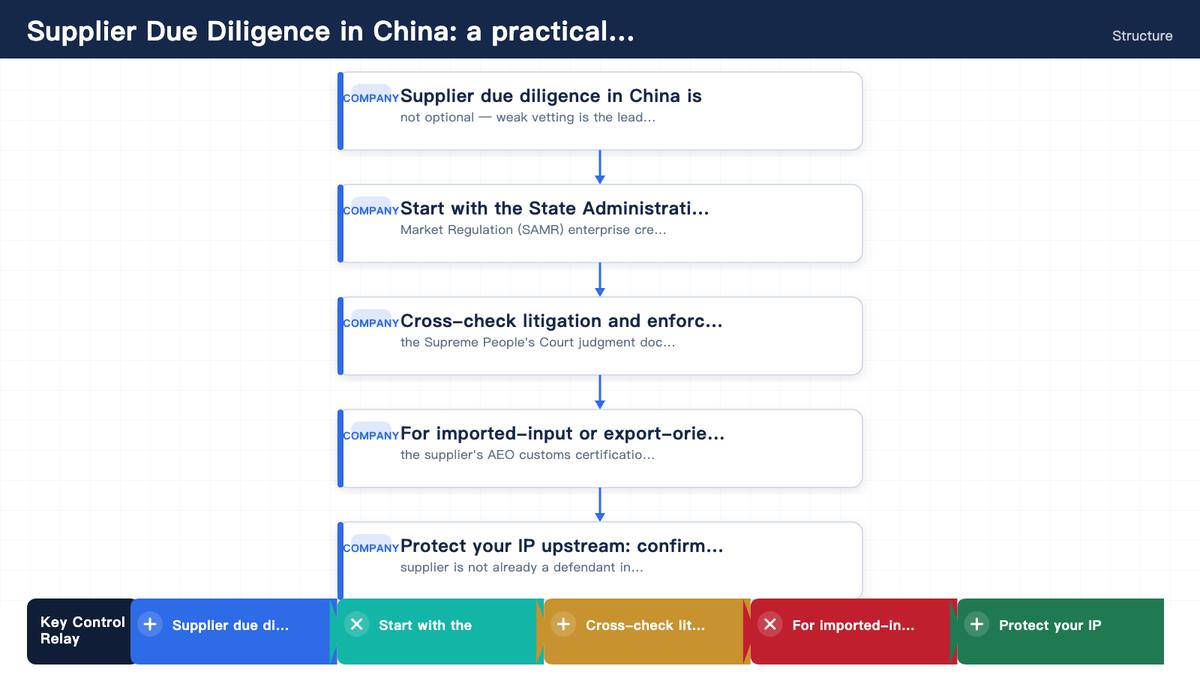
- Supplier due diligence in China is not optional — weak vetting is the leading cause of product-recall, IP-leakage and payment-fraud losses for foreign buyers.
在华供应商尽调不是可选项——尽调薄弱是外资采购方遭遇产品召回、IP 泄露与货款欺诈损失的首要原因。- Start with the State Administration for Market Regulation (SAMR) enterprise credit portal (国家企业信用信息公示系统) to confirm a supplier’s legal existence, registered capital, business scope and any “abnormal operation” (经营异常) flag.
先从市场监管总局的企业信用信息公示系统核验供应商的合法存续、注册资本、经营范围及是否被列入”经营异常名录”。- Cross-check litigation and enforceement records on the Supreme People’s Court judgment document site (裁判文书网) and the Credit China portal (信用中国) for dishonest-actor (失信) listings.
在最高人民法院裁判文书网与”信用中国”平台交叉核验诉讼与失信被执行人记录。- For imported-input or export-oriented supply, verify the supplier’s AEO customs certification status (海关 AEO 认证) and any record of customs violations.
对涉进口料件或出口导向的供应,核查其海关 AEO 认证状态及是否有海关违规记录。- Protect your IP upstream: confirm the supplier is not already a defendant in patent/trademark suits and lock ownership of tooling, moulds and designs by contract.
前置保护 IP:确认供应商未已卷入专利/商标诉讼,并通过合同锁定模具、治具与设计成果的所有权。- Red flags include refusal to provide a unified social credit code (统一社会信用代码), consistently low registered capital against large orders, and pressure for 100% advance payment.
红旗信号包括拒提供统一社会信用代码、注册资本偏低却接大额订单、以及催促 100% 预付款。- Combine official databases with at least one on-site visit and a sealed-sample QC test before committing volume orders.
将官方数据库核查,与至少一次实地走访及封样质检结合,再下量产物料订单。
Supplier Due Diligence in China: a practical checklist | 在华供应商尽职调查:实操清单
Overview
For a foreign-invested enterprise (FIE) building a supply chain in China, supplier due diligence is the single most under-rated control. The country offers world-class manufacturing depth, but the supplier population is vast and uneven: alongside tier-1 factories sit shell companies, sub-contractors operating outside their licensed scope, and intermediaries whose only asset is a WeChat account. A disciplined, document-backed vetting process protects against four concrete risks — product quality and recall exposure, IP leakage, contractual non-performance, and payment fraud.
This article sets out a practical, repeatable checklist: which official databases to query, what contractual and on-site steps to take, and which warning signs should stop a deal. It is written for procurement and sourcing managers at foreign firms, and pairs naturally with the customs, IP and company-setup articles in this library.
Why due diligence matters here
China’s company law makes incorporation easy and cheap, which is a feature for entrepreneurs but a risk for buyers. A supplier can be legally registered with a nominal registered capital and still lack the assets, licences or workforce to perform. Because many transactions are intermediated and relationship-based, foreign buyers are frequent targets of advance-fee fraud and quality substitution. The cost of a bad supplier is rarely limited to the failed batch: it flows into brand damage, recall and cross-border liability. Diligence is therefore not a compliance checkbox but a core purchasing competence.
What to check — the core files
Begin with identity and status. The National Enterprise Credit Information Publicity System (国家企业信用信息公示系统, run by SAMR) is the authoritative free source for a supplier’s uniform social credit code, legal representative, registered and paid-in capital, establishment date, business scope, branch structure, and any administrative penalty or “abnormal operation” listing. A supplier that will not disclose its credit code, or appears only as a recently capitalised micro-firm, warrants caution.
Then assess legal exposure. The China Judgments Online (裁判文书网, Supreme People’s Court) and the Credit China portal (信用中国, which aggregates dishonest-debtor / 失信被执行人 and major tax-violation blacklists) reveal litigation history, enforced judgments and trustworthiness ratings. A pattern of sued-as-defendant cases, especially in contract or product-liability disputes, is a material signal.
For trade-exposed supply, check customs AEO status via the General Administration of Customs: AEO-certified enterprises enjoy simplified clearance and are generally more disciplined; a history of customs penalties is a red flag for export-bound or import-dependent lines.
Tools, databases and third-party services
Official portals are free but can be cumbersome. Many FIEs use them in combination with commercial intelligence platforms (e.g., Qichacha / Tianyancha / Qixin) that consolidate court, credit, patent and bidding records into a single supplier profile. Treat these as a screen, not a substitute: always trace any alarming finding back to the underlying official record before acting. Industry associations and Chamber of Commerce networks are also useful for reputational references on mid-size manufacturers.
On-site verification and sample testing
No remote check replaces a factory visit. A physical audit should confirm: the entity actually operates at the registered address; the workforce and equipment match the claimed capacity; quality certifications (ISO 9001, industry-specific) are valid and in the supplier’s own name; and environmental/social-insurance compliance is visibly maintained. Before volume commitment, require a sealed-sample QC test at an independent lab, and retain the samples as a benchmark for incoming inspection.
Contractual and IP protections
Diligence must be converted into contract terms. Specify quality standards and acceptance criteria, tie payment to inspection milestones (avoid 100% advance), and explicitly assign ownership of tooling, moulds, drawings and any jointly developed IP to the buyer. Include audit rights, recall/indemnity clauses, and governing-law/jurisdiction terms consistent with the dispute-resolution article in this library. Where the supplier will handle your trademarked or patented product, add confidentiality and non-use undertakings.
Common red flags
- Refusal or inability to provide the unified social credit code.
- Registered capital far below the scale of the order, or a company incorporated only weeks before a large contract.
- Business scope that does not include the product being sourced (operating outside licensed scope is a compliance breach).
- Pressure for full advance payment, or insistence on personal-account settlement.
- A “factory” that is actually a trading intermediary with no production assets.
- Prior defendant history in product-liability or IP-infringement suits.
What to do next
- Build a standard supplier-onboarding packet: credit-code check + litigation/credit check + business-scope confirmation, filed before first PO.
- Run at least one unannounced on-site audit per critical supplier per year.
- Lock IP and tooling ownership in writing; never rely on relationship assurance.
- Tie payments to inspected milestones; cap any advance at a defensible percentage.
- Keep a rejected-supplier list shared across your China procurement team.
Sources
- 国家企业信用信息公示系统(市场监管总局)— https://www.gsxt.gov.cn (official portal)
- 中国裁判文书网(最高人民法院)— https://wenshu.court.gov.cn (official portal)
- 信用中国 — https://www.creditchina.gov.cn (official portal)
- 中华人民共和国海关总署(AEO 认证)— http://www.customs.gov.cn (official portal)
- 市场监管总局 SAMR — https://www.samr.gov.cn (official portal)
Related reading
- see also: 进口清关-进出口清关 (customs clearance for sourced goods)
- see also: 知识产权-商标 (protecting your brand against supplier misuse)
- see also: 电商数字-数据出境 (when supplier data crosses borders)
在华供应商尽职调查:实操清单
概述
对在中国搭建供应链的外商投资企业(FIE)而言,供应商尽职调查是最被低估的一道管控。中国拥有世界一流的制造纵深,但供应商群体庞杂且良莠不齐:与一线工厂并存的,有空壳公司、超出许可范围经营的转包方,以及唯一资产只是一个微信账号的中间商。一套有据可查、可重复的尽调流程,能防范四类具体风险——产品质量与召回暴露、IP 泄露、合同违约,以及货款欺诈。
本文给出一份实用、可复用的清单:该查哪些官方数据库、该采取哪些合同与实地步骤、哪些预警信号应叫停交易。它面向外资企业的采购与寻源经理,并与本库中的海关、知识产权、公司设立等文章天然互补。
为何在华尽调尤为关键
中国《公司法》让公司设立简便且成本低,这对创业者是好事,对采购方却是风险。一家供应商可以合法注册、认缴资本名义化,却并无履约所需的资产、牌照或人手。由于大量交易经由中介、依赖关系,外资买方常成为预付款欺诈与以次充好问题的目标。劣质供应商的代价很少止步于那批货:它会蔓延至品牌损害、召回与跨境责任。因此尽调不是合规勾选,而是核心采购能力。
该查什么——核心档案
从身份与状态入手。国家企业信用信息公示系统(市场监管总局运营)是核验供应商统一社会信用代码、法定代表人、注册资本与实缴、成立日期、经营范围、分支机构,以及任何行政处罚或”经营异常”列名的权威免费来源。拒披露信用代码、或仅为近期低资本微企的供应商,须警惕。
继而评估法律风险。中国裁判文书网(最高人民法院)与信用中国平台(聚合失信被执行人、重大税收违法黑名单)可揭示诉讼史、强制执行与守信状况。若呈”作为被告频发”、尤其是合同或产品责任纠纷,是重大信号。
对涉贸供应,经海关总署核查海关 AEO 认证状态:AEO 企业享通关便利、通常更守规;有海关处罚史,对出口或进口依赖型产线都是红旗。
工具、数据库与第三方服务
官方平台免费但操作繁琐。许多 FIE 将其与商业情报平台(如企查查、天眼查、启信)配合使用,把法院、信用、专利与招投标记录整合为单一供应商画像。把它们当筛查手段,而非替代:对任何告警发现,行动前务必回溯至底层官方记录。行业协会与商会网络,也对中型制造企业的声誉参考很有价值。
实地核验与样品检测
远程核查无法替代工厂走访。实地审计应确认:该主体确实在注册地经营;人员与设备匹配其宣称产能;质量认证(ISO 9001 及行业特定)有效且落在供应商自身名下;环保与社保合规可见地维持。量产前,要求独立实验室做封样质检,并留存样品作为来料检验基准。
合同与 IP 保护
尽调必须转化为合同条款。明确质量标准与验收准则,把付款与检验节点挂钩(避免 100% 预付),并以书面形式将模具、治具、图纸及任何共同开发 IP 的所有权指定给买方。纳入审计权、召回/赔偿条款,以及与本库争议解决文章一致的准据法与管辖约定。当供应商将处理你方商标或专利产品时,追加保密与不使用的承诺。
常见红旗信号
- 拒绝或无法提供统一社会信用代码。
- 注册资本远低于订单规模,或公司在大额合同前仅成立数周。
- 经营范围不含所采购产品(超范围经营即违规)。
- 施压要求全额预付,或坚持以个人账户结算。
- “工厂”实为无生产资产的贸易中介。
- 曾有产品责任或 IP 侵权”被告”历史。
下一步建议
- 建立标准供应商准入包:信用代码核查 + 诉讼/信用核查 + 经营范围确认,首单前归档。
- 每年对关键供应商至少做一次不预先通知的实地审计。
- 书面锁定 IP 与模具所有权;绝不依赖关系承诺。
- 付款与检验节点挂钩;任何预付款封顶在可控比例。
- 维护一份采购团队共享的”拒用供应商名单”。
来源
- 国家企业信用信息公示系统(市场监管总局)— https://www.gsxt.gov.cn
- 中国裁判文书网(最高人民法院)— https://wenshu.court.gov.cn
- 信用中国 — https://www.creditchina.gov.cn
- 中华人民共和国海关总署(AEO 认证)— http://www.customs.gov.cn
- 市场监管总局 SAMR — https://www.samr.gov.cn
相关阅读
- 参见:进口清关-进出口清关(所购货物的海关清关)
- 参见:知识产权-商标(防范供应商滥用你的品牌)
- 参见:电商数字-数据出境(当供应商数据跨境时)