
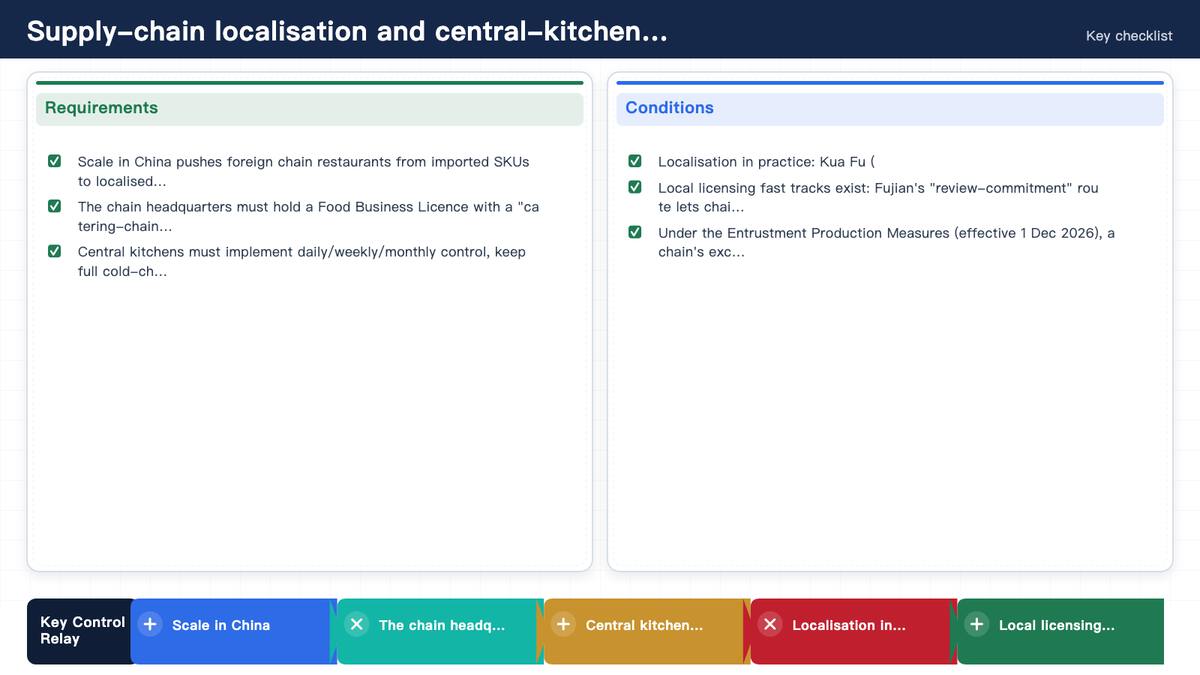
- Scale in China pushes foreign chain restaurants from imported SKUs to localised supply chains: central kitchens, unified distribution and “one taste across a thousand stores” standardisation.
在中国做规模,外资连锁餐饮须从进口单品转向本地化供应链:中央厨房、统一配送与”千店一味”标准化。- The chain headquarters must hold a Food Business Licence with a “catering-chain management” item, run an independent food-safety unit, and appoint a food-safety director and officers; it may not contract away food-safety liability.
连锁总部须持含”餐饮服务连锁管理”项目的《食品经营许可》,设独立食品安全机构并配备总监与员,且不得通过合同转嫁食品安全责任。- Central kitchens must implement daily/weekly/monthly control, keep full cold-chain and distribution records, and enforce separate raw/cooked tools and temperature-controlled preparation rooms.
中央厨房须落实日管控、周排查、月调度,留存完整冷链与配送记录,并执行生熟工具分开、专间温控。- Localisation in practice: Kua Fu (夸父炸串) runs a 100,000-tonne smart factory in Linyi supplying 3,000 stores with unified, cold-chain pre-processed skewers, removing store-level sourcing.
实践案例:夸父炸串在临沂运营10万吨级智慧工厂,向3000家门店统一冷链配送预处理串品,取消门店自采。- Local licensing fast tracks exist: Fujian’s “review-commitment” route lets chains with ≥10 directly-operated stores open new direct stores without on-site inspection.
存在本地许可快车道:福建”评审承诺制”允许≥10家直营门店的连锁新开直营店免现场核查。- Under the Entrustment Production Measures (effective 1 Dec 2026), a chain’s exclusive sauces/pre-processed ingredients made to its spec are caught as entrustment production, making the brand the responsible party.
依据《食品委托生产监督管理办法》(2026年12月1日施行),连锁企业按自身规格定制的专属酱料/预加工原料构成委托生产,品牌为责任方。
Supply-chain localisation and central-kitchen compliance for foreign chain restaurants in China | 外资连锁餐饮供应链本地化与中央厨房合规
Overview
Once a foreign restaurant brand moves beyond flagship stores to hundreds of outlets, the competitive edge shifts from brand power to supply-chain localisation. Centralised production, unified distribution and standardised taste (“one taste across a thousand stores”) require a compliant backbone: a licensed chain headquarters, central kitchens under tight control, and a local supplier base. This article covers the 2026 compliance framework for scaling a chain in China.
Market context
China’s chain-restaurant regulation has sharpened into a full-chain regime. At the centre sits the chain headquarters, accountable for system-building, supervision and unified management. Beneath it, central kitchens concentrate processing and distribution; stores execute under daily control. Recent local rules (Changsha’s 2026 chain-restaurant food-safety guide; Heilongjiang’s 2026 food-business-licence review rules; Fujian’s 2026 review-commitment route) show a clear trend: more explicit HQ duties, stricter central-kitchen requirements, and faster licensing for qualifying chains.
Key 2026 developments
Headquarters responsibilities. The HQ must hold a valid Food Business Licence covering a “catering-chain management” (餐饮服务连锁管理) item. It must establish an independent food-safety management body, appoint a dedicated food-safety director and officers, and run a “weekly check, monthly scheduling” (周排查、月调度) mechanism. It must conduct at least one full coverage inspection per year, must not use contracts to evade food-safety responsibility, and must report its national store list and management status to the regulator each December. On the documentation side, the HQ builds systems for purchase inspection, training assessment and complaint handling, with a supplier admission-and-exit mechanism and traceable vouchers; responsible persons and managers must complete at least 40 hours of concentrated training annually.
Central-kitchen control. Central kitchens must implement daily/weekly/monthly control, upload records to the local food-safety platform, and fully disclose licences, health certificates and traceability codes. Purchase inspection requires complete documentation; distribution is fully logged; special records cover staff health, additive use and food retention samples. Process controls mandate raw/cooked tool separation and temperature-controlled preparation rooms; distribution uses dedicated vehicles safeguarding temperature and hygiene — preventing cross-contamination from processing to delivery.
Store-level execution. Stores need a valid Food Business Licence, label “网络经营” for online channels, and staff food-safety personnel by scale, all under daily/weekly/monthly control uploaded to the platform. They must display licences, health certificates, complaint lines and anti-waste notices; delivery must use tamper-evident seals (食安封签) and store-made-only preparation is strictly required (no subcontracting production).
Localisation in practice. Kua Fu (夸父炸串), a 3,000-store skewer chain, opened a fourth-generation smart factory in Linyi, Shandong in 2026 with 100,000 tonnes annual capacity and automated skewer lines plus digital quality control. All skewer raw materials are uniformly processed in the factory and cold-chain delivered; stores lost the right to self-procure, eliminating instability and cross-contamination at source. The brand partners with a leading compound-condiment maker for exclusive sauces, oils and seasonings, with annual quality targets (e.g. zero batch quality incidents). Hardware and SOP are unified chain-wide — equipment parameters, operating standards and back-of-house layout — with fryers fitted with timers to replace eyeball judgement.
Licensing acceleration. Fujian’s “review-commitment” (评审承诺制) route lets a chain with ≥10 directly-operated stores and “four unifications” (unified organisation, management, distribution and food-safety responsibility) open new direct stores without on-site inspection, with post-licence verification within 30 working days. Heilongjiang’s 2026 review rules explicitly set area, equipment, cold-chain, testing and labelling requirements for central kitchens and collective-meal delivery, and define review norms for chain HQs and food-service management companies, including cross-provincial filing.
Entrustment production overlay. Where a chain commissions exclusive sauces, pre-processed ingredients or signature items to a contractor’s spec, the arrangement may meet the three elements of entrustment production under the Food Entrustment Production Supervision Measures (effective 1 December 2026), making the brand the responsible entrusting party with supervision and staffing duties.
Practical steps
- Stand up a licensed HQ entity with the catering-chain-management licence item before scaling; build the food-safety unit and appoint director/officers.
- Design the central kitchen to daily/weekly/monthly control and cold-chain standards; plan dedicated vehicles and retention-sample protocols.
- Localise the supplier base — move from imported to domestically processed ingredients; use unified factories to remove store-level sourcing variability.
- Standardise hardware and SOP chain-wide (equipment, layout, cooking parameters) to lock taste and reduce human error.
- Use fast-track licensing (e.g. Fujian review-commitment) where the store count qualifies.
- Map custom SKUs to the Entrustment Measures — if you spec exclusive items, you are the responsible party; set up supervision before 1 December 2026.
Related reading
- Foreign F&B brand entry paths and food-safety compliance (see article 154).
- Imported food and health-food registration, filing and labelling (see article 155).
Sources
- 同花顺 — 长沙发布餐饮连锁企业食品安全管理指南(2026-02-05)
- 黑龙江省市场监督管理局 — 《食品经营许可审查细则》起草说明(2026-07)
- 福建省市场监督管理局 — 《食品经营许可和备案管理》评审承诺制规定(闽市监规〔2026〕1号)
- 国家市场监督管理总局 — 官方网站(食品生产经营监管)
外资连锁餐饮供应链本地化与中央厨房合规
概述
当外国餐饮品牌从旗舰店迈向数百家门店,竞争优势便从品牌力转向供应链本地化。集中生产、统一配送与标准化口味(”千店一味”)需要合规骨架支撑:持证连锁总部、严控的中央厨房与本土供应商基础。本文覆盖2026年在中国扩张连锁的合规框架。
市场背景
中国连锁餐饮监管已细化为全链条制度。中心是连锁总部,对体系构建、监督巡查与统一管理负责。其下,中央厨房集中加工与配送;门店在执行层落实日管控。近期地方规则(长沙2026连锁餐饮食品安全指南、黑龙江2026食品经营许可审查细则、福建2026评审承诺制)呈现清晰趋势:总部职责更明确、中央厨房要求更严、符合条件的连锁许可更快。
2026年核心进展
总部职责。 总部须持含“餐饮服务连锁管理”项目的有效《食品经营许可》;设独立食品安全管理机构,配备专职食品安全总监与食品安全员,运行”周排查、月调度”机制;每年至少一次全覆盖巡查;不得通过合同规避食品安全责任;每年12月向监管报送全国门店清单及管理情况。文件记录上,总部建进货查验、培训考核、投诉处置等制度,设供货者准入退出机制与可追溯凭证;负责人及管理人员每年集中培训不少于40学时。
中央厨房管控。 中央厨房须落实日管控、周排查、月调度,记录上传食安平台,全面公示证照、健康证明与追溯码。进货查验须索证索票齐全;配送全程记录;从业人员健康、添加剂使用、食品留样专项记录完整。过程控制要求生熟工具分开、专间温控达标;配送使用专用车辆保障温度与卫生——从加工到配送全程防范交叉污染。
门店执行。 门店须持有效《食品经营许可》,网络经营标注”网络经营”,按规模配食品安全管理人员,均执行日管控、周排查、月调度并上传平台。须公示证照、健康证明、投诉电话与反食品浪费提示;外卖须用食安封签,且严禁委托他人制作。
本地化实践。 拥有3000家门店的夸父炸串,2026年在山东临沂投产第四代智慧工厂,年产能10万吨,全自动化穿串线与数字化品控。所有串品原料由工厂统一加工、全程冷链配送,门店不再拥有自采权限,从源头消除不稳定与交叉污染。品牌与复合调味品龙头合作研发专属酱料、煎炸油与撒料,设定年度质量目标(如批量性质量问题零发生)。硬件与SOP全链统一——设备参数、操作标准、后厨布局——炸炉强制配计时器以取代凭经验操作。
许可提速。 福建”评审承诺制”允许拥有≥10家直营门店且”四统一”(统一组织架构、经营管理、配送食品、承担食品安全责任)的连锁,新开直营店免现场核查直接发证,领证后30个工作日内事后核查。黑龙江2026审查细则明确中央厨房与集体用餐配送单位的场所面积、设备配置、冷链运输、检验检测、信息标注等专项要求,并界定连锁总部与餐饮服务管理企业的审查规范,含跨省经营报备。
委托生产叠加。 连锁企业按自身规格委托定制专属酱料、预加工原料或特色单品,可能符合《食品委托生产监督管理办法》(2026年12月1日施行)的委托生产三要素,使品牌成为责任委托方,承担监督与人员配置义务。
实务步骤
- 先设立持证总部实体,取得餐饮服务连锁管理许可项目再扩张;建立食品安全机构并配齐总监与员。
- 设计中央厨房以日管控、周排查、月调度与冷链标准为准;规划专用车辆与留样规程。
- 本地化供应商基础——从进口转向国内加工原料;以统一工厂消除门店自采波动。
- 全链统一硬件与SOP(设备、布局、烹饪参数),锁定口味并减少人为误差。
- 善用快车道许可(如福建评审承诺制),在门店数达标时适用。
- 将定制单品映射至《委托生产办法》——若按你规格定制,你即为责任方;须在2026年12月1日前建立监督体系。
延伸阅读
- 外资餐饮品牌入华路径与食安合规(参见154篇)。
- 进口食品与保健食品注册、备案及标签合规(参见155篇)。
来源