
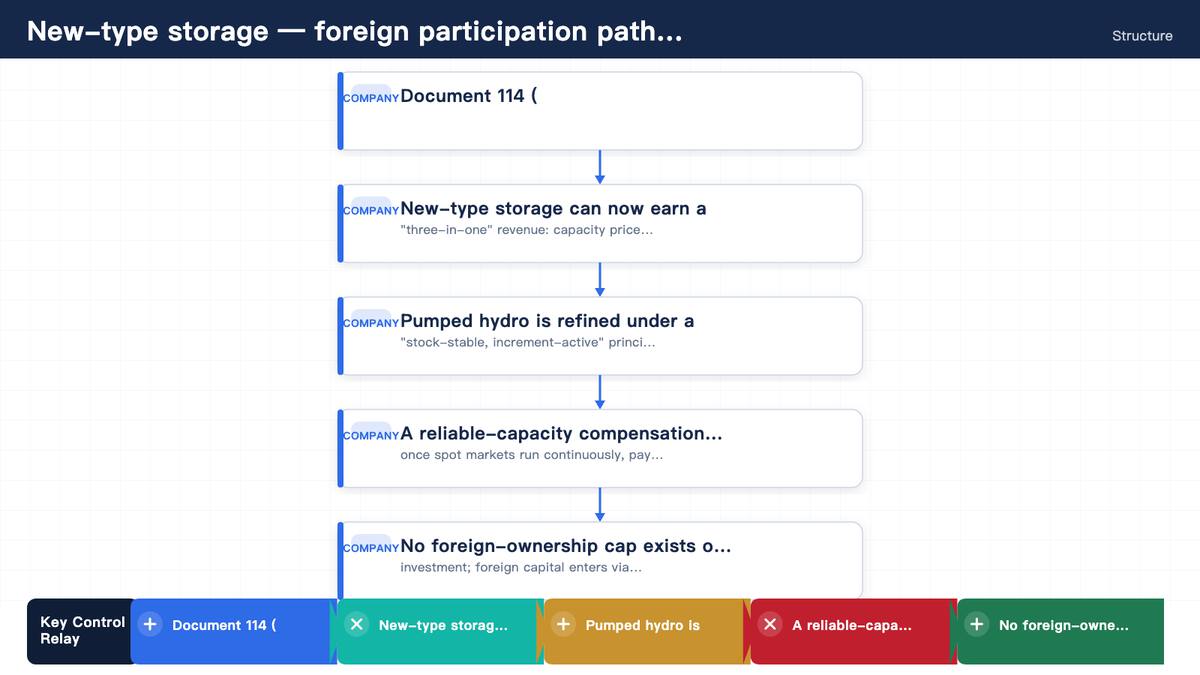
- Document 114 (发改价格〔2026〕114号, Jan 2026) is the first national-level rule to explicitly create a capacity-price mechanism for grid-side standalone new-type storage, treating it on a par with coal power as a capacity resource.
114号文(发改价格〔2026〕114号,2026年1月)是首个在国家层面明确建立电网侧独立新型储能容量电价机制的规则,将其与煤电同等视为容量资源。- New-type storage can now earn a “three-in-one” revenue: capacity price + energy arbitrage + ancillary services; the capacity price is benchmarked to local coal capacity price and scaled by peak-shifting ability.
新型储能如今可获得”三位一体”收入:容量电价+能量价差+辅助服务;容量电价以当地煤电容量价为基准,按顶峰能力折算。- Pumped hydro is refined under a “stock-stable, increment-active” principle: pre-633-file plants keep government pricing; post-633-file plants get a unified capacity price plus market-revenue sharing.
抽水蓄能在”存量保稳、增量促活”原则下完善:633号文前开工者延续政府定价;之后开工者获统一容量电价加市场收益分享。- A reliable-capacity compensation mechanism will follow once spot markets run continuously, paying all qualified resources by the same “peak capability” yardstick — moving from “classified compensation” to “equal pay for equal work.”
现货市场连续运行后将建立可靠容量补偿机制,以同一”顶峰能力”标尺补偿所有合格资源——由”分类补偿”走向”同工同酬”。- No foreign-ownership cap exists on storage investment; foreign capital enters via local project companies and can supply equipment (lithium, flow, compressed-air, flywheel) or invest in projects.
储能投资无外资股比上限;外资经由本地项目公司进入,可提供设备(锂电、液流、压缩空气、飞轮)或投资项目。- Technology choice now competes on function, not just cost: short-duration storage suits high-frequency regulation, long-duration (flow, compressed air) suits peak-shifting and wins more capacity value.
技术路线如今按功能而非仅成本竞争:短时储能适合高频调频,长时(液流、压缩空气)适合削峰填谷、获更多容量价值。- User affordability assessment is a new gate: projects lacking it cannot be planned, approved, or given capacity payment — disciplining over-build.
用户承受能力评估成为新门槛:未开展评估的项目不得纳入规划及核准、不得给予容量电费或可靠容量补偿。
New-type storage — foreign participation pathways | 新型储能(电化学/抽水蓄能)外资参与路径
Overview
China is building the world’s largest renewable system, and variability makes storage a strategic pillar of the new power system. In January 2026 the NDRC and NEA issued Document 114 (发改价格〔2026〕114号), overhauling the capacity-price mechanism for regulating resources — coal, gas, pumped hydro and, for the first time at national level, grid-side standalone new-type storage. For foreign investors, storage is open (no ownership cap) and now has a clearer revenue floor.
This article explains the 2026 pricing reform, the pumped-hydro and new-storage mechanics, the foreign-participation pathway, and where capital can win. It is informational; confirm current detail with qualified PRC advisers.
The 2026 capacity-price reform (Document 114)
Document 114’s logic: as renewables become the largest installed source, the system needs regulating capacity that “shows up” at peak. It classifies and improves capacity prices for coal, gas, pumped hydro and grid-side standalone new storage, and previews a reliable-capacity compensation mechanism.
- Coal and gas. Regions raise the fixed-cost recovery via capacity price to at least 50% (coal: RMB 165/kW-year baseline); gas can get a comparable mechanism.
- Pumped hydro. Pre-633-file (发改价格〔2021〕633号) plants keep government pricing; post-633-file plants get a provincially set unified capacity price (every 3–5 years, cost-recovery basis, with duration折减) plus a share of market revenue.
- Grid-side standalone new-type storage. For the first time nationally, plants serving system security, not in behind-the-meter pairing, and on a provincial list, may receive a capacity price. The price is benchmarked to the local coal capacity price and scaled by peak-shifting ability (ratio = full-power discharge duration ÷ longest net-load-peak duration, capped at 1), adjusted for market and system needs.
The “three-in-one” revenue for new storage
The reform gives grid-side standalone storage a composite income:
- Capacity price — a stable, regulated floor scaled to peak capability.
- Energy arbitrage — charge/discharge spread in the electricity market.
- Ancillary services — regulation, peak-shifting and other system-value payments.
A reliable-capacity compensation mechanism follows once spot markets run continuously: qualified resources (coal, gas, eligible grid-side storage, later pumped hydro) are paid by the same “reliable capacity” yardstick, ending type-by-type capacity pricing — “equal pay for equal work.” This rewards genuine peak contribution regardless of technology.
Pumped hydro: stock-stable, increment-active
Pumped hydro, the largest existing flexible resource, is refined rather than reinvented:
- Stock (pre-633). Continue government pricing; after the operating term, re-price to cover necessary upgrades and O&M.
- Increment (post-633). Unified capacity price + market-revenue sharing, with the share set by the province; revenue mix shifts from high capacity-fee share toward diversified market income, pushing cost discipline and siting quality.
For foreign investors, pumped hydro is capital-intensive and long-cycle; the clearer price path improves bankability but the asset itself is usually a domestic-led, grid-adjacent play.
Foreign-participation pathway
There is no foreign-ownership cap on storage investment or equipment manufacturing. Foreign capital typically enters via:
- Equipment supply. Lithium, flow (vanadium), compressed-air, flywheel and BMS/PCS technologies — China’s storage manufacturing is large but foreign IP in long-duration chemistry, safety and power electronics remains attractive for local JV or supply agreements.
- Project investment. A locally incorporated project company builds and operates a grid-side standalone storage plant, joins the provincial list, and earns the three-in-one revenue. Because there is no ownership cap, the entity can be wholly foreign-owned.
- Integrated plays. Pair storage with wind/solar (see the wind-solar article) or green-hydrogen bases (see the green-hydrogen article) to capture co-located value.
The practical gate is no longer ownership but user affordability assessment: provinces must assess user capacity to pay, and projects without it cannot be planned, approved, or granted capacity payment. This disciplines over-build and ties approvals to genuine system need.
Where capital can win
- Long-duration storage. Flow and compressed-air gain more capacity value under the peak-ability scaling — a differentiated play versus lithium’s frequency strength.
- Safety and power electronics. PCS, BMS and fire-safety IP are recurring needs as fleets scale.
- Project development with offtake certainty. Plants sited where the grid needs peak capacity, on the provincial list, capture the capacity floor plus market upside.
- Cross-border technology transfer. Foreign long-duration or safety IP localised via JV meets both the speed and compliance bar.
Common pitfalls
- Assuming storage revenue is just energy arbitrage. The 2026 reform adds a capacity floor and ancillary services — model all three.
- Ignoring the user-affordability gate. Projects without the assessment cannot be approved or paid.
- Competing on cell cost alone. Technology choice now competes on function (duration, response) under a uniform capacity yardstick.
- Over-building without grid need. The assessment discipline reduces speculative permits.
- Treating pumped hydro as a quick entry. It is capital-heavy and long-cycle; the clearer price helps bankability, not speed.
What to do next
- Decide the entry mode — equipment supply, project investment, or integrated with renewables/H2.
- For projects, incorporate a local company and target the provincial grid-side standalone storage list.
- Model the three-in-one revenue (capacity + arbitrage + ancillary) under Document 114.
- Pre-clear the user-affordability assessment with provincial authorities before committing capital.
- Choose technology by function: short-duration for frequency, long-duration for peak value.
- Track the rollout of the reliable-capacity compensation mechanism in spot-market-running regions.
Sources
- 国家发展改革委、国家能源局《关于完善发电侧容量电价机制的通知》(发改价格〔2026〕114号):https://www.ndrc.gov.cn/xwdt/tzgg/202601/t20260130_1403525_ext.html
- 国家发展改革委 政策解读 完善发电侧容量电价机制答记者问(2026-01):https://gbdy.ndrc.gov.cn/gbdyzcjd/202601/t20260130_1403528.html
- 国家发展改革委(NDRC)门户网站 — 能源价格与新型储能政策:https://www.ndrc.gov.cn
- 国家能源局(NEA)门户网站 — 新型储能电站建设与并网:https://www.nea.gov.cn
Related reading
- 风光发电外资项目核准与并网政策(146-wind-solar-2026)
- 绿氢/氢能产业外资投资机会与示范区(147-green-hydrogen-2026)
- 全国碳市场扩容对外资企业影响(148-carbon-market-2026)
新型储能(电化学/抽水蓄能)外资参与路径
概述
中国正在建设全球最大的可再生能源体系,而波动性使储能成为新型电力系统的战略支柱。2026年1月,发改委与能源局发布114号文(发改价格〔2026〕114号),重构调节性资源的容量电价机制——煤电、气电、抽水蓄能,并首次在国家层面纳入电网侧独立新型储能。对外国投资者,储能开放(无股比上限)且如今有了更清晰的收益底。
本文解释2026年电价改革、抽水蓄能与新型储能机制、外资参与路径与资本可胜出之处。本文仅为信息参考,具体细节请以合格中国顾问确认。
2026年容量电价改革(114号文)
114号文的逻辑:随可再生成为第一大装机电源,系统需要”顶峰时能顶上”的调节容量。它分类完善煤电、气电、抽水蓄能与电网侧独立新型储能的容量电价,并预告可靠容量补偿机制。
- 煤电与气电。 各地通过容量电价回收煤电机组固定成本比例提至不低于50%(煤电基准165元/千瓦·年);气电可建可比机制。
- 抽水蓄能。 633号文(发改价格〔2021〕633号)前开工者延续政府定价;之后开工者获省级统一容量电价(每3–5年、按成本回收、按时长折减)加市场收益分享。
- 电网侧独立新型储能。 首次在国家层面,对服务系统安全、未参与配储、纳入省级清单的电站可给予容量电价。电价以当地煤电容量价为基准,按顶峰能力折算(比例=满功率放电时长÷全年最长净负荷高峰持续时长,上限1),并考虑市场与系统需求。
新型储能的”三位一体”收入
改革赋予电网侧独立储能复合收入:
- 容量电价 —— 按顶峰能力折算的稳定管制底价。
- 能量价差 —— 电力市场中的充放电价差。
- 辅助服务 —— 调频、调峰等系统价值支付。
现货市场连续运行后将建立可靠容量补偿机制:合格资源(煤电、气电、合格电网侧储能,后续含抽水蓄能)按同一”可靠容量”标尺补偿,终结按类型分别定价——”同工同酬”。这不论技术、只奖真实顶峰贡献。
抽水蓄能:存量保稳、增量促活
作为既有最大灵活资源,抽水蓄能是完善而非重塑:
- 存量(633前)。 延续政府定价;经营期满后按弥补必要技改与运维重新核价。
- 增量(633后)。 统一容量电价+市场收益分享,分享比例由省级定;收入结构从高容量电费占比转向多元化市场收入,倒逼成本约束与选址质量。
对外资,抽水蓄能资本密集、周期长;更清晰的价格路径提升可融资性,但资产本身通常为国内主导、邻近电网的玩法。
外资参与路径
储能投资与设备制造均无外资股比上限。外资通常经以下方式进入:
- 设备供应。 锂电、液流(钒)、压缩空气、飞轮及BMS/PCS技术——中国储能制造规模大,但国外在长时化学、安全与功率电子上的IP仍具本地合资或供货吸引力。
- 项目投资。 本地设立项目公司建设运营电网侧独立储能电站,进入省级清单,赚取三位一体收入。因无所有权上限,实体可为外商独资。
- 一体化玩法。 将储能与风光(见风光篇)或绿氢基地(见绿氢篇)配对,捕捉协同价值。
实务门槛不再是所有权,而是用户承受能力评估:各省须评估用户支付能力,未开展评估的项目不得纳入规划及核准、不得给予容量电费或可靠容量补偿。这约束过度建设,把核准与真实系统需求挂钩。
资本可胜出之处
- 长时储能。 液流与压缩空气在顶峰能力折算下获更多容量价值——与锂电的调频强项形成差异化。
- 安全与功率电子。 随装机扩张,PCS、BMS与消防安全IP是持续需求。
- 有承购确定性的项目开发。 落在电网需顶峰容量处、进入省级清单的电站,可获容量底价加市场上行。
- 跨境技术转移。 经合资本地化的国外长时或安全IP,同时满足速度与合规门槛。
常见误读
- 以为储能收益仅是能量价差。 2026改革新增容量底价与辅助服务——三者须一并建模。
- 忽视用户承受能力门槛。 未评估的项目不得核准或获付费。
- 仅以电芯成本竞争。 在统一容量标尺下,技术路线如今按功能(时长、响应)竞争。
- 不顾电网需求过度建设。 评估纪律减少投机性核准。
- 把抽水蓄当快速入口。 其资本重、周期长;更清晰的价格助可融资性,而非速度。
下一步建议
- 决定进入模式——设备供应、项目投资,或与可再生/氢一体化。
- 对项目,设立本地公司并瞄准省级电网侧独立储能清单。
- 依114号文建模三位一体收入(容量+价差+辅助服务)。
- 在投入资本前,与省级部门预先厘清用户承受能力评估。
- 按功能选技术:短时用于调频,长时用于顶峰价值。
- 跟踪现货市场运行区域可靠容量补偿机制的落地。
来源
- 国家发展改革委、国家能源局《关于完善发电侧容量电价机制的通知》(发改价格〔2026〕114号):https://www.ndrc.gov.cn/xwdt/tzgg/202601/t20260130_1403525_ext.html
- 国家发展改革委 政策解读 完善发电侧容量电价机制答记者问(2026-01):https://gbdy.ndrc.gov.cn/gbdyzcjd/202601/t20260130_1403528.html
- 国家发展改革委(NDRC)门户网站 — 能源价格与新型储能政策:https://www.ndrc.gov.cn
- 国家能源局(NEA)门户网站 — 新型储能电站建设与并网:https://www.nea.gov.cn
相关阅读
- 风光发电外资项目核准与并网政策(146-wind-solar-2026)
- 绿氢/氢能产业外资投资机会与示范区(147-green-hydrogen-2026)
- 全国碳市场扩容对外资企业影响(148-carbon-market-2026)