
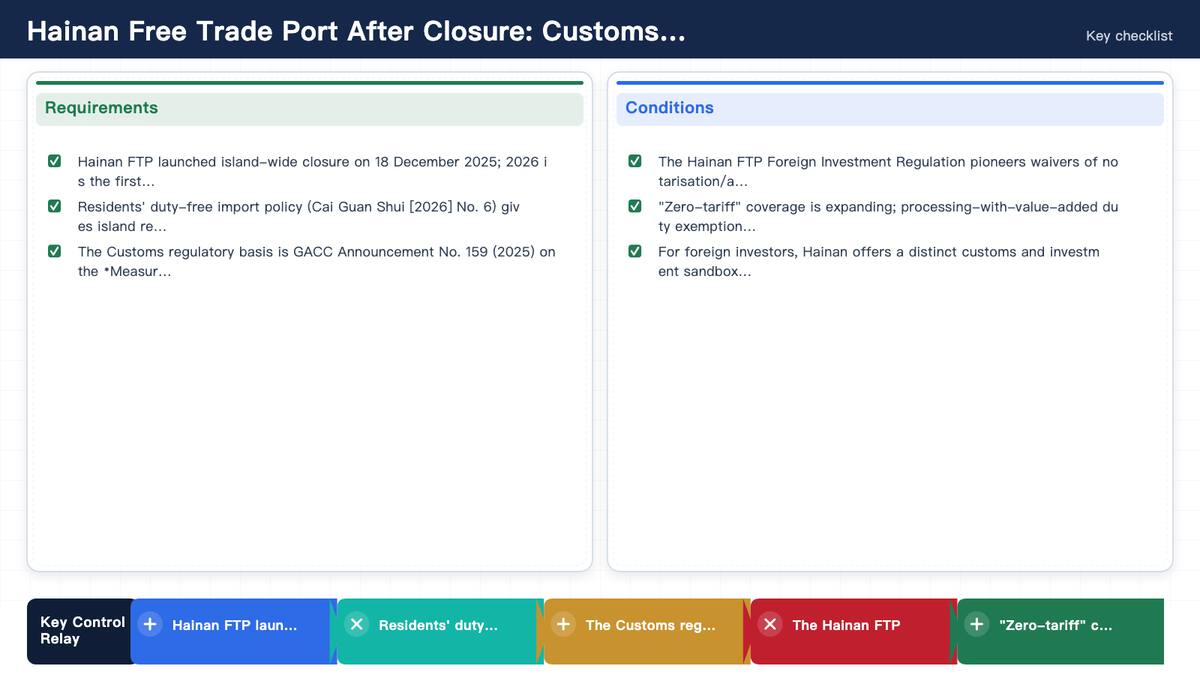
- Hainan FTP launched island-wide closure on 18 December 2025; 2026 is the first full year of the “first line open, second line managed” regime.
海南自贸港于 2025 年 12 月 18 日启动全岛封关;2026 年是「一线放开、二线管住」的首个完整年度。- Residents’ duty-free import policy (Cai Guan Shui [2026] No. 6) gives island residents RMB 10,000/year of duty-free inbound goods under a positive list.
岛内居民零关税政策(财关税〔2026〕6 号)按正面清单给予岛内居民每人每年 1 万元免税进境商品额度。- The Customs regulatory basis is GACC Announcement No. 159 (2025) on the *Measures for Hainan FTP Customs Control*; traditional businesses (CBZ, bonded, FTZ) continue under existing rules.
海关监管依据是海关总署 2025 年第 159 号公告《海关对海南自由贸易港监管办法》;传统业务(综保区、保税、自贸区)仍按现行规定。- The Hainan FTP Foreign Investment Regulation pioneers waivers of notarisation/authentication for qualifying foreign investors’ identity documents — lowering the entry barrier.
海南自贸港外商投资条例率先对符合条件的外国投资者主体资格/身份证明免公证、认证或附加证明书,降低准入壁垒。- “Zero-tariff” coverage is expanding; processing-with-value-added duty exemption is being scaled, and the “zero-tariff + exhibition” model is encouraged.
「零关税」覆盖面扩大;加工增值免关税效应扩容,「零关税+展销」新业态受鼓励。- For foreign investors, Hainan offers a distinct customs and investment sandbox — track the positive lists, the second-line credit system, and the foreign-investment facilitation rules.
对外资,海南是独特的海关与投资沙盒——关注正面清单、二线信用体系与外商投资便利化规则。
Hainan Free Trade Port After Closure: Customs, Zero-Tariff and the Foreign-Investment Edge (2026) | 封关后的海南自贸港:海关、零关税与外资优势(2026)
Hainan Free Trade Port (FTP) crossed a threshold on 18 December 2025, when island-wide closure (封关) formally launched. In 2026 the port operates under the “first line open, second line managed” architecture: goods through the “first line” (inbound) and within the island follow the special arrangements, while the “second line” (to the mainland) is where customs control and mainland tariffs apply.
The resident-consumption duty-free policy is a headline feature. *Cai Guan Shui [2026] No. 6* (Ministry of Finance, GACC, STA) grants Hainan island residents — Chinese citizens with Hainan ID/residence/social-security cards, and foreign residents holding residence documents — a positive-list, per-person annual quota of RMB 10,000 for duty-free inbound goods (exempt from import tariff and import-stage and domestic VAT/consumption tax). Goods are bought in designated duty-free stores, taken on the spot, and must not be resold. The provincial government bears the anti-smuggling responsibility and may cap quantities for risk control.
Customs control is anchored in GACC Announcement No. 159 (2025), the *Measures for the Customs Control of the Hainan Free Trade Port*. After closure, special scenarios (first-line inbound, second-line outbound partly) are supervised under the closure policy files — the *FTP Import Taxation Goods Catalogue*, the *FTP Prohibited/Restricted Import-Export Goods List*, and the tax notices. Traditional businesses — comprehensive bonded zones, bonded logistics centres, off-zone processing trade, and duty-free/ cross-border e-commerce — continue under existing rules, unaffected by closure. Goods that have completed tax, licence and inspection formalities at first-line, on-island, or second-line are no longer under customs control.
On the investment side, the *Hainan FTP Foreign Investment Regulation* is notably pro-entry: it pushes “five-direction” opening and, importantly, pioneers waiving notarisation, authentication or apostille for qualifying foreign investors’ entity-qualification or identity documents — a direct removal of a long-standing friction. The port also advances “minimal approval” and extreme-streamlining of investment approvals.
For a foreign investor, Hainan in 2026 is a distinct sandbox: zero-tariff coverage is widening, processing-with-value-added duty exemption is scaling, and the “zero-tariff + exhibition” model is promoted. The practical steps are to monitor the positive lists, understand the second-line credit-based customs clearance (low-risk goods get “second-speed release”), and use the foreign-investment facilitation rules. Hainan is best read not as a tax haven but as a customs and investment laboratory for China’s next opening chapter.
封关后的海南自贸港:海关、零关税与外资优势(2026)
海南自贸港在 2025 年 12 月 18 日跨过门槛,全岛封关正式启动。2026 年,自贸港运行于「一线放开、二线管住」架构:经「一线」(进境)与岛内的货物适用特殊安排,「二线」(往内地)才是海关监管与内地关税适用之处。
岛内居民零关税是标志性政策。财关税〔2026〕6 号(财政部、海关总署、税务总局)给予海南岛内居民——持海南身份证/居住证/社保卡的中国公民,以及在琼工作生活持居留证件的外籍人员——按正面清单每人每年 1 万元免税进境商品额度(免进口关税及进口环节、国内环节增值税消费税)。商品在指定免税店购买、现场提货,不得再次销售。省政府承担反走私主体责任,可就部分商品限购。
海关监管以海关总署 2025 年第 159 号公告《海关对海南自由贸易港监管办法》为据。封关后,特色场景(一线进境、二线出岛部分)按封关政策文件监管——《海南自由贸易港进口征税商品目录》《禁止限制进出口货物物品清单》及税收通知。传统业务——综保区、保税物流中心、区外加工贸易、离岛免税与跨境电商——仍按现行规定,不受封关影响。已在「一线」、岛内或「二线」办结税证检手续的货物,不再受海关监管。
投资侧,《海南自由贸易港外商投资条例》明显亲准入:推进「五向图强」开放,并率先对符合条件的外国投资者主体资格或身份证明免公证、认证或附加证明书——直接消除长期摩擦。自贸港还推进极简审批。
对外资,2026 年的海南是独特沙盒:零关税覆盖面扩大,加工增值免关税效应扩容,「零关税+展销」新业态受鼓励。实操是关注正面清单、理解二线信用通关(低风险货物「秒速放行」)、用足外商投资便利化规则。海南不应被读作避税港,而应视为中国下一轮开放的海关与投资实验室。
Operating in the Closure Regime
For a trading or manufacturing investor, the closure changes the customs math. Goods entering through the “first line” and staying on-island benefit from the special arrangements; moving them to the mainland (“second line”) triggers mainland tariffs and control. Plan inventory and distribution accordingly — hold bonded or zero-tariff stock on-island, and treat the second-line crossing as the taxable event. The “zero-tariff + exhibition” model lets you show goods on-island and sell into the mainland only when moved, smoothing cash flow.
For an investment project, use the foreign-investment facilitation. The waiver of notarisation/authentication for qualifying investors’ identity documents cuts a real friction point in outbound-inbound group structures. Combine it with Hainan’s minimal-approval stance and the expanding zero-tariff and processing-value-added lists. Watch the second-line credit system: honest, low-risk operators get “second-speed release,” which compounds the time saving.
Set a Hainan watch list. The positive lists (import-taxation goods, prohibited/restricted items) and the zero-tariff/processing lists are adjusted by the authorities as conditions allow. Subscribe to the customs and finance-trade department updates, revisit the scope each quarter, and engage the port’s service channels early. Hainan rewards those who read the detailed lists — not those who assume a blanket tax holiday.
在封关体制下运营
对贸易或制造投资者,封关改变了海关算式。经「一线」进境并留在岛内的货物适用特殊安排;运往内地(「二线」)触发内地关税与监管。据此规划库存与分销——在岛内持保税或零关税库存,把二线 crossing 当作应税事件。『零关税+展销』让你在岛内展示、仅在实际运出时销往内地,平滑现金流。
对投资项目,用足外商投资便利化。对符合条件投资者身份证明免公证/认证,削减了跨境集团结构中的真实摩擦。将其与海南极简审批、扩容的零关税与加工增值清单结合。关注二线信用体系:诚信低风险经营者获「秒速放行」,叠加省时。
设海南关注清单。正面清单(进口征税商品、禁止限制物品)与零关税/加工清单由当局按条件动态调整。订阅海关与自贸港财政贸易部门更新,每季度重审范围,并早接港区服务通道。海南奖励读懂明细清单者——而非假定一刀切免税者。
Practitioner Quick Reference
- Closure: Hainan FTP launched island-wide closure on 18 Dec 2025; “first line open, second line managed”.
- Resident duty-free: Cai Guan Shui [2026] No. 6 gives RMB 10,000/year per person under a positive list.
- Customs basis: GACC Announcement No. 159 (2025) on the FTP customs-control measures.
- Unchanged: CBZ, bonded logistics, off-zone processing, duty-free and cross-border e-commerce keep existing rules.
- Investment edge: foreign-investment regulation waives notarisation/authentication for qualifying investors.
- Zero-tariff: coverage expanding; processing-value-added exemption scaling; “zero-tariff + exhibition” promoted.
- Action: track positive lists and the second-line credit system; engage port service channels early.
实务速查
- 封关: 海南自贸港 2025 年 12 月 18 日全岛封关;「一线放开、二线管住」。
- 居民零关税: 财关税〔2026〕6 号按正面清单给予每人每年 1 万元。
- 海关依据: 海关总署 2025 年第 159 号公告《自贸港监管办法》。
- 不变: 综保区、保税物流、区外加工、离岛免税与跨境电商仍按现行规则。
- 投资优势: 外商投资条例对符合条件投资者免公证/认证。
- 零关税: 覆盖面扩大;加工增值免关税扩容;「零关税+展销」受鼓励。
- 行动: 关注正面清单与二线信用体系;早接港区服务通道。
Sources