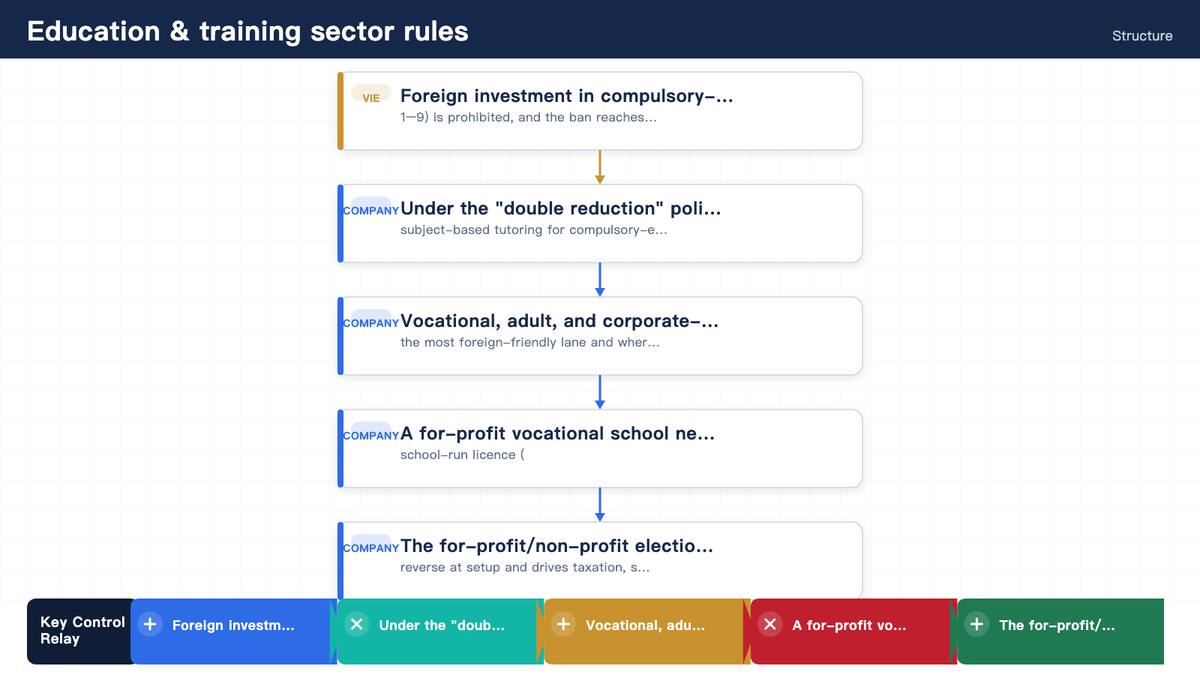
- Foreign investment in compulsory-education institutions (grades 1–9) is prohibited, and the ban reaches participating in or actually controlling such schools, including via VIE.
禁止外商投资义务教育机构(1–9年级),且禁令及于参与举办或实际控制,包括通过VIE协议控制。- Under the “double reduction” policy, for-profit subject-based tutoring for compulsory-education students is effectively barred and new approvals are frozen.
依据”双减”政策,面向义务教育学生的营利性学科类培训实质被禁,新增审批已冻结。- Vocational, adult, and corporate-skills training is the most foreign-friendly lane and where most foreign training JVs are structured.
职业教育、成人教育与岗位技能培训是最对外资友好的通道,多数外资培训合资企业在此架构下设立。- A for-profit vocational school needs a school-run licence (办学许可证) plus company incorporation; non-profit schools register as private non-enterprise units.
营利性职业学校须取得办学许可证并完成公司登记;非营利学校登记为民办非企业单位。- The for-profit/non-profit election is hard to reverse at setup and drives taxation, surplus distribution, and asset treatment, so decide it before incorporating.
营利/非营利的选择在设立时难以逆转,并决定税收、结余分配与资产处置,故须在设立前确定。- Once training opens to the public or issues certificates it is treated as schooling and requires the 办学许可证; a plain training-scope company is only safe for in-house staff upskilling.
一旦培训面向公众或发放证书即按办学认定并须办学许可证;仅含培训范围的普通公司仅在本企业内训时安全。
Education & training sector rules | 教育培训行业规则
Overview
Education is one of the most restricted sectors for foreign investment in China. The core rule is bright-line: investment in compulsory-education institutions (grades 1–9, the “九年义务教育” segment) is prohibited, and the negative list expressly bans foreign investment in compulsory-education institutions. Beyond that, the law draws careful lines between different education levels and between for-profit and non-profit activity.
This article explains the foreign-investment restrictions, the K-12 vs. vocational/adult distinction, and the compliance posture for training joint ventures. It is informational; education structuring should be confirmed with qualified PRC counsel.
The compulsory-education prohibition
The 2020/2021 negative lists prohibit foreign investment in compulsory-education institutions. This is reinforced by the Private Education Promotion Law and its 2021 Implementation Regulations, which state that foreign-invested enterprises and social organisations actually controlled by the foreign party may not run, participate in, or actually control private schools that deliver compulsory education. Public schools for compulsory education may not run or participate in private schools, and local governments may not use state-owned or public resources to run compulsory-education private schools. In short, a foreign investor has no lawful path to own or control a compulsory-education school.
Worth stressing: the ban reaches not only “running” a school but also “participating in running” and “actually controlling” one. Even a foreign investor holding only a minority stake, a board seat, or a contractual arrangement that influences school decisions can breach the rule if deemed the actual controller. Compulsory-education private schools are also tightly constrained on approval, enrolment, fees, and teaching materials, and may not be tied to real-estate or other commercial interests. For foreign capital eyeing the education sector, the safest strategy is to wholly avoid running or controlling grades 1–9 and concentrate resources on the clearly open vocational and adult-training lanes.
K-12, high school, and the “double reduction”
Senior high school (普通高中) is not compulsory education, but the regulatory climate is cautious. The 2021 “double reduction” (双减) policy strictly limits for-profit subject-based tutoring for compulsory-education students; for-profit curriculum-subject tutoring for the compulsory stage is essentially barred, and tutoring institutions are required to be non-profit in that segment. Foreign investors should treat K-12 subject tutoring as effectively closed to for-profit foreign capital. International/charter-style senior-high and certain non-subject (arts, sports, STEM interest) training are possible but are supervised closely and vary by locality.
Supplementary note: after double reduction, the constraints on subject tutoring extend well beyond the profit bar — class timing (no classes on holidays, weekends, or winter/summer breaks), content (no超前 or off-syllabus teaching), prepaid-fee custody (tuition held in bank escrow with payment caps), and advertising limits. Even non-subject training (arts, sports, science/technology) now requires a licence from the competent authority and falls under fund supervision. Senior high school is not compulsory, but international and cross-border programs — such as sino-foreign cooperation in running schools — require approval under the Regulation on Chinese-foreign Cooperation in Running Schools and cannot be launched at will. Any foreign layout in K-12 or high school should first pin down the education stage, subject attribute, and local enforcement posture.
Vocational, adult, and skills training — the open lane
Vocational education is the most foreign-friendly lane. The Private Education Promotion Law and the Implementation Regulations encourage enterprises to run or participate in for-profit vocational schools through sole, joint-venture, or cooperative forms. Public schools may even attract enterprise capital to run for-profit vocational schools. Adult continuing education, professional-skills training, and corporate training are generally open to foreign investment, subject to the education-authority approval and the standard company and foreign-investment filings. This is where most foreign training JVs are structured.
The open lane still has structure. A for-profit vocational school is a “for-profit private school” (营利性民办学校) that must be incorporated as a limited-liability or joint-stock company and obtain a school-run licence (办学许可证) from the education authority; it is then registered with the market regulator as an enterprise legal person. Non-profit vocational schools, by contrast, are registered as private non-enterprise units (民办非企业单位). The choice between for-profit and non-profit is irreversible at setup in practice and drives taxation, the ability to distribute surplus, and asset treatment. Foreign investors should also note that even in the open vocational lane, certain programs (e.g. those granting degrees or involving national education examinations) need additional approval, and foreign teachers must hold the proper work permits and qualifications.
Setting up a training JV or entity
A foreign education/training investor usually establishes a WFOE or a JV with a domestic partner and obtains the school-run licence (办学许可证) from the competent education authority for degree-granting or licensed training activity; pure corporate upskilling training may be delivered through a company with education/training in its business scope, but activities that look like schooling still require the licence. The entity must observe the private-education rules on related-party transactions, fee collection, and the prohibition on controlling compulsory-education schools via M&A or contractual arrangements (the VIE/协议控制 route to compulsory education is explicitly barred).
A recurring compliance trap is the boundary between a company that “trains” and a school that “teaches.” Pure in-house corporate upskilling for the entity’s own staff can run through a standard company whose business scope includes training, with no school licence. But the moment the activity opens to the public, issues certificates, or looks like curriculum delivery, the education authority treats it as schooling and requires the 办学许可证 plus the corporate/non-enterprise registration. In the K-12 and tutoring space, local bureaus have effectively frozen new approvals for subject-based tutoring and imposed strict prepaid-fee custody and price caps, so even non-subject training is now licensed and supervised. Foreign entrants should map each planned activity to the correct permit before incorporating.
Common pitfalls
- Confusing “non-profit” with “may not have a surplus”. Non-profit private schools may run surpluses, but the surplus cannot be distributed to investors; only for-profit private schools may distribute profit, and they require the school licence plus company incorporation.
- Assuming a VIE can reach compulsory education. The private-education rules explicitly bar foreign control of compulsory-education schools via VIE or contractual arrangements; there is no compliant workaround.
- Treating K-12 subject tutoring as open to foreign capital. Under double reduction, for-profit subject tutoring for the compulsory stage is effectively barred, and new approvals are effectively frozen.
- Believing all training is foreign-open. Compulsory education (grades 1–9) is prohibited to foreign investment; schooling-like activities also need the school-run licence regardless of corporate form.
- Incorporating first, then figuring out the licence. The for-profit/non-profit election and the licence type should be decided before incorporation, because the election drives taxation, surplus distribution, and asset treatment and is hard to reverse.
- Overlooking the school-vs-company boundary. Once training opens to the public or issues certificates, the activity is treated as schooling and needs the 办学许可证; a plain training-scope company is only safe for in-house staff upskilling.
What to do next
- Treat compulsory education (grades 1–9) as prohibited for foreign ownership/control — do not structure around it.
- Avoid for-profit K-12 subject tutoring; if entering K-12, use non-subject interest training and confirm the local licence posture.
- Anchor the China plan on vocational, adult, and corporate-skills training, which are open to foreign investment.
- Obtain the school-run licence from the education authority where the activity is schooling-like; use a company with training scope only where genuinely non-schooling.
- Keep ownership clean: the negative list and private-education law bar foreign control of compulsory education via JV, M&A, or VIE.
- Engage the provincial education department and PRC counsel early — approval scope and interpretation vary by region.
Sources
- Ministry of Education (MOE) — Implementation Regulations of the Private Education Promotion Law: https://www.moe.gov.cn/jyb_sjzl/sjzl_zcfg/zcfg_jyxzfg/202110/t20211029_575965.html
- MOE (English) — private education to be promoted: https://en.moe.gov.cn/documents/laws_policies/202105/t20210518_532063.html
- MOE — regulating private compulsory education development: https://www.moe.gov.cn/jyb_xwfb/moe_2082/2021/2021_zl38/202105/t20210524_533204.html
- State Council — private education and Chinese-foreign cooperation in running schools (official portal): https://www.gov.cn/ (official portal)
- NDRC/MOFCOM — negative list revision (prohibits compulsory-education investment): https://en.ndrc.gov.cn/news/mediarusources/202112/t20211228_1310393.html
- Ministry of Commerce (MOFCOM) — policy release portal: https://wms.mofcom.gov.cn/zcfb/index.html
Related reading
- see also: Healthcare & pharma market access (45-healthcare-pharma-market-access)
- see also: Renewable energy & green investment incentives (49-renewable-energy-green-investment)
- see also: E-commerce market entry for foreign brands (43-ecommerce-market-entry)
教育培训行业规则
概述
教育是中国对外资限制最严格的行业之一。核心规则是一条明线:禁止投资义务教育机构(1–9 年级,”九年义务教育”学段),负面清单明确禁止外商投资义务教育机构。在此之外,法律在不同教育阶段之间、在营利性与非营利性活动之间划出细致的界限。
本文说明外资准入限制、K-12 与职业教育/成人教育的区分,以及培训类合资企业的合规范式。本文仅为信息参考,教育架构安排应经合格中国法律顾问确认。
义务教育禁止规则
2020/2021 年版负面清单禁止外商投资义务教育机构。这一禁止由《民办教育促进法》及其 2021 年《实施条例》强化:外商投资企业及外方为实际控制人的社会组织,不得举办、参与举办或实际控制实施义务教育的民办学校。实施义务教育的公办学校不得举办或参与举办民办学校,地方政府不得利用国有资产或公办教育资源举办义务教育民办学校。简言之,外国投资者没有合法路径拥有或控制义务教育学校。
还需强调:该禁止不仅针对”举办”,也及于”参与举办”与”实际控制”。即便外资仅通过少数股权、董事席位或协议安排影响学校决策,若被认定为实际控制人,仍违反禁令。此外,义务教育阶段的民办学校在审批、招生、收费与教材方面受严格约束,且不得与房地产等利益捆绑。对意在教育赛道的外资而言,最稳妥的策略是彻底回避 1–9 年级的举办与控制,将资源集中于明确开放的职业与成人培训。
K-12、高中与”双减”
普通高中不属于义务教育,但监管气候审慎。2021 年”双减”政策严格限制面向义务教育学生的营利性学科类培训;义务教育阶段营利性学科培训基本被禁,该学段培训机构须登记为非营利。外国投资者应将 K-12 学科培训视为对外资营利资本实质关闭。国际/特色高中及部分非学科(艺术、体育、STEM 兴趣)培训虽有可能,但受严格监管且因地而异。
补充提示:”双减”之后,学科类培训的监管不仅限营利性禁止,还包括培训时间(不得占用节假日、休息日及寒暑假)、培训内容(不得超前超标)、预收费监管(资金银行托管、限额收费)与广告限制。即便非学科类(艺术、体育、科技)培训,亦须取得相应主管部门的许可并纳入资金监管。普通高中虽非义务教育,但国际课程与涉外办学(如中外合作办学)须依《中外合作办学条例》经教育主管部门审批,不可自行开展。外资在 K-12 与高中阶段的任何布局,都应先厘清学段、学科属性与本地执行口径。
职业教育、成人教育与技能培训——开放通道
职业教育是最对外资友好的通道。《民办教育促进法》及《实施条例》鼓励企业以独资、合资、合作等方式举办或参与举办营利性职业学校;公办学校亦可吸引企业资本举办营利性职业学校。成人继续教育、职业技能培训与企业内训一般对外资开放,但须取得教育主管部门审批及标准的企业与外资备案。多数外资培训合资企业即在此架构下设立。
开放通道仍有结构。营利性职业学校属”营利性民办学校”,须登记为有限责任公司或股份有限公司,并取得教育行政部门的办学许可证,再于市场监管部门登记为企业法人;非营利性职业学校则登记为民办非企业单位。营利与非营利的选择在设立时实际上不可逆,并决定税收、结余分配权与资产处置。外资还应注意,即便在开放的职业教育通道,部分项目(如颁发学历或涉及国家教育考试者)须另行审批,外籍教师须持合规工作许可与资质。
设立培训合资企业或实体
外资教育/培训投资者通常设立 WFOE 或与国内伙伴组建合资企业,并向主管教育行政部门取得办学许可证(从事学历教育或需许可的培训活动);纯企业内训可通过经营范围含”培训”的公司开展,但形似办学的活动仍须许可证。实体须遵守民办教育关于关联交易、收费以及禁止通过并购或协议控制(VIE)掌控义务教育学校的规定——以 VIE/协议控制路径进入义务教育被明确禁止。
一个反复出现的合规陷阱是”培训的公司”与”教学的学校”之间的界限。仅为本实体员工开展的内部技能提升,可通过经营范围含”培训”的普通公司进行,无需办学许可证。但一旦活动面向公众、发放证书或形似课程交付,教育行政部门即按办学认定,要求办学许可证加企业/民非登记。在 K-12 与培训领域,地方主管部门已实质冻结学科类培训的新增审批,并施以严格的预收费监管与价格上限,因此即便非学科培训如今也须许可与监管。外资进入者应在设立前将每项计划活动对应到正确许可。
常见误读
- 把”非营利”误认为”不能有结余”。 非营利民办学校可有结余,但结余不得向举办者分配;只有营利性民办学校可分配利润,且须办学许可证加公司登记。
- 以为 VIE 可触达义务教育。 民办教育规则明确禁止外资通过 VIE 或协议控制掌控义务教育学校,无合规绕道。
- 把 K-12 学科培训视为对外资开放。 双减下,义务教育阶段营利性学科培训实质被禁,新增审批实质冻结。
- 以为所有培训均对外资开放。 义务教育(1–9 年级)禁止外资投资;形似办学的活动无论何种公司形式均须办学许可证。
- 先设立、后补许可。 营利/非营利的选择与许可类型应在设立前确定,因其决定税收、结余分配与资产处置,且难以逆转。
- 忽视”学校”与”公司”的界限。 一旦培训面向公众或发放证书,即按办学认定并需办学许可证;仅含培训范围的普通公司,仅在本企业内训时安全。
下一步建议
- 将义务教育(1–9 年级)视为外资拥有/控制的禁区——不要绕道架构。
- 避免营利性 K-12 学科培训;若进入 K-12,采用非学科兴趣培训并确认本地许可姿态。
- 将中国计划锚定在对外资开放职业教育、成人教育与岗位技能培训上。
- 形似办学的活动须从教育行政部门取得办学许可证;仅当确属非办学时,才用含培训范围的公司。
- 保持股权清晰:负面清单与民办教育法禁止外资通过合资、并购或 VIE 控制义务教育。
- 尽早对接省级教育行政部门与中国法律顾问——审批范围与解释因地而异。
来源
- 教育部(MOE)——《民办教育促进法实施条例》:https://www.moe.gov.cn/jyb_sjzl/sjzl_zcfg/zcfg_jyxzfg/202110/t20211029_575965.html
- 教育部(英文)——民办教育将获促进:https://en.moe.gov.cn/documents/laws_policies/202105/t20210518_532063.html
- 教育部——依法规范民办义务教育发展:https://www.moe.gov.cn/jyb_xwfb/moe_2082/2021/2021_zl38/202105/t20210524_533204.html
- 国务院——民办教育及中外合作办学相关法规(官方门户):https://www.gov.cn/(官方门户)
- 发改委/商务部——负面清单修订(禁止投资义务教育):https://en.ndrc.gov.cn/news/mediarusources/202112/t20211228_1310393.html
- 商务部(MOFCOM)——政策发布门户:https://wms.mofcom.gov.cn/zcfb/index.html
相关阅读
- 参见:医疗医药准入(45-healthcare-pharma-market-access)
- 参见:可再生能源与绿色投资激励(49-renewable-energy-green-investment)
- 参见:外国品牌的电商入华(43-ecommerce-market-entry)