
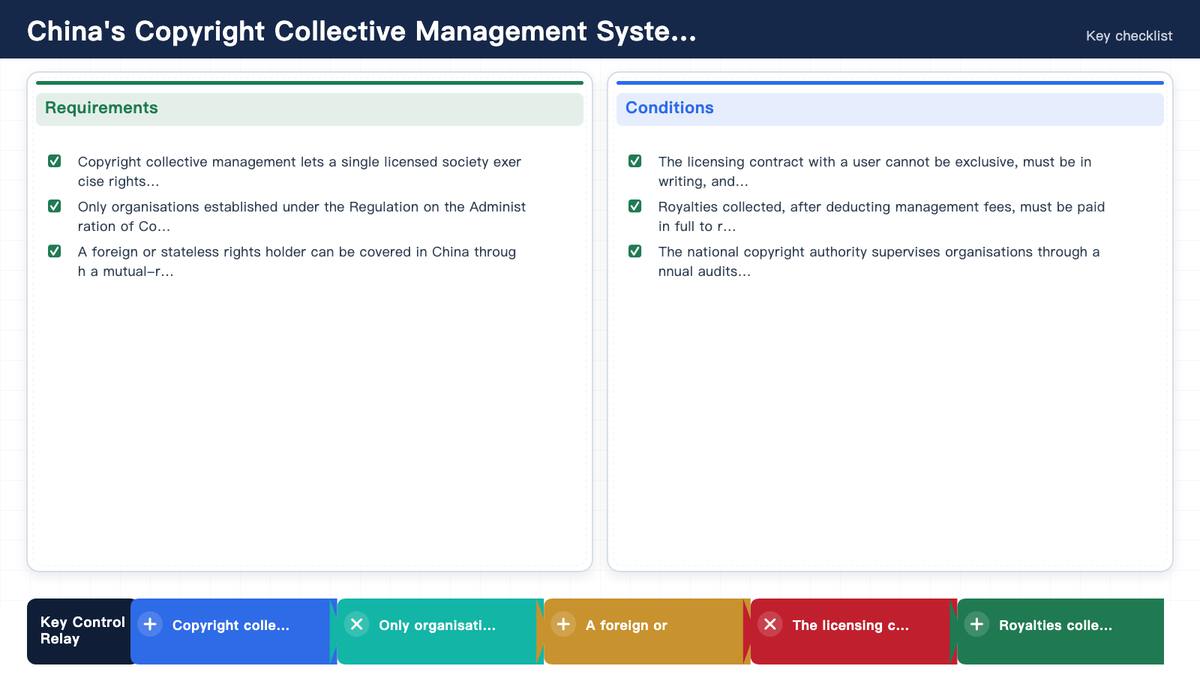
- Copyright collective management lets a single licensed society exercise rights that individual rights holders cannot efficiently enforce themselves — performance, broadcasting, rental, information-network transmission and reproduction — and license users, collect royalties, and distribute them on the rights holder’s behalf.
著作权集体管理由依法设立的集体管理组织,集中行使权利人难以自行有效行使的权利——表演权、广播权、出租权、信息网络传播权、复制权等,并以自己名义向使用者许可、收取使用费并向权利人转付。- Only organisations established under the Regulation on the Administration of Copyright Collective Management (State Council Decree No. 429) may conduct collective management; no other entity or individual may do so.
只有依据《著作权集体管理条例》(国务院令第 429 号)设立的组织方可从事集体管理活动,其他任何组织和个人均不得从事。- A foreign or stateless rights holder can be covered in China through a mutual-representation agreement between a Chinese collective management organisation and its overseas counterpart, which must be filed with and announced by the national copyright authority.
外国及无国籍权利人可通过中国集体管理组织与境外同类组织订立的”相互代表协议”获得覆盖,该协议须报国务院著作权管理部门备案并予以公告。- The licensing contract with a user cannot be exclusive, must be in writing, and is capped at two years (renewable); the organisation may not refuse a user who requests a licence on reasonable terms.
与使用者订立的许可使用合同不得为专有许可、须以书面形式订立、期限不得超过 2 年(可续订);对以合理条件要求订立合同的,集体管理组织不得拒绝。- Royalties collected, after deducting management fees, must be paid in full to rights holders and may not be diverted; fee records must be kept for at least ten years and are open to inspection by rights holders and users.
收取的使用费在提取管理费后须全部转付权利人、不得挪作他用;使用费转付记录须保存 10 年以上,权利人及使用者有权查阅。- The national copyright authority supervises organisations through annual audits, mandatory disclosure of fee schedules, and a 60-day deadline to investigate complaints from rights holders or users.
国务院著作权管理部门通过年度审计、使用费收取标准公告公示以及对权利人/使用者举报 60 日内调查处理等制度实施监督。
China’s Copyright Collective Management System (2026): What Foreign Rights Holders and Users Should Know | 中国著作权集体管理制度(2026):涉外权利人与使用者须知
Why collective management exists
Many copyright rights are impractical for an individual creator or company to monitor and license one transaction at a time. Whoever owns the public-performance right to a song cannot realistically chase every café, shopping mall, radio station and streaming platform that plays it. China solves this through copyright collective management — a system in which a single licensed society, authorised by many rights holders, bundles their rights, licenses users centrally, collects royalties, and distributes them back. For a foreign-invested enterprise that either owns copyrighted works or uses music, text, software or broadcasts in its business, understanding this system is essential: it determines how you lawfully license background music, karaoke, online content, or how your own works get enforced and monetised in China.
The legal foundation
The system rests on the Regulation on the Administration of Copyright Collective Management (State Council Decree No. 429, effective 1 March 2005), issued under the Copyright Law. The regulation defines what collective management is, who may do it, how an organisation is set up, how it operates, and how it is supervised. Supplementary approval rules are maintained by the National Press and Publication Administration (which houses the National Copyright Administration, NCA). The key structural point: collective management is a closed, licensed monopoly — only organisations approved by the NCA may operate, and their business scopes must not overlap.
What rights can be collectively managed
Under the regulation, the rights that rights holders “find difficult to effectively exercise themselves” may be managed collectively. These include:
- Performance right — public playing or singing of a work.
- Projection/rendering right — showing a work in public by technical means.
- Broadcasting right — wireless or wired broadcasting and rebroadcasting.
- Rental right — renting out originals or copies of certain works.
- Information-network transmission right — making a work available to the public over a network.
- Reproduction right — among others that are hard to police individually.
These are precisely the rights that a foreign brand’s in-house legal team cannot practically police across thousands of venues or platforms — which is what makes collective management the practical enforcement channel.
How an organisation is established
Establishing a collective management organisation is a State-approved activity. The threshold conditions are specific:
- At least 50 rights holders发起设立 (as initiators).
- Its business scope must not cross or overlap with an already-registered organisation.
- It must be able to represent the relevant rights holders’ interests nationwide.
- It must have draft articles, a draft fee-collection standard, and a draft royalty-distribution method.
The applicant files with the NCA, which decides within 60 days whether to grant a Copyright Collective Management Licence. Within 30 days of approval, the applicant registers with the Ministry of Civil Affairs; within 30 days of registration, it files a copy of the registration certificate with the NCA, which announces the articles, fee standard and distribution method. The organisation must run its general assembly at least annually and maintain a council of no fewer than nine members.
How collective management works in practice
For a rights holder, the flow is:
- Sign a collective management contract authorising the organisation to manage specified rights. The organisation may not refuse a qualified rights holder.
- While the contract is in force, the rights holder generally may not itself exercise or license the contracted rights.
- A rights holder may withdraw per the organisation’s rules; however, licences already granted to users remain valid until expiry, and the rights holder keeps entitlement to royalties from them.
For a user (say, a retailer playing music, a hotel offering video-on-demand, or a platform streaming content), the flow is:
- The organisation must license on reasonable request and may not refuse or impose an exclusive licence.
- The licence contract is in writing, capped at two years, renewable.
- The user must provide usage data (titles, right-holder names, manner, quantity, time) unless the contract says otherwise; the organisation has a confidentiality duty over any trade secrets in that data.
- The organisation must maintain a rights-information query system that both rights holders and users can consult.
Royalties and supervision
The economic safeguards are deliberately strict:
- The organisation sets a fee-collection standard, which is announced by the NCA; royalties are then negotiated against that standard.
- After deducting a management fee (which must decline as revenue rises), all remaining royalties must be paid to rights holders — none may be diverted.
- The organisation must keep royalty-distribution records for at least ten years, and rights holders and users have a statutory right to inspect them.
- Each year the organisation publishes an audited financial report.
- The NCA supervises through on-site checks, account review, and attendance at key meetings, and must investigate complaints within 60 days. Rights holders may report refusals to license, mis-handled fees, or denied record access; users may report unlawful refusals to contract or failures to apply the announced fee standard.
What this means for foreign-invested enterprises
- If you use copyrighted content in China — background music in stores, karaoke in F&B outlets, streaming or broadcast features in apps, or reproduction of texts/images — obtain licences through the relevant collective management organisation rather than assuming individual clearance covers public-performance or network-transmission scenarios. Keep your usage records; they are your defence against disputes and your input to royalty calculation.
- If you own copyrights — music, literature, software, audiovisual works — you can join a Chinese collective management organisation, or, more commonly for foreign holders, be covered via a mutual-representation agreement between that organisation and your home-country society. File and confirm the agreement’s NCA备案/announcement so your coverage is recognised.
- Plan for two-year licence cycles and budget royalties against the announced fee standards; treat the management-fee decline and full-distribution rules as your assurance that fees reach rights holders (including you, if you are one).
- Watch the boundaries. The organisation cannot grant exclusive licences, cannot refuse reasonable requests, and cannot divert royalties. If you encounter such conduct as a user or rights holder, you have a statutory complaint route to the NCA.
Boundaries to keep in mind
Collective management covers only the rights assigned to it — it is not a blanket licence for all uses, and it does not replace direct licensing for rights outside its scope (e.g., translation, adaptation, or exclusive commercialisation you wish to control yourself). The mutual-representation route is the practical bridge for most foreign rights holders, but it depends on a valid, filed agreement. And because each organisation has a non-overlapping scope, identify the correct one for your specific right (performance, reproduction, network transmission, etc.) before engaging.
中国著作权集体管理制度(2026):涉外权利人与使用者须知
为何需要集体管理
许多著作权权利若由权利人逐笔监督与许可,在现实中几乎不可行。一首歌曲的公开表演权人,不可能逐一追查每一家咖啡馆、商场、广播电台与流媒体平台。中国的解决之道是著作权集体管理——由一家经许可的集体管理组织,获得众多权利人授权后将其权利打包,统一向使用者许可、集中收取使用费并分配回权利人。对于既可能拥有作品又可能使用音乐、文字、软件或广播内容的在华外资企业而言,理解这套制度至关重要:它决定了你如何合法取得背景音乐、卡拉 OK、线上内容的许可,也决定了你自己的作品在中国如何获得保护与变现。
法律基础
该制度建立在《著作权集体管理条例》(国务院令第 429 号,2005 年 3 月 1 日施行)之上,系依据《著作权法》制定。条例界定了集体管理的含义、主体资格、设立程序、运营规则与监督机制。补充性的审批规则由国家新闻出版署(加挂国家版权局牌子)维护。关键结构特征是:集体管理是一种封闭、经许可的专营——只有经国家版权局批准的组织方可运营,且其业务范围不得交叉、重合。
可纳入集体管理的权利
依条例,权利人”难以有效行使”的权利可由集体管理组织管理,主要包括:
- 表演权——公开表演或演奏作品。
- 放映权——通过技术手段公开再现作品。
- 广播权——无线或有线方式广播及转播。
- 出租权——出租特定作品原件或复制件。
- 信息网络传播权——通过网络向公众提供作品。
- 复制权——以及其他难以个别监管的权利。
这些恰恰是外资品牌自有法务团队难以在成千上万个场所或平台逐一维权的权利——这也正是集体管理成为实际维权通道的原因。
组织如何设立
设立集体管理组织属于行政许可事项,门槛明确:
- 发起设立的权利人不少于 50 人。
- 业务范围须与已登记组织不交叉、不重合。
- 须能在全国范围代表相关权利人利益。
- 须具备章程草案、使用费收取标准草案及使用费转付办法草案。
申请人向国家版权局提交材料,国家版权局自收到之日起 60 日内作出是否批准的决定;获批后 30 日内到民政部办理登记;登记证书核发后 30 日内将副本报国家版权局备案,由后者公告章程、收费标准与转付办法。组织须每年至少召开一次会员大会,理事会成员不少于 9 人。
集体管理的实际运作
对权利人而言,流程为:
- 订立集体管理合同,授权组织管理特定权利;对符合条件的权利人,组织不得拒绝。
- 合同有效期内,权利人一般不得自行行使或许可合同约定的权利。
- 权利人可按章程退出;但已授予使用者的许可在期满前继续有效,权利人仍有权取得相应使用费。
对使用者(如在门店播放音乐的零售商、提供点播的酒店、流媒体平台)而言,流程为:
- 组织必须按合理请求予以许可,不得拒绝,也不得订立专有许可。
- 许可合同须为书面形式,期限不超过 2 年,可续订。
- 使用者须提供使用数据(作品名称、权利人名称、使用方式、数量、时间等),合同另有约定除外;涉及商业秘密的,组织负有保密义务。
- 组织须建立权利信息查询系统,供权利人与使用者查询。
使用费与监督
经济层面的保障十分严格:
- 组织制定使用费收取标准,由国家版权局公告;使用费在该标准基础上协商确定。
- 提取管理费(须随收入增加而逐步降低)后,剩余使用费须全部转付权利人,不得挪作他用。
- 组织须编制并保存使用费转付记录至少 10 年,权利人与使用者有权查阅。
- 组织每年须发布经审计的财务报告。
- 国家版权局通过现场检查、账目核查、列席重要会议实施监督,并须在 60 日内调查举报事项。权利人可就拒绝许可、费用处理不当、拒绝提供记录等举报;使用者可就违法拒绝订约或未按公告标准收费等举报。
对在华外资企业的启示
- 若你在中国境内使用受版权保护的内容——门店背景音乐、餐饮卡拉 OK、应用内的流媒体或广播功能、文字/图像复制等——应通过相关集体管理组织取得许可,而非想当然地认为个别授权已覆盖公开表演或网络传播场景。保留使用记录:既是争议抗辩依据,也是使用费计算的基础。
- 若你拥有版权——音乐、文学、软件、视听作品——可加入中国集体管理组织;对境外权利人更常见的方式,是通过该组织与本国同类组织之间的相互代表协议获得覆盖。确认该协议已向国家版权局备案并公告,以便你的覆盖获得承认。
- 规划 2 年许可周期,并依据公告的收费标准预算使用费;将管理费递减与全额转付规则视为费用最终到达权利人(包括你自身,若你也是权利人)的保障。
- 注意边界。 组织不得授予专有许可、不得拒绝合理请求、不得挪用使用费。作为使用者或权利人若遇此类行为,依法可向国家版权局投诉。
须把握的边界
集体管理仅覆盖被授权给它的权利——并非对所有使用的一揽子许可,也不能替代对范围外权利(如翻译、改编或你希望亲自控制的独占商业化)的直接许可。相互代表协议是多数境外权利人最现实的桥梁,但它依赖一份有效且已备案的协议。又因各组织业务范围不重叠,在接洽前应确认针对你特定权利(表演、复制、信息网络传播等)的正确组织。
Sources