
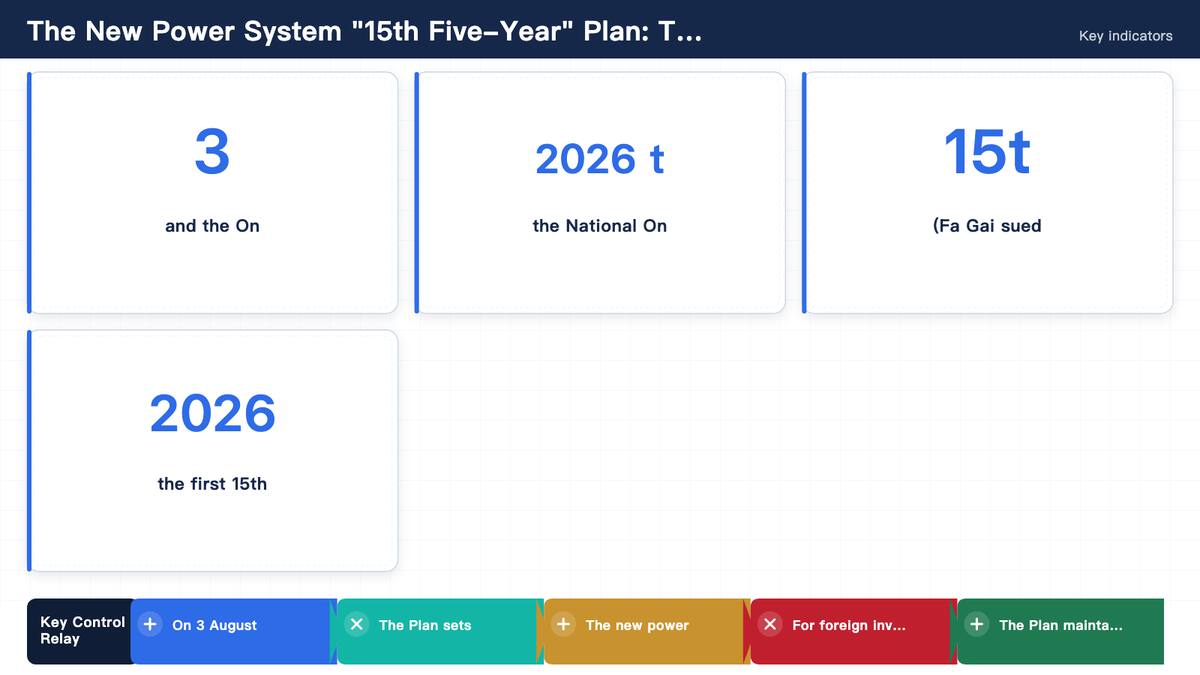
- On 3 August 2026 the NDRC and the National Energy Administration issued the New Power System Construction “15th Five-Year” Plan (Fa Gai Neng Yuan [2026] No. 942), the first dedicated five-year roadmap for the power sector, targeting initial completion of the new power system by 2030.
2026 年 8 月 3 日,国家发展改革委、国家能源局印发《新型电力系统建设”十五五”规划》(发改能源〔2026〕942 号),这是电力行业首份专项五年规划,目标到 2030 年初步建成新型电力系统。- The Plan sets concrete 2030 targets: non-fossil energy generation reaching 50% of total electricity, over 2.8 billion kW of new-energy capacity integrated at high level, 160 GW of pumped storage, 300 GW-plus of new energy storage and 40 million-plus charging piles.
规划设定具体 2030 目标:非化石能源发电量占比达 50%,实现 28 亿千瓦以上新能源高水平消纳,抽水蓄能装机约 1.6 亿千瓦,新型储能超 3 亿千瓦,充电桩总量增至 4000 万个以上。- The new power system is a 10-dimension build covering supply, grid, storage, demand, market and digitalisation — with “calculation-power electricity” (electrical power for data centres) named as a key demand-side driver, targeting 80 TWh of computing-power electricity by 2030.
新型电力系统建设覆盖电源、电网、储能、负荷、市场与数字化十大维度,”算电融合”被列为关键负荷侧动力,到 2030 年算力用电量预计达 8000 亿千瓦时。- For foreign investors, the Plan opens concrete commercial entry points: new-energy storage manufacturing and operation, virtual power plants and demand response, grid digitalisation, charging infrastructure, green power direct supply to industrial parks and data centres, and participation in the national unified electricity market.
对外国投资者,规划打开具体商业入口:新型储能制造与运营、虚拟电厂与需求响应、电网数字化、充电基础设施、工业园区与数据中心绿电直供,以及参与全国统一电力市场。- The Plan maintains a binding national average new-energy utilisation rate of around 90%, with differentiated utilisation-rate guidance by region, meaning green-power purchase and consumption strategies must be location-specific.
规划保持全国新能源利用率 90% 左右的约束性导向,并按区域资源禀赋实行分档利用率管控,绿电采购与消纳策略须按地点定制。- Institutional mechanisms support the transition: a full-cycle monitoring and early-warning system from planning to grid connection, nine major special projects including wind-solar bases, UHV expansion, storage and computing-power green-power packages, and continued power market reform.
制度机制支撑转型:建立”规划—建设—并网—消纳”全周期监测预警机制,实施风光基地、特高压扩容、储能建设、算力绿电配套等九大专项工程,并持续推进全国统一电力市场化改革。
The New Power System “15th Five-Year” Plan: Targets, Opportunities and Foreign-Investor Entry Points in China’s Green Power Economy | 新型电力系统”十五五”规划:目标、机遇与外国投资者在中国绿电经济中的切入点
The Plan and its significance
On 3 August 2026 the National Development and Reform Commission and the National Energy Administration issued the New Power System Construction “15th Five-Year” Plan (Fa Gai Neng Yuan [2026] No. 942), the first dedicated five-year programme for the power sector and the guiding document for China’s electricity industry through 2030. The strategic target is the initial completion of a new power system by 2030 — a system that is secure and reliable, green and low-carbon, resilient and intelligent. The Plan is structured around ten dimensions spanning generation supply, grid, storage, load, market, technology and security governance, and it explicitly places electricity as the leading force in economic development: “rather than let development wait for electricity, let electricity wait for development.” For foreign investors, the Plan is the definitive map of where China’s power-related capital expenditure will flow between 2026 and 2030.
The headline 2030 targets
The Plan sets quantified targets that define the size of the opportunity. On generation: non-fossil power capacity reaches 65% of installed capacity and 50% of generation; conventional hydro reaches about 410 GW; nuclear about 110 GW; biomass, CSP, geothermal and ocean energy about 65 GW. On grid and integration: more than 2.8 billion kW of wind and solar capacity is integrated at a high level; the west-to-east power transmission capacity rises to 420 GW. On storage and flexibility: about 160 GW of pumped storage; more than 300 GW of new energy storage; virtual power plants and vehicle-to-grid each reach 50 GW of dispatchable capacity. On demand and charging: more than 40 million charging piles, supporting more than 110 million electric vehicles. On markets and efficiency: the national new-energy utilisation rate is maintained around 90%, with differentiated utilisation guidance by region. On computing: computing-power electricity consumption reaches 80 TWh by 2030, about 6% of total electricity use. These are not aspirational numbers; they are the planning basis for the nine major special projects that follow.
The ten dimensions and the nine special projects
The Plan’s ten dimensions organise the work: (1) optimised green supply — “desert-gobi-wasteland” large wind-solar bases and distributed PV, coal power transitioning to a regulating role; (2) grid upgrading — UHV DC and 750 kV backbone expansion, main-grid-subgrid-microgrid integration; (3) flexible adjustment — independent and shared storage, pumped storage, virtual power plants; (4) demand-side — computing-power coordination, green power direct supply to data centres and industrial parks, nationwide charging networks; (5) electricity-security support; (6) digital and intelligent upgrade; (7) cross-sector integration (electricity-heat, electricity-hydrogen, electricity-transport); (8) unified electricity market reform; (9) technology and equipment; and (10) security governance and regulation. The nine major special projects include wind-solar base construction, UHV capacity expansion, storage construction and a computing-power green-power package, each with funding and assessment support. For a foreign supplier of grid equipment, storage systems, charging hardware or control software, these dimensions translate directly into pipeline demand over the next four years.
Where foreign investors can enter
Foreign investment in the new power system can take several routes. First, manufacturing and operation of new energy storage: with more than 300 GW of new storage targeted, the domestic storage value chain — cells, PCS, BMS, EMS, system integration — is one of the largest single equipment markets in the world, and foreign technology holders have historically participated through JVs and technology licensing. Second, virtual power plants and demand response: aggregated flexible loads, EV charging and industrial demand response are being commercialised through market mechanisms, and foreign aggregators with proven software can partner with domestic utilities and platforms. Third, grid digitalisation: dispatch software, grid modelling, and the “digital twin” of the Yangshan-style smart platforms that the Plan generalises — foreign advanced-grid software and hardware vendors have a genuine opening. Fourth, charging infrastructure and vehicle-to-grid: with 40 million-plus piles planned, charge-point operators, and V2G technology providers can enter through JVs with local operators. Fifth, green power procurement and PPAs: the market-based electricity market and green certificate system let foreign-invested manufacturers sign green-power agreements, an increasingly important element of EU CBAM and supply-chain decarbonisation strategies. Sixth, computing-power green power: the Plan explicitly supports green electricity direct supply to computing parks, which foreign data-centre operators and cloud providers can structure into their China procurement.
The market and utilisation-rate framework
Foreign investors should note two structural features. First, the utilisation-rate framework: the Plan maintains a national average utilisation rate around 90% but introduces differentiated guidance by region and a full-cycle “planning–construction–grid-connection–consumption” monitoring and early-warning mechanism. This means green-power availability and pricing differ materially across provinces, and a company’s decarbonisation and PPA strategy must be built province by province, not nationally. Second, the market reform track: the Plan continues the push toward a unified national electricity market, with pricing reform for new-energy generation and greater reliance on market mechanisms for storage and flexibility. Foreign-invested manufacturers should treat electricity market participation — long-term agreements, ancillary services, capacity mechanisms — as part of their China energy strategy, not as an optional add-on.
What has not changed: the security and state-control framework
The Plan is ambitious on market mechanisms but unambiguous on the structure of the sector: electricity grid remains a state-controlled strategic asset, and foreign participation runs through equipment supply, technology, storage, charging, demand-side aggregation, green power procurement and selected services — not through ownership of grid assets or base-load generation. The encouraged-catalogue and negative-list regimes continue to define what is open and at what equity ratio. Foreign investors should therefore structure participation around the value chain rather than around asset ownership, and should verify the current status of each activity under the negative list and sector licences before committing.
Practical steps for foreign investors in 2026–2030
First, map your technology or service to the ten dimensions and the nine projects, and identify the province-level implementation plans that will follow — provincial NDRC and energy bureau documents are where the concrete project lists will appear. Second, for manufacturers, locate within the new-energy equipment supply chain where China’s local content requirements and standards apply, and structure JV or licensing relationships accordingly. Third, for investors in storage, virtual power plants and charging, assess the market-based revenue streams (peak-valley spreads, ancillary services, capacity payments) that the reform track is creating. Fourth, for corporate decarbonisation, build a province-specific green power procurement model using direct green power trading, certificates and the emerging long-term agreements. Fifth, monitor the nine special projects as they are rolled out — funding mechanisms, procurement calendars and standards-setting will determine the practical window for foreign suppliers.
Outlook
The New Power System “15th Five-Year” Plan is the clearest statement yet of where China’s power sector is heading and how much capital will be deployed to get there. For foreign investors, it converts a diffuse set of green-energy ambitions into quantified, project-linked demand across storage, grid digitalisation, charging, virtual power plants, green-power markets and computing-power integration. The window is open now, and it is defined less by policy text than by the provincial project pipelines and market mechanisms that the Plan is already activating.
Sources
- 国家能源局 — 《到2030年新型电力系统初步建成》(2026-08-07,介绍《新型电力系统建设”十五五”规划》主要目标):https://www.nea.gov.cn/20260807/34bfc6ca545f4627b2a1c1f00462c141/c.html
- 国家能源局 — 《新型电力系统建设明确施工图》(2026-08-17,规划目标与重点任务解读):https://www.nea.gov.cn/20260817/43f478dfe4724af583286b61f36dfa04/c.html
- 庆阳市发展和改革委员会 — 《国家发展改革委、国家能源局印发〈新型电力系统建设”十五五”规划〉》(发改能源〔2026〕942号,十大维度与九大专项工程要点):https://fgw.zgqingyang.gov.cn/zzzq/zzlm/tzgg1__xwzx/tzgg/content_352741
- 人民日报(中国能源报)— 《加快构建新型电力系统 夯实能源强国建设根基——〈新型电力系统建设”十五五”规划〉解读》(2026-08-17):https://paper.people.com.cn/zgnyb/pc/content/202608/17/content_30175895.html
新型电力系统”十五五”规划:目标、机遇与外国投资者在中国绿电经济中的切入点
规划及其意义
2026 年 8 月 3 日,国家发展改革委、国家能源局印发《新型电力系统建设”十五五”规划》(发改能源〔2026〕942 号),这是电力行业首份专项五年规划,也是 2030 年前中国电力工业的纲领性文件。战略目标是到 2030 年初步建成新型电力系统——安全可靠、绿色低碳、坚强韧性、智能灵活。规划贯通电源、电网、储能、负荷、市场、技术与安全治理十大维度,并把电力置于经济发展的先导地位:”宁让电等发展、不让发展等电”。对外国投资者,规划是 2026—2030 年中国电力相关资本开支流向的权威地图。
2030 年核心目标
规划以量化目标界定机会规模。电源侧:非化石能源发电装机占比达 65%、发电量占比达 50%;常规水电约 4.1 亿千瓦;核电约 1.1 亿千瓦;生物质、光热、地热、海洋能约 6500 万千瓦。电网与消纳:实现 28 亿千瓦以上风光新能源高水平消纳;西电东送整体输送能力提升至 4.2 亿千瓦。储能与调节:抽水蓄能约 1.6 亿千瓦;新型储能超 3 亿千瓦;虚拟电厂与车网互动可调规模均达 5000 万千瓦。负荷与充电:充电桩总量增至 4000 万个以上,支撑超 1.1 亿辆电动汽车。市场与效率:全国新能源利用率稳定在 90% 左右,按区域分档管控。算力:2030 年算力用电量达 8000 亿千瓦时,约占全社会用电量 6%。这些不是愿景数字,而是其后九大专项工程的规划基础。
十大维度与九大专项工程
规划的十大维度组织工作:(1)优化绿色供给——”沙戈荒”大型风光基地与分布式光伏,煤电转向调节兜底;(2)电网升级——特高压直流与 750 千伏骨干网架,主配微一体化;(3)灵活调节——独立与共享储能、抽水蓄能、虚拟电厂;(4)负荷侧——算电融合、数据中心与工业园区绿电直供、全域充电网络;(5)电力安全保供;(6)数字化智慧升级;(7)跨域融合(电热、电氢、电交通);(8)统一电力市场化改革;(9)技术与装备;(10)安全治理与监管。九大专项工程含风光基地、特高压扩容、储能建设、算力绿电配套等,各有资金与考核支撑。对电网设备、储能系统、充电硬件或控制软件的境外供应商,这些维度在未来四年直接转化为管线需求。
外国投资者可进入之处
外国投资进入新型电力系统有若干路径。其一,新型储能制造与运营:以超 3 亿千瓦新型储能为目标,国内储能价值链——电芯、PCS、BMS、EMS、系统集成——是全球最大的单体装备市场之一,外国技术持有者历来通过合资与技术许可参与。其二,虚拟电厂与需求响应:聚合灵活负荷、电动汽车充电与工业需求响应正通过市场机制商业化,有成熟软件的外国聚合商可与国内电力公司与平台合作。其三,电网数字化:调度软件、电网建模与规划推广的智能平台——外国先进电网软硬件厂商有真实窗口。其四,充电基础设施与车网互动:4000 万以上充电桩规划下,运营商与 V2G 技术提供者可经与本地运营商合资进入。其五,绿电采购与购电协议:市场化电力市场与绿证体系让外资制造商可签绿电协议,这是欧盟 CBAM 与供应链脱碳战略中日益重要的环节。其六,算力绿电:规划明确支持算力园区绿电直供,外国数据中心与云服务运营商可纳入其在华采购结构。
市场与利用率框架
外国投资者应关注两个结构性特征。其一,利用率框架:规划保持全国平均利用率 90% 左右,但引入分档差异化指导与”规划—建设—并网—消纳”全周期监测预警机制。这意味着各省绿电可得性与价格差异显著,企业脱碳与 PPA 策略须逐省构建,而非全国统一。其二,市场改革轨道:规划持续推进全国统一电力市场,改革新能源发电定价,储能与灵活性更多依赖市场机制。外资制造商应把电力市场参与——长期协议、辅助服务、容量机制——纳入在华能源战略,而非可选附加项。
未变之处:安全与国资框架
规划对市场机制雄心勃勃,但对行业结构毫不含糊:电网仍是国家控制的战略资产,外国参与通过设备供应、技术、储能、充电、需求侧聚合、绿电采购与部分服务展开——而非拥有电网资产或基荷电源。鼓励目录与负面清单继续定义开放范围与股比。外国投资者应围绕价值链而非资产所有权构建参与,并在投入前核验各活动在负面清单与行业许可下的当前状态。
2026—2030 外国投资者实操
其一,把技术或服务映射到十大维度与九大项目,关注随之而来的省级实施方案——省发改委与能源局文件是具体项目清单所在。其二,制造商:辨识新能源装备供应链中本地化要求与标准适用环节,相应构建合资或许可关系。其三,储能、虚拟电厂与充电投资者:评估改革轨道正在创造的市场化收入流(峰谷价差、辅助服务、容量补偿)。其四,企业脱碳:用绿电直接交易、绿证与新成长的长协,构建逐省绿电采购模型。其五,跟踪九大专项工程落地——资金机制、采购节奏与标准制定将决定外国供应商的实操窗口。
展望
《新型电力系统建设”十五五”规划》是迄今最清晰的中国电力部门走向与资本投入量级声明。对外国投资者,它把分散的绿色能源雄心转化为跨储能、电网数字化、充电、虚拟电厂、绿电市场与算电融合的量化和项目挂钩需求。窗口期就在当下,其边界更多由规划正在激活的省级项目管线与市场机制界定,而非政策文本本身。
Sources
- 国家能源局 — 《到2030年新型电力系统初步建成》(2026-08-07):https://www.nea.gov.cn/20260807/34bfc6ca545f4627b2a1c1f00462c141/c.html
- 国家能源局 — 《新型电力系统建设明确施工图》(2026-08-17):https://www.nea.gov.cn/20260817/43f478dfe4724af583286b61f36dfa04/c.html
- 庆阳市发展和改革委员会 — 《国家发展改革委、国家能源局印发〈新型电力系统建设”十五五”规划〉》(发改能源〔2026〕942号):https://fgw.zgqingyang.gov.cn/zzzq/zzlm/tzgg1__xwzx/tzgg/content_352741
- 人民日报(中国能源报)—《新型电力系统建设”十五五”规划》解读(2026-08-17):https://paper.people.com.cn/zgnyb/pc/content/202608/17/content_30175895.html