
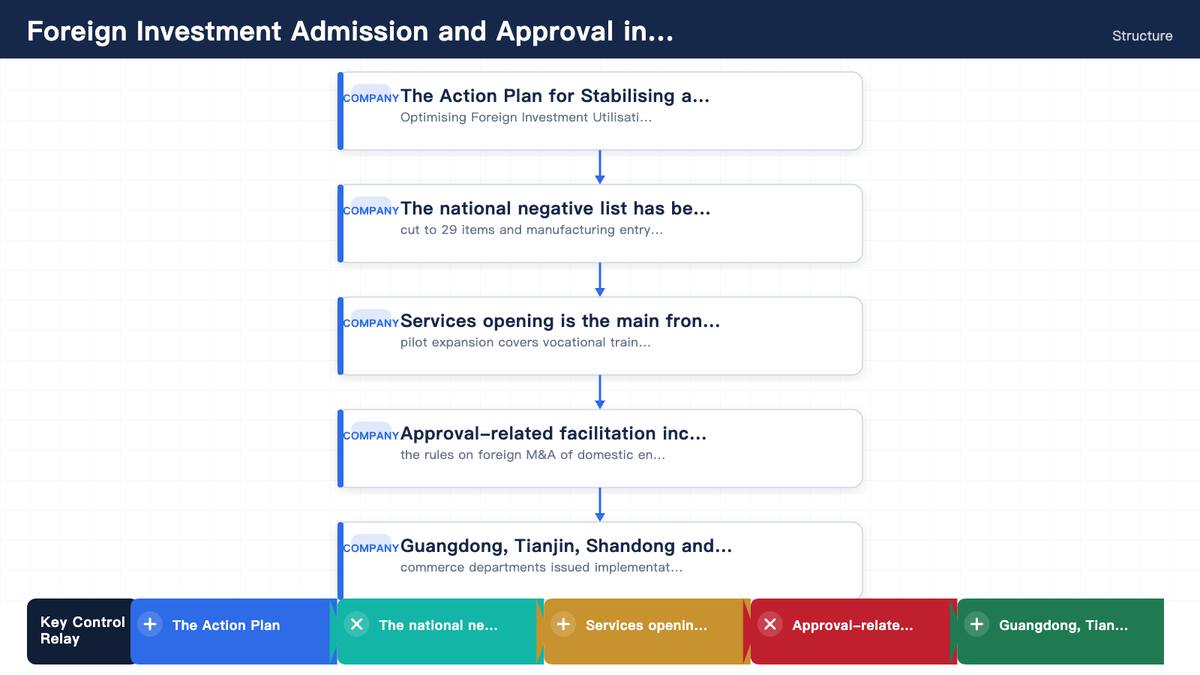
- The Action Plan for Stabilising and Optimising Foreign Investment Utilisation (Shang Zi Fa [2026] No. 97), approved by the State Council and released in June 2026, shifts foreign investment management from “market access” to “post-entry operation” (zhun ru to zhun ying).
经国务院同意、2026 年 6 月印发的《利用外资固稳促优行动方案》(商资发〔2026〕97 号),把外资管理重心从”准入”转向”准营”。
- The national negative list has been cut to 29 items and manufacturing entry restrictions fully cleared; the focus now is removing hidden barriers so licensed foreign firms can actually operate.
全国版外资准入负面清单已压减至 29 条、制造业准入限制全部清零;下一步重点在于打通”大门开、小门不开”的隐性壁垒,保障外资企业顺畅经营。
- Services opening is the main front: pilot expansion covers vocational training institutions, vocational colleges and high-level science, engineering, agriculture and medicine universities, plus value-added telecom, biotech and wholly foreign-owned hospitals.
服务业开放成为主攻方向:稳步扩大职业技能培训机构、职业院校、高水平理工农医类大学对外开放试点,稳妥实施增值电信、生物技术、外商独资医院等试点。
- Approval-related facilitation includes accelerated revision of the rules on foreign M&A of domestic enterprises, optimised procedures and consideration requirements, and a new channel for qualified foreign equity investment institutions to join non-related-industry A-share issuances as strategic investors.
审批便利化措施包括加快修订外资并购境内企业规定、优化并购管理流程与对价支付要求,并允许符合条件的外资股权投资机构以战略投资者身份参与非相关行业上市公司证券发行。
- Guangdong, Tianjin, Shandong and Shanghai local commerce departments issued implementation guidance and liaison briefings through August 2026, confirming the plan is being operationalised at provincial level.
广东、天津、山东、上海等地商务部门 2026 年 8 月陆续转发文件并发布解读周报,确认方案已在省级层面进入落地执行。
- Foreign companies should treat the action plan as a near-term compliance and planning signal: re-test new business lines against opening pilots, prepare M&A filings under the forthcoming revised rules, and use one-stop service windows for admission questions.
外资企业应把行动方案视为近期合规与规划信号:对照开放试点重测新业务线、按即将修订的并购规则准备申报材料、通过一站式窗口解决准入疑问。
Foreign Investment Admission and Approval in China: Post-Entry Reform Under the 2026 Action Plan | 中国外资准入与审批:2026 年行动方案下的”准营”改革
Why this matters now
In June 2026, the Ministry of Commerce, the National Development and Reform Commission and the Ministry of Finance, with the approval of the State Council, issued the Action Plan for Stabilising and Optimising Foreign Investment Utilisation (Shang Zi Fa [2026] No. 97, “the Action Plan”). Through August 2026, provincial commerce departments including Tianjin, Dezhou (Shandong) and the Shanghai Municipal Foreign Affairs Office published the full text, implementation highlights and interpretive briefings, signalling that the plan is moving from announcement to execution. For foreign investors, the Action Plan marks a clear shift in admission philosophy: after years of cutting the negative list, Chinese authorities now frame the binding constraint as “post-entry operation” — whether licensed foreign enterprises can actually obtain premises, licences, data flows and market access on equal terms. This article explains the admission-and-approval content of the plan and what it means for inbound transactions.
From negative-list reduction to post-entry reform
The Action Plan’s official framing rests on a decade of negative-list work. The national foreign investment negative list has been cut to 29 items, and 2024 amendments deleted the final two manufacturing restrictions, achieving “zeroing out” of manufacturing admission limits. The free trade pilot zone (FTZ) list stands at 27 items. In the words of Vice Minister Ling Ji, because manufacturing admission is fully open, the policy focus shifts to “post-admission, post-entry” issues: government procurement discrimination, long data-export review cycles, cumbersome profit reinvestment procedures and blocked innovation-drug channels. The Action Plan therefore organises its 15 measures around expanding market access, raising investment facilitation, strengthening investment promotion, improving service systems and optimising supervision.
Services opening pilots: where approval matters most
Three pilot lines matter most for approval processes. First, education: the plan calls for steadily expanding pilots for foreign vocational training institutions, vocational colleges and high-level universities in science, engineering, agriculture and medicine, building on the expansion of the national services opening-up comprehensive pilots to nine new cities since 2025. Second, telecoms: value-added telecom pilots in Beijing, Shanghai, Hainan and Shenzhen have removed foreign shareholding caps on specified services; the plan supports continuing the pilot and expanding it. Third, healthcare: the plan urges prompt approval of expanded pilot regions for biotech and wholly foreign-owned hospitals, and supports segmented production of drugs by foreign marketing authorisation holders. Each of these lines still requires a licence, approval or filing, so the practical question for investors is how the pilot admission actually operates.
M&A and capital market channels
Two approval-related items deserve attention. First, the plan accelerates revision of the Provisions on the Acquisition of Domestic Enterprises by Foreign Investors (the “10-Order”), optimising merger review procedures and consideration requirements and strengthening inter-agency coordination. Second, it allows qualified foreign equity investment institutions to participate, as strategic investors, in securities issuance of listed companies in non-related industries. Under the current strategic investment framework — revised in late 2024 to allow foreign natural persons, tender offers and cross-border share swaps using unlisted overseas equity — this “cross-industry” opening widens the door for foreign private equity and sovereign funds to access A-share markets without a same-industry strategic link. Both channels will require coordination between MOFCOM, CSRC and SAMR approvals.
Provincial implementation and practical signals
Provincial rollout confirms the plan is operational. The Tianjin Municipal Commerce Bureau published the full text on 20 August 2026. The Dezhou Municipal Commerce Bureau, Shandong, released a five-pillar, fifteen-measure summary. The Shanghai Municipal Foreign Affairs Office’s bi-weekly foreign investment briefing (Issue 154, 12 August 2026) analysed the “admission to operation” logic, the brokerage of pilot experiences, and the practical facilitation measures for expatriates. For foreign companies, the concrete signals are: expect revised M&A rules that shorten timelines and relax consideration methods; expect more foreign equity investment institutions to qualify as strategic investors; and expect pilot expansion announcements in education, telecoms and healthcare before the end of 2026.
Practical steps
Foreign investors should take four steps now. First, map target business lines against the opening pilots to confirm whether admission is permitted, conditional or still restricted. Second, prepare M&A documentation ahead of the revised 10-Order: deal teams should track the draft, stress-test consideration structures (cash, shares, cross-border swap) and align with SAMR merger-filing thresholds. Third, for services businesses, engage local commerce departments and one-stop service windows to verify post-entry licensing requirements, since provincial interpretation may differ. Fourth, monitor pilot region expansions, particularly in biotech and wholly foreign-owned hospitals, and file expressions of interest where the business case is strong.
Compliance notes
The Action Plan is a policy document, not a law or regulation; binding changes will arrive through the revised 10-Order, pilot implementation notices and strategic investment guidance. Foreign companies should not assume current approval procedures have changed until the implementing rules are published. Provincial interpretations may differ, so local confirmation is essential. Finally, the “post-entry” agenda implies that equal treatment, procurement access and data-flow facilitation will be tested in practice; companies experiencing hidden barriers should use the foreign investment complaint mechanism and roundtable channels referenced in the plan.
中国外资准入与审批:2026 年行动方案下的”准营”改革
为什么当下重要
2026 年 6 月,经国务院同意,商务部、国家发展改革委、财政部印发《利用外资固稳促优行动方案》(商资发〔2026〕97 号,下称”行动方案”)。2026 年 8 月以来,天津市商务局、山东德州市商务局、上海市人民政府外事办公室等省级部门陆续发布全文、要点解读与涉外资讯周报,表明方案正从发布走向执行。对外国投资者而言,行动方案标志着准入理念的明确转向:在多年缩减负面清单之后,官方把瓶颈界定为”准营”——已获准入的外资企业能否在土地、牌照、数据流动、政府采购等方面平等取得实际经营条件。本文解读行动方案中的准入审批内容及其对入境交易的涵义。
从缩减负面清单到”准营”改革
行动方案的官方叙事建立在十年负面清单工作之上。全国版外资准入负面清单已压减至 29 条,2024 年版修订删除制造业最后两项限制,实现制造业准入限制”清零”;自贸试验区版清单为 27 条。正如商务部副部长凌激所言,制造业准入问题已全部解决,政策重心转向”准入后、准营前”问题:政府采购隐性歧视、数据出境审批周期长、利润再投资外汇手续繁琐、创新药上市渠道不畅等。行动方案因此围绕扩大市场准入、提升投资便利度、提高投资促进水平、健全服务保障体系、优化外资管理五个方面提出 15 条举措。
服务业开放试点:审批最集中的领域
有三条试点线对审批流程最重要。其一,教育:方案提出稳步扩大职业技能培训机构、职业院校、高水平理工农医类大学的对外开放试点,承接 2025 年以来服务业扩大开放综合试点新增 9 个城市的进程。其二,电信:北京、上海、海南、深圳增值电信开放试点已取消指定业务的外资股比限制,方案支持继续推进并扩大。其三,医疗:方案提出抓紧研究报批进一步扩大生物技术、外商独资医院领域开放试点区域范围,并支持境外药品上市许可持有人开展药品分段生产。这三条线目前仍需牌照、许可或备案,对投资者而言,实操问题就是试点准入如何落地。
并购与资本市场通道
两项与审批相关的安排值得关注。其一,方案加快修订《关于外国投资者并购境内企业的规定》(”10 号令”),优化并购管理流程和对价支付要求,强化部门监管协同。其二,允许符合条件的外资股权投资机构以战略投资者身份参与”非相关行业”上市公司证券发行。在 2024 年底修订、允许外国自然人、要约收购及以境外非上市股权实施跨境换股的战略投资框架下,这一”跨界”安排为外资私募与主权基金无需同行业战略关联即可进入 A 股市场打开了通道。两个通道都需商务部、证监会与市场监管总局审批协同。
省级落地与实务信号
省级推进表明方案已进入执行。天津市商务局 2026 年 8 月 20 日发布文件全文;山东德州市商务局发布”五方面十五条举措”摘要;上海市人民政府外事办公室 2026 年 8 月 12 日《上海资讯周报》第 154 期从”准入到准营”角度解析制度逻辑、试点固化路径与外籍人士便利措施。对外资企业,具体信号是:预计修订后的并购规则将压缩时限、放宽对价方式;更多外资股权投资机构将具备战略投资者资格;教育、电信、医疗试点扩容公告有望在 2026 年底前落地。
实操步骤
外资投资者应立即采取四步。其一,把目标业务线对照开放试点清单,确认准入属于允许、有条件还是仍受限。其二,抢在修订版 10 号令出台前准备并购材料:交易团队应跟踪草案、压力测试对价结构(现金、股份、跨境换股),并与市场监管总局经营者集中申报门槛对齐。其三,对服务业项目,与地方商务部门和一站式窗口确认准营牌照要求,因为省级解释可能存在差异。其四,紧盯生物技术、外商独资医院等试点区域扩容,商业论证充分的可提前提交意向。
合规提示
行动方案是政策文件而非法律或规章;有约束力的变化将通过修订版 10 号令、试点实施通知与战略投资指引落地。在实施细则公布前,外资企业不应假设现行审批程序已经改变。省级解释可能不同,本地确认必不可少。最后,”准营”议程意味着国民待遇、政府采购准入与数据流动便利将接受实践检验;企业遇到隐性壁垒,可运用方案提及的外商投资投诉机制与圆桌会议渠道。
Sources
- 天津市商务局《商务部 国家发展改革委 财政部关于印发〈利用外资固稳促优行动方案〉的通知》(2026-08-20):https://shangwuju.tj.gov.cn/tjsswjzz/zwdt/wzdt/wzgl/zcfg/202608/t20260820_7355374.html
- 德州市商务局《【转载】五方面十五条举措出台 推动利用外资固稳促优》:http://dzswj.dezhou.gov.cn/n49266865/n49266915/c101676121/content.html
- 上海市人民政府外事办公室《上海资讯周报》涉外资讯一站式服务(2026 年 8 月第 2 期,总第 154 期,2026-08-12):https://wsb.sh.gov.cn/ztzl/shzxzb/20260811/bd3b73a6e882435e92bd4f7213129b46.html