
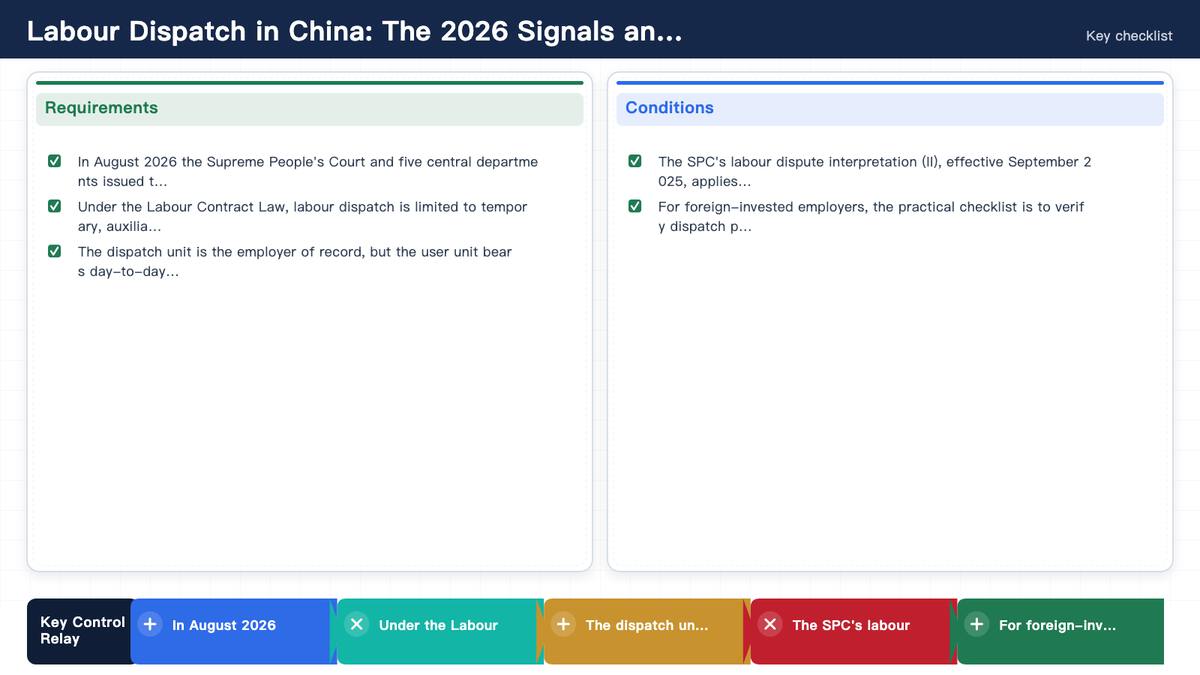
- In August 2026 the Supreme People’s Court and five central departments issued the Opinions on Strengthening the Management of Employed Court Clerks, which require courts to sign labour contracts directly with clerks and “gradually eliminate labour dispatch” — a significant signal in the broader shift from dispatched to direct employment.
2026 年 8 月,最高人民法院会同中央组织部、中央政法委、中央编办、财政部、人力资源社会保障部印发《关于进一步加强人民法院聘用制书记员管理工作的意见》,要求法院直接与聘用制书记员签订劳动合同、”逐步取消劳务派遣用工方式”——在从派遣到直接用工的整体转向中释放重要信号。
- Under the Labour Contract Law, labour dispatch is limited to temporary, auxiliary or substitute positions, and dispatched workers may not exceed 10% of total headcount; violations carry fines and correction orders.
依《劳动合同法》,劳务派遣仅限临时性、辅助性、替代性岗位,被派遣劳动者数量不得超过用工总量 10%;违反的责令限期改正并处罚款。
- The dispatch unit is the employer of record, but the user unit bears day-to-day duties: working hours, leave and overtime pay obligations rest with the user unit, and the user unit and dispatch unit bear joint liability for harm caused by dispatched workers.
劳务派遣单位是用人单位,但用工单位承担日常义务:执行劳动标准、支付加班费、提供岗位福利;被派遣劳动者因执行工作任务造成他人损害的,由用工单位承担侵权责任,派遣单位有过错的承担相应责任。
- The SPC’s labour dispute interpretation (II), effective September 2025, applies a “facts-first” principle: courts determine whether a labour relationship exists by the substance of control, not the contract title — relevant where “outsourcing” is in fact disguised dispatch.
最高法劳动争议司法解释(二)(2025 年 9 月施行)确立”事实优先”原则:法院综合人格、经济、组织从属性判断劳动关系,不囿于合同名称——对”假外包真派遣”直接相关。
- For foreign-invested employers, the practical checklist is to verify dispatch positions against the three-role and 10% caps, keep dispatch agreements clearly allocating duties, document the distinction between genuine outsourcing and dispatch, and prepare for direct-employment transitions in services they currently dispatch.
对外资雇主,实操清单是:对照三性与 10% 上限核验派遣岗位、派遣协议明确划分权责、留存”真外包”与派遣的区分证据、对现派遣岗位的转直接用工过渡做好准备。
Labour Dispatch in China: The 2026 Signals and Foreign-Employer Compliance | 中国劳务派遣:2026 年信号与外资雇主合规
Why this matters now
In August 2026 the Supreme People’s Court, together with the Central Organisation Department, the Central Political and Legal Affairs Commission, the Central Establishment Office, the Ministry of Finance and the Ministry of Human Resources and Social Security, issued the Opinions on Further Strengthening the Management of Employed Court Clerks. The Opinions state that courts should sign labour contracts directly with employed clerks and “gradually eliminate the labour dispatch model”. Although the document addresses court staffing, it is the clearest institutional signal in years that China’s regulators view direct employment, not dispatch, as the default model — a signal relevant to every employer using dispatched workers, including foreign-invested companies. Combined with the facts-first test in the SPC labour dispute interpretation (II) (effective September 2025), which treats disguised dispatch as direct employment, the 2026 message for foreign employers is: re-audit dispatch arrangements, confirm genuine outsourcing where claimed, and plan transitions to direct employment where the law requires it.
The legal framework for dispatch
Under the Labour Contract Law (Article 66), labour dispatch may only be used for temporary (no more than six months), auxiliary (supporting positions in the main business) or substitute (positions whose incumbents are on leave or otherwise unavailable) positions. The Dispatch Provisions (MOHRSS Order No. 22) add a hard cap: dispatched workers may not exceed 10% of the user unit’s total headcount. Where the user unit exceeds the cap or uses dispatch in non-qualifying positions, the labour administrative authority orders rectification within a period and may fine. The dispatch unit is the employer of record — it signs the labour contract, pays social insurance and handles termination — but the user unit bears day-to-day obligations: implementing labour standards, paying overtime and providing post benefits. For tort harm caused by dispatched workers performing work, the user unit bears the liability; the dispatch unit bears corresponding liability if at fault. If the dispatch unit and the user unit have agreed on internal allocation in the dispatch agreement, that allocation binds them but does not bind the injured party.
The “facts-first” test and disguised dispatch
The SPC labour dispute interpretation (II), effective September 2025, entrenches a “facts-first” principle: courts determine whether a labour relationship exists by looking at the substance — personality subordination (management, discipline, attendance), economic subordination (payment of remuneration) and organisational subordination (work as part of the business) — rather than the label on the contract. For foreign employers, this matters because arrangements labelled “business outsourcing” or “service contracts” are frequently re-characterised as dispatch or direct employment where the user unit actually manages the workers, schedules them, sets pay levels or integrates them into core operations. The consequence of re-characterisation is severe: back payment of social insurance with surcharges, double-wage compensation for unsigned contracts, unpaid overtime and, in the worst cases, full work-injury benefits and statutory severance.
The direct-employment signal in 2026
The August 2026 Opinions on court clerks require courts to transition from dispatched to direct employment for clerical staff, with service-length continuity arrangements and ten-level grading systems. The document’s significance for employers generally is directional: it signals that regulators and courts expect dispatch to shrink toward its statutory niche. For foreign-invested companies, the practical implication is to treat dispatch as a constrained tool, not a general staffing model. Where dispatch is used legitimately (temporary, auxiliary or substitute positions within the 10% cap), maintain clear dispatch agreements; where dispatch is used in core operations or above the cap, plan the transition to direct employment — including service-length carry-over under Article 46 of the labour interpretation (I), which aggregates years of service where the worker is moved to a new employer not for his or her own reasons.
Practical steps for foreign employers
First, audit every dispatched position against the three-role test and the 10% cap; flag non-compliant uses. Second, for each dispatch agreement, confirm the allocation of day-to-day obligations (working hours, leave, overtime, post benefits) between the user unit and the dispatch unit, and confirm social insurance is paid by the dispatch unit. Third, where “outsourcing” is claimed, verify genuine outsourcing: the contractor manages its own workers, invoices for results, and the user unit does not direct daily work; keep evidence of this boundary. Fourth, for positions to be converted to direct employment, plan service-length aggregation, contract signing within one month of employment, and coordinate with payroll for social insurance registration. Fifth, monitor judicial trends: the facts-first test will continue to be applied by arbitration committees and courts, so documentation discipline matters more than contract labels.
Compliance notes
The 10% cap is calculated on the user unit’s total headcount including the dispatched workers themselves; excluding them from the denominator is a common error. The three-role test applies cumulatively: a position must satisfy temporary or auxiliary or substitute conditions at the time of use. Dispatched workers have the right to equal pay for equal work, and the user unit cannot “send back” a dispatched worker in violation of the law without consequences. Finally, the August 2026 Opinions are specific to courts; there is no general regulation yet mandating the elimination of dispatch, but the direction of travel is clear — treat direct employment as the default and dispatch as the exception.
中国劳务派遣:2026 年信号与外资雇主合规
为什么当下重要
2026 年 8 月,最高人民法院会同中央组织部、中央政法委、中央编办、财政部、人力资源社会保障部印发《关于进一步加强人民法院聘用制书记员管理工作的意见》。意见要求人民法院直接与聘用制书记员签订劳动合同,”逐步取消劳务派遣用工方式”。虽然文件针对法院队伍建设,但这是多年来监管层最明确的制度信号之一:中国监管者把直接用工、而非派遣,视为默认模式——这对所有使用派遣劳动者的雇主、包括外资企业都直接相关。叠加最高法劳动争议司法解释(二)(2025 年 9 月施行)确立的”事实优先”测试——将”假派遣”重新定性为直接劳动关系——2026 年对外资雇主的讯息是:重新审计派遣安排、确认声称的”真外包”、按法律要求规划转直接用工。
派遣的法律框架
依《劳动合同法》第六十六条,劳务派遣仅限临时性(存续不超过 6 个月)、辅助性(为主营业务提供服务的非主营业务岗位)、替代性(用工单位的劳动者因脱产学习、休假等原因无法工作的一定期间内,由其他劳动者替代工作的岗位)岗位。人社部《劳务派遣暂行规定》(第 22 号令)增设硬性上限:被派遣劳动者数量不得超过用工单位用工总量的 10%。超比例或非三性岗位用派遣的,劳动行政部门责令限期改正并处罚款。派遣单位是用人单位——签劳动合同、缴社保、办理解除——但用工单位承担日常义务:执行劳动标准、支付加班费、提供岗位福利。被派遣劳动者因执行工作任务造成他人损害的,由用工单位承担侵权责任;派遣单位有过错的,承担相应责任。派遣单位与用工单位在派遣协议中约定内部责任分担的,该约定对其有约束力,但不得对抗受害人。
“事实优先”测试与”假派遣”
最高法劳动争议司法解释(二)(2025 年 9 月施行)强化”事实优先”原则:法院综合人格从属性(管理、纪律、考勤)、经济从属性(报酬支付)与组织从属性(劳动属业务组成部分)判断劳动关系是否存在,不拘泥于合同名称。对外资雇主,这很关键,因为标为”业务外包”或”服务合同”的安排,一旦用工单位实际管理劳动者、排班、定薪或将其纳入核心运营,常被重新定性为派遣甚至直接劳动关系。重新定性的后果严重:补缴社保及滞纳金、未签书面合同二倍工资差额、补发加班费,最严重时承担全部工伤保险待遇与法定经济补偿。
2026 年的直接用工信号
2026 年 8 月书记员意见要求法院将派遣用工转为直接用工,配套工龄衔接安排与十级分级管理。该文件对一般雇主的意义是方向性的:它表明监管与司法预期派遣将收缩至其法定适用空间。对外资企业,实际含义是把派遣视为受约束的工具而非通用用工模式。合法使用派遣(三性岗位且不超 10% 上限)的,保留清晰的派遣协议;在核心岗位或超比例使用派遣的,规划转直接用工——包括依劳动争议司法解释(一)第四十六条处理工龄合并计算(劳动者非因本人原因被安排到新用人单位且原单位未支付经济补偿的,年限合并计算)。
外资雇主实操步骤
其一,对照三性测试与 10% 上限逐岗审计,标记不合规使用。其二,对每份派遣协议,确认用工单位与派遣单位之间日常义务(工时、休假、加班、岗位福利)的分配,并确认社保由派遣单位缴纳。其三,对声称”外包”的安排,核验真外包:承包方自行管理其人员、按成果开票、用工单位不指挥日常工作;留存边界证据。其四,对拟转直接用工的岗位,规划工龄合并、用工之日起一个月内签订书面合同,并与薪酬团队协调社保登记。其五,跟踪司法趋势:仲裁委与法院将持续适用”事实优先”测试,留痕纪律比合同名称更重要。
合规提示
10% 上限以用工单位用工总量(含被派遣劳动者本人)为基数计算;把派遣人员从分母中剔除是常见错误。三性测试须在用工时点逐岗判断。被派遣劳动者享有同工同酬权利,用工单位违法退回派遣劳动者须承担后果。最后,2026 年 8 月意见仅针对法院系统,尚无普遍强制取消派遣的法规,但方向明确——把直接用工作为默认、派遣作为例外。
Sources
- 最高人民法院《最高人民法院等六部门联合印发〈关于进一步加强人民法院聘用制书记员管理工作的意见〉》(2026-08-05):https://www.court.gov.cn/zixun/xiangqing/507841.html
- 人民法院内蒙古自治区子站转载《最高人民法院政治部负责人就〈关于进一步加强人民法院聘用制书记员管理工作的意见〉答记者问》(2026-08):http://lxxfy.nmgfy.gov.cn/article/detail/2026/08/id/9451881.shtml
- 人民网·中国共产党新闻网(《人民日报》2026-08-06 报道)《最高法等六部门发文 全面加强聘用制书记员队伍规范管理》:https://cpc.people.com.cn/BIG5/n1/2026/0806/c64387-40774857.html