
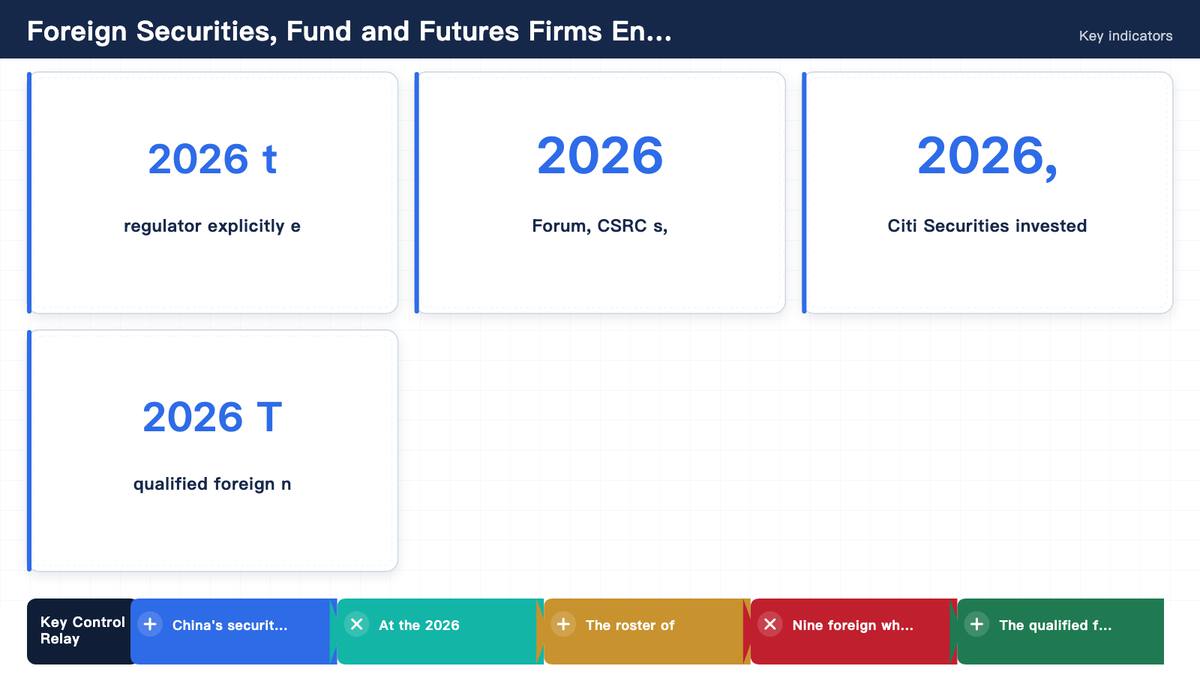
- China’s securities, public-fund and futures sectors are fully open to foreign capital, and in 2026 the regulator explicitly pledged to support new wholly-foreign-owned or joint-venture securities, fund and futures institutions.
中国的证券、公募基金与期货行业已对外资全面开放,2026年监管层明确表态支持新设外商独资或合资证券、基金、期货机构。- At the 2026 Lujiazui Forum, CSRC Chairman Wu Qing announced support for foreign institutions to set up securities, fund and futures firms in China and encouraged licensed foreign players to join the expanded fund-investment-advisory pilot.
在2026年陆家嘴论坛,证监会主席吴清宣布支持外资在华新设证券、基金、期货公司,并鼓励外资持牌机构参与基金投顾业务扩大试点。- The roster of wholly-foreign-owned securities firms keeps growing: Mizuho Securities (China) became the first Japan-invested wholly-owned broker in January 2026, and Citi Securities (China)’s establishment was approved in May 2026.
外商独资券商队伍持续扩容:瑞穗证券(中国)于2026年1月成为首家日资独资券商,花旗证券(中国)于2026年5月完成设立审批。- Nine foreign wholly-owned public fund companies now operate onshore, and Goldman Sachs Futures became the fourth foreign wholly-owned futures company in March 2026.
目前已有9家外商独资公募基金公司在中国内地展业,高盛期货于2026年3月成为境内第四家外资独资期货公司。- The qualified foreign investor (QFII) regime is being optimised, with QFII allowed to participate in onshore treasury-futures trading; cumulative QFII approvals reached 981 by end-May 2026.
合格境外投资者(QFII)制度持续优化,QFII获准有序参与境内国债期货交易;截至2026年5月底,合格境外投资者累计已达981家。- An eight-agency 2026 enforcement plan “opens the front door and blocks the side door” — cracking down on illegal cross-border securities/futures/fund activity while steering foreign capital into compliant, licensed establishment.
2026年八部门整治方案”开正门、堵偏门”——在打击非法跨境证券期货基金活动的同时,引导外资通过合规持牌渠道展业。- The 2026 Action Plan to Stabilize and Optimize Foreign Investment supports foreign institutions in using risk-management tools including treasury futures and in conducting fund-investment-advisory business.
2026年《利用外资固稳促优行动方案》支持外资机构运用包括国债期货在内的风险管理工具,并依法开展基金投资顾问业务。
Foreign Securities, Fund and Futures Firms Entering China: Wholly-Owned Market Access and QFII Expansion in 2026 | 外资证券、基金与期货公司进入中国:2026年独资准入与合格境外投资者扩容
Overview
When China removed foreign ownership caps in securities, fund management and futures in 2020, it opened the door. By 2026 the China Securities Regulatory Commission (CSRC) actively supports foreign investors in setting up wholly-owned or joint-venture securities, fund and futures institutions; the licensed roster keeps lengthening and the qualified foreign investor (QFII) channel is deepening with onshore derivatives access. This article covers the three licensed forms, the 2026 Lujiazui signals, the wholly-foreign-owned roster, QFII optimisation, the enforcement logic, and the licensing pathway.
Three Licensed Forms
A foreign financial institution can enter through three separately licensed, CSRC-supervised forms. A securities company (证券公司) may underwrite, broker, trade proprietary and manage assets; a foreign group may hold up to 100% and incorporate a wholly-foreign-owned securities company. A public fund management company (公募基金管理公司) manages publicly offered funds; foreign asset managers have incorporated wholly-foreign-owned fund companies onshore. A futures company (期货公司) brokers futures and options; foreign participation is also capped at 100%. All three follow pre-establishment national treatment plus a negative list, with the financial-sector negative list fully cleared — the binding constraints are prudential and conduct standards, not ownership ratios.
The 2026 Lujiazui Forum Signals
The clearest 2026 signal came from CSRC Chairman Wu Qing’s keynote at the Lujiazui Forum on 17 June 2026. He pledged to actively support foreign investors in newly establishing wholly-owned or joint-venture securities, fund and futures institutions — moving the message from “caps removed” to “new institutions welcomed.” He encouraged licensed foreign institutions to join the expanded fund-investment-advisory (基金投顾) pilot, a wealth-management line where foreign groups have mature overseas experience. And he committed to implementing the QFII optimisation scheme, letting QFII participate in onshore treasury-futures trading in an orderly way while supporting Hong Kong’s launch of a five-year RMB treasury-futures product. He framed the principle as “open the front door, block the side door” (开正门、堵偏门).
Wholly-Foreign-Owned Roster
The securities roster shows the opening is real. As of early 2026, six wholly-foreign-owned securities companies operated onshore: J.P. Morgan, Goldman Sachs, Standard Chartered, BNP Paribas, UBS, and — from January 2026 — Mizuho Securities (China), the first Japan-invested wholly-owned broker (RMB 2.3bn capital). In February 2026, Daiwa became 100%-foreign-owned after its domestic shareholders transferred their 49% stake; in May 2026, Citi Securities (China)’s establishment was approved, lifting the wholly-owned count toward seven. Public fund management has the deepest footprint: nine foreign wholly-owned public fund companies operate onshore (BlackRock, Fidelity, Neuberger Berman, Schroders, AllianceBernstein, Allianz newly established; JPMorgan, Manulife, Morgan Stanley converted). AllianceBernstein Fund’s fourth capital increase reached RMB 600m in May 2026; Fidelity reached USD 218m. In futures, Goldman Sachs Futures landed in March 2026 as the fourth foreign wholly-owned futures company.
QFII Expansion and Treasury-Futures Access
The QFII regime is being broadened on two fronts. First, the CSRC is implementing its QFII optimisation scheme, smoothing how foreign institutions obtain and use the status. Second, QFII is allowed to participate in onshore treasury-futures trading in an orderly way, giving long-term foreign holders of Chinese bonds a tool to hedge interest-rate risk; Hong Kong’s planned five-year RMB treasury-futures product links onshore and offshore channels. Demand is visible: CSRC data cited in state media show cumulative qualified foreign investors reached 981 by end-May 2026, and the first five months of 2026 added 50 new approvals — a record high for the period. The expanding QFII base and deepening licensed roster show foreign capital entering as both investors and operators.
“Open the Front Door, Block the Side Door”
On 9 May 2026, eight agencies — CSRC, MIIT, the Ministry of Public Security, the People’s Bank of China, the State Administration for Market Regulation, the National Financial Regulatory Administration, the Cyberspace Administration and the State Administration of Foreign Exchange — issued the Implementation Plan for Comprehensive Rectification of Illegal Cross-Border Securities, Futures and Fund Activities (证监发〔2026〕28号), approved by the State Council. It sets a two-year concentrated rectification to fully ban illegal cross-border operations by overseas institutions, prohibiting them from marketing, soliciting, opening accounts, transmitting orders or moving funds in China without CSRC approval, and barring domestic intermediaries from assisting. During the window, overseas institutions may only allow one-way selling and withdrawal for existing domestic clients, then shut down China-facing systems. The logic is explicit: licensed operation is an international norm, so “open the front door” by guiding foreign capital to set up compliant institutions, while “blocking the side door” of illegal solicitation.
Practical Licensing Steps
A foreign group should: choose the form and ownership model (the 2026 signals favour new wholly-owned entries); confirm the parent is a well-capitalised, soundly supervised institution with home-regulator consent; file the CSRC establishment application (feasibility study, shareholder structure, articles, compliance/AML framework, home supervisor’s licence and consent); for fund companies, lodge the advisory pilot alongside the core licence; stand up governance, systems and staff during preparation and commission the pre-opening audit; obtain the licence, register with the market regulator and open within the prescribed window; and plan QFII and treasury-futures access as a parallel investor channel.
Related Reading
Companion pieces cover the foreign-bank licensing pathway, the QFLP private-equity pilot, and the foreign insurance and reinsurance market-access route. This article is confined to securities, fund and futures establishment and the QFII channel.
外资证券、基金与期货公司进入中国:2026年独资准入与合格境外投资者扩容
概述
2020年,中国取消证券、基金、期货行业的外资持股比例限制,将长期存在的数量型上限变为一扇敞开的大门。到2026年,这扇门已被进一步拓宽:中国证券监督管理委员会(证监会)公开表态,积极支持外资在华新设独资或合资的证券、基金、期货机构;持牌外资机构的名单持续拉长;合格境外投资者(QFII)渠道也随境内衍生品准入而不断深化。对于希望进入中国资本市场的外资金融集团而言,2026年既是准入窗口高度开放的一年,也是监管强调”持牌经营、合规展业”的一年。
本文依次梳理三种可设立的持牌形态、2026年陆家嘴论坛释放的开放信号、外商独资券商与基金期货机构的具体阵容、QFII制度优化与国债期货准入、八部门方案”开正门、堵偏门”的整治逻辑,以及获取牌照的实操路径,为有意落地的外资机构提供一张清晰的路线图。需要说明的是,本文聚焦机构设立与投资者通道,不涉及已在其他姊妹篇中详述的外资银行、保险、再保险等形态,以免模糊主线。读者在参考时,应把本文与2026年《利用外资固稳促优行动方案》中”稳步提升金融业开放水平”的条款结合起来看,才能完整理解政策意图。
三种持牌形态
外资金融机构可通过三种分别持牌、均由证监会监管的形态进入中国资本市场。证券公司可从事保荐承销、经纪、自营交易与资产管理,外资集团最高可持股100%,并可在境内注册外商独资证券公司。公募基金管理公司管理公开募集的公募基金,外资资产管理机构已在境内注册多家外商独资公募基金。期货公司经纪期货与期权,外资持股比例上限同样为100%。
三者目前均适用”准入前国民待遇加负面清单”的管理框架,金融业相关负面清单的限制措施已完全清零。真正构成约束的是审慎监管与行为监管标准,而非股权比例。这意味着,外资进入这些行业的障碍已从”能不能控股”转变为”是否满足资本、治理与合规要求”,外资机构在股权安排上的自由度已达到历史高位。对计划进入中国市场的外资集团而言,首要问题不再是股权上限,而是能否证明自身具备持续盈利能力、良好风控与有效的反洗钱体系,并拿出令监管认可的筹建方案。
2026年陆家嘴论坛信号
2026年最清晰的开放信号,来自证监会主席吴清6月17日在陆家嘴论坛的主旨演讲。他提出三项具体举措:第一,积极支持外资在华新设独资或合资的证券、基金、期货公司,把政策基调从”取消限制”进一步推进到”欢迎新设”,明确牌照通道是敞开的;第二,鼓励外资持牌机构参与基金投资顾问业务扩大试点——基金投顾允许持牌机构代客户作出基金投资决策并管理组合,是外资集团在海外具备成熟经验的财富管理业务线;第三,落实合格境外投资者制度优化方案,推动QFII有序参与境内国债期货交易,并支持香港启动5年期人民币国债期货。
这三项举措把机构准入与风险管理工具配套起来。吴清同时把原则概括为”开正门、堵偏门”:支持合法合规的跨境投资,但坚持持牌经营、依法打击非法跨境活动,既为合规机构留出空间,也划清非法展业的红线。对于外资机构而言,这一表述释放的信号是:监管欢迎的是”持证进场”的长期资本,而非绕开牌照的短期跨境套利。这一表态与同期的八部门整治方案互为表里,构成2026年金融业开放与规范的一体两面。
外商独资券商与基金期货阵容
证券业的名单表明开放是实打实的。截至2026年初,已有6家外商独资券商在境内展业:摩根大通证券(中国)、高盛(中国)证券、渣打证券(中国)、法巴证券(中国)、瑞银证券(中国),以及2026年1月成立的瑞穗证券(中国)——首家日资独资券商,注册资本23亿元。2026年2月,大和证券(中国)在两家中资股东转让合计49%股权后,变为100%外资控股;2026年5月,花旗证券(中国)设立审批完成,若后续程序顺利,外商独资券商数量将增至7家。这一格局显示,先前持股少数的国际银行正向全资控制迈进,而瑞穗、花旗等新进入者则直接以100%股权入场,印证了开放政策的连续性。
公募基金管理是外资足迹最深的领域。境内已有9家外商独资公募基金公司:贝莱德基金、富达基金、路博迈基金、施罗德基金、联博基金、安联基金为新设机构,摩根资产管理、宏利基金、摩根士丹利基金则由合资转型而来。多家机构以增资释放长期信心——联博基金于2026年5月完成第四次增资,注册资本由1亿元增至6亿元;富达基金同月亦增资至2.18亿美元。期货方面,高盛期货于2026年3月正式落地,成为境内第四家外资独资期货公司,凸显国际投行对境内衍生品市场的持续投入。这些动态共同说明,外资已在证券、基金、期货三条线同步深化布局,而非停留在少数试点。
QFII扩容与国债期货准入
QFII制度——合格境外机构投资者投资境内证券的通道——正从两个方向拓宽。其一,证监会落实QFII优化方案,理顺外资机构取得与使用这一资格的具体路径,降低制度性成本;其二,推动QFII有序参与境内国债期货交易,使长期持有中国债券的外资机构获得利率风险对冲工具,而香港拟推出的5年期人民币国债期货,则与在岸市场形成联通,打通在岸与离岸的风险对冲通道。需求端同样清晰:据官方媒体援引证监会数据,截至2026年5月底,合格境外投资者累计已达981家;2026年前5个月新增50家,创历史同期新高。
不断扩容的QFII基数与持续深化的持牌机构阵容共同表明,外资正以”投资者”与”运营者”双重身份进入中国市场,开放已从准入环节延伸到交易与风险管理环节。对境外资产管理人而言,QFII加国债期货的组合,意味着可以更完整地管理人民币债券头寸的利率风险,从而提升长期配置中国资产的意愿与能力,这正是2026年开放举措希望达成的效果。可以预见,随着风险管理工具进一步丰富,外资参与境内资本市场的深度还将继续提升。
“开正门、堵偏门”的整治逻辑
2026年5月9日,证监会、工业和信息化部、公安部、中国人民银行、市场监管总局、国家金融监督管理总局、国家网信办、国家外汇局八部门联合印发《综合整治非法跨境证券期货基金经营活动实施方案》(证监发〔2026〕28号),经国务院同意。方案设定两年集中整治期,目标是全面取缔境外机构非法跨境经营活动,实现”坚决取缔非法、稳妥清理存量”。它明确禁止境外机构未经证监会批准,在境内开展证券期货基金业务的营销招揽、开户、交易指令处理与资金划转,并禁止境内中介与平台协助此类活动。
在两年窗口期内,境外机构仅允许存量境内客户单向卖出并转出资金,期满后须全面关停面向境内的网站与系统。其牌照逻辑十分明确:持牌经营是国际通行规则,方案通过引导外资通过合规渠道新设机构、拓展业务来”开正门”,同时封堵非法跨境招揽的”偏门”。对境外金融集团而言,信号毫不含糊——应依托证监会牌照设立并展业,而非借助面向境内客户的离岸平台,否则将面临清理与查处。这一整治与同期的开放举措是一体两面:越是敞开合规准入,越要压实非法跨境的边界,以维护市场秩序与投资者权益。
实操牌照步骤
外资集团可按以下顺序推进牌照申请:第一,选定形态与持股模式——在证券、基金、期货之间选择,并决定新设独资、转型现有合资还是收购,2026年的政策信号偏向新设独资;第二,确认母公司资质,最终母公司应为资本雄厚、受母国有效监管、信誉良好并取得监管同意的金融机构;第三,向证监会提交设立申请,材料包括可行性研究、股权结构、章程、合规与风控框架、反洗钱制度,以及母国监管当局的许可与同意意见;第四,如为基金公司,可一并申报基金投顾试点,作为核心牌照之外的增值业务线。
第五,在筹建阶段建立治理、系统与人员,并聘请开展开业前审计;第六,领取牌照、向市场监管部门登记,并在规定期限内开业;第七,若集团同时管理境外客户资金流,可并行规划QFII与国债期货准入,作为配套的投资者通道,使机构牌照与投资者通道相互协同。整体看,2026年的政策环境对外资新设机构是友好的,但成功落地仍取决于母公司资质、筹备质量与对境内监管预期的把握。建议外资机构在正式申报前,与监管及专业顾问充分沟通,确保材料一次到位,避免无谓的补正与延迟。
延伸阅读
姊妹篇涵盖外资银行牌照路径、QFLP私募股权试点,以及外资保险与再保险机构市场准入。本文严格聚焦于证券、基金、期货的设立与QFII渠道,不展开其他金融牌照形态,以免模糊主线。对于正在评估中国市场的外资金融机构,建议将本文与前述姊妹篇对照阅读,以形成对金融业开放全貌的完整认识,并据此选择最适合自身战略基因的进入路径。在牌照落地后,机构还应同步关注数据跨境、反洗钱与持续合规等运营事项,方能把准入红利转化为可持续的在华业务。
实务提示
对计划进入中国市场的外资金融机构而言,除了理解准入与整治两条线,还应提前做好三项准备。第一,明确集团战略基因:若以机构展业为目标,应尽早启动母公司资质梳理与可行性研究;若以配置中国资产为目标,应同步规划QFII资格与国债期货对冲方案,使投资者通道与机构牌照相互协同。第二,重视合规预期管理:在”开正门、堵偏门”的框架下,任何绕开牌照的跨境展业都面临清理风险,机构从筹建阶段起就应按持牌标准搭建反洗钱、风控与数据合规体系。
第三,善用政策沟通渠道:2026年的圆桌会议与重大外资项目专班,为外资提供了把合理诉求直达监管的路径,机构可在筹备期主动对接,减少信息不对称。总体而言,2026年是中国资本市场对外资最为友好的窗口期之一,但”友好”不等于”无门槛”——成功落地仍取决于资质、筹备质量与对监管预期的理解。建议外资机构在正式申报前,与监管及专业顾问充分沟通,确保材料一次到位,把准入红利真正转化为可持续的在华业务。
值得补充的是,外资在选定机构形态时,应把”三条线”的协同一并纳入规划。证券、基金、期货虽分属不同牌照,但同一国际集团往往同时具备经纪、资管与衍生品需求,可在集团层面统筹申报节奏,避免各子公司各自为政、重复提交集团材料。以高盛、摩根大通、瑞银等机构为例,其境内布局均呈现”券商+基金+期货”的组合特征,说明监管与市场都预期外资以综合金融服务者的身份进入,而非单一牌照试水。
同时,持牌机构落地后,运营合规的复杂度会快速上升。数据跨境流动须满足境内个人信息与重要数据出境要求;反洗钱与制裁筛查须与母国集团标准对接又符合本地监管口径;持续报告义务则贯穿日常经营。机构应在筹建期即设立本地合规与风控节点,而非等开业后再补。最后,QFII与机构牌照是互补而非替代关系:即便已设独资券商或公募,境外集团管理母行或客户资金仍需通过QFII等投资者通道参与在岸市场,二者叠加才能形成完整的”机构+投资者”双身份布局。把握这一点,外资方能把2026年的开放窗口转化为长期可运营的中国业务。
最后需提醒,牌照获批只是起点,机构进入展业期后还应建立常态化的监管沟通节奏。可指定专人对接证监会及派出机构的持续监管事项,跟踪规则更新——例如QFII额度使用、国债期货参与范围、外资股东持股变动等,均可能随市场开放节奏调整。对同时管理在岸与离岸业务的总部,应设立清晰的中国区合规汇报线,确保母国集团治理与本地持牌要求同向。唯有把准入、展业与持续合规视为一个连续过程,外资金融机构才能把2026年的政策红利稳定地沉淀为长期业务能力。
Sources