
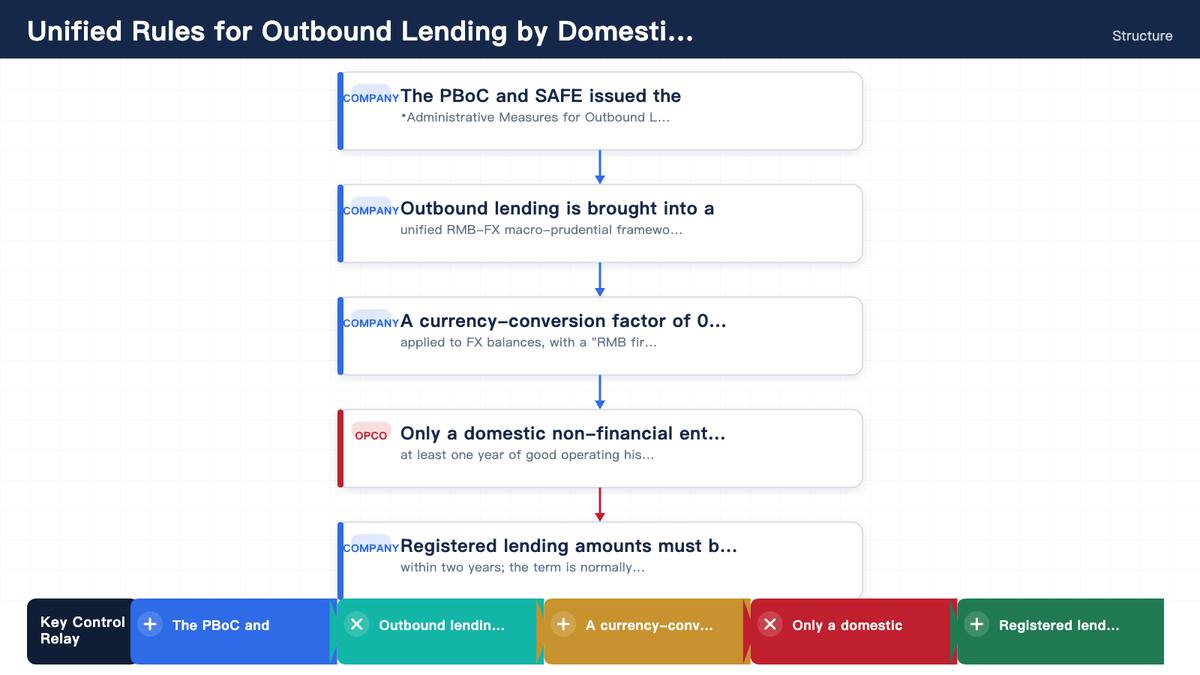
- The PBoC and SAFE issued the *Administrative Measures for Outbound Lending by Domestic Enterprises* (Yin Fa [2026] No. 63), effective 20 April 2026, unifying RMB and FX outbound lending under one rulebook.
中国人民银行、国家外汇管理局印发《境内企业境外放款管理办法》(银发〔2026〕63号),自2026年4月20日起施行,将人民币与外币境外放款统一于同一规则框架。
- Outbound lending is brought into a unified RMB-FX macro-prudential framework; the balance cap equals the lender’s latest audited owner’s equity multiplied by a coefficient raised from 0.5 to 0.6.
境外放款纳入本外币一体化宏观审慎管理,余额上限=放款人最近一期经审计所有者权益×宏观审慎调节系数(由0.5上调至0.6)。
- A currency-conversion factor of 0.5 is applied to FX balances, with a “RMB first” tilt to encourage lending in RMB and support currency internationalisation.
外币余额适用0.5的币种转换因子,并设置”本币优先”导向,鼓励以人民币开展境外放款,支持人民币国际化。
- Only a domestic non-financial enterprise with at least one year of good operating history, and an equity link to the overseas borrower, may lend; funds must be the lender’s own capital, not debt-financed.
放款人须为依法注册成立1年以上、经营记录良好的境内非金融企业,且与境外借款人存在直接或间持股关系;资金须为自有资金,不得借债出资。
- Registered lending amounts must be used within two years; the term is normally 6 months to 5 years, with at most one extension, and overdue borrowers are barred from new lending.
已登记放款金额须在2年内使用;期限原则上6个月至5年,展期原则上不超过一次,逾期借款人不得新增放款。
- Foreign-invested enterprises with overseas subsidiaries can fund them more cheaply and predictably, while legacy rules (Hui Fa [2009] No. 24, Yin Fa [2016] No. 306, Yin Fa [2021] No. 2) are repealed.
拥有境外子公司的外商投资企业可更低成本、更可预期地为其供资,同时旧规(汇发〔2009〕24号、银发〔2016〕306号、银发〔2021〕2号)被废止。
- Registration is filed at the SAFE branch where the lender is registered, with the handling bank performing due diligence, consistency checks and data reporting.
登记向放款人注册地外汇局分局申请,经办银行履行尽职调查、一致性审查与数据报送义务。
Unified Rules for Outbound Lending by Domestic Enterprises (2026): What FIEs with Overseas Units Need to Know | 境内企业境外放款统一管理新规(2026):外资企业须知
Why this matters now
When a Chinese subsidiary of a foreign group needs to fund an overseas affiliate — to stock inventory, bridge a working-capital gap, or seed a new venture — it typically uses outbound lending (境外放款). Until 2026, RMB and FX outbound lending were governed by separate, older notices with differing rules on funding source, tenor and extension. On 13 March 2026 the People’s Bank of China (PBoC) and SAFE jointly issued the *Administrative Measures for Outbound Lending by Domestic Enterprises* (Yin Fa [2026] No. 63), published on 20 March and effective 20 April 2026. The Measures unify the two currencies under one “same business, same rules” framework, lift the macro-prudential coefficient, and give foreign-invested enterprises (FIEs) a clearer, cheaper channel to support their cross-border groups.
For an FIE treasury, the change is material: a single, predictable rulebook for moving RMB or FX to an affiliated overseas entity, a higher aggregate ceiling, and explicit encouragement to lend in RMB. It sits on the outbound side of cross-border capital, complementing — but clearly distinct from — external-debt and cash-pooling regimes.
What the Measures unify
The Measures define outbound lending as a domestic non-financial enterprise (the “lender”) providing cross-border financing to a qualified overseas enterprise (the “borrower”) under a contract specifying amount, rate, term and use. The core reform is consolidation: the old RMB notice (Yin Fa [2016] No. 306) and the old FX notice (Hui Fa [2009] No. 24), plus the 2021 coefficient adjustment (Yin Fa [2021] No. 2), are all repealed and replaced by one text. Enterprises no longer juggle two playbooks; the same filing, account, and use rules apply regardless of currency.
Three pillars carry the reform. First, unified RMB-FX management: a lender runs one limit and one set of procedures for both currencies. Second, macro-prudential management: the outstanding balance ceiling is pegged to owner’s equity, and the coefficient is raised. Third, explicit prudential duties for banks and enterprises to keep risks contained.
The macro-prudential ceiling and the 0.5→0.6 lift
The outstanding outbound-lending balance ceiling equals the lender’s latest audited owner’s equity multiplied by the macro-prudential adjustment coefficient. The outstanding balance itself equals the sum of the lender’s RMB and FX outstanding balances plus the sum of its FX outstanding balances multiplied by a currency-conversion factor of 0.5. To better meet the cross-border operating needs of “going-out” enterprises, the coefficient was raised from 0.5 to 0.6, lifting the overall ceiling. PBoC and SAFE may adjust the coefficient and the conversion factor as the balance of payments and macro-control needs evolve.
The 0.5 conversion factor means FX balances count half-weight against the ceiling — a deliberate “RMB first” tilt that rewards lending in RMB and advances currency internationalisation. A group that lends in RMB therefore consumes less of its ceiling than one that lends in FX for the same nominal amount.
Who may lend, and how
Eligibility is tightened but sensible. The lender must be a domestic non-financial enterprise, legally established for at least one year, with a sound operating record, sound finance and internal controls, and no major violations in the past three years. The borrower must be lawfully established with a sound record and no major violations. Crucially, the lender and borrower must share a direct or indirect equity relationship, or be held by the same parent. The lender’s outstanding balance must be within its ceiling, the loan rate and term must be commercially reasonable (term normally 6 months to 5 years), and any prior lending must have been repaid on time or have a justified reason for delay.
Funds must be the lender’s own capital — own RMB, own FX, or RMB purchased for the loan — and must not come from personal funds or from the lender’s own debt financing. Use is restricted: not outside the borrower’s business scope, not to circumvent overseas direct investment or securities-investment controls, and not for money-laundering, terrorist-financing or tax-evasion purposes.
Registration, accounts and the bank’s role
Registration is filed at the SAFE branch where the lender is registered, before the first drawdown, and registered amounts must be used within two years (unused portions lapse). Changes, extensions and cancellations follow defined paths — some cancellations can be done at the handling bank. The lender opens a dedicated outbound-lending account (RMB and/or FX) at a bank in the SAFE branch’s jurisdiction; multiple loans may share one account.
The handling bank is on the front line: it reviews the source of funds for authenticity and compliance, checks the business against SAFE’s capital-account system, and ensures cumulative outflows do not exceed the registered amount and that repatriations are reasonable. Both the lender and the bank must report balance-of-payments, account, FX-settlement and RMB cross-border (RCPMIS) data accurately and on time.
Operational steps for an FIE group
- Map the group. Identify the domestic entity best placed to lend and confirm an equity link (direct/indirect, or common parent) to the overseas borrower.
- Size the ceiling. Pull the latest audited owner’s equity; multiply by 0.6 to get the ceiling, then net out any existing RMB/FX outbound balances (FX at 0.5 weight).
- Choose the currency deliberately. Because FX counts half-weight, prefer RMB where the borrower can use it, to preserve ceiling headroom.
- Prepare the package. Draft the loan agreement (amount, rate, term, currency, repayment, use) and gather incorporation and ownership proofs and audited financials.
- File at SAFE, draw at the bank. Register at the lender’s local SAFE branch, then open the dedicated account and draw through the handling bank within the two-year window.
- Monitor and report. Track repayment; if overdue, no new lending to that borrower. Keep RCPMIS and balance-of-payments filings current.
Risks and compliance notes
The higher coefficient is a convenience, not a free pass. Lending must stay within the equity-based ceiling and respect the truthful-use and no-debt-funding rules; related-party pricing should be defensible. Overdue loans block new lending to the same borrower, and the handling bank will suspend outbound transfers for an overdue borrower. Cross-border guarantees that crystallise into external claims (e.g., inbound guarantees performed) also count toward the ceiling. Multinational cash-pool and centralized-operation outbound lending follow their own rules and are carved out. Penalties under the PBoC Law and FX Regulations apply for unregistered lending, false filings, or misuse of funds. FIEs should reconcile legacy registrations: the Measures mainly govern new business, with a transition window for存量 matters.
境内企业境外放款统一管理新规(2026):外资企业须知
为何当下重要
当外国集团的境内子公司需要为境外关联企业供资——补充存货、弥合营运资金缺口或孵化新业务——通常会使用境外放款。在2026年之前,人民币与外币境外放款分别由较早出台、规则各异的通知管理,在资金来源、期限与展期上要求不一。2026年3月13日,中国人民银行与国家外汇管理局联合印发《境内企业境外放款管理办法》(银发〔2026〕63号),3月20日公布、4月20日施行。该办法将两种货币统一于”相同业务、相同规则”的单一框架,上调宏观审慎系数,并为外商投资企业提供更清晰、更低成本的跨境集团供资渠道。
对于外资企业财资而言,变化是实质性的:一套可预期的规则,即可向境外关联企业调出人民币或外币;更高的整体上限;并明确鼓励以人民币放款。它处于跨境资本的”出境”一侧,与入境外债、资金池制度互补但明显不同。
办法统一了什么
办法将境外放款定义为境内非金融企业(”放款人”)按合同约定金额、利率、期限、用途等,向符合条件的境外企业(”借款人”)提供资金跨境融通的行为。核心改革是整合:旧人民币通知(银发〔2016〕306号)、旧外币通知(汇发〔2009〕24号)以及2021年系数调整(银发〔2021〕2号)一并废止,由一份文本取代。企业不再 juggling 两套规则,无论币种,适用同一备案、账户与用途规则。
改革由三根支柱支撑。其一,本外币统一管理:放款人针对两种货币运行同一上限与同一套流程。其二,宏观审慎管理:余额上限与所有者权益挂钩,系数上调。其三,明确银行与企业的审慎职责以控制风险。
宏观审慎上限与0.5→0.6上调
境外放款余额上限=放款人最近一期经审计所有者权益×宏观审慎调节系数。境外放款余额=放款人本外币境外放款余额之和+放款人外币境外放款余额之和×币种转换因子(0.5)。为更好满足”走出去”企业跨境运营资金需求,系数由0.5上调至0.6,整体抬高上限。人民银行、外汇局可根据国际收支形势及宏观调控要求适时调整系数与转换因子。
0.5的转换因子意味着外币余额按半权重计入上限——这是刻意设置的”本币优先”导向,奖励以人民币放款、推进人民币国际化。因此,以人民币放款的集团,相较以同等名义金额外币放款的集团,消耗的上限更少。
谁可以放款,如何操作
准入被收紧但合情合理。放款人须为境内非金融企业,依法注册成立1年以上,经营记录良好,财务与内控制度健全,近3年无重大违法违规。借款人须依法成立、经营记录良好、近3年无重大违法违规。关键在于,放款人与借款人须存在直接或间持股关系,或受同一母公司直接或间持股。放款人余额须未超上限,利率与期限须具商业合理性(期限原则上6个月至5年),且既有放款须按期足额收回或逾期有正当理由。
资金须为放款人自有资金——自有人民币、自有外币或购汇资金——不得来自个人资金或放款人自身债务融资。用途受限:不得超出借款人经营范围,不得规避境外直接投资或证券投资管理政策,不得违反反洗钱、反恐融资、反逃税规定。
登记、账户与银行职责
登记在放款人注册地外汇局分局办理,于首次放款前完成,已登记金额须在2年内使用(未汇出部分自动失效)。变更、展期、注销各有明确路径——部分注销可在经办银行办理。放款人在外汇局分局辖区内银行开立境外放款专用账户(人民币及/或外币),多笔放款可共用一个账户。
经办银行处于第一线:对资金来源真实性、合规性尽调,对照外汇局资本项目系统做一致性审查,确保累计汇出不超登记金额、汇入规模合理。放款人与银行均须及时准确报送国际收支、账户、结售汇及人民币跨境收付(RCPMIS)数据。
外资集团的操作步骤
- 梳理集团。 确定最适合放款的境内主体,并确认与境外借款人的持股关联(直接/间接或同一母公司)。
- 测算上限。 提取最近一期经审计所有者权益,乘以0.6得上限,再扣除既有本外币境外放款余额(外币按0.5权重)。
- 审慎选择币种。 因外币半权重,借款人可用时优先选人民币,以保留上限空间。
- 备齐材料。 拟定贷款协议(金额、利率、期限、币种、还本付息、用途),准备成立与持股证明及经审计财报。
- 外汇局登记、银行提款。 向放款人所在地外汇局分局登记,再开专用账户,在2年窗口内经经办银行提款。
- 监控与报送。 跟踪还本;一旦逾期,不得对该借款人新增放款;保持RCPMIS与国际收支申报及时。
风险与合规提示
系数上调是便利而非通行证。放款须守住基于所有者权益的上限,遵守真实自用与不得借债出资规则;关联交易定价应可抗辩。逾期贷款阻断对该借款人新增放款,经办银行将暂停其 outbound 划转。履约形成对外债权的跨境担保(如内保外贷履约)亦计入上限。跨国公司本外币一体化资金池及跨境资金集中运营项下的境外放款另循其规,被明确排除。对未登记放款、材料不实或资金挪用,依《人民银行法》《外汇管理条例》处罚。外资企业应对接存量登记:办法主要规范新增业务,并为存量事项预留过渡期。
Sources
- 中国人民银行、国家外汇管理局有关部门负责人就《关于印发〈境内企业境外放款管理办法〉的通知》答记者问(银发〔2026〕63号,2026-03-20,2026-04-20施行,系数0.5→0.6,币种转换因子0.5):<https://www.pbc.gov.cn/huobizhengceersi/214481/214511/3406535/2026032018104759684/index.html>
- 国家外汇管理局深圳市分局《中国人民银行 国家外汇管理局关于印发〈境内企业境外放款管理办法〉的通知》(银发〔2026〕63号全文,2026-03-13,废止汇发〔2009〕24号、银发〔2016〕306号、银发〔2021〕2号):<https://www.safe.gov.cn/big5/big5/www.safe.gov.cn:443/shenzhen/2026/0327/2435.html>
- 国家外汇管理局海南省分局《中国人民银行 国家外汇管理局发布〈境内企业境外放款管理办法〉》(新闻稿,统一本外币、宏观审慎系数上调至0.6):<http://m.safe.gov.cn/big5/big5/www.safe.gov.cn/hainan/2026/0324/2351.html>
- 深圳市司法局合规资讯《中国人民银行 国家外汇管理局印发〈境内企业境外放款管理办法〉》(2026-03-13印发,2026-04-20实施):<https://sf.sz.gov.cn/ztzl/hg/yjxx/zdly/jrjg/content/post_12771322.html>