
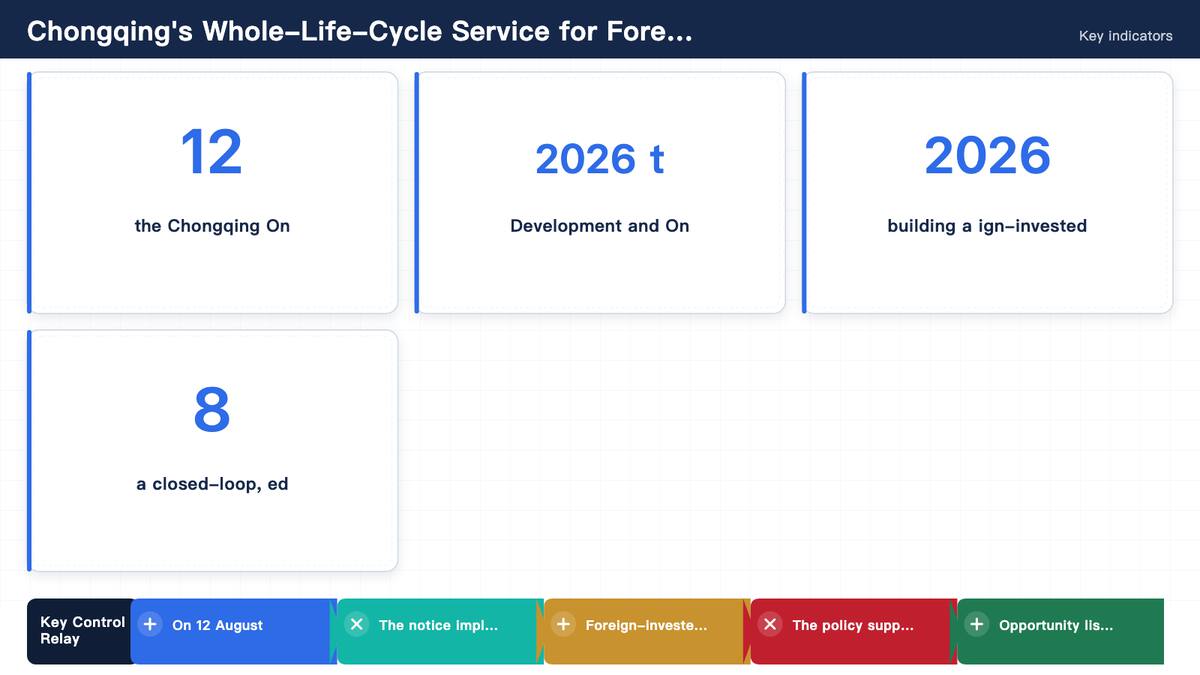
- On 12 August 2026 the Chongqing Development and Reform Commission issued a notice on whole-life-cycle services for foreign-invested projects (Yu Fagai Guifan [2026] No. 8), building a closed-loop, tiered service system from attraction to production.
2026年8月12日,重庆市发展和改革委员会印发《关于提升外商投资项目全生命周期服务水平的通知》(渝发改规范〔2026〕8号),构建外资项目从招引到投产的全生命周期闭环、分级分类服务体系。
- The notice implements the national Action Plan to Stabilise and Optimise Foreign Investment (Shangzi Fa [2026] No. 97) at provincial level, covering project scouting, landing, construction, operation and reinvestment.
该通知在省级层面落实国家《利用外资固稳促优行动方案》(商资发〔2026〕97号),覆盖项目谋划、落地、建设、运营与再投资各环节。
- Foreign-invested projects of USD 50 million and above are brought into the municipal special task force; large, nationally significant projects can be recommended to the national major foreign-project task force.
投资5000万美元及以上外资项目纳入市级外资项目专班;投资规模大、带动作用强的市级重大项目可推荐纳入国家重大外资项目专班。
- The policy supports reinvestment by foreign investors through the 10% profit-reinvestment tax credit, deferred withholding tax on reinvested profits, and lower initial land costs and streamlined approvals.
政策落实境外投资者以分配利润直接投资10%税额抵免、利润再投资递延缴纳预提所得税双重税收优惠,并降低初期用地成本、优化审批手续。
- Opportunity lists will be published by country and sector, targeting Singapore, Germany and other priority sources, with a “publish-track-landing” mechanism and dynamic optimisation.
将分国别、分领域、分批次发布外商投资机会清单,紧盯新加坡、德国等重点国别与地区,建立”发布—跟踪—落地”全流程机制并动态优化。
- For foreign investors, the notice is a model of the “one-stop” service trend now embedded in provincial implementation of the 2026 FIE stabilisation policy.
对外资投资者而言,该通知是”一站式”服务趋势的范例——这一趋势已内嵌于2026年稳外资政策的地方落实中。
Chongqing’s Whole-Life-Cycle Service for Foreign-Invested Projects: A Provincial Model of the 2026 One-Stop Trend | 重庆外商投资项目全生命周期服务:2026年”一站式”趋势的省级范例
Why this matters now
The gap between “welcome to invest” and “actually operating smoothly” is where foreign investment policies live or die. On 12 August 2026, the Chongqing Development and Reform Commission published a notice on improving whole-life-cycle services for foreign-invested projects (Yu Fagai Guifan [2026] No. 8). The notice is a provincial working implementation of the national Action Plan to Stabilise and Optimise Foreign Investment (Shangzi Fa [2026] No. 97), and it reads as a detailed operating manual for the “one-stop” and “full-lifecycle” service model that Chinese governments at all levels are now expected to deliver. For foreign investors comparing locations within China, such documents matter because they convert abstract national policy into concrete local commitments — who will help, how fast, and what can be escalated.
What the notice actually promises
The notice organises services around the project lifecycle. In project scouting, Chongqing will strengthen the attraction of foreign projects with a tiered pipeline mechanism, use the pilot free-trade zone to seek opening pilots in value-added telecom, healthcare and education, publish opportunity lists by country and sector (Singapore and Germany are named as priorities), and build a “publish-track-landing” mechanism with dynamic optimisation. On reinvestment, the notice commits to fully implementing the national 10% tax credit for foreign investors reinvesting distributed profits, the deferred withholding tax on profit reinvestment, lower initial land costs and streamlined approvals, plus a reinvestment project library. On construction, it establishes tiered service: projects of USD 50 million and above enter the municipal task force; large nationally significant projects can be recommended to the national major foreign-project task force for planning, land, energy and approval support; other projects are served by district task forces. It also includes mechanisms for problem escalation across departments.
Why this matters for foreign investors
Foreign investors evaluating China typically ask three questions: how long until the project starts operations, who resolves cross-department bottlenecks, and what happens when the project wants to expand. The Chongqing notice answers all three. The USD 50-million task-force threshold is a clear, published commitment that larger projects get dedicated municipal attention. The national task-force escalation path is significant because national-level support can unlock planning, land, energy and approval resources that provinces cannot. The reinvestment support is equally concrete — the 10% credit and deferred withholding tax are real money, and the notice makes their implementation a documented provincial commitment. For a multinational deciding where to locate a regional headquarters or a manufacturing base, a province with a published whole-lifecycle service model is easier to budget around than one whose service posture is unknown.
Practical steps for foreign investors
- Use the published channels. Locate the provincial DRC notice and the responsible task-force office; route project inquiries through documented channels rather than ad-hoc contacts.
- Size your project deliberately. If the investment is at or above USD 50 million, confirm the municipal task force applies; if nationally significant, ask about recommendation to the national task force.
- Plan reinvestment mechanics. If you intend to reinvest distributed profits, structure the documentation to capture both the 10% credit and deferred withholding treatment, and confirm with local tax authorities.
- Track the opportunity lists. The country/sector lists are published with a tracking mechanism; monitor them for land, energy and procurement opportunities relevant to your industry.
- Escalate through the right door. Understand the problem-escalation mechanism so that land, approval or coordination issues go to the responsible tier rather than getting lost.
- Benchmark across provinces. Treat the Chongqing notice as a baseline; compare the service commitments of other provinces you are evaluating so location decisions rest on comparable service guarantees.
Risks and compliance notes
Whole-life-cycle service commitments are directional: they describe an operating philosophy and institutional arrangements, not statutory entitlements to specific outcomes. The reinvestment tax incentives, for example, depend on meeting the eligibility conditions in the underlying national announcements, and the tax authorities’ interpretation governs. Task-force membership accelerates coordination but does not replace licence and approval requirements. Foreign investors should also verify current status — opportunity lists, task-force compositions and tax rulings can change — and should document all commitments they rely on in writing. Finally, the notice is Chongqing-specific; the same national policy is being implemented differently elsewhere, so comparing implementation documents, not just slogans, is the practical way to choose a location.
重庆外商投资项目全生命周期服务:2026年”一站式”趋势的省级范例
为什么当下重要
“欢迎投资”与”实际顺利运营”之间的落差,正是外资政策成败之处。2026年8月12日,重庆市发展和改革委员会印发《关于提升外商投资项目全生命周期服务水平的通知》(渝发改规范〔2026〕8号)。该通知是国家《利用外资固稳促优行动方案》(商资发〔2026〕97号)的省级落地实施,读起来就像中国各级政府现在都应交付的”一站式””全生命周期”服务模式的详细操作手册。对外资投资者比较中国各地选址而言,这类文件之所以重要,在于它们把抽象的国家政策转化为具体的本地承诺——谁来帮、多快、什么事可以升级处理。
通知实际承诺了什么
通知围绕项目生命周期组织服务。在项目谋划阶段,重庆将建立梯度招引机制强化外资项目招引,依托自贸试验区争取增值电信、医疗、教育等领域开放试点,分国别、分领域发布外商投资机会清单(新加坡、德国被点名为重点),并建立”发布—跟踪—落地”机制、动态优化。在再投资方面,通知承诺全面落实境外投资者以分配利润直接投资10%税额抵免、利润再投资递延预提所得税双重税收优惠,降低初期用地成本、优化审批手续,并建立再投资项目库。在建设阶段,建立分级分类服务:投资5000万美元及以上项目纳入市级外资项目专班;投资规模大、带动作用强的重大项目可推荐纳入国家重大外资项目专班,争取规划、用地、能耗、审批保障;其他项目由区县专班服务。通知还包括跨部门问题升级处理机制。
为何外资投资者应关注
外资投资者评估中国通常问三个问题:项目多久能投产、跨部门堵点谁来协调、扩产时会发生什么。重庆通知回答了全部三个。5000万美元专班门槛是一个清晰、公开的承诺,表明较大项目将获得市级专项关注。国家专班升级路径意义重大,因为国家层面支持可以解锁省级无法提供的规划、用地、能耗与审批资源。再投资支持同样具体——10%抵免与递延预提税是真金白银,通知使其实施成为文件化的省级承诺。对决定区域总部或制造基地落点的大型跨国企业而言,一个发布全生命周期服务模式的省份,比一个服务姿态不明的省份更容易做预算。
外资投资者的操作步骤
- 使用公开渠道。 找到省级发改委通知与负责的专班办公室;通过文件化渠道而非临时联系人办理项目咨询。
- 审慎设计项目规模。 若投资达到或超过5000万美元,确认适用市级专班;若属国家级重大意义项目,询问推荐进入国家专班的路径。
- 规划再投资机制。 若拟将分配利润再投资,设计文档以同时捕捉10%抵免与递延预提税待遇,并与当地税务部门确认。
- 跟踪机会清单。 国别/领域清单附跟踪机制发布;关注与你行业相关的土地、能源与采购机会。
- 走对升级之门。 理解问题升级机制,使用地、审批或协调问题进入对应层级,而非丢失在流程中。
- 跨省对标。 将重庆通知作为基线;比较你正在评估的其他省份的服务承诺,使选址决策建立在可比较的服务保障上。
风险与合规提示
全生命周期服务承诺是指向性的:它们描述运营理念与制度安排,而非对特定结果的法定权利。例如,再投资税收激励取决于满足国家层面公告的资格条件,并以税务机关的解释为准。进入专班加速协调,但不替代许可证与审批要求。外资投资者还应核实最新状态——机会清单、专班组成与税收裁定都可能变化——并应以书面形式记录所依赖的全部承诺。最后,该通知是重庆专属;同一国家政策在其他地方以不同方式实施,因此比较实施文件而非口号,才是选地的实际方法。
Sources
- 重庆市发展和改革委员会官网《关于提升外商投资项目全生命周期服务水平的通知》(渝发改规范〔2026〕8号,2026-08-12):<https://www.fzggw.cq.gov.cn/zwgk/zfxxgkml/zcwj/xzgfxwj/sfzggwxzgfxwj/202608/t20260812_15921872.html>
- 乌兰察布市商务局官网(国新办发布会实录):商务部副部长凌激、国家发展改革委外资司负责人荆琴、财政部国库司负责人郑涌介绍《利用外资固稳促优行动方案》政策措施:<https://swj.wulanchabu.gov.cn/zxft/1994919.html>
- 陕西省商务厅官网转发商务部 国家发展改革委 财政部《利用外资固稳促优行动方案》(商资发〔2026〕97号)全文:<https://sxdofcom.shaanxi.gov.cn/fdi/yhzc/40265.jhtml>
- 山西省民营经济发展局官网《外资企业可重点关注哪些扩大准入领域?》(2026-08-10,摘自商资发〔2026〕97号):<https://myj.shanxi.gov.cn/ztzl/bwbd/lywzgw/202608/t20260810_10196322.shtml>