
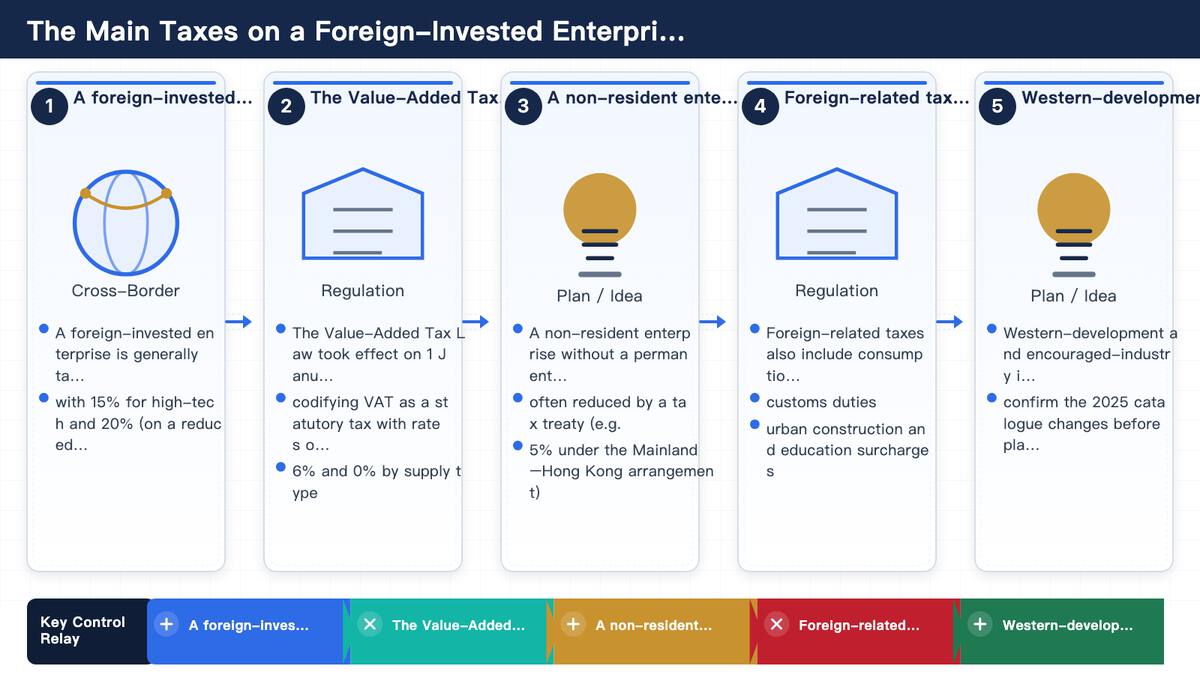
- A foreign-invested enterprise is generally taxed like a domestic one: a 25% corporate income tax (CIT) rate, with 15% for high-tech and 20% (on a reduced base) for small low-profit firms.
外商投资企业原则上与内资同税:企业所得税基准税率25%,高新技术企业减按15%,小型微利企业减计所得后按20%。- The Value-Added Tax Law took effect on 1 January 2026, codifying VAT as a statutory tax with rates of 13%, 9%, 6% and 0% by supply type.
《增值税法》自2026年1月1日施行,将增值税上升为法律,按应税行为设13%、9%、6%、0%四档税率。- A non-resident enterprise without a permanent establishment pays 10% withholding tax on China-sourced income, often reduced by a tax treaty (e.g., 5% under the Mainland–Hong Kong arrangement).
未设机构场所的非居民企业就中国来源所得缴纳10%预提所得税,常依税收协定降低(如内地与香港安排下为5%)。- Foreign-related taxes also include consumption tax, customs duties, urban construction and education surcharges, deed, land-appreciation, stamp and property taxes depending on the activity.
涉外税种还视业务涵盖消费税、关税、城建税与教育费附加、契税、土地增值税、印花税、房产税等。- Western-development and encouraged-industry incentives can cut the CIT rate to 15%; confirm the 2025 catalogue changes before planning.
西部大开发与鼓励类产业优惠可把企业所得税率降至15%;规划前须核对2025版鼓励目录的变动。- Practical step: map every supply and cross-border payment to its tax base and rate; lock treaty benefits via the tax-residency and beneficial-owner tests.
实操建议:将每项销售与跨境支付映射到税基与税率;通过税收居民与受益所有人测试锁定协定优惠。
The Main Taxes on a Foreign-Invested Enterprise in China and the 2026 VAT Law in Practice | 外商投资企业主要税种与2026增值税法实施实务
A foreign-invested enterprise (FIE) in China is subject to essentially the same tax framework as a domestic company, plus a few inbound/outbound mechanics that matter for cross-border groups. Understanding the tax base and rate of each major tax — and the 2026 codification of VAT — is the foundation of compliant structuring.
Corporate income tax
Enterprise income tax (CIT) applies at a standard 25% rate to resident enterprises (including FIEs established in China or managed from China). High-tech enterprises recognised under the 2016 recognition measures enjoy a 15% rate. Small low-profit enterprises may compute taxable income at 25% and pay 20% — a policy extended through 31 December 2027. Non-resident enterprises without a permanent establishment pay 10% withholding tax on China-sourced income, reducible under a tax treaty. A treaty example: under the Mainland–Hong Kong arrangement, qualified Hong Kong-resident recipients of dividends may be taxed at 5% rather than 10%.
The Value-Added Tax Law (effective 2026)
On 1 January 2026 the *Value-Added Tax Law* came into force, elevating VAT from a provisional regulation to a statute, with the implementing regulations effective the same day. Rates follow the supply: 13% for most goods, processing, repair, and tangible-property leasing; 9% for transport, construction, real-estate leasing, agricultural staples, utilities and imported items in the listed categories; 6% for modern services, intangibles and financial services; 0% for exports and specified cross-border services. FIEs must invoice, file and credit input VAT under the new statute.
Consumption tax, customs and surcharges
Manufacturers and importers of taxable consumer goods (tobacco, alcohol, cosmetics, jewellery, fuel, vehicles, etc.) pay consumption tax, chiefly at production/import, with some items taxed at retail. Imported goods bear customs duties plus import VAT and consumption tax under the *Customs Law*; exports are generally VAT- and consumption-tax exempt or refunded. Urban construction and education surcharges are levied on the VAT/cost basis; deed, land-appreciation, stamp and property taxes apply depending on property and transaction activity.
Incentives and the encouraged catalogue
Beyond the high-tech 15% rate, the western-development policy (extended by the 2020 No. 23 announcement) cuts CIT to 15% for encouraged industries in western regions. The *Catalogue of Encouraged Industries for Foreign Investment* is revised periodically; its 2025 edition deleted and added entries, so an FIE must re-check eligibility — mis-claiming a removed item risks back tax, late fees and credit damage. For example, foreign investment in Guizhou’s computing-power industry may qualify for the 15% rate only if the activity remains in the current catalogue.
Practical steps
- Classify supplies. Fix the VAT rate (13/9/6/0) for every product and service line.
- Elect CIT incentives deliberately. Apply high-tech or western/encouraged-industry rates only with clean accounting separation.
- Use treaties. Claim reduced withholding via the tax-residency certificate and beneficial-owner analysis for dividends, interest and royalties.
- Re-check the catalogue. Before year-end planning, confirm encouraged-industry entries against the latest catalogue.
- Handle cross-border GST correctly. Exports and specified cross-border services are zero-rated; document the substantive test.
外商投资企业主要税种与2026增值税法实施实务
中国的外商投资企业原则上适用与内资企业相同的税制框架,另有若干跨境进出机制对跨国集团尤为重要。厘清各主要税种的税基与税率,并理解2026年增值税的法典化,是合规架构的基础。
企业所得税
企业所得税对居民企业(含在中国设立或实际管理机构在中国的外商投资企业)适用25%基准税率。高新技术企业依2016年认定办法享受15%税率。小型微利企业可减按25%计算应纳税所得额并按20%缴纳——该政策延续至2027年12月31日。未设机构场所的非居民企业就中国来源所得缴纳10%预提所得税,可经税收协定降低。例如依内地与香港安排,符合条件的香港居民股息收款人可适用5%而非10%。
增值税法(2026年施行)
2026年1月1日《增值税法》正式施行,将增值税由暂行条例上升为法律,实施条例同日生效。税率依应税行为:绝大多数货物、加工修理、有形动产租赁为13%;交通运输、建筑、不动产租赁、粮食等农产品、公用事业及列举进口货物为9%;现代服务、无形资产与金融服务为6%;出口及特定跨境服务为0%。外商投资企业须依新法开票、申报并抵扣进项。
消费税、关税与附加
应税消费品(烟草、酒、化妆品、珠宝、成品油、小汽车等)的生产与进口环节缴纳消费税,部分在零售环节加征。进口货物依《关税法》缴纳关税及进口增值税、消费税;出口一般免征或退还增值税、消费税。城建税与教育费附加按增值税/消费税为基计征;契税、土地增值税、印花税、房产税视不动产与交易活动适用。
优惠与鼓励目录
除高新15%外,西部大开发政策(2020年第23号公告延续)对西部地区鼓励类产业减按15%。《鼓励外商投资产业目录》定期修订,其2025版有删有增,外资企业须重新核对资格——错误申报已删除条目将面临补税、滞纳金与信用损害。例如外商投资贵州算力产业,仅当活动仍在现行目录内才可适用15%税率。
实操步骤
- 归类应税行为。 为每条产品与服务线确定增值税率(13/9/6/0)。
- 审慎适用所得税优惠。 高新或西部/鼓励类优惠须账务清晰分离方可适用。
- 用足协定。 通过税收居民证明与受益所有人分析,就股息、利息、特许权使用费申请降低预提税。
- 复核目录。 年末规划前,按最新目录确认鼓励类条目。
- 正确处理跨境税。 出口与特定跨境服务零税率,须留存实质性测试证据。
Practitioner Quick Reference
- CIT 25% baseline: 15% for high-tech, 20% (reduced base) for small low-profit, 10% withholding for non-resident outbound.
所得税基准25%:高新15%,小微减计后20%,非居民出境预提10%。 - VAT statute from 2026: rates 13/9/6/0 by supply; invoice, file and credit under the new law.
2026年增值税法:按应税行为13/9/6/0;依新法开票、申报、抵扣。 - Treaty relief: claim reduced withholding via tax-residency certificate and beneficial-owner test.
协定优惠:凭税收居民证明与受益所有人测试申请降低预提税。 - Western/encouraged 15%: re-check the latest encouraged catalogue before planning.
西部/鼓励类15%:规划前复核最新鼓励目录。 - Surcharges & others: urban-construction and education surcharges, deed, land-appreciation, stamp, property as applicable.
附加与其他:城建税、教育费附加、契税、土地增值税、印花税、房产税视情形。
Common Pitfalls
- Missing the VAT law change: legacy provisional-regulation habits no longer match the 2026 statute.
忽视增值税法变化:沿用暂行条例习惯已不符2026年法律。 - Mis-claiming encouraged items: a deleted 2025 catalogue entry risks back tax and late fees.
错申报鼓励类:2025版目录已删除条目将面临补税与滞纳金。 - Ignoring treaties: paying 10% when a 5% treaty rate applies wastes cash.
忽略协定:本可适用5%却缴10%预提税,白白浪费现金。
2026 Watchlist
- VAT law implementation: watch supplementary rules and invoicing system updates under the 2026 statute.
增值税法实施:关注2026年法律下的配套规则与开票系统更新。 - Western catalogue 2025: re-check encouraged-industry entries before year-end planning.
西部目录2025版:年末规划前复核鼓励类条目。 - Treaty updates: new or revised tax treaties may lower withholding further.
协定更新:新签或修订的税收协定或进一步降低预提税。
Key Figures
- 25%: standard corporate income tax rate for resident enterprises.
25%:居民企业标准企业所得税率。 - 15%: reduced CIT rate for high-tech and western/encouraged industries.
15%:高新技术企业及西部/鼓励类产业的优惠税率。 - 10%: withholding tax on China-sourced income for non-resident enterprises (often lower by treaty).
10%:非居民企业中国来源所得预提税(常依协定降低)。 - 13 / 9 / 6 / 0%: the VAT rates by supply type under the 2026 statute.
13/9/6/0%:2026年增值税法按应税行为的税率。
Sources