
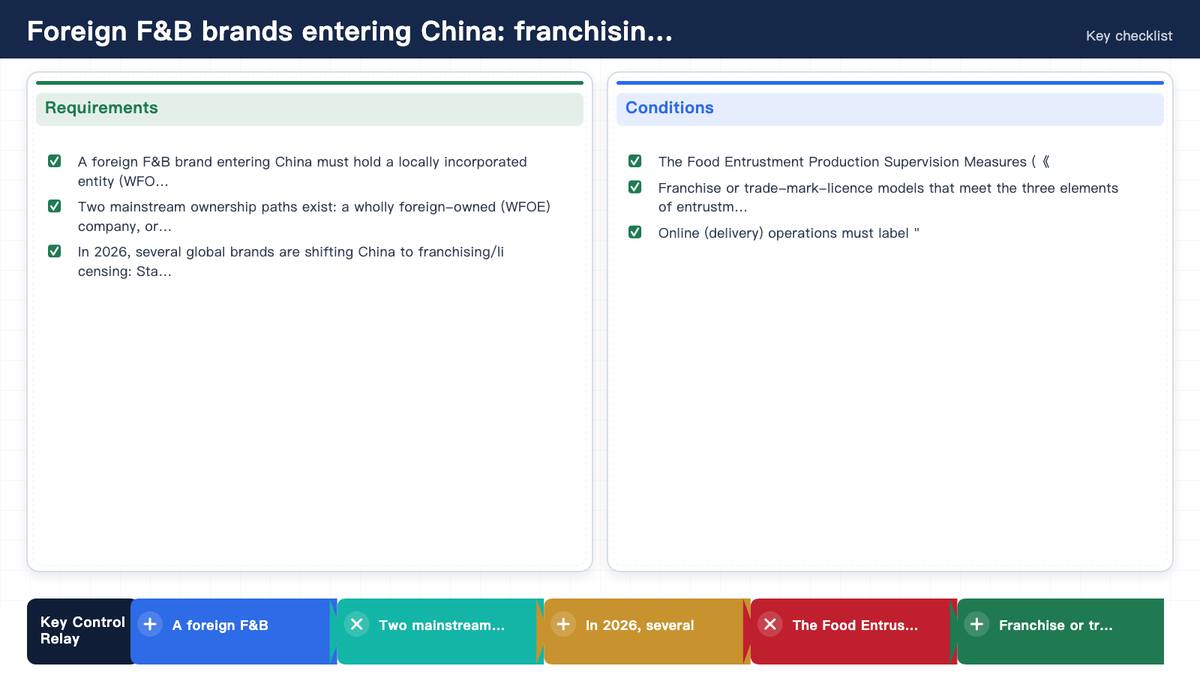
- A foreign F&B brand entering China must hold a locally incorporated entity (WFOE or JV) that obtains the business licence with a catering scope and the Food Business Licence (食品经营许可); the licence is held by the China company, not the overseas brand.
外国餐饮品牌入华须由本地设立实体(WFOE或合资)取得含餐饮经营范围的营业执照及《食品经营许可》;许可证由中国公司持有,而非境外品牌。- Two mainstream ownership paths exist: a wholly foreign-owned (WFOE) company, or franchising (特许经营) under the Commercial Franchise Administration Regulation, which requires the franchisor to have two directly-operated stores operating for over one year (“two stores, one year”).
主要有两条路径:外商独资企业(WFOE),或依据《商业特许经营管理条例》的特许经营,要求特许人拥有2个直营店且经营满1年(”两店一年”)。- In 2026, several global brands are shifting China to franchising/licensing: Starbucks China moved to a franchise model via a Bayu-controlled JV; Wendy’s plans 1,000 stores in 10 years via local operators.
2026年,多家国际品牌将中国业务转向特许/授权:星巴克中国经博裕控股合资转为特许模式;温蒂汉堡计划10年通过本土运营商开1000家店。- The Food Entrustment Production Supervision Measures (《食品委托生产监督管理办法》), effective 1 December 2026, make the entrusting party (brand) responsible for the food safety of entrust-produced food — directly reshaping how franchisors and chain brands source and supervise.
2026年12月1日施行的《食品委托生产监督管理办法》规定委托方(品牌)对委托生产食品安全负责,直接重塑特许人与连锁品牌的采购与监督方式。- Franchise or trade-mark-licence models that meet the three elements of entrustment production are caught by the Measures; the brand must hold a food licence/record, supervise the manufacturer, and appoint food-safety directors and officers.
符合委托生产三要素的特许经营或商标授权模式受该办法约束;品牌须持食品许可/备案、监督生产方,并配备食品安全总监与食品安全员。- Online (delivery) operations must label “网络经营”, use tamper-evident seals (食安封签), and adopt “open kitchen” (明厨亮灶) in many localities; non-compliance blocks launch.
网络经营须标注”网络经营”、使用食安封签,并在多地实行明厨亮灶;不合规将阻碍开业。
Foreign F&B brands entering China: franchising vs. wholly-owned paths and food-safety compliance | 外资餐饮品牌入华开店(特许经营/独资)路径与食安合规
Overview
China’s food-and-beverage market is large but tightly regulated at the point of operating a restaurant. A foreign brand’s entry decision — wholly-owned (WFOE) versus franchising (特许经营) — is no longer only a commercial choice; it now drives the food-safety accountability structure, especially after the Food Entrustment Production Supervision Measures take effect on 1 December 2026. This article maps the two entry paths, the licensing stack, and the 2026 compliance posture for foreign brands.
Market context
Foreign F&B entry rests on two layers:
- Entity and licence layer — a locally incorporated company (WFOE or JV) with a business licence whose scope covers catering/food sales, plus a Food Business Licence (食品经营许可) issued by the county-level market-regulation authority for catering and most food-sales activities.
- Product and supply layer — meal components, seasonings and packaged items must meet labelling, production-licence and (if imported) GACC registration rules.
The choice between WFOE and franchising affects who holds the licence, who bears food-safety responsibility, and how fast the store network can scale.
Key 2026 developments
Franchising gains momentum. The Commercial Franchise Administration Regulation (《商业特许经营管理条例》) governs franchising: a franchisor with registered trademarks, trade dress, patents or know-how licenses a franchisee to operate under a unified model for a fee. To register and roll out franchising, the franchisor must have two directly-operated stores with over one year of operation (“two stores, one year”). In 2026, the model is accelerating: Starbucks China completed a equity transfer to a Boyu-controlled JV (Boyu 60%, Starbucks 40%), with about 8,000 stores gradually moving to a franchise model; Wendy’s announced a plan for 1,000 stores in 10 years via local operators such as DPC (Domino’s China), CFB (DQ/Papa John’s China) and Furi (Subway China). McDonald’s shifted China to franchising through a CITIC-led JV in 2017.
The Food Entrustment Production Supervision Measures (effective 1 December 2026). This SAMR rule redefines accountability for the hugely common OEM/ODM model. “Entrustment production” means a contractor, at the entrusting party’s request, performs all or part of the food production process and delivers the food. Crucially, where a trade-mark licence or franchise arrangement meets the three elements of entrustment production, it is caught by the Measures — the entrusting party (the brand) is responsible for the food safety of the entrust-produced food and must not offload responsibility through a licence or franchise contract.
Obligations on the entrusting brand. The entrusting party must:
- hold a Food Business Licence or a prepackaged-food-only filing, and possess the ability to supervise the contractor;
- establish food-safety management systems (daily/weekly/monthly control, contractor qualification checks, contract reporting, raw-material control, label review, supervision, inspection, recall);
- appoint a food-safety director and food-safety officers, trained and assessed;
- keep stock, accounting and supervision records and report entrustment relationships to the regulator.
Obligations on the contractor. The contractor must hold a Food Production Licence covering the exact product category, maintain production capabilities and food-safety systems, and appoint its own director and officers.
Operating-level compliance. For dine-in and delivery, localities increasingly require: a valid Food Business Licence; “网络经营” labelling for online channels; tamper-evident delivery seals (食安封签); and “open kitchen” (明厨亮灶) video接入 for chain brands. A new store cannot launch without these in many cities.
Licensing acceleration for chains. Some provinces (e.g. Fujian) operate a “review-commitment” (评审承诺制) route: a chain with ≥10 directly-operated stores and “four unifications” (unified organisation, management, distribution and food-safety responsibility) can open new direct stores without on-site inspection, with post-licence verification within 30 working days.
Practical steps
- Choose the entity path early — WFOE gives full control but slower scaling; franchising scales fast but requires the “two stores, one year” track record and a China franchisor entity.
- Incorporate the licence-holding company first — the Food Business Licence and customs declarant status sit with the China entity, not the parent.
- If franchising, build the franchisor entity and the two-store record before publicly recruiting franchisees.
- Map your supply chain to the Entrustment Measures — if you OEM/ODM or use trade-mark licence, you are the responsible entrusting party; set up supervision systems and appoint safety staff now (before 1 December 2026).
- Prepare the operating stack — Food Business Licence scope, online “网络经营” labelling, 食安封签, and 明厨亮灶 where required.
- Use chain-licensing fast tracks where available (e.g. review-commitment routes) to compress store opening.
Related reading
- Imported food and health-food registration, filing and labelling (see article 155).
- Supply-chain localisation and central-kitchen compliance for chain restaurants (see article 156).
Sources
- 国家市场监督管理总局 — 《食品委托生产监督管理办法》实施问答(2026-06-23)
- 国家市场监督管理总局 — 官方网站(食品生产经营监管)
- 福建省市场监督管理局 — 《食品经营许可和备案管理》评审承诺制规定(闽市监规〔2026〕1号)
外资餐饮品牌入华开店(特许经营/独资)路径与食安合规
概述
中国餐饮食品市场规模庞大,但在门店运营环节监管严密。外国品牌入华选择外商独资(WFOE)还是特许经营(特许经营),已不单纯是商业决策;尤其在《食品委托生产监督管理办法》于2026年12月1日施行后,它直接决定了食品安全责任结构。本文梳理两条进入路径、许可组合,以及外资品牌2026年的合规姿态。
市场背景
外资餐饮入华依赖两层:
- 实体与许可层——本地设立公司(WFOE或合资),营业执照经营范围涵盖餐饮/食品销售,并取得县级市场监管部门核发的《食品经营许可》(餐饮及多数食品销售活动)。
- 产品与供应链层——餐食组件、调味料与预包装品须符合标签、生产许可及(进口品)海关注册规则。
WFOE与特许经营的选择,影响由谁持有许可证、由谁承担食品安全责任,以及门店网络扩张速度。
2026年核心进展
特许经营升温。 《商业特许经营管理条例》规制特许经营:拥有注册商标、企业标志、专利或专有技术的特许人,以合同形式许可被特许人按统一模式经营并收取费用。开展特许经营备案须拥有2个直营店且经营满1年(”两店一年”)。2026年该模式加速:星巴克中国完成股权交割,转由博裕控股合资(博裕60%、星巴克40%),约8000家门店逐步转为特许模式;温蒂汉堡(Wendy’s)宣布10年通过达势股份(达美乐中国)、CFB集团(DQ/棒约翰中国)、富瑞食(赛百味中国)等本土运营商开设1000家店。麦当劳2017年经中信系合资将中国转为特许经营。
《食品委托生产监督管理办法》(2026年12月1日施行)。 该市场监管总局规章重塑了极为普遍的OEM/ODM模式。”委托生产”指受托方按委托方要求,从事食品全部或部分环节生产并交付。关键的是,商标授权或特许经营若符合委托生产三要素,即受该办法约束——委托方(品牌)对委托生产食品安全负责,不得借许可或特许经营合同减轻、免除自身责任。
对委托品牌的义务。 委托方须:
- 取得食品经营许可或仅销售预包装食品备案,并具备监督受托方的能力;
- 建立食品安全管理制度(日管控、周排查、月调度、受托方资质查验、合同报告、原辅料控制、标签审核、监督、抽检、召回);
- 配备食品安全总监与食品安全员,经培训并考核;
- 留存进销存与监督记录,并向监管报告委托生产关系。
对受托方的义务。 受托方须取得涵盖受托产品类别的食品生产许可,具备相应生产能力与食品安全保障体系,并配备自身总监与员。
运营层合规。 对堂食与外卖,多地要求:有效《食品经营许可》;网络渠道标注”网络经营”;使用食安封签;连锁品牌实行明厨亮灶视频接入。缺项将阻碍新店开业。
连锁许可提速。 部分省份(如福建)实行”评审承诺制”:拥有≥10家直营门店且”四统一”(统一组织架构、经营管理、配送食品、承担食品安全责任)的连锁企业,新开直营店免现场核查直接发证,领证后30个工作日内事后核查。
实务步骤
- 尽早选择实体路径——WFOE控制力强但扩张慢;特许经营扩张快,但须有”两店一年”记录与中国特许人实体。
- 先设立持证公司——《食品经营许可》与报关主体由中国实体持有,而非母公司。
- 若做特许经营,先建特许人实体与两店记录,再公开招募加盟商。
- 将供应链映射至《委托生产办法》——若OEM/ODM或商标授权,你即为责任委托方;须在2026年12月1日前建立监督体系并配齐安全人员。
- 备齐运营组合——《食品经营许可》范围、网络”网络经营”标注、食安封签,以及所需的明厨亮灶。
- 善用连锁许可快车道(如评审承诺制)压缩开店周期。
延伸阅读
- 进口食品与保健食品注册、备案及标签合规(参见155篇)。
- 外资连锁餐饮供应链本地化与中央厨房合规(参见156篇)。
来源