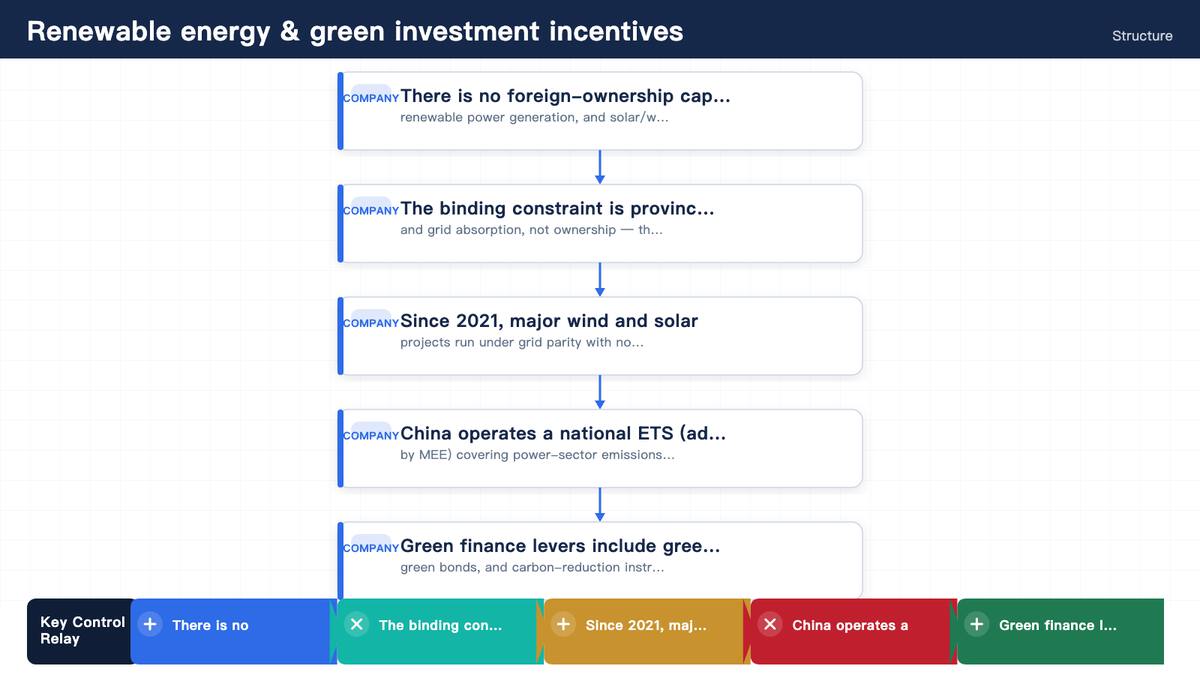
- There is no foreign-ownership cap on renewable power generation, and solar/wind equipment manufacturing is fully open to foreign investment.
可再生能源发电无外资股比上限,光伏与风电设备制造对外资完全开放。- The binding constraint is provincial planning and grid absorption, not ownership — the practical vehicle is a locally incorporated project company.
真正约束在于省级规划与电网消纳而非所有权——实务载体是本地设立的项目公司。- Since 2021, major wind and solar projects run under grid parity with no feed-in subsidy; revenue rests on power-purchase terms, green-power trading, and green certificates (绿证).
自2021年起主要风光项目在平价上网下运行、无度电补贴;收入取决于购电条款、绿电交易与绿证。- China operates a national ETS (administered by MEE) covering power-sector emissions and expanding to more sectors, plus a restarted voluntary CCER offset market.
中国运行由生态环境部管理的全国碳市场(ETS),覆盖电力行业并扩至更多行业,另设已重启的自愿减排CCER市场。- Green finance levers include green loans, green bonds, and carbon-reduction instruments secured against subsidy/settlement receivables.
绿色金融杠杆包括绿色信贷、绿色债券,以及以补贴/结算应收为担保的碳减排支持工具。- NEA/NDRC encourage foreign-related capital and Belt-and-Road partnerships, opening third-market renewable routes with Chinese counterparts.
国家能源局与发改委鼓励涉外资本及”一带一路”合作,为外资在第三方市场与中方开展可再生能源项目打开路径。
Renewable energy & green investment incentives | 可再生能源与绿色投资激励
Overview
China hosts the world’s largest and fastest-growing renewable-energy system — by the end of 2025 total renewable installed capacity exceeded 2.3 billion kW, and wind and solar alone reached about 1.84 billion kW, surpassing thermal power as the single largest power source. For foreign investors, the sector is broadly open: manufacturing of solar and wind equipment is unrestricted, and power-generation projects are open to domestic and foreign capital alike.
This article outlines foreign-investor access to wind/solar, green-incentive and financing levers, and participation in the carbon market. It is informational; confirm current subsidy, tariff, and ETS detail with qualified PRC advisers.
Foreign-investor access to wind and solar
There is no foreign-ownership cap on renewable power generation; foreign-funded enterprises may invest in wind, solar, biomass, and hydropower projects on the same footing as domestic firms, typically through a locally incorporated project company. The National Energy Administration (NEA) and the NDRC set the planning and pricing framework, while provincial authorities handle project filing/approval and grid-connection. Equipment manufacturing (PV modules, wind turbines) is fully open and globally competitive; the constraint is usually grid absorbption and provincial planning, not ownership.
Foreign access is also shaped by the foreign-investment negative list (负面清单). Renewable power generation is not on the restricted or prohibited lists, so a wholly foreign-owned enterprise is permitted for generation; the restrictions that remain are sectoral — for example, certain grid assets, distribution-network ownership, and power-grid operation are treated differently and are not the natural vehicle for a generation-focused entrant. This is precisely why the practical structure is a project company that builds and operates generation assets but does not own the transmission backbone. Confirming the negative-list status early avoids designing a holding structure that later runs into a sector cap.
Green incentives & the “grid-parity” era
Since 2021 China’s major wind and solar projects have operated under grid parity (平价上网) without feed-in subsidies, so the investment case rests on power-purchase terms, green-power trading, and green certificates (绿证) rather than direct subsidies. The NEA’s 2022 “High-quality development of new energy” plan and subsequent guidance promote integrated development (solar + storage, deser/Gobi/wasteland bases, “sand-desert-gobi-wasteland” large bases), distributed PV, and rural energy pilots. Local governments may add land, tax, and financing support within the law.
Within the grid-parity framework the economics increasingly depend on scale and co-location. Large “sand-desert-gobi-wasteland” base projects benefit from low land cost and dedicated transmission, while distributed PV competes on avoiding retail tariffs. Provincial pilots for green-electricity direct trading and the growing green-certificate market let developers monetise the environmental attribute separately from the kilowatt-hour, which is especially relevant where the host off-taker has its own renewable-consumption obligation. Foreign investors should also watch the gradual shift — in some provinces — from a fixed benchmark on-grid tariff toward more market-based electricity pricing, which transfers some volume and price risk from the off-taker or utility to the project and rewards better generation forecasting and storage co-location.
Financing, private capital, and “going out”
The NEA and NDRC actively encourage private and foreign-related capital into new energy, including participation in large bases, solar thermal, biomass, and heating projects, and support for green finance, carbon-reduction instruments, and eligible local-government bonds. For developers, financing levers include green loans, green bonds, and renewable-power-price-claim loans secured against subsidy/settlement receivables. Chinese new-energy firms are also steered to “go global” under the Belt and Road, which opens partnership routes for foreign players in third markets.
Carbon market & green-power consumption
China operates a national Emissions Trading Scheme (ETS) administered under the ecology/environment authority (MEE), covering power-sector emissions with expansion planned to more sectors; a separate voluntary GHG-voluntary-offset (CCER) market supports project-based offsets. Green certificates (绿证) certify renewable generation and are increasingly used to meet green-power consumption obligations for key energy-using industries; the NEA and related bodies are building the world’s largest green-certificate market and pursuing international mutual recognition. Foreign investors should weigh ETS compliance, green-certificate revenue, and power-purchase structuring together.
For foreign participants the ETS and CCER are primarily a revenue-and-risk overlay rather than a core generation licence. As the scheme expands beyond power to industries such as steel, cement, and aluminium, more counterparties will need certificates, deepening market liquidity. The voluntary CCER market, restarted after a multi-year pause, allows project-based offsets — forestry, methane utilisation, and eligible renewable projects may issue CCERs that compliance entities buy. Practical market entry often runs through a Chinese partner or a domestically registered trading entity, since account opening and trading follow domestic rules. Treat green certificates and CCER as complementary but distinct: the certificate proves renewable origin for consumption obligations, while the CCER is a tradable emission offset that retires against a compliance entity’s allowance gap.
Practical example
Consider “NordSolar,” a Danish renewable developer that wants to build a 50 MW distributed rooftop-PV-plus-storage system on the warehouses of a Chinese logistics group in Zhejiang province, selling power directly to the host off-taker under a third-party-investment (TPI, 合同能源管理 / energy-management contract) model.
The first step was incorporation: NordSolar set up a wholly foreign-owned project company in the local free-trade zone, which — because generation has no foreign-ownership cap — could hold the generation assets and sign the grid-connection and power-purchase arrangements directly. The provincial energy bureau’s annual construction plan and a grid-absorption study confirmed the 50 MW fit within the local distribution-grid capacity, which is the real gate on the deal, not the nationality of the investor.
Second, revenue was modelled without any feed-in subsidy. Instead the project stacked three streams: (a) the TPI tariff charged to the host — typically a discount to the retail electricity price, agreed contractually; (b) green-power trading and green-certificate (绿证) revenue from the renewable generation; and (c) potential capacity or ancillary-service value from the co-located storage. The levelised cost was most sensitive to the host’s load curve, so NordSolar modelled on-site self-consumption first and grid export second, sizing the battery to capture the self-consumption arbitrage rather than for wholesale arbitrage.
Third, financing used a green loan secured against the project company and its settlement receivables, with a structure eligible for the carbon-reduction support instruments referenced by the NEA and NDRC. Because storage was co-located, the project also qualified for integrated-development treatment under the new-energy high-quality plan, improving its bankability.
Finally, NordSolar tracked the national ETS and the CCER restart. Although the project’s own emissions were negligible, the host’s compliance obligations and the certificate market affected the value of the green-power contract; NordSolar priced a modest green premium into the TPI tariff to reflect the host’s own ESG and renewable-consumption targets, turning a soft commitment into a contracted revenue line.
The takeaway: the binding constraint was provincial planning and grid absorption, not foreign ownership. A local project company, subsidy-free revenue stacking, and green finance turned an open-but-thin-margin sector into a bankable deal.
What to do next
- Confirm the provincial plan and grid-absorption study before committing capital — provincial planning, not ownership, is the binding constraint.
- Assume no feed-in subsidy; model revenue on grid-parity power price, green-power trading, and green certificates.
- Incorporate a local project company; foreign ownership of generation is permitted but the entity drives permits and grid connection.
- Explore green finance: green loans/bonds and subsidy-receivable financing for eligible projects.
- Track the ETS sector expansion and CCER restart to value carbon and certificate streams.
- Consider Belt-and-Road partnerships for third-market renewable projects with Chinese counterparts.
Sources
- National Energy Administration (NEA) — policy interpretation on high-quality new-energy development: https://www.nea.gov.cn/2022-05/30/c_1310608538.htm
- NEA — supporting private/non-state capital in new-energy construction: https://www.nea.gov.cn/20250506/6c9892f4b33b4056afb57a7bf7622290/c.html
- NDRC — official portal (pricing, planning, green incentives): https://www.ndrc.gov.cn
- Ministry of Ecology and Environment (MEE) — official portal (national ETS administration): https://www.mee.gov.cn
- NEA — official portal: https://www.nea.gov.cn
Related reading
- see also: Automotive & EV market entry (46-automotive-ev-market-entry)
- see also: Financial services & fintech licensing (44-financial-services-fintech-licensing)
- see also: Import-export licensing & customs clearance (50-import-export-customs-clearance)
可再生能源与绿色投资激励
概述
中国拥有全球规模最大、增长最快的可再生能源体系——截至 2025 年底,可再生能源总装机突破 23 亿千瓦,其中风电光伏合计约 18.4 亿千瓦,历史性超过火电成为第一大电源。对外国投资者而言,该 sector 大体开放:光伏与风电设备制造不受限制,发电项目对内资与外资一视同仁。
本文勾勒外资对风光电的准入、绿色激励与融资杠杆,以及参与碳市场的路径。本文仅为信息参考,具体补贴、电价与碳市场细节请以合格中国顾问确认。
外资对风电与光伏的准入
可再生能源发电无外资股比上限;外资企业可与内资企业同等投资风电、光伏、生物质与水电项目,通常经由本地设立的项目公司。国家能源局(NEA)与发改委设定规划与电价框架,省级部门负责项目核准/备案与并网。设备制造(光伏组件、风机)完全开放且具全球竞争力;约束通常在于电网消纳与省级规划,而非所有权。
外资准入亦受外商投资准入负面清单(负面清单)塑造。可再生能源发电未被列入限制或禁止清单,故发电可设外商独资企业;剩余的限制具有行业性——例如部分电网资产、配电网所有权与电网运营被区别对待,并非以发电为核心的进入者之自然载体。正因为如此,实务结构通常是设立一个建设并运营发电资产、但不持有输电主干的项目公司。尽早确认负面清单状态,可避免设计出后续遭遇行业股比上限的持股结构。
绿色激励与”平价上网”时代
自 2021 年起,中国主要风光项目在平价上网(无度电补贴)下运行,投资测算因此取决于购电条款、绿电交易与绿证(绿证),而非直接补贴。国家能源局 2022 年”新能源高质量发展”方案及后续引导,推进集成发展(光伏+储能、沙戈荒基地、沙漠戈壁荒漠大型基地)、分布式光伏与乡村能源试点。地方政府可在法律框架内叠加土地、税收与融资支持。
在平价上网框架下,经济性日益取决于规模与协同布局。大型”沙戈荒”基地项目受益于低土地成本与专用输送通道,而分布式光伏则靠规避零售电价取胜。各省绿电直接交易试点与不断扩大的绿证市场,让开发商得以将环境属性与千瓦时本身分开变现,这在用电方自身负有可再生能源消纳责任时尤为关键。外资还应关注部分省份由固定标杆上网电价逐步转向更市场化电价的趋势——这把部分电量与价格风险从用电方或电网转移到项目侧,更考验发电预测与储能协同能力。
融资、民营资本与”走出去”
国家能源局与发改委积极鼓励民营及涉外资本进入新能源,包括参与大型基地、光热、生物质与供热项目,并支持绿色金融、碳减排工具及符合条件的地方政府债券。对开发商而言,融资杠杆包括绿色信贷、绿色债券,以及以补贴/结算应收为担保的再生能源电价确权贷款。中国新能源企业亦被引导在”一带一路”下”走出去”,为外资在第三方市场的合作打开路径。
碳市场与绿电消费
中国运行由国家生态环境主管部门(MEE)管理的全国碳排放权交易体系(ETS),目前覆盖电力行业排放并计划扩至更多行业;另设温室气体自愿减排(CCER)市场支撑项目级抵消。绿证(绿证)认证可再生发电量,并日益用于满足重点用能行业的绿电消费责任;国家能源局等正建设全球最大绿证市场并推动国际互认。外资投资者应将 ETS 合规、绿证收益与购电结构一并权衡。
对外资参与者而言,ETS 与 CCER 主要是收益与风险叠加层,而非核心发电许可。随着体系由电力扩至钢铁、水泥、铝等行业,更多交易对手将需要配额,市场流动性随之加深。暂停数年后重启的自愿减排 CCER 市场允许项目级抵消——林业、甲烷利用与符合条件的可再生项目可签发 CCER,由履约企业购买。实务进入常经由中方合作伙伴或境内注册交易主体进行,因开户与交易遵循国内规则。应将绿证与 CCER 视作互补但不同:绿证证明用于消纳责任的可再生来源,而 CCER 是可抵减履约企业配额缺口的可交易排放抵消。
实操示例
以丹麦可再生能源开发商”NordSolar”为例,其拟在浙江某物流集团仓库屋顶建设 50 MW”分布式光伏+储能”系统,按第三方投资(TPI,合同能源管理)模式将电力直供用能方。
第一步是设立实体:NordSolar 在当地区自贸片区设立外商独资项目公司——因发电无外资股比上限,该公司可直接持有发电资产并签署并网与购售电安排。省能源局的年度建设计划与电网消纳研究确认 50 MW 落在当地配电网容量之内,这才是交易的真正门槛,而非投资者国籍。
第二步,收入在毫无度电补贴下建模,转由三条流叠加:(a)向用能方收取的合同能源管理电价——通常较零售电价打折、合同约定;(b)来自可再生发电的绿电交易与绿证(绿证)收益;(c)协同储能可能带来的容量或辅助服务价值。平准化成本对用能方负荷曲线最敏感,故 NordSolar 先按就地自用、再按上网建模,并将电池容量定位于捕捉自用套利,而非批发套利。
第三步,融资采用以项目公司及其结算应收为担保的绿色信贷,结构符合发改委与国家能源局提及的碳减排支持工具。因储能协同,项目亦适用新能源高质量发展方案下的集成发展待遇,提升可融资性。
最后,NordSolar 跟踪全国 ETS 与 CCER 重启。尽管项目自身排放可忽略,但用能方的履约义务与绿证市场影响绿电合同价值;NordSolar 在合同能源管理电价中计入适度绿色溢价,反映用能方自身的 ESG 与可再生能源消纳目标,把软性承诺变成合同收入项。
结论是:约束在于省级规划与电网消纳,而非外资所有权。本地项目公司、无补贴下的收入叠加与绿色金融,把一个开放但薄利的行业变成了可融资的交易。
下一步建议
- 在投入资本前确认省级规划与电网消纳研究——约束在于省级规划而非所有权。
- 假定无度电补贴;以平价电价、绿电交易与绿证建模收入。
- 设立本地项目公司;发电外资所有权虽被允许,但实体驱动许可与并网。
- 探索绿色金融:符合条件的项目可用绿色信贷/债券及补贴应收融资。
- 跟踪 ETS 行业扩围与 CCER 重启,以评估碳与绿证收益流。
- 考虑以”一带一路”合作,与中方在第三方市场开展可再生能源项目。
来源
- 国家能源局(NEA)——新能源高质量发展方案政策解读:https://www.nea.gov.cn/2022-05/30/c_1310608538.htm
- 国家能源局——支持民营等非公资本参与新能源建设:https://www.nea.gov.cn/20250506/6c9892f4b33b4056afb57a7bf7622290/c.html
- 国家发展和改革委员会(NDRC)——官方门户(电价、规划、绿色激励):https://www.ndrc.gov.cn
- 生态环境部(MEE)——官方门户(全国碳市场管理):https://www.mee.gov.cn
- 国家能源局(NEA)——官方门户:https://www.nea.gov.cn
相关阅读
- 参见:汽车与新能源汽车入华(46-automotive-ev-market-entry)
- 参见:金融服务与金融科技牌照(44-financial-services-fintech-licensing)
- 参见:进出口许可与海关清关(50-import-export-customs-clearance)