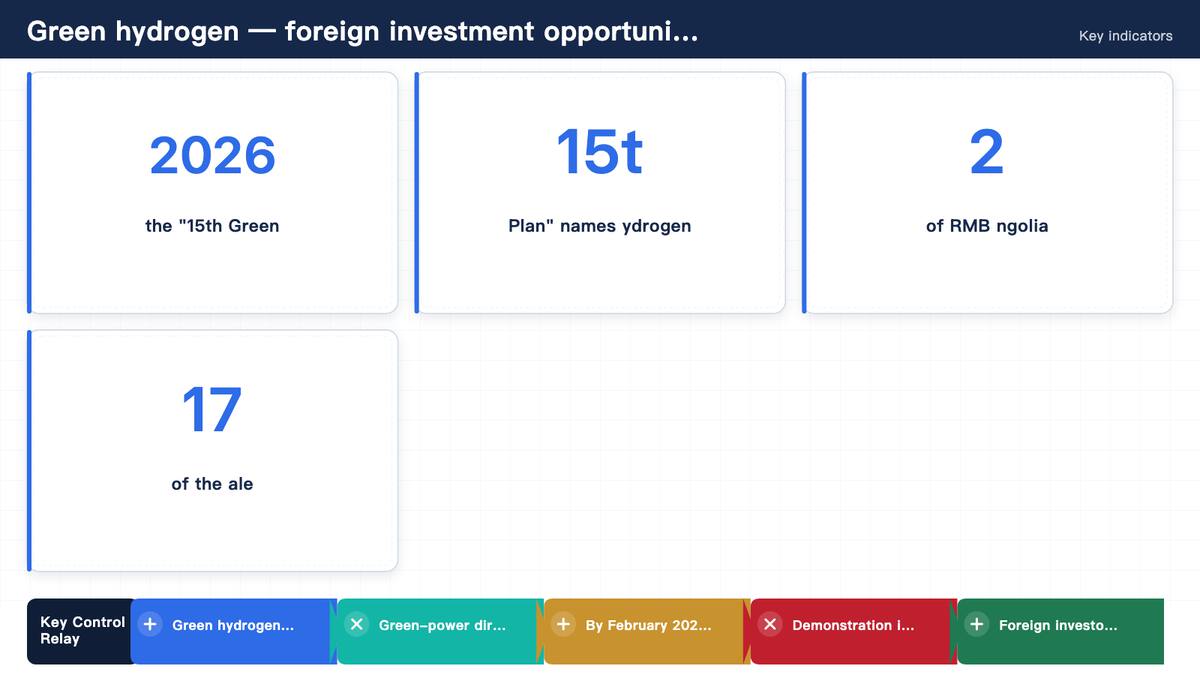
- Green hydrogen is a 2026 policy priority: the “15th Five-Year Plan” names hydrogen and green fuels as new growth points, and Inner Mongolia alone targets large-scale green-H2 clusters with costs of RMB 17–20/kg (about 60% of the national average).
绿氢是2026年政策重点:”十五五”规划将氢能、绿色燃料列为新增长点;仅内蒙古即瞄准规模化绿氢集群,成本17–20元/公斤(约全国均价的60%)。- Green-power direct connection (绿电直连, 发改能源〔2025〕650号 and 〔2026〕688号) is the key enabler — it gives electrolytic hydrogen 100% physical green-power traceability and removes the public-grid “middle leg,” cutting cost and certifying origin.
绿电直连(发改能源〔2025〕650号、〔2026〕688号)是关键赋能手段——为电解制氢提供100%物理绿电溯源,去掉公共电网”中转”,降本并认证来源。- By February 2026, 84 green-direct-connection projects had been approved nationwide (32.59 GW of renewable capacity); at least eight large green-H2 projects advanced in 2026 across Xinjiang, Inner Mongolia, Guangdong, Heilongjiang and Hubei.
截至2026年2月,全国已审批84个绿电直连项目(可再生装机3259万千瓦);2026年新疆、内蒙古、广东、黑龙江、湖北等地至少8个大型绿氢项目推进。- Demonstration is moving from pilot to scale: the world’s largest green-hydrogen-ammonia project (Oriental Energy, Chifeng) shipped its first green ammonia export in 2026 and holds ISCC GHG certification — a template for export-oriented green fuels.
示范正从试点走向规模:全球最大绿氢制氨项目(远景赤峰)2026年首发绿氨出海并获ISCC GHG认证——是可出口绿色燃料的范本。- Foreign investors enter via local project companies and partnerships; the sector has no generation-ownership cap, and green-direct-connection rules explicitly welcome foreign-related and private capital in new energy.
外资经由本地项目公司与合作进入;该领域无发电所有权上限,且绿电直连规则明确欢迎涉外与民营资本进入新能源。- Watch the cost and certification stack: electrolyser capex, renewable power price (as low as RMB 0.15–0.21/kWh in the west), green-certificate/ISCC traceability, and provincial pilots (Inner Mongolia, Jilin, Xinjiang) defining上网 electricity ratios.
关注成本与认证栈:电解槽资本开支、可再生电价(西部低至0.15–0.21元/千瓦时)、绿证/ISCC溯源,以及界定上网电量比例的内蒙古、吉林、新疆等省级试点。- Opportunities span the value chain: green-H2 for refining/chemicals, green ammonia/methanol/Sustainable Aviation Fuel, hydrogen pipelines and equipment, and “wind-solar-hydrogen-storage” integrated bases.
机会覆盖价值链:炼化/化工绿氢、绿氨/绿醇/可持续航空燃料、氢管网与装备,以及”风光氢储”一体化基地。
Green hydrogen — foreign investment opportunities and demonstration zones | 绿氢/氢能产业:外资投资机会与示范区
Overview
Hydrogen — especially green hydrogen produced from renewable power — has moved from pilot exploration to ordered scale-up in China. The “15th Five-Year Plan” explicitly names hydrogen and green fuels as new growth points, and 2026 is seeing a wave of large green-direct-connection (绿电直连) hydrogen projects. For foreign investors, the sector is open and policy-backed, but success hinges on mastering the green-power-direct-connection mechanism, the cost stack, and international certification for export.
This article outlines the 2026 policy push, demonstration clusters, the foreign-investor access path, and where capital can win. It is informational; confirm current detail with qualified PRC advisers.
The 2026 policy push
Two national instruments anchor green hydrogen:
- Green-power direct connection. The NDRC/NEA *Notice on Orderly Promoting Green-Power Direct Connection* (发改能源〔2025〕650号, May 2025) defined the model and standards; a September 2025 transmission-and-distribution price notice clarified the cost rules (capacity/demand-based payment, no system-reserve or transmission energy charge on downside power). The 2026 multi-user version (发改能源〔2026〕688号) extends it to several off-takers. For electrolytic hydrogen this is decisive: dedicated lines deliver 100% green power with clear physical traceability, solving both the cost (power is 60–80% of green-H2 cost) and the origin-certification problem for export markets.
- “15th Five-Year Plan” and local pilots. The national plan lays out green-H2 demonstration bases in Inner Mongolia, Gansu and Xinjiang. Inner Mongolia alone has issued 19 hydrogen policies covering the full “produce–store–transport–use” chain, built 8 green-H2 projects (≈80,000 t/yr capacity), and in early 2026 reported output of 12,694 t in 2025 (3.6× YoY) at RMB 17–20/kg — about 60% of the national average. Provinces such as Jilin and Xinjiang have issued their own green-direct-connection implementation schemes, with defined caps on grid-fed electricity ratios (e.g., Inner Mongolia: ≤40% in 2027, ≤20% from 2028 for grid-connected hydrogen-based green-fuel projects).
Demonstration at scale
By February 2026 the NEA had disclosed 84 approved green-direct-connection projects (32.59 GW of renewable capacity). At least eight large green-H2 projects advanced in 2026:
- Xinjiang Iwu off-grid wind-solar hydrogen — 690 MW renewable + 160 MW/320 MWh storage, ~30,000 t/yr green H2, RMB 2.459 billion.
- Baowu Qingneng (Yangjiang) green-H2 park — Guangdong’s only green-power-supplied demonstration park, 1.5 GW offshore-wind direct hydrogen, 80,000 t/yr, RMB 11.09 billion.
- Oriental Energy (Chifeng) 1.52 Mt green ammonia — world’s largest, 100% green-direct-connection, first green-ammonia export shipped in 2026 with ISCC GHG certification.
- Heilongjiang Huanan 1.2 GW off-grid wind hydrogen + methanol — ~300,000 t/yr green methanol.
- Inner Mongolia Arunqi wind-hydrogen SAF — 1 GW wind, 35,000 t/yr green aviation kerosene.
- Hubei Daye, Inner Mongolia Dengkou, and others — varied off-grid/grid-connected configurations.
The pattern: large “wind-solar-hydrogen-storage” integrated bases in resource-rich western/northern provinces, with downstream products (H2, ammonia, methanol, SAF) aimed at both domestic decarbonisation and export.
Foreign-investor access
Hydrogen production and renewable generation are not on the restricted negative list; there is no foreign-ownership cap on generation, and green-direct-connection rules explicitly welcome foreign-related and private capital in new energy. The practical vehicle is a locally incorporated project company (often in an FTZ or demonstration zone) that builds renewable generation, electrolysers and (optionally) downstream plants, and signs green-direct-connection and offtake arrangements.
Foreign capital can enter as: (a) an equity investor in a Chinese project company or JV; (b) an equipment/technology supplier (electrolysers, compressors, fuel cells, ammonia synthesis); or (c) an offtaker/partner for green fuels (shipping, aviation, chemicals) seeking certified green molecules. The 2026 environment is unusually welcoming because local governments compete to attract green-industry anchor projects with land, grid and fiscal support (some western regions offer up to ~20% investment subsidies).
Where capital can win
- Electrolyser and balance-of-plant supply. China’s electrolyser manufacturing is cost-competitive; foreign IP in high-efficiency stacks, membranes and controls can partner locally.
- Green-fuel offtake and certification. Export-oriented green ammonia/methanol/SAF needs ISCC/equivalent certification and traceable green power — a service and trading niche.
- Integrated bases and pipelines. Inner Mongolia’s provincial hydrogen-pipeline plan (“one trunk, two loops, four outlets”) and storage/transport equipment are open to investment.
- Demonstration-zone first-movers. Bases in Inner Mongolia, Gansu, Xinjiang and Guangdong offer the clearest policy certainty and infrastructure.
Common pitfalls
- Assuming grid parity alone solves green-H2 economics. Power cost is necessary but not sufficient; electrolyser utilisation, capex and offtake certainty matter more.
- Ignoring green-direct-connection rules. Without dedicated-line traceability, export-market certification (ISCC/CBAM) is hard.
- Over-looking provincial caps on grid-fed ratios. Some provinces limit how much a green-H2 project may export to the grid.
- Treating hydrogen as a single market. Downstream products (H2/NH3/MeOH/SAF) have very different offtakers and certification needs.
- Underestimating certification and logistics. Export green fuels requires ISCC GHG and traceable power; pipelines/trucks add cost.
What to do next
- Target resource-rich, policy-certain bases (Inner Mongolia, Gansu, Xinjiang, Guangdong) for a project company.
- Master the green-direct-connection application: dedicated line, traceability, and provincial grid-fed-ratio caps.
- Build the cost stack: renewable power price, electrolyser capex/utilisation, and offtake contracts.
- Secure ISCC/equivalent certification early if aiming at export; align traceable green power.
- Consider equipment supply + offtake partnership rather than sole-project ownership.
- Track the 2026 green-direct-connection project approvals and provincial pilot rules.
Sources
- 国家发展改革委、国家能源局《关于有序推动绿电直连发展有关事项的通知》(发改能源〔2025〕650号)及2026年多用户版(发改能源〔2026〕688号):https://www.nea.gov.cn/20260520/9e1c4277ce324c8ab82a84da98da7980/c.html
- 国家发展改革委(NDRC)门户网站 — 氢能、新型能源体系与绿电直连政策:https://www.ndrc.gov.cn
- 国家能源局(NEA)门户网站 — 绿电直连项目审批与可再生能源规划:https://www.nea.gov.cn
- 科技日报 — 我国绿证全生命周期管理机制全面细化(2026-01-07):https://www.stdaily.com/web/gdxw/2026-01/07/content_458646.html
Related reading
- 风光发电外资项目核准与并网政策(146-wind-solar-2026)
- 新型储能外资参与路径(149-storage-2026)
- 全国碳市场扩容对外资企业影响(148-carbon-market-2026)
绿氢/氢能产业:外资投资机会与示范区
概述
氢——尤其由可再生电力生产的绿氢——在中国已从试点探索走向有序规模化。国家”十五五”规划明确将氢能、绿色燃料列为新增长点,2026年正涌现一批大型绿电直连制氢项目。对外国投资者,该领域开放且有政策支撑,但成败取决于掌握绿电直连机制、成本栈与出口所需的国际认证。
本文勾勒2026年政策推动、示范集群、外资准入路径与资本可胜出之处。本文仅为信息参考,具体细节请以合格中国顾问确认。
2026年政策推动
两项国家级文件锚定绿氢:
- 绿电直连。 发改委/能源局《关于有序推动绿电直连发展有关事项的通知》(发改能源〔2025〕650号,2025年5月)明确了模式与标准;2025年9月输配电价通知细化成本规则(按容/需量缴纳,下网电量不再缴系统备用费与输配电量电费)。2026年多用户版(发改能源〔2026〕688号)扩展至多个用户。对电解制氢这具决定性:专用线路送达100%绿电并清晰物理溯源,同时解决成本(电力占绿氢成本60–80%)与出口市场的来源认证问题。
- “十五五”与地方试点。 国家规划在内蒙古、甘肃、新疆布局绿氢示范基地。仅内蒙古即出台19项氢能政策,覆盖”制储输用”全链,建成8个绿氢项目(约8万吨/年产能),2026年初披露2025年产量12694吨(同比增3.6倍),成本17–20元/公斤——约全国均价的60%。吉林、新疆等省出台各自绿电直连实施方案,并界定上网电量比例上限(如内蒙古:并网型氢基绿色燃料项目2027年前上网≤40%、2028年起≤20%)。
规模化示范
截至2026年2月,能源局披露全国已审批84个绿电直连项目(可再生装机3259万千瓦)。2026年至少8个大型绿氢项目推进:
- 新疆伊吾离网风光制氢 —— 69万千瓦可再生+16万千瓦/32万千瓦时储能,约3万吨/年绿氢,投资24.59亿元。
- 宝武清能(阳江)绿氢产业园 —— 广东唯一绿电直供示范园,1.5GW海上风电直连制氢,8万吨/年,投资110.9亿元。
- 远景赤峰152万吨绿氨 —— 全球最大、100%绿电直连,2026年首发绿氨出海并获ISCC GHG认证。
- 黑龙江桦南1.2GW离网风电制氢+甲醇 —— 约30万吨/年绿色甲醇。
- 内蒙古阿荣旗风光制氢SAF —— 1GW风电,3.5万吨/年绿色航空煤油。
- 湖北大冶、内蒙古磴口等 —— 多样的离网/并网配置。
模式是:资源富集的西部/北部省份建设大型”风光氢储”一体化基地,下游产品(氢、氨、甲醇、SAF)兼顾国内脱碳与出口。
外资准入
氢生产与可再生发电不在负面清单限制之列;发电无外资股比上限,且绿电直连规则明确欢迎涉外与民营资本进入新能源。务实载体是本地设立的项目公司(常在自贸片区或示范区),建设可再生发电、电解槽及(可选)下游装置,并签署绿电直连与购售安排。
外资可进入为:(a)中国项目公司或合资企业的股权投资者;(b)设备/技术供应商(电解槽、压缩机、燃料电池、合成氨);(c)寻求认证绿色分子的绿燃料(航运、航空、化工)承购方或伙伴。2026年环境格外友好,因地方政府以土地、电网与财政支持(西部部分地区最高约20%投资补助)竞逐绿色产业锚定项目。
资本可胜出之处
- 电解槽与辅助系统供应。 中国电解槽制造具成本竞争力;国外在高效率电堆、膜与控制系统上的IP可本地合作。
- 绿燃料承购与认证。 出口型绿氨/绿醇/SAF需要ISCC/等效认证与可溯源绿电——一个服务与贸易利基。
- 一体化基地与管网。 内蒙古省级氢管网规划(”一干双环四出口”)及储运装备对外开放投资。
- 示范区先行者。 内蒙古、甘肃、新疆、广东的基地提供最清晰的政策确定性与基础设施。
常见误读
- 以为平价上网 alone 解决绿氢经济性。 电力成本必要但不充分;电解槽利用率、资本开支与承购确定性更重要。
- 忽视绿电直连规则。 无专用线溯源,出口市场认证(ISCC/CBAM)困难。
- 忽视省级上网比例上限。 部分省份限制绿氢项目向电网送电的比例。
- 把氢当作单一市场。 下游产品(氢/氨/醇/SAF)的承购方与认证需求截然不同。
- 低估认证与物流。 出口绿色燃料需ISCC GHG与可溯源绿电;管输/槽车增加成本。
下一步建议
- 瞄准资源富集、政策确定的基地(内蒙古、甘肃、新疆、广东)设立项目公司。
- 吃透绿电直连申请:专用线路、溯源与省级上网比例上限。
- 构建成本栈:可再生电价、电解槽资本开支/利用率与承购合同。
- 若瞄准出口,尽早取得ISCC/等效认证;对齐可溯源绿电。
- 考虑设备供应+承购合作,而非 sole 项目持股。
- 跟踪2026年绿电直连项目审批与省级试点规则。
来源
- 国家发展改革委、国家能源局《关于有序推动绿电直连发展有关事项的通知》(发改能源〔2025〕650号)及2026年多用户版(发改能源〔2026〕688号):https://www.nea.gov.cn/20260520/9e1c4277ce324c8ab82a84da98da7980/c.html
- 国家发展改革委(NDRC)门户网站 — 氢能、新型能源体系与绿电直连政策:https://www.ndrc.gov.cn
- 国家能源局(NEA)门户网站 — 绿电直连项目审批与可再生能源规划:https://www.nea.gov.cn
- 科技日报 — 我国绿证全生命周期管理机制全面细化(2026-01-07):https://www.stdaily.com/web/gdxw/2026-01/07/content_458646.html
相关阅读
- 风光发电外资项目核准与并网政策(146-wind-solar-2026)
- 新型储能外资参与路径(149-storage-2026)
- 全国碳市场扩容对外资企业影响(148-carbon-market-2026)