
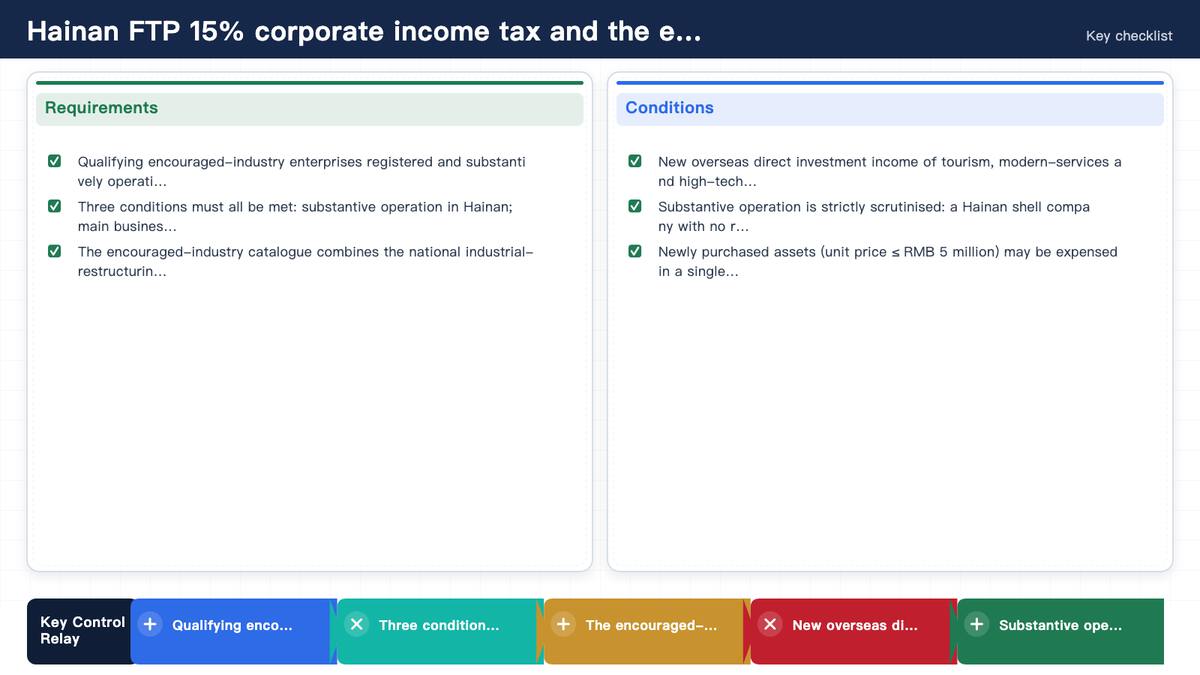
- Qualifying encouraged-industry enterprises registered and substantively operating in the Hainan FTP pay corporate income tax at a reduced 15% rate, extended through 31 December 2027 by Caishui [2025] No. 3.
注册在海南自贸港并实质性运营的鼓励类产业企业减按15%税率征收企业所得税,依据财税〔2025〕3号延续至2027年12月31日。- Three conditions must all be met: substantive operation in Hainan; main business in an encouraged-industry catalogue item; and encouraged-industry main-business revenue ≥ 60% of total revenue in the year.
须同时满足三项条件:在海南实质性运营;主业属于鼓励类产业目录项目;当年鼓励类主营业务收入占收入总额60%以上。- The encouraged-industry catalogue combines the national industrial-restructuring catalogue, the foreign-investment encouraged catalogue, and the Hainan FTP added catalogue; the Hainan-added list alone exceeds 1,100 items and was expanded to 1,249 items in the 2025 edition.
鼓励类目录由产业结构调整指导目录、鼓励外商投资产业目录与海南自贸港新增鼓励类产业目录共同构成;仅海南新增目录即超1100条,2025年版扩容至1249条。- New overseas direct investment income of tourism, modern-services and high-tech enterprises is exempt from CIT for investments made in 2020–2027.
旅游业、现代服务业、高新技术企业2020—2027年间新增境外直接投资所得免征企业所得税。- Substantive operation is strictly scrutinised: a Hainan shell company with no real staff, assets or decision-making on the island will be denied the benefit.
实质性运营受到严格审核:仅在海南设空壳公司、无实际人员资产与决策的机构将被否决优惠。- Newly purchased assets (unit price ≤ RMB 5 million) may be expensed in a single year or accelerated; the policy is claimed at provisional filing and annual settlement, with records kept for inspection.
新购置单价不超过500万元的资产可一次性税前扣除或加速折旧;优惠在预缴与汇算清缴时享受,留存备查。
Hainan FTP 15% corporate income tax and the encouraged-industry catalogue | 海南自贸港企业所得税15%优惠与鼓励类产业目录实务
Overview
The “dual 15%” tax regime is the centrepiece of Hainan FTP’s low-tax pillar. For foreign-invested enterprises, the 15% corporate income tax (CIT) rate — versus the standard 25% national rate — is the single most material saving, but it is conditional. Eligibility turns on two things a foreign group can control: choosing a business that sits in the encouraged-industry catalogue, and building substantive operation in Hainan. This article explains the mechanics, the catalogue, and the 2026 compliance posture.
Market context
Hainan’s CIT preference is set against China’s standard 25% rate and sits within a broader “low tax rate, simplified tax system” design. The preference was first introduced for 2020–2024 and, by Caishui [2025] No. 3 (*Circular on Continuing the Hainan FTP Enterprise Income Tax Preferences*), extended through 31 December 2027 — giving foreign investors a stable, multi-year horizon. The Hainan Provincial Tax Bureau has issued implementing guidance (effective 1 January 2025 to 31 December 2027) clarifying filing and substantiation.
Key 2026 developments
Eligibility — the three conditions. A beneficiary is an enterprise registered in the FTP (including a resident enterprise, a branch established in Hainan, or a non-resident enterprise establishment/place in Hainan) that:
- conducts substantive operation in the FTP;
- takes an encouraged-industry catalogue item as its main business; and
- earns encouraged-industry main-business revenue of at least 60% of total revenue in the year.
Total revenue includes sales, services, property transfers, dividends and all other income types. The 60% threshold is hard — a mixed operator (e.g. marine ecological restoration plus ordinary construction) must actually derive the majority of income from the encouraged activity.
The catalogue. “Encouraged industries” means the intersection of three documents: the *Catalogue for Guiding Industrial Restructuring*, the *Catalogue of Industries Encouraging Foreign Investment*, and the *Hainan FTP Added Encouraged-Industry Catalogue*. The Hainan-added list alone exceeds 1,100 items and, under the 2025 edition implemented in 2026, was expanded to 1,249 items, reaching into biomedical, offshore wind, NEVs, commercial space launch, international education, high-standard farmland, and modern services. Recent additions of note include expanding “yacht design, manufacture, assembly and repair”; adding space food, space biomedicine and space medical research; and new modern-services entries such as metaverse R&D, international air-freight services, and drug non-clinical safety evaluation.
Substantive operation is real. Tax authorities verify that the entity has a registered address in Hainan, an actual operating organisation, personnel and assets matching its business, and that business decisions and financial accounting are conducted in Hainan. A shell company — registered but with core team and operations offshore — fails. Verification checks payroll, asset ownership and contract execution.
Overseas direct investment exemption. For tourism, modern-services and high-tech enterprises, new overseas direct investment income earned in 2020–2027 is exempt from CIT. “New” investment includes establishing overseas branches, incorporating overseas enterprises, increasing capital in existing overseas enterprises, and acquiring overseas equity. The beneficiary must belong to one of the three industries with main-business revenue ≥ 60%.
Accelerated depreciation. Newly acquired assets (unit price ≤ RMB 5 million) may be expensed in a single year or depreciated/amortised on an accelerated basis. The preference is claimed at provisional filing and annual settlement; enterprises keep supporting records rather than filing them upfront.
Claiming the benefit. Eligible enterprises enjoy the 15% rate at provisional filing and annual CIT settlement, submitting primarily retained documents: a description and evidence that the main business is on the FTP encouraged catalogue with ≥60% revenue share, and evidence of substantive operation (production/operation, personnel, finance, property control).
Practical steps
- Test the catalogue fit early — confirm your proposed main business maps to a specific encouraged-industry item across all three catalogues.
- Engineer substantive operation — locate decision-making, finance and core staff in Hainan; avoid a pass-through shell.
- Model the 60% revenue line — if you run mixed activities, structure entities so the Hainan entity’s income is predominantly encouraged.
- Plan ODIs — if in tourism/modern-services/high-tech, route new overseas investments through the Hainan entity to use the exemption.
- Use the asset expensing — for fit-out, equipment and intangibles ≤ RMB 5 million, claim one-off or accelerated treatment.
- Keep retained records — catalogue mapping, revenue split, and substantive-operation evidence must be ready for post-hoc verification.
Related reading
- Hainan FTP sealing mechanism and foreign-investor implications (see article 150).
- Hainan FTP zero-tariff lists: raw materials, equipment and transport (see article 151).
Sources
- 海南自由贸易港官方网站 — 鼓励类企业实施15%企业所得税
- 中国税务报 — 投资海南外资企业:根据最新产业目录,及时优化投资方向(2026-02-03)
- 海南省人民政府网 — 海南自贸港”两个15%”所得税政策有何吸引力(2025-12)
- 香港工业贸易署 — 国家税务总局海南省税务局关于延续实施海南自贸港企业所得税优惠政策有关问题的公告(征求意见稿,2025)
海南自贸港企业所得税15%优惠与鼓励类产业目录实务
概述
“双15%”税制是海南自贸港低税率支柱的核心。对外资企业而言,15%企业所得税率(相对全国标准25%)是最具实质意义的节税项,但它是有条件的。资格取决于外资集团可把控的两件事:选择落入鼓励类产业目录的业务,以及在海南构建实质性运营。本文解析其机制、目录与2026年合规姿态。
市场背景
海南企业所得税优惠置于全国25%标准税率背景之下,并属于”低税率、简税制”整体设计。该优惠最初适用于2020—2024年,依据财税〔2025〕3号《关于延续实施海南自由贸易港企业所得税优惠政策的通知》延续至2027年12月31日,为外资提供了稳定、多年的政策预期。海南省税务局已发布施行口径(2025年1月1日至2027年12月31日),明确申报与留存要求。
2026年核心进展
资格——三项条件。 享惠主体为注册在自贸港的企业(含居民企业、在琼分支机构、非居民企业在琼机构场所),须同时满足:
- 在自贸港实质性运营;
- 以鼓励类产业目录项目为主营业务;
- 当年鼓励类主营业务收入占收入总额60%以上。
收入总额涵盖销售货物、提供劳务、转让财产、股息红利等全部收入类型。60%为硬性门槛——混合经营者(如海洋生态修复兼普通建筑)须确有多数收入来自鼓励类活动。
目录构成。 “鼓励类产业”指三份文件的交集:《产业结构调整指导目录》《鼓励外商投资产业目录》与《海南自由贸易港新增鼓励类产业目录》。仅海南新增目录即超1100条,2026年实施的2025年版扩容至1249条,覆盖生物医药、海上风电、新能源汽车、商业航天发射、国际教育、高标准农田与现代服务业。值得关注的扩容包括:将”游艇的设计、制造、维修”扩展为”设计、制造、组装、维修”;新增航天食品、航天生物医药、航天医学研究;新增”元宇宙技术研发””国际航空货运服务””药品非临床安全评价”等现代服务条目。
实质性运营是实打实的。 税务机关核查企业注册地址在海南、有实际经营机构、配备与业务匹配的人员与资产、业务决策与财务核算在海南开展。空壳公司——仅注册而核心团队与运营在境外——将不达标。核查通过工资薪金发放、资产购置、合同执行等确认实际经营。
境外直接投资所得免税。 旅游业、现代服务业、高新技术企业2020—2027年间新增境外直接投资所得免征企业所得税。”新增”包括境外新设分支机构、新设企业、增资扩股、收购境外股权。享惠企业须属三类产业且主营业务收入占比≥60%。
加速折旧。 新购置单价不超过500万元的资产可一次性税前扣除或加速折旧摊销。优惠在预缴与汇算清缴时享受,企业留存备查而非事前报送。
享受方式。 符合条件的企业在预缴与年度汇算时按15%税率享受,主要留存资料:主营属于自贸港鼓励类目录且收入占比≥60%的说明与佐证,以及实质性运营(生产经营、人员、财务、财产管控)的说明与佐证。
实务步骤
- 尽早测试目录匹配——确认拟议主业映射到三份目录中的具体鼓励类条目。
- 构建实质性运营——将决策、财务与核心人员落在海南,避免通道型空壳。
- 测算60%收入线——若经营混合业务,应拆分实体使海南公司收入 predominantly 为鼓励类。
- 规划境外投资——若属旅游/现代服务/高新技术,通过海南主体开展新增境外投资以用足免税。
- 运用资产一次性扣除——对≤500万元的装修、设备与无形资产,申请一次性或加速处理。
- 留存备查资料——目录映射、收入拆分与实质性运营证据须随时可应事后核查。
延伸阅读
- 海南自贸港封关运作机制与对外资含义(参见150篇)。
- 海南自贸港零关税清单:原辅料、自用设备与交通工具(参见151篇)。
来源