
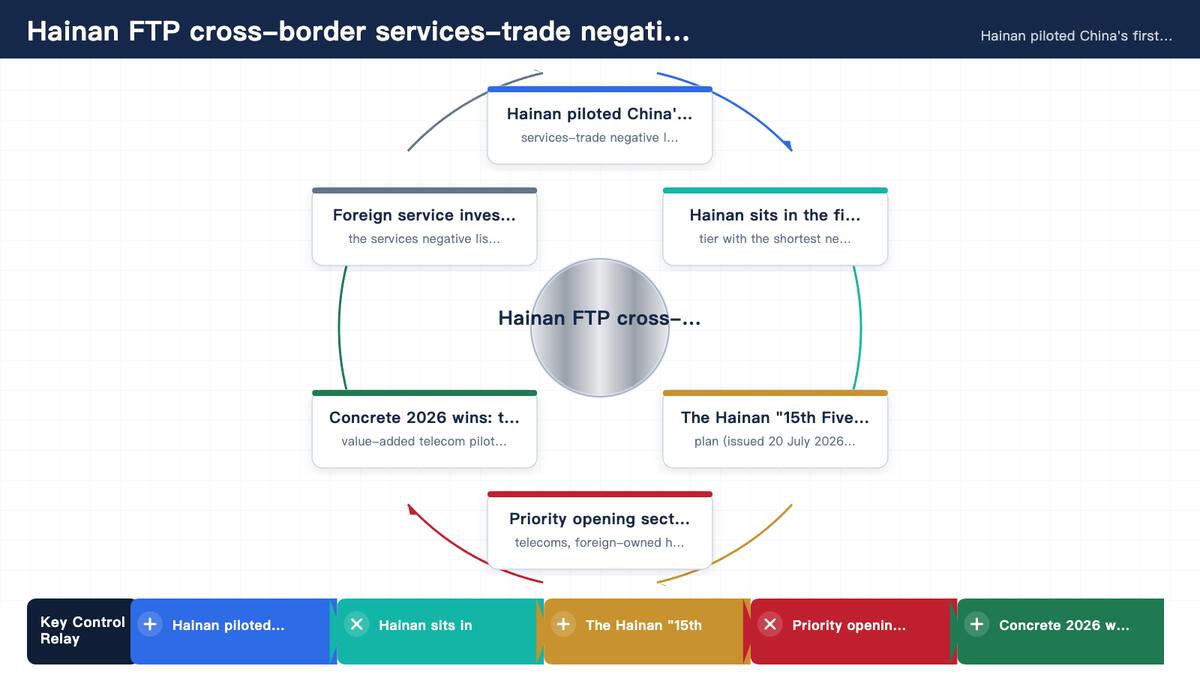
- Hainan piloted China’s first cross-border services-trade negative list in July 2021; from 1 March 2026 the revised Foreign Trade Law elevated the negative-list system for cross-border services trade into national law, reinforcing “entry unless prohibited”.
海南于2021年7月推出全国首张跨境服务贸易负面清单;自2026年3月1日起施行的新修订《对外贸易法》将跨境服务贸易负面清单管理制度上升为法律,强化”非禁即入”。- Hainan sits in the first tier with the shortest negative list and the highest degree of services openness in China, ahead of the national and pilot-FTZ versions.
海南处于第一梯队,拥有全国最短的负面清单与最高水平的服务业开放程度,优于全国版与自贸试验区版。- The Hainan “15th Five-Year” services plan (issued 20 July 2026) commits to optimising the cross-border services-trade negative list and building a national services-trade innovation demonstration zone.
海南”十五五”服务业发展规划(2026年7月20日发布)承诺优化跨境服务贸易负面清单,建设国家服务贸易创新发展示范区。- Priority opening sectors include value-added telecoms, foreign-owned hospitals, education, finance, culture and tourism, transport and cross-border data flow.
重点开放领域涵盖增值电信、外商独资医院、教育、金融、文旅、交通及跨境数据流动。- Concrete 2026 wins: three foreign-invested value-added telecom pilots licensed in Hainan; the first wholly foreign-owned hospital (Boao Fulong Cardiovascular Hospital) licensed; Switzerland’s EHL opened Hainan EHL Tourism University in September 2025.
2026年具体落地:海南获批3家外资增值电信试点;全国首家外商独资医院博鳌富隆心血管医院获批;瑞士洛桑酒店管理学院2025年9月在海南开办海南洛桑旅游大学。- Foreign service investors should pair the services negative list with the foreign-investment access negative list and the 15% tax regime to size the Hainan opportunity.
外资服务业投资者应将服务贸易负面清单与外资准入负面清单、15%税制组合运用,以评估海南机遇。
Hainan FTP cross-border services-trade negative list and foreign services opportunities | 海南自由贸易港跨境服务贸易负面清单与外资服务业机会
Overview
Services dominate foreign direct investment into China, yet services opening touches sensitive areas — finance, telecoms, data, culture — where regulation is deeper than at the border. Hainan’s distinctive contribution is the cross-border services-trade negative list (跨境服务贸易负面清单), first piloted here in July 2021 as a national first, and now codified into national law by the revised Foreign Trade Law effective 1 March 2026. For foreign service providers, Hainan offers the shortest such list in China and a live test-bed for sectors still restricted elsewhere.
Market context
China’s services-trade opening follows a clear gradient. The first tier is Hainan FTP, with the shortest negative list and the highest openness. Nationally and in pilot free-trade zones, separate cross-border services-trade negative lists apply. In addition, dedicated comprehensive services-opening pilot programmes run across 20 provinces/cities. Hainan thus combines the most liberal services-trade list with the shortest foreign-investment access negative list and the “dual 15%” tax regime — a rare package for service-sector entrants.
Key 2026 developments
Negative-list management becomes law. The revised Foreign Trade Law (effective 1 March 2026) provides that the state implements a negative-list management system for cross-border services trade conducted through cross-border delivery, overseas consumption and movement of natural persons. This lifts the “entry unless prohibited” principle to statutory status, giving foreign service suppliers stable, clear legal certainty.
Hainan “15th Five-Year” services plan. Issued on 20 July 2026, the *Hainan Services Sector 15th Five-Year Development Plan* commits to: studying optimisation of both the cross-border services-trade negative list and the foreign-investment access negative list; building a national services-trade innovation demonstration zone; and aligning with high-standard rules such as CPTPP and DEPA. Sector specifics include: telecoms (data trading and security), medical wellness (loosening institutional-cooperation and orphan-drug import limits), finance (deepening QFLP, green finance, offshore trade), commerce/culture-tourism (cross-border e-commerce, international consumption facilities), and transport (green-channel cross-border freight, multi-modal pilots).
Value-added telecoms. Beijing, Shanghai, Hainan and Shenzhen piloted removal of foreign-equity caps on value-added telecom services such as IDC. In Hainan, three foreign-invested enterprises — Dun & Bradstreet Data Technology (Hainan), Inno (Hainan) Offshore Data Investment Management, and Hainan Chuanbaoge Network Technology — have been approved as value-added telecom pilots. Nationwide, by end-2025 over 90 foreign firms had been approved for such pilots and more than 150 foreign-invested or wholly foreign-owned medical institutions operated.
Wholly foreign-owned hospitals. Nine provinces/municipalities permit wholly foreign-owned hospitals. Hainan licensed its first — Boao Fulong Cardiovascular Hospital — in 2025. The model is spreading: Tianjin’s Pengrui Li (Singapore-backed) opened China’s first wholly foreign-owned tertiary general hospital in February 2025, and Guangzhou’s Pengrui Rehabilitation Hospital is expected to open by end-2026.
Education and aviation. Switzerland’s EHL (École hôtelière de Lausanne) opened Hainan EHL Tourism University in September 2025. On aviation, Kazakhstan’s SCAT launched the Sanya–Prague route as China’s first seventh-freedom air-rights flight, illustrating Hainan’s transport liberalisation.
Openness metrics. 86 countries enjoy visa-free entry to Hainan and 176 countries/regions have invested there, underscoring the port’s pull for international services capital.
Practical steps
- Screen your service against the Hainan cross-border services-trade negative list first — it is shorter than the national version, so a service restricted elsewhere may be permissible in Hainan.
- Layer the foreign-investment access negative list — cross-border delivery (mode 1) and commercial presence (mode 3) are governed by different instruments; confirm both.
- Use the “15th Five-Year” plan sectors — telecoms, medical wellness, finance, culture-tourism, transport — as a pipeline of where pilot approvals are flowing.
- Consider the entity and tax structure — pair market access with the 15% CIT (encouraged industries) and the EF account for cross-border settlements.
- Engage pilots early — Hainan runs comprehensive opening pilots where “entry” often still needs a “licence to operate” (准入到准营); build the operating licence and staffing plan in parallel.
- Monitor the 2026 optimisation cycle — the plan explicitly commits to refining both negative lists during the 15th Five-Year period; engage in consultation where possible.
Related reading
- Hainan FTP sealing mechanism and foreign-investor implications (see article 150).
- Hainan FTP 15% corporate income tax and encouraged-industry catalogue (see article 153).
Sources
- 证券日报/证券时报 — 《对外贸易法》大修:跨境服务贸易纳入负面清单管理(2026-03)
- 中国新闻网 — 海南”十五五”进一步扩大服务业对外开放(2026-07-21)
- 金融时报 — 海南产经新观察:稳步扩开放引外资(2026-02-27)
- 中国证券报 — 政策可预见性提升 服务业开放迎新机遇(2026-06-17)
海南自由贸易港跨境服务贸易负面清单与外资服务业机会
概述
服务业占据中国吸收外资的主体,但服务业开放触及金融、电信、数据、文化等敏感领域,其监管深度远超边境。海南的独特贡献在于跨境服务贸易负面清单——2021年7月在此全国首发试点,并由2026年3月1日起施行的新修订《对外贸易法》上升为法律。对于境外服务提供者,海南提供全国最短的此类清单,并成为其他区域仍受限行业的鲜活试验场。
市场背景
中国服务贸易开放呈现清晰的梯度。第一梯队是海南自贸港,拥有最短负面清单与最高开放水平;全国与自贸试验区分别适用各自的跨境服务贸易负面清单;另有20个省市开展服务业扩大开放综合试点。海南因此将最宽松的服务贸易清单、最短的外资准入负面清单与”双15%”税制组合在一起,为服务业进入者提供了罕见的政策包。
2026年核心进展
负面清单管理入法。 2026年3月1日起施行的新修订《对外贸易法》规定,国家对境外服务提供者以跨境交付、境外消费、自然人移动模式开展的跨境服务贸易,实行负面清单管理制度。这把”非禁即入”原则提升至法律地位,赋予外资服务提供者稳定、明确的法律预期。
海南”十五五”服务业规划。 2026年7月20日发布的《海南省”十五五”服务业发展规划》提出:研究优化跨境服务贸易负面清单与外商投资准入负面清单;建设国家服务贸易创新发展示范区;对标CPTPP、DEPA等国际高标准经贸规则。细分领域包括:电信(健全数据交易与安全体系)、医疗康养(放宽机构合作限制与罕见病药品进口限制)、金融(深化QFLP试点、绿色金融、离岸贸易)、商贸文旅(优化跨境电商与国际化消费设施)、交通(打通跨境货运绿色通道、探索多式联运)。
增值电信。 北京、上海、海南、深圳试点取消IDC等增值电信业务外资股比限制。在海南,邓白氏数据科技(海南)、一诺(海南)离岸数据投资管理、海南传宝阁网络科技3家外资企业获批增值电信业务经营试点。全国层面,截至2025年底已有90多家外资企业获批增值电信试点,150余家合资及独资医疗机构运营。
外商独资医院。 9个省市允许设立外商独资医院。海南于2025年获批全国首家外商独资医院——博鳌富隆心血管医院。模式正在扩展:天津鹏瑞利(新加坡背景)2025年2月开诊中国首家外商独资三级综合医院,广州鹏瑞利康复医院预计2026年底投入运营。
教育与航空。 瑞士洛桑酒店管理学院(EHL)2025年9月在海南开办海南洛桑旅游大学。航空方面,哈萨克斯坦斯卡特航空开通三亚—布拉格航线,为全国首条第七航权航线,体现了海南的运输自由化。
开放指标。 86国享受海南免签入境,176个国家和地区在琼投资,凸显自贸港对国际服务业资本的吸引力。
实务步骤
- 先对照海南跨境服务贸易负面清单筛查你的服务——它短于全国版,他处受限的服务在海南或许可行。
- 叠加外资准入负面清单——跨境交付(模式一)与商业存在(模式三)由不同工具规制,须两者都确认。
- 善用”十五五”规划 sector——电信、医疗康养、金融、文旅、交通是试点审批流向的领域。
- 考虑实体与税制——将市场准入与15%企业所得税(鼓励类)、EF账户跨境结算组合运用。
- 尽早对接试点——海南开展综合开放试点,”准入”往往仍需”准营”;并行规划经营许可证与人员配置。
- 关注2026优化周期——规划明确承诺在”十五五”期间完善两张负面清单,可行时参与意见征询。
延伸阅读
- 海南自贸港封关运作机制与对外资含义(参见150篇)。
- 海南自贸港企业所得税15%优惠与鼓励类产业目录(参见153篇)。
来源