
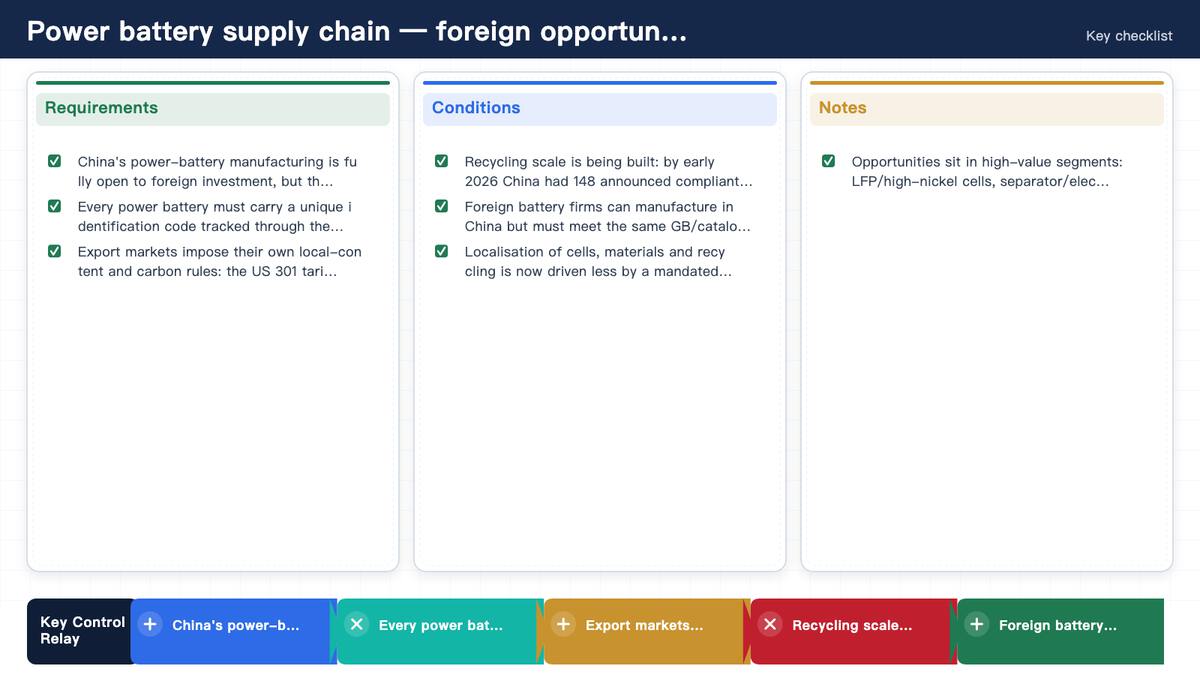
- China’s power-battery manufacturing is fully open to foreign investment, but the 2024 MIIT “Comprehensive Utilisation of End-of-Life NEV Power Batteries (2024 Edition)” norm tightens recycling, traceability and technical thresholds.
中国动力电池制造对外资完全开放,但工信部2024年《新能源汽车废旧动力电池综合利用行业规范条件(2024年本)》提高了回收、溯源与技术门槛。- Every power battery must carry a unique identification code tracked through the national traceability platform from production to retirement; producers bear extended-producer-responsibility obligations.
每块动力电池须具唯一识别编码,经国家溯源平台从生产追踪至退役;生产者承担生产者责任延伸义务。- Export markets impose their own local-content and carbon rules: the US 301 tariffs raise Chinese EV/battery duties (EVs to 100% from 2024), and the EU Battery Regulation mandates carbon-footprint declarations and a battery passport.
出口市场设有本地含量与碳规则:美国301关税上调中国电动车/电池税率(2024年起电动车达100%),欧盟新电池法要求碳足迹声明与电池护照。- Recycling scale is being built: by early 2026 China had 148 announced compliant enterprises and provincial clusters (Ganzhou, Changsha); the 2025 State Council action plan targets a standardised, efficient recovery system.
回收规模正在形成:截至2026年初中国已公告148家合规企业并形成赣州、长沙等集群;2025年国务院行动方案目标是规范化、高效回收体系。- Foreign battery firms can manufacture in China but must meet the same GB/catalogue and recycling obligations as domestic players; a non-compliant pack can block the whole vehicle’s type approval.
外资电池企业可在中国制造,但须满足与本土企业同等的GB/目录与回收义务;不合规电池包可拖垮整车准入。- Localisation of cells, materials and recycling is now driven less by a mandated JV ratio and more by cost, lead-time, and customer (OEM) ESG/sourcing requirements.
电芯、材料与回收的本地化,如今更少由强制合资比例驱动,更多由成本、交期与整车厂ESG/采购要求驱动。- Opportunities sit in high-value segments: LFP/high-nickel cells, separator/electrolyte materials, recycling and refurbishment, and battery-swap/energy-storage co-location.
机会在于高价值环节:磷酸铁锂/高镍电芯、隔膜电解液材料、回收再利用,以及换电/储能协同。
Power battery supply chain — foreign opportunities and localisation | 动力电池产业链:外资机会与本地化配套
Overview
China hosts the world’s densest and lowest-cost power-battery supply chain — from cathode and anode materials to cells, packs, BMS and recycling. For foreign battery makers and the OEMs that buy from them, the sector is legally open: there is no foreign-ownership cap on battery manufacturing, and the 2024 negative list cleared manufacturing-sector restrictions generally.
The practical question in 2026 is not “may I invest” but “how do I meet China’s tightening recycling, traceability and technical rules while competing on a supply chain that is rapidly localising and, at the same time, navigating US and EU trade and carbon barriers abroad.” This article outlines the regulatory floor, the localisation logic, and where foreign capital can still win.
The regulatory floor: type approval, catalogue and traceability
Beyond general manufacturing access, batteries sit under a specific regime. The MIIT “Roadmap”/catalogue system and battery-recycling traceability rules mean a battery pack needs type approval and a traceable recycling channel. The 2024 revision of the *Measures for Comprehensive Utilisation of End-of-Life NEV Power Batteries* (effective 1 January 2025) raises the bar further: registered capital of no less than RMB 10 million, paid-in capital of no less than RMB 5 million,梯次利用 capacity of at least 1,000 t/year and再生利用 of at least 5,000 t/year. It lifts the lithium recovery rate from ≥85% to ≥90%, adds an electrode-powder recovery rate of ≥98% and impurity caps (aluminium <1.5%), and requires R&D spend as a share of utilisation revenue.
Traceability is the part most often underestimated. Every power battery receives a unique identification code and is tracked through a national platform from production to retirement; producers (including foreign battery makers) must register and meet recycling-responsibility obligations under the extended-producer-responsibility framework. Importers of complete vehicles with batteries should confirm the pack’s approval status and coding before shipment, because a non-compliant battery can block the whole vehicle’s type approval.
Localisation logic: from mandated ratio to market pull
With the ownership cap gone, a foreign battery firm is no longer required to form a JV or to source a fixed local share. In practice, however, China’s cell, material and equipment ecosystem is the densest in the world, so most entrants localise for cost and lead-time reasons. The driver has shifted: it is no longer a legal JV ratio but customer pull — Chinese OEMs (including foreign-brand JVs) now demand fast response, local R&D presence and ESG/sourcing credentials, and they increasingly award contracts to suppliers who can iterate on China’s 12–18 month development clock.
This matters for foreign Tier-1 battery and materials suppliers. A foreign cell maker that runs its China business on a slow headquarters cycle will lose bids not because it is expensive but because it is late. The 2026 competitive edge is local decision autonomy plus speed, not price alone.
Export barriers reshape the China play
Foreign battery firms in China must also plan for destination markets. The US 301 tariff review raised duties on Chinese EVs to 100% and on lithium batteries to 25% from 2024, and the US has layered software/hardware restrictions on connected and autonomous vehicles. The EU’s Battery Regulation (in force and tightening through 2026–2027) mandates carbon-footprint declarations, a digital battery passport, and minimum recycled-content thresholds; its CBAM indirectly raises the carbon cost of steel and aluminium enclosures. China’s own export-tax-rebate step-down on batteries (a rebate cut from 9% to 6% in 2026, with a planned further move) signals a push up the value chain.
The practical response for a foreign battery investor is to separate “China-for-China” from “China-for-export.” The former leans into the local supply chain and catalogue inclusion; the latter requires carbon-accounting, passport readiness and, for the US/EU, likely local production in those regions or routing through third countries with genuine transformation.
Where foreign capital can still win
Opportunities are not in commoditised cells but in high-value, capability-intensive segments:
- Advanced materials and components — high-nickel cathodes, silicon-anode and separator/electrolyte formulations where foreign IP still leads.
- Recycling and refurbishment — the 2024 norm and 2025 State Council action plan explicitly encourage producers to build recovery systems and use recycled metal; by early 2026 China had announced 148 compliant enterprises and clusters in Ganzhou and Changsha. Foreign players with hydrometallurgy or direct-recycling IP can partner locally.
- Battery-swap and storage co-location — the 2026 halved NEV purchase tax and the separate energy-storage capacity-price mechanism (see the storage article) make pack-level services attractive.
- Testing, certification and safety — SAMR-led national standards for recycling (22 published by late 2025) create demand for conformance and quality-infrastructure services.
Common pitfalls
- Treating battery entry as pure manufacturing. Type approval, catalogue inclusion and traceability are separate gates; miss one and the pack cannot ship.
- Assuming the JV cap removal removes local-content pressure. The pressure now comes from OEMs and ESG rules, not a legal ratio.
- Underestimating recycling obligations. Extended-producer responsibility and the 90% lithium-recovery bar apply to foreign makers too.
- Ignoring export carbon rules. EU passport/CBAM and US tariffs can erase China-cost advantages on outbound packs.
- Running China on headquarters time. Slow decision cycles lose bids regardless of price.
What to do next
- Confirm the MIIT catalogue and CCC path before committing a cell or pack line; budget for GB-standard testing and coding.
- Build or partner for a compliant recycling/traceability channel — register on the national platform and meet the 2024 norm’s scale and recovery thresholds.
- Localise materials and R&D decision-making in China to match the 12–18 month OEM clock; grant the China entity real autonomy.
- Separate China-for-China from China-for-export; for the latter, stand up carbon accounting and passport readiness now.
- Scout high-value niches (materials, recycling, swap/storage, testing) rather than competing on commoditised cells.
- Track the 2025 Catalogue of Encouraged Foreign Investment Industries and local green-manufacturing incentives.
Sources
- 工业和信息化部《新能源汽车废旧动力电池综合利用行业规范条件(2024年本)》解读(2025-01-01实施):https://policy.mofcom.gov.cn/claw/policyInfo.shtml?id=6971
- 国家市场监督管理总局(SAMR)门户网站 — 动力电池回收利用国家标准:https://www.samr.gov.cn
- 国家发展改革委(NDRC)门户网站 — 循环经济与绿色制造:https://www.ndrc.gov.cn
- 科技日报 — 美国对华汽车产业关税与围堵报道(2026):https://www.stdaily.com/web/gjxw/2026-05/06/content_512332.html
Related reading
- 新能源汽车整车制造准入(142-nev-manufacturing-2026)
- 智能网联汽车(自动驾驶)外资测试牌照与数据合规(144-icv-2026)
- 新型储能外资参与路径(149-storage-2026)
动力电池产业链:外资机会与本地化配套
概述
中国拥有全球最密集、成本最低的动力电池供应链——从正负极材料到电芯、电池包、BMS与回收。对国外电池企业与采购它们的OEM而言,该领域在法律上开放:电池制造无外资股比上限,2024年版负面清单整体清除了制造业限制。
2026年的实操问题不是”能否投资”,而是”在满足中国日益收紧的回收、溯源与技术规则的同时,如何在一个快速本地化的供应链上竞争,并在海外应对美欧贸易与碳壁垒”。本文勾勒监管底线、本地化逻辑,以及外资仍可胜出的位置。
监管底线:型式准入、目录与溯源
除一般制造准入外,电池另有一套制度。工信部”公告/目录”体系与电池回收溯源规则意味着,电池包须通过型式准入并具备可追溯回收渠道。2024年修订的《新能源汽车废旧动力电池综合利用行业规范条件(2024年本)》(2025年1月1日施行)进一步抬高门槛:注册资本不少于1000万元、实缴不少于500万元,梯次利用产能不低于1000吨/年、再生利用不低于5000吨/年;锂回收率由≥85%提至≥90%,新增电极粉料回收率≥98%与杂质上限(铝<1.5%),并要求研发费用占综合利用业务收入的比例。
溯源是最常被低估的一环。每块动力电池具唯一识别编码,经国家平台从生产追踪至退役;生产者(含外资电池企业)须登记并依生产者责任延伸框架履行回收义务。进口含电池整车者应在发运前确认电池包准入状态与编码,因为不合规电池可拖垮整车准入。
本地化逻辑:从强制比例到市场牵引
股比上限取消后,外资电池企业不再被强制组建合资或采购固定本地比例。但实践中,中国的电芯、材料与设备生态全球最密集,多数进入者为成本与交期而本地化。驱动力已转变:不再是法律上的合资比例,而是客户牵引——中国OEM(含外资品牌合资企业)如今要求快速响应、本地研发存在感与ESG/采购资质,并日益把合同授予能在中国12–18个月开发节奏上迭代的供应商。
这对国外电池与材料Tier-1至关重要。若以总部慢周期运营中国业务,丢单并非因为贵,而是因为慢。2026年的竞争优势是本地决策自主权加速度,而非仅靠价格。
出口壁垒重塑中国打法
在中国的外资电池企业还须规划目的地市场。美国301复审自2024年起将中国电动车关税提至100%、锂电池提至25%,并对智能网联与自动驾驶汽车叠加软件/硬件限制。欧盟新电池法(已生效并在2026–2027年趋严)要求碳足迹声明、数字电池护照与最低回收料比例;其CBAM通过钢铝外壳间接抬高碳成本。中国自身对电池出口退税的阶梯式下调(2026年由9%降至6%,并计划进一步退出)释放了向价值链上游迈进的信号。
对外资电池投资者的务实应对,是将”中国供中国”与”中国供出口”分开。前者依托本地供应链与目录列入;后者须具备碳核算、护照准备,且对美欧市场大概率需要在当地生产或经具备实质性转化的第三国绕道。
外资仍可胜出的位置
机会不在商品化电芯,而在高价值、能力密集的环节:
- 先进材料与部件 —— 高镍正极、硅负极及隔膜/电解液配方,外资IP仍领先。
- 回收与再利用 —— 2024年规范与2025年国务院行动方案明确鼓励生产者建立回收体系并使用再生金属;截至2026年初中国已公告148家合规企业,形成赣州、长沙集群。具备湿法冶金或直接回收IP的外资可本地合作。
- 换电与储能协同 —— 2026年购置税减半与独立的储能容量电价机制(见储能篇)使包级服务具吸引力。
- 测试、认证与安全 —— 市场监管总局主导的回收国标(2025年底已发布22项)催生对合规与质量基础设施服务的需求。
常见误读
- 把电池进入当作纯制造。 型式准入、目录列入与溯源是分立闸门;漏掉一项电池包便无法出货。
- 以为取消股比即消除本地含量压力。 压力如今来自OEM与ESG规则,而非法律比例。
- 低估回收义务。 生产者责任延伸与90%锂回收门槛同样适用于外资企业。
- 忽视出口碳规则。 欧盟护照/CBAM与美国关税可抹平中国成本优势。
- 以总部节奏运营中国。 慢决策周期无论价格如何都会丢单。
下一步建议
- 在落子电芯或电池包产线前,确认工信部目录与CCC路径;为GB标准测试与编码预留预算。
- 建设或合作合规的回收/溯源渠道——在国家平台登记,并满足2024年规范的规模与回收门槛。
- 在中国本地化材料与研发决策,以匹配12–18个月OEM节奏;赋予中国实体真实自主权。
- 区分中国供中国与中国供出口;对后者,立即建立碳核算与护照准备。
- 瞄准高价值利基(材料、回收、换电/储能、测试),而非在商品化电芯上竞争。
- 关注2025年版《鼓励外商投资产业目录》与地方绿色制造激励。
来源
- 工业和信息化部《新能源汽车废旧动力电池综合利用行业规范条件(2024年本)》解读(2025-01-01实施):https://policy.mofcom.gov.cn/claw/policyInfo.shtml?id=6971
- 国家市场监督管理总局(SAMR)门户网站 — 动力电池回收利用国家标准:https://www.samr.gov.cn
- 国家发展改革委(NDRC)门户网站 — 循环经济与绿色制造:https://www.ndrc.gov.cn
- 科技日报 — 美国对华汽车产业关税与围堵报道(2026):https://www.stdaily.com/web/gjxw/2026-05/06/content_512332.html
相关阅读
- 新能源汽车整车制造准入(142-nev-manufacturing-2026)
- 智能网联汽车(自动驾驶)外资测试牌照与数据合规(144-icv-2026)
- 新型储能外资参与路径(149-storage-2026)