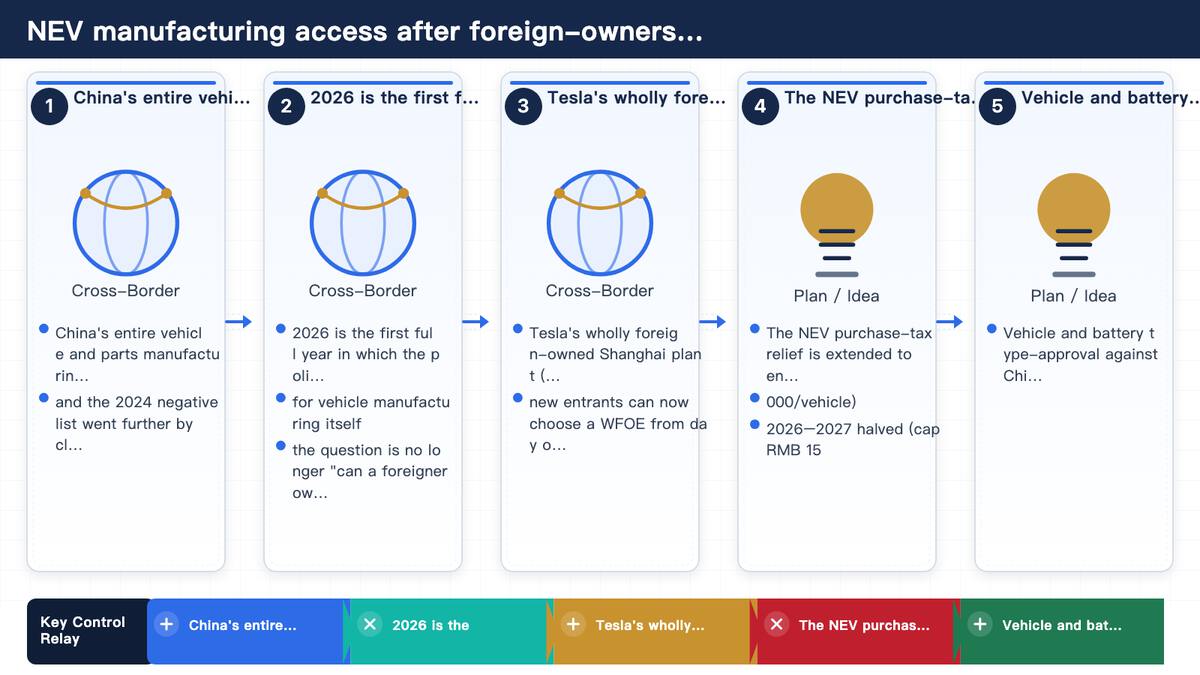
- China’s entire vehicle and parts manufacturing chain has been open to foreign investment without equity caps since 1 January 2022, and the 2024 negative list went further by clearing all manufacturing restrictions (“manufacturing zeroed-out”).
自2022年1月1日起,整车与零部件全链条已对外资开放、不设股比上限;2024年版负面清单进一步清除制造业全部限制(”制造业清零”)。- 2026 is the first full year in which the policy focus has shifted from opening manufacturing to “access-plus-operation” in services; for vehicle manufacturing itself, the question is no longer “can a foreigner own it” but “how to operate competitively.”
2026年是政策重心由制造业开放转向服务业”既准入又准营”的首个完整年度;对整车制造本身,问题已不是”外资能否控股”,而是”如何具竞争力地运营”。- Tesla’s wholly foreign-owned Shanghai plant (operational since 2020) and BMW’s 75% control of its Chinese JV (effective 2022) are the templates; new entrants can now choose a WFOE from day one.
特斯拉上海全资工厂(2020年投产)与宝马对中国合资企业75%控股(2022年生效)已成为范本;新进入者可一开局即选择外商独资企业。- The NEV purchase-tax relief is extended to end-2027: 2024–2025 fully exempt (cap RMB 30,000/vehicle), 2026–2027 halved (cap RMB 15,000/vehicle).
新能源汽车购置税减免延续至2027年底:2024–2025年全免(每辆乘用车上限3万元),2026–2027年减半(上限1.5万元)。- Vehicle and battery type-approval against Chinese GB standards (CCC + MIIT announcement/catalogue) remains mandatory and is not substituted by UN/ECE or US approval.
依中国GB标准的车辆与电池型式准入(CCC+工信部公告/目录)仍为强制,UN/ECE或美国批准不能替代。- Adjacent auto activities — mapping, connected-vehicle data, and certain telecom/ICT services — still face ownership or licensing limits under the negative list and sector rules.
汽车相邻业务——地图测绘、智能网联汽车数据及部分电信/ICT服务——在负面清单与行业规则下仍受股比或许可限制。- China is increasingly used as an export base; a WFOE plant can serve both the domestic market and third-country exports, but US and EU trade barriers reshape the destination mix.
中国日益被用作出口基地;外商独资工厂可同时服务国内与第三国市场,但美欧贸易壁垒重塑了目的地组合。
NEV manufacturing access after foreign-ownership liberalisation | 外资股比放开后的新能源汽车整车制造准入
Overview
China is the world’s largest car market and the global leader in new-energy vehicles (NEVs — battery electric, plug-in hybrid, and fuel-cell vehicles). For foreign carmakers, the single most important structural change of the last decade was the staged removal of the joint-venture (JV) foreign-ownership cap, completed on 1 January 2022. Since then the entire vehicle and parts chain has been open to foreign investment without equity limits. The 2024 negative list then deleted the last manufacturing restrictions, achieving a de facto “manufacturing zeroed-out” position.
This article reviews the opening trajectory, the post-liberalisation market structure in 2026, the incentive backdrop (notably the 2026–2027 halved NEV purchase tax), and the boundaries that ownership liberalisation did not remove — data, mapping and telecom. It is informational; confirm current policy detail with qualified PRC advisers.
From JV caps to a manufacturing-cleared market (2018–2024)
China’s automotive opening was staged over years. The 2018 negative-list revision began a five-year transition: foreign caps were removed on special-purpose and new-energy vehicle manufacturing in 2018, on commercial vehicles in 2020, and finally on passenger vehicles and the “at most two JVs per vehicle category” rule on 1 January 2022. Since then, the entire vehicle and parts chain is open to foreign investment without equity caps, co-led by the NDRC and MIIT; the negative list is jointly issued by the NDRC and MOFCOM.
The 2024 negative list (effective 1 November 2024) went further. It deleted the two remaining manufacturing restrictions — “publication printing must be Chinese-controlled” and the bar on certain traditional Chinese medicine preparation techniques — completing the clearance of manufacturing-sector foreign-access limits. In the words used by Chinese officials, manufacturing restrictions were “zeroed out.” For a foreign carmaker this means a WFOE plant is legally permitted from day one, with no mandatory partner and no fixed local-share requirement in the entry rule itself.
Two clarifications prevent misreading the opening. First, the lift applies to vehicle and parts manufacturing equity, not to every adjacent activity. The negative list and sector rules still govern related services such as automotive data, mapping, and certain telecom/ICT elements; a foreign entrant in those areas may still face ownership or licensing limits. Second, “no JV required” is not “no local footprint advised.” Even a wholly foreign-owned plant must satisfy local content indirectly through the supply chain to be price-competitive, and provincial investment-promotion terms, land and talent still favour entities with a real in-China operation.
2026 market structure: who owns what
The post-2022 market shows two clear templates. Tesla’s Shanghai Gigafactory, a wholly foreign-owned plant operational since 2020, demonstrated that a foreign OEM can build, certify and export from China without a local JV. BMW raised its stake in its Chinese JV to 75% (effective 2022), exercising the freed cap. Volkswagen had earlier taken full control of its JAC Volkswagen (SOL) venture in 2020. These moves were not merely financial restructurings; they re-centred product, software and export decisions inside China.
By 2026 the practical question is strategy, not permission. A foreign entrant choosing a WFOE accepts full control and full compliance responsibility; a JV with a Chinese partner still offers faster local sourcing, licensing and government-relations leverage. Many foreign brands that entered via JV decades ago are now renegotiating the balance — some buying up stakes, others deepening local R&D so that China becomes the global product-definition hub. MOFCOM has explicitly said that, with manufacturing limits cleared, the 2026 emphasis is on attracting R&D and high-end manufacturing links to China and on ensuring foreign-invested enterprises can both “access and operate” (既准入又准营) in the opened sectors.
The 2026 incentive backdrop: purchase tax and beyond
The direct NEV purchase subsidy fully exited at end-2022. Today the main national demand lever is the vehicle purchase-tax relief, extended by the Ministry of Finance, SAT and MIIT to end-2027: NEVs purchased in 2024–2025 are exempt (per-passenger-vehicle cap RMB 30,000); those purchased in 2026–2027 are taxed at half rate (cap RMB 15,000). For a 2026 buyer of a RMB 300,000 NEV, the taxable base is RMB 30,000 at 10%, the half-rate relief is RMB 1,500, so RMB 1,500 of tax is due — a material but shrinking advantage versus the 2024–2025 full exemption.
City-level licence and traffic privileges in restricted cities (Beijing, Shanghai, Guangzhou, Shenzhen and others) still carry real value, but rules differ sharply — some cities allocate separate NEV quotas, others tighten plug-in hybrids, and fuel-cell vehicles remain in demonstration phase. The dual-credit regime (average fuel-consumption and NEV credits) also binds both foreign and domestic OEMs and must be folded into any market-entry plan. Because these levers shift year to year, treat any specific rate as time-bound and verify before relying on it.
Where ownership is still not free
Liberalisation of manufacturing equity must be distinguished from liberalisation of the data and connectivity stack that rides on the vehicle. Three boundaries remain:
- Mapping and surveying. High-definition map surveying is a restricted activity; foreign ownership and cross-border map-data flows are constrained. L3+ autonomy that depends on HD maps therefore touches a sector that is not opened by the manufacturing rule.
- Connected-vehicle data. Automotive data collection, storage and cross-border transfer are governed by the data-security and personal-information regimes; a foreign OEM must plan for in-China data localisation and, where relevant, a security assessment for outbound transfer.
- Telecom/ICT elements. Certain onboard connectivity, V2X and cloud services sit in sectors with ownership or licensing limits under the negative list and the cross-border services negative list.
These are addressed in a separate article on intelligent and connected vehicles; the point here is that “I can own the factory” does not automatically mean “I can own the map, the data platform and the connectivity layer.”
Market-access paths and the export-hub angle
A foreign carmaker can (1) import vehicles as general trade (subject to tariffs, CAFC/NEV credit rules and China-unique type-approval / CCC); (2) manufacture locally via a WFOE or JV; or (3) focus on NEVs where the policy and incentive tilt is strongest. Component and battery suppliers typically set up manufacturing or R&D entities and pursue CCC and MIIT catalogue inclusion.
A newer path is the export hub: a China WFOE that serves the domestic market and also ships to third countries (Southeast Asia, the Middle East, Latin America). This works best where the destination does not impose the high US/EU barriers. The 2024–2026 US 301 tariff increases — EVs from China at 100% and lithium batteries at 25% — and the EU’s rising local-content and carbon requirements mean that, for the US and increasingly the EU, direct export from China is constrained, pushing foreign OEMs toward localising production in those regions or routing via third countries. China remains the lowest-cost, densest NEV supply base in the world, which is precisely why it is attractive as both a market and an export platform.
Common pitfalls
- Assuming the JV-cap removal opens every auto-adjacent business. Manufacturing equity is free, but data, mapping and some ICT/services tied to vehicles can still carry ownership or licensing limits.
- Believing the NEV purchase subsidy still exists. The direct subsidy exited at end-2022; today the lever is the 2026–2027 halved purchase-tax relief and city privileges, which change yearly.
- Treating overseas homologation as Chinese certification. A UN/ECE or US type-approval does not substitute for China’s CCC and MIIT vehicle-type approval against GB standards.
- Overlooking the dual-credit regime. Average-fuel-consumption and NEV-credit rules bind vehicle makers; a foreign entrant, importing or building locally, must fold credit compliance into its plan.
- Assuming wholly foreign ownership removes the need for a local footprint. Without local sourcing and a real in-China operation, cost and lead-time disadvantages usually outweigh the equity freedom.
What to do next
- Decide WFOE vs JV early — the choice drives control, compliance and government-relations exposure, not just ownership.
- Plan CCC and MIIT vehicle-type approval / NEV catalogue before any sale; budget for GB-standard testing.
- Size the business case on the 2026–2027 halved purchase-tax relief and city privileges, verified annually; assume the direct subsidy is gone.
- Separate the manufacturing question from the data/mapping/connectivity question; engage cybersecurity and surveying advisers before promising L3+ features.
- Evaluate China as an export hub but model US/EU tariff and carbon barriers into destination mix.
- Track the 2025 edition of the Catalogue of Encouraged Foreign Investment Industries (205 net new items, emphasising advanced manufacturing) for potential incentives.
Sources
- 国家发展改革委(NDRC)门户网站 — 外资准入与制造业开放政策:https://www.ndrc.gov.cn
- 商务部(MOFCOM)门户网站 — 2025年版鼓励外商投资产业目录、稳外资政策:https://www.mofcom.gov.cn
- 国务院 — 《延续和优化新能源汽车车辆购置税减免政策的公告》(2024–2027,2026–2027减半):https://www.gov.cn/zhengce/202306/content_6887717.htm
- 工业和信息化部(MIIT)门户网站 — 车辆与电池准入、双积分管理:https://www.miit.gov.cn
Related reading
- 智能网联汽车(自动驾驶)外资测试牌照与数据合规(144-icv-2026)
- 动力电池产业链外资机会与本地化配套(143-battery-supply-2026)
- 可再生能源与绿色投资激励(49-renewable-energy-green-investment)
外资股比放开后的新能源汽车整车制造准入
概述
中国是全球最大的汽车市场,也是新能源汽车(NEV,含纯电动、插电式混动与燃料电池)的全球领跑者。对外国车企而言,过去十年最重要的结构性变化,是分阶段取消合资(JV)外资股比限制、并于2022年1月1日完成。自此,整车与零部件全链条对外资开放、不再设股比上限。2024年版负面清单进一步删除制造业剩余限制,实现事实上的”制造业清零”。
本文回顾开放路径、2026年股比放开后的市场格局、激励背景(尤其是2026–2027年购置税减半),以及股权放开并未消除的边界——数据、地图与电信。本文仅为信息参考,具体政策细节请以合格中国顾问确认。
从股比限制到制造业清零(2018–2024)
中国汽车业的开放分阶段推进。2018年负面清单修订启动五年过渡:2018年取消专用车与新能源汽车外资股比限制,2020年取消商用车限制,最终于2022年1月1日取消乘用车股比及”同一类整车产品合资企业不超过两家”的限制。此后整车与零部件全链条对外资开放、不设股比上限,由发改委与工信部共同牵头,负面清单由发改委与商务部联合发布。
2024年版负面清单(2024年11月1日施行)更进一步,删除制造业仅剩的两条限制——”出版物印刷须由中方控股”与部分中药饮片炮制技术限制——完成制造业外资准入限制的清除。用官方表述,即制造业限制”清零”。对国外车企而言,这意味着外商独资企业自第一天起即合法可行,无强制伙伴、准入规则本身也无固定本地股比要求。
两点澄清可避免误读开放。其一,股比放开适用于整车与零部件制造股权,而非所有相邻活动:负面清单与行业规则仍监管汽车数据、地图测绘及部分电信/ICT要素,外资在这些领域仍可能面临股比或许可限制。其二,”无需合资”不等于”无需本地布局”:即便全资工厂,为保持价格竞争力仍须通过供应链间接满足本地配套,且地方招商引资条件、土地与人才仍向真正在华运营的实体倾斜。
2026市场格局:谁持有什么
2022年后的市场呈现两种清晰范本。特斯拉上海超级工厂作为2020年投产的外商独资企业,证明了外资OEM无需本地合资即可在中国建厂、认证与出口。宝马于2022年将其中国合资企业股比提升至75%,行使了被放开的限制。大众则早在2020年取得江淮大众(SOL)全资控制权。这些动作不只是财务重组,更把产品、软件与出口决策重新收归中国。
到2026年,实操问题已转向战略而非许可。选择WFOE的外资接受完全控制与完全合规责任;与中国伙伴合资则仍能获得更快的本地采购、牌照与政府关系杠杆。许多数十年前以合资进入的外国品牌正在重新平衡——有的增持股份,有的深化本地研发,使中国成为全球产品定义中心。商务部明确表示,制造业限制清零后,2026年的重点是吸引跨国公司将研发与高端制造环节放在中国,并保障外资企业在已开放领域”既准入又准营”。
2026激励背景:购置税及更多
新能源汽车直接购置补贴已于2022年底全面退出。当前主要全国性需求杠杆是车辆购置税减免,由财政部、税务总局与工信部延续至2027年底:2024–2025年购置的新能源汽车免征(每辆乘用车上限3万元);2026–2027年减半征收(上限1.5万元)。以2026年购买一辆30万元NEV为例,计税价3万元、税率10%,减半 relief 为1.5万元,须缴税1.5万元——相比2024–2025年全免,优势仍在但逐步收窄。
限牌城市(北京、上海、广州、深圳等)的牌照与通行优待仍具实质价值,但规则差异极大:有的城市对NEV单独配置指标,有的收紧插电混动,燃料电池车仍处示范阶段。双积分(平均燃料消耗量与新能源汽车积分)政策约束外资与本土OEM,须纳入任何市场准入计划。因这些杠杆逐年变化,任何具体税率均应视为时效性数字,引用前须核实。
股权仍未自由之处
制造股权的放开,须与搭载于车辆之上的数据与连接栈的放开区分开来。三道边界仍在:
- 地图测绘。 高精地图测绘属受限活动;外资持股与跨境地图数据流动受限。依赖高精地图的L3+自动驾驶因此触及制造业规则并未放开的领域。
- 智能网联汽车数据。 汽车数据收集、存储与跨境传输受数据安全与个人信息制度监管;外资OEM须规划数据境内本地化,并在需要时履行出境安全评估。
- 电信/ICT要素。 部分车载连接、V2X与云服务处于负面清单及跨境服务贸易负面清单下有股比或许可限制的 sector。
这些在另一篇智能网联汽车文章中详述;此处要点是”我能拥有工厂”并不自动等于”我能拥有地图、数据平台与连接层”。
准入路径与出口基地角度
外国车企可(1)以一般贸易进口车辆(须缴关税,满足CAFC/NEV积分规则,以及中国特有的型式准入/CCC);(2)通过WFOE或合资本地制造;或(3)聚焦政策与激励倾斜最明显的NEV。零部件与电池供应商通常设立制造或研发实体,并争取CCC与工信部目录列入。
一条较新的路径是出口基地:中国WFOE既服务国内市场,也向第三国(东南亚、中东、拉美)发货。这在不施加美欧高壁垒的目的地效果最佳。2024–2026年美国301关税上调——中国电动车100%、锂电池25%——以及欧盟日益提高的本地含量与碳要求,意味着对美乃至对欧的直接出口受约束,推动外资OEM在那些区域本地化生产或经第三国绕道。中国仍是全球成本最低、最密集的NEV供应链基地,正因如此,它既是市场也是出口平台。
常见误读
- 以为取消合资限制即放开所有汽车相关业务。 制造股权已自由,但车辆相关的数据、地图测绘及部分ICT/服务仍可能受股比或许可限制。
- 以为新能源车购置补贴仍在。 直接补贴已于2022年底退出;如今杠杆是2026–2027年减半的购置税减免与城市优待,且逐年变化。
- 把境外认证当作中国认证。 UN/ECE或美国型式批准不能替代中国CCC与工信部依GB标准的车辆型式准入。
- 忽视双积分。 双积分政策约束整车企业;外资以进口或本地制造整车,均须纳入积分合规。
- 以为全资即可不要本地布局。 缺乏本地采购与真实在华运营,成本与交期劣势通常盖过股权自由的好处。
下一步建议
- 尽早决定WFOE还是合资——该选择决定控制权、合规与政府关系敞口,而非仅仅是所有权。
- 在任何销售前规划CCC与工信部车辆型式准入/新能源目录;为GB标准测试预留预算。
- 以2026–2027年减半的购置税减免与城市优待为基础做商业测算,逐年核实;假定直接补贴已取消。
- 把制造问题与数据/地图/连接问题分开;在承诺L3+功能前,先对接网络安全与测绘顾问。
- 将中国视为出口基地评估,但把美欧关税与碳壁垒纳入目的地组合模型。
- 关注2025年版《鼓励外商投资产业目录》(净增205条,侧重先进制造)可能带来的激励。
来源
- 国家发展改革委(NDRC)门户网站 — 外资准入与制造业开放政策:https://www.ndrc.gov.cn
- 商务部(MOFCOM)门户网站 — 2025年版鼓励外商投资产业目录、稳外资政策:https://www.mofcom.gov.cn
- 国务院 — 《延续和优化新能源汽车车辆购置税减免政策的公告》(2024–2027,2026–2027减半):https://www.gov.cn/zhengce/202306/content_6887717.htm
- 工业和信息化部(MIIT)门户网站 — 车辆与电池准入、双积分管理:https://www.miit.gov.cn
相关阅读
- 智能网联汽车(自动驾驶)外资测试牌照与数据合规(144-icv-2026)
- 动力电池产业链外资机会与本地化配套(143-battery-supply-2026)
- 可再生能源与绿色投资激励(49-renewable-energy-green-investment)