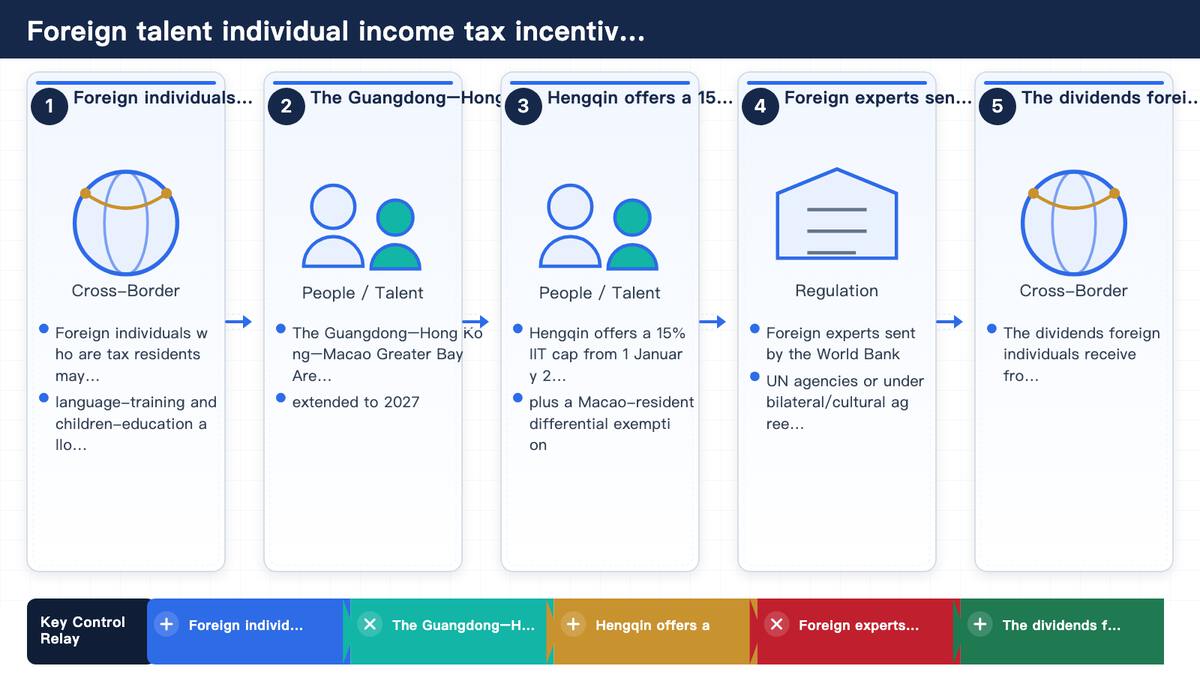
- Foreign individuals who are tax residents may choose between standard special additional deductions and the housing, language-training and children-education allowances (non-taxable) — but not both — under the延续 policy through 31 December 2027.
符合居民个人条件的外籍个人,可在专项附加扣除与住房、语言训练、子女教育等津补贴免税优惠之间择一享受(不得同时),该政策延续至2027年12月31日。- The Guangdong–Hong Kong–Macao Greater Bay Area subsidy caps the effective IIT burden of overseas high-end and urgently-needed talent at 15%, extended to 2027.
粤港澳大湾区对境外高端和紧缺人才的个税补贴,将实际税负封顶在15%,政策延续至2027年。- Hengqin offers a 15% IIT cap from 1 January 2026 to 31 December 2027 for domestic and foreign high-end/talented personnel, plus a Macao-resident differential exemption.
横琴自2026年1月1日至2027年12月31日,对境内外高端及紧缺人才个税负超15%部分免征,并对澳门居民给与税负差额免征。- Foreign experts sent by the World Bank, UN agencies or under bilateral/cultural agreements may be exempt from IIT on qualifying salary income.
由世界银行、联合国直接派往或依两国政府文化交流项目来华工作等特定外籍专家,其符合条件工资薪金可免征个税。- The dividends foreign individuals receive from FIEs remain temporarily exempt under the current foreign-individual preference framework.
外籍个人从外商投资企业取得的股息、红利所得,依现行外籍个人优惠框架暂免征收个税。- Annual IIT settlement reconciles the choice; foreign employees should model residency (183-day rule) and treaty benefits before year-end.
个税年度汇算清缴对选择进行清算;外籍员工应在年末前测算居民身份(183天规则)与协定待遇。- Employers must document the chosen regime and keep evidence, since the choice is locked for the tax year once made.
用人单位须留存所选制度证据,因该选择一经作出在一个纳税年度内不得变更。
Foreign talent individual income tax incentives in China (2026): allowances, the 15% Greater Bay Area cap and Hengqin | 2026年中国外籍人才个人所得税优惠:津补贴、大湾区15%封顶与横琴
Overview: a layered incentive map
China uses individual income tax (IIT) to attract global talent while keeping a broad base. For foreign-invested enterprises hiring expatriates, three layers matter in 2026: (1) the national foreign-individual allowance preference; (2) the Greater Bay Area (GBA) 15% cap subsidy; and (3) the Hengqin cooperative zone 15% cap. This article maps each for HR and mobility teams.
The national foreign-individual allowance preference
The Ministry of Finance and the State Taxation Administration (STA) continue the policy on foreign individuals’ housing, language-training and children-education allowances. Per the STA’s published guidance, a foreign individual who qualifies as a resident individual may choose either the special additional deductions under the IIT law or the exemption on allowances for housing, language training and children’s education under earlier notices (财税字〔1994〕020号, 国税发〔1997〕54号, 财税〔2004〕29号) — but not both. Once chosen, the election is locked for the tax year. The policy is currently in force through 31 December 2027.
Exempt items foreign individuals may claim
Under the STA’s consolidated Q&A, foreign individuals temporarily enjoy exemption on: non-cash or reimbursement-form housing, meal and relocation subsidies; reasonable business-travel subsidies (domestic/overseas); home-visit, language-training and children-education expenses; dividends/bonuses from FIEs; and, where qualifying, salary income of foreign experts sent by the World Bank, UN agencies, UN-aid projects, aid-country experts, and cultural/exchange experts whose pay is borne by the foreign government under bilateral or inter-governmental programs. These are the building blocks of a low effective rate for genuinely resident expatriates.
The Greater Bay Area 15% cap
For overseas (including Hong Kong, Macao and Taiwan) high-end and urgently-needed talent working in the GBA, the finance and tax authorities grant a subsidy equal to the IIT amount exceeding the 15% effective rate, and that subsidy is exempt from IIT. The applicable scope covers the nine Pearl River Delta cities (Guangzhou, Shenzhen, Zhuhai, Foshan, Huizhou, Dongguan, Zhongshan, Jiangmen, Zhaoqing). The policy is extended and in force through 31 December 2027 (originally 财税〔2019〕31号, extended by 财税〔2023〕34号). Employers in Guangzhou, Shenzhen and elsewhere in the GBA should confirm the local “talent list” administration.
Hengqin: a 15% cap plus a Macao differential
On 2 February 2026, the Ministry of Finance and the STA issued a notice continuing the Hengqin Guangdong–Macao Deep Cooperation Zone IIT preference. From 1 January 2026 to 31 December 2027, for domestic and foreign high-end and urgently-needed talent working in Hengqin, the portion of IIT exceeding 15% is exempted. A separate rule exempts the portion of Macao residents’ IIT exceeding the Macao tax burden. Covered income includes comprehensive income (wages, remuneration, author’s remuneration, royalties), business income, and government-recognized talent-subsidy income, enjoyed at annual IIT settlement.
Residency, the 183-day rule and treaties
Whether a foreign employee is a tax resident drives the choice above. Under the IIT law, an individual present in China for 183 days or more in a tax year is generally a tax resident (subject to treaty tie-breaker and the “six-year” rule for worldwide income). Many double-taxation agreements provide relief on salaries, dependent personal services and director fees; the STA’s treaty-benefit regime lets qualifying individuals claim reduced rates. Mobility teams should model residency and treaty positions before year-end, because the foreign-individual allowance election is annual.
Annual settlement and employer duties
The annual IIT settlement (汇算清缴) reconciles withholdings against the chosen regime and any treaty benefits. Employers must: (1) document which regime each foreign employee elected; (2) retain evidence of allowances and the talent-list determinations; (3) file and withhold correctly during the year; and (4) support the employee’s settlement. Because the election is locked per tax year, getting the choice right upfront avoids a costly reversal.
Practical steps for FIEs hiring foreign talent
- Classify each expat as resident or non-resident early in the assignment year.
- Model the two national routes (special additional deductions vs. allowances) and pick the lower-burden one.
- Check GBA / Hengqin eligibility if the role sits in Guangdong or Hengqin; pursue the talent list.
- Confirm treaty benefits where salary is treaty-covered.
- Lock the annual election and keep evidence; brief payroll.
- Plan the year-end settlement so refunds or top-ups are handled cleanly.
Related reading
Expatriate IIT compliance (residency, the 183-day rule and treaty benefits) and the GBA talent tax subsidy are covered in separate articles; this piece is the incentive map plus the action list.
2026年中国外籍人才个人所得税优惠:津补贴、大湾区15%封顶与横琴
概览:分层的激励版图
中国以个人所得税(IIT)在拓宽税基的同时吸引全球人才。对雇佣外籍员工的外资企业,2026年有三类优惠需关注:(1)全国性的外籍个人津补贴优惠;(2)粤港澳大湾区15%封顶补贴;(3)横琴合作区15%封顶。本文为人力资源与人才流动团队梳理每一项。
全国性外籍个人津补贴优惠
财政部、国家税务总局延续了外籍个人住房、语言训练、子女教育等津补贴政策。据税务总局公布的指引,符合居民个人条件的外籍个人,可选择享受个税专项附加扣除,也可选择按早期文件(财税字〔1994〕020号、国税发〔1997〕54号、财税〔2004〕29号)享受住房补贴、语言训练费、子女教育费等津补贴免税优惠,但不得同时享受。一经选择,在一个纳税年度内不得变更。该政策目前执行至2027年12月31日。
外籍个人可享的免税项目
依税务总局整合问答,外籍个人暂免征收个税的项目包括:以非现金或实报实销形式取得的住房、伙食、搬迁补贴;合理的境内外出差补贴;探亲、语言训练、子女教育费;从外商投资企业取得的股息红利;以及特定外籍专家(世界银行、联合国及其专门机构、联合国援助项目、援助国专家、两国政府文化交流项目等且报酬由外方负担者)的符合条件工资薪金。这些是真正居民外籍员工低实际税率的构成模块。
大湾区15%封顶
对在大湾区工作的境外(含港澳台)高端和紧缺人才,财政与税务部门给予补贴,该补贴免征个税,使实际税负不超过15%。适用范围涵盖珠三角九市(广州、深圳、珠海、佛山、惠州、东莞、中山、江门、肇庆)。政策经延续,执行至2027年12月31日(原财税〔2019〕31号,经财税〔2023〕34号延续)。广州、深圳及大湾区其他城市的用人单位应确认当地”人才清单”管理口径。
横琴:15%封顶外加澳门差额
2026年2月2日,财政部、国家税务总局印发通知,延续横琴粤澳深度合作区个人所得税优惠政策。自2026年1月1日至2027年12月31日,对在该区工作的境内外高端和紧缺人才,其个税负超过15%的部分予以免征;另对澳门居民个税负超过澳门税负的部分予以免征。涵盖所得包括综合所得(工资薪金、劳务报酬、稿酬、特许权使用费)、经营所得及地方政府认定的人才补贴性所得,于年度汇算时享受。
居民身份、183天规则与协定
外籍员工是否构成”居民个人”决定上述选择的适用。依个税法,一个纳税年度内在中国境内居住累计满183天的个人一般为居民(受协定加比规则及”六年规则”影响)。多项税收协定对薪金、独立个人劳务、董事费等给予减免;税务总局协定待遇机制使符合条件者适用低税率。人才流动团队应在年末前测算居民身份与协定立场,因为外籍个人津补贴选择按年锁定。
年度汇算与雇主义务
个税年度汇算清缴按所选制度及协定待遇对预缴进行清算。用人单位须:(1)记录每位外籍员工所选制度;(2)留存津补贴与人才清单认定的证据;(3)年度内正确扣缴申报;(4)协助员工汇算。因选择按年锁定,事前选对可避免 costly 的逆转。
外资企业雇佣外籍人才的实操步骤
- 在派遣年度早期将每位外派员工归类为居民或非居民。
- 测算两条全国路径(专项附加扣除 vs 津补贴),择实际负担更低者。
- 核查大湾区/横琴资格,角色位于广东或横琴者争取人才清单。
- 确认协定待遇,薪金受协定覆盖时适用。
- 锁定年度选择并留存证据,培训 payroll。
- 规划年末汇算,干净处理退税或补税。
延伸阅读
外籍员工个税合规(居民身份、183天规则与协定待遇)与大湾區人才税补贴本站另有专文;本文为优惠版图加行动清单。
Sources