
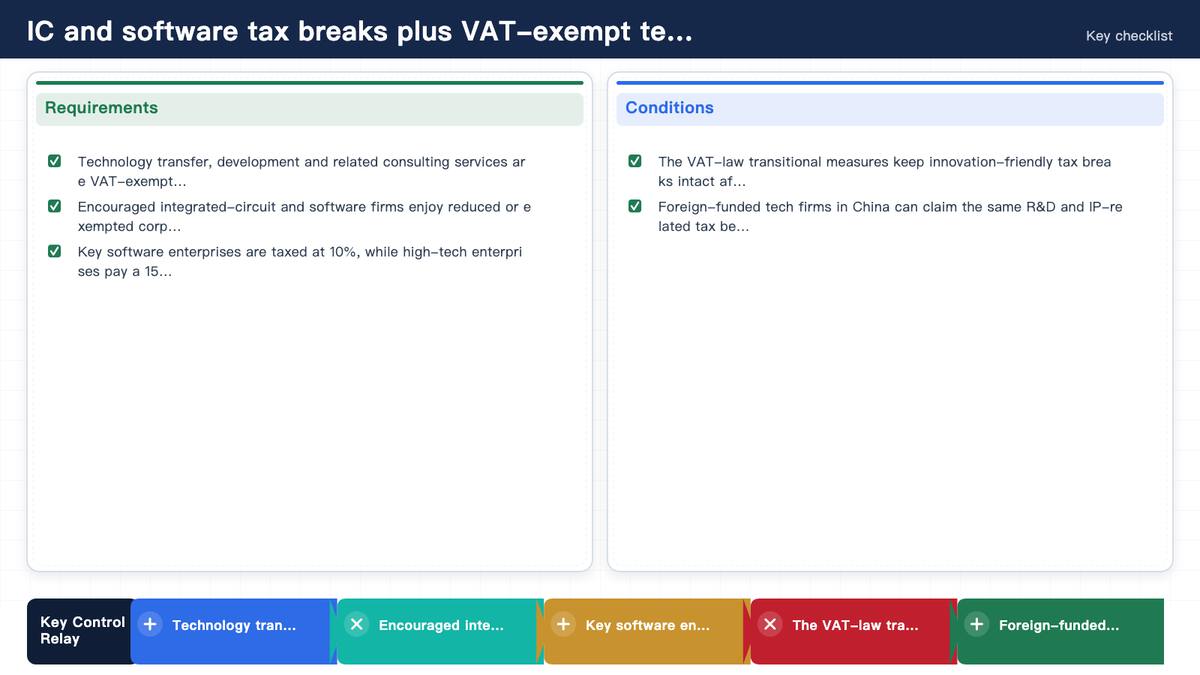
- Technology transfer, development and related consulting services are VAT-exempt from 1 January 2026 to 31 December 2027. 技术转让、技术开发及相关咨询服务在2026年1月1日至2027年12月31日期间免征增值税。
- Encouraged integrated-circuit and software firms enjoy reduced or exempted corporate income tax. 国家鼓励的集成电路与软件企业享受企业所得税减免。
- Key software enterprises are taxed at 10%, while high-tech enterprises pay a 15% preferential rate. 重点软件企业适用10%税率,高新技术企业适用15%优惠税率。
- The VAT-law transitional measures keep innovation-friendly tax breaks intact after the VAT Law takes effect. 增值税法过渡性措施在增值税法施行后保留了鼓励创新的税收优惠。
- Foreign-funded tech firms in China can claim the same R&D and IP-related tax benefits. 在华外资科技企业可同等享受研发与知识产权相关的税收优惠。
IC and software tax breaks plus VAT-exempt technology transfer | 集成电路软件税收优惠与技术转让免征增值税
China has layered a set of tax incentives to support the integrated-circuit (IC) and software industries, and in 2026 it extended the VAT exemption for technology transfer and development. For foreign investors building R&D, design or licensing operations in China, these breaks are directly usable and worth structuring around.
Overview
Two tax tracks matter most for technology firms:
- Value-added tax (VAT) exemption on technology transfer, technology development, and the related technical consulting and technical services.
- Corporate income tax (CIT) incentives for encouraged IC and software enterprises, plus the general 15% rate for high-tech enterprises.
Both tracks are open to foreign-funded enterprises (FIEs) established in China, provided they meet the substantive requirements (genuine R&D, qualified contracts, proper filing).
VAT exemption under the 2026 transitional measures
The Ministry of Finance and State Taxation Administration Announcement No. 10 of 2026 sets out transitional measures linked to the coming into force of the VAT Law. For the period 1 January 2026 to 31 December 2027, the following are exempt from VAT:
- Transfer of technology (technology transfer);
- Technology development (commissioned or cooperative R&D that yields new technology);
- Related technical consulting and technical services directly associated with the above.
This exemption preserves the long-standing “four-tech” VAT exemption (technical transfer, technical development, and related technical consulting/services) that would otherwise have been recast by the new VAT Law. Claimants generally must register the technology contract with the local science and technology authorities and obtain a tax exemption filing or record from the tax office.
Practical points for foreign firms
- Licensing IP into China, or providing development services from a Chinese entity, can fall within the exemption if the contract qualifies.
- Pure trading of goods, or services not “technical” in nature, is out of scope.
- Keep contract wording aligned with the catalog definitions and obtain the local S&T bureau record.
CIT incentives for IC and software
Encouraged IC design, equipment, materials, packaging/testing, and software enterprises have historically enjoyed a “two years exempt, three years half” CIT holiday (exempt in the first two years of profitability, 50% reduced in the following three). Specific measures such as Cai Shui [2020] No. 45 and related documents continue to apply, subject to the encouraged-industry catalog and qualifying conditions (e.g., core business share, R&D intensity, staff qualifications).
Key software enterprises
“Key” (national-priority) software enterprises that satisfy the catalog and qualification rules are taxed at a reduced 10% CIT rate once recognized.
High-tech enterprises
Regardless of IC/software status, enterprises recognized as High and New Technology Enterprises (HNTE) pay a preferential 15% CIT rate (versus the standard 25%). Recognition requires core自有 IP, R&D spend thresholds, and revenue composition rules.
| Incentive | Rate / benefit | Typical eligibility |
|---|---|---|
| VAT exemption (tech transfer & development) | 0% VAT | Qualified tech contract, S&T record |
| Encouraged IC / software CIT holiday | 0% (Y1–2), 12.5% (Y3–5) | Encouraged-industry catalog, substance |
| Key software enterprise | 10% CIT | Priority catalog + recognition |
| High-tech enterprise (HNTE) | 15% CIT | HNTE recognition, R&D intensity |
Why this matters for market entry
Foreign technology companies often hesitate to localize IP or R&D in China for tax or control reasons. The combination above lowers the effective tax cost of:
- Setting up a Chinese R&D center that licenses back to group;
- A Chinese software/IC design entity selling qualified products;
- Cross-border technology development contracts executed through a Chinese vehicle.
Because the VAT exemption is time-bound to end-2027, firms should plan contract timing and filings early. The CIT incentives are longer-lived but catalog-dependent, so eligibility should be confirmed with advisers before relying on them.
Sources
- Shanghai Tax “2366” Guide (上海税务) — 2026-02 guide citing 财政部 税务总局公告2026年第10号 (VAT-law transitional measures / 技术转让与技术开发免征增值税).
- State Taxation Administration (国家税务总局) — homepage; search 财政部 税务总局公告2026年第10号 for the official announcement text.
集成电路软件税收优惠与技术转让免征增值税
中国针对集成电路(IC)与软件产业构建了多层税收优惠体系,并于2026年延续了技术转让与技术开发的增值税免征政策。对于计划在中国设立研发、设计或许可业务的外国投资者而言,这些优惠可以直接适用,值得围绕其进行税务架构设计。
概述
科技类企业最需要关注两条税收主线:
- 增值税(VAT)免征:覆盖技术转让、技术开发及其相关技术咨询、技术服务。
- 企业所得税(CIT)优惠:面向国家鼓励的集成电路与软件企业,以及普遍适用高新技术企业的15%优惠税率。
两条主线均对外商投资企业(FIE)开放,前提是满足实质性要求(真实研发、合格合同、规范备案)。
2026年过渡性措施下的增值税免征
财政部、国家税务总局公告2026年第10号针对增值税法施行出台了过渡性措施。在2026年1月1日至2027年12月31日期间,以下项目免征增值税:
- 技术转让;
- 技术开发(委托或合作研发形成新技术);
- 与上述活动直接相关的技术咨询、技术服务。
该免征政策保留了原有”四技”(技术转让、技术开发及相关技术咨询、技术服务)增值税免税待遇,使其不因增值税法重构而中断。享受方通常须将技术合同在当地科技主管部门登记,并向税务机关办理免税备案或申报。
外资企业实操要点
- 向中国许可知识产权,或以中国主体提供开发服务,若合同合格,可纳入免征范围。
- 单纯的货物贸易或非”技术性”服务不在范围内。
- 合同措辞应与目录定义保持一致,并取得科技部门登记。
集成电路与软件的所得税优惠
国家鼓励的集成电路设计、装备、材料、封装测试及软件企业,历史上享受”两免三减半“企业所得税优惠(获利年度起前两年免征,后三年减半)。财税〔2020〕第45号等文件继续适用,但须满足鼓励类产业目录及资格条件(如主营业务占比、研发强度、人员资质)。
重点软件企业
符合目录与认定规则的国家规划布局内重点软件企业,经认定后减按10%税率征收企业所得税。
高新技术企业
无论是否属于IC/软件行业,经认定的高新技术企业(HNTE)统一适用15%优惠税率(标准税率为25%)。认定要求包括核心自主知识产权、研发费用占比及收入结构等规则。
| 优惠类型 | 税率 / 待遇 | 典型资格条件 |
|---|---|---|
| 增值税免征(技术转让与开发) | 0% 增值税 | 合格技术合同、科技登记 |
| 鼓励类IC/软件所得税优惠 | 0%(前2年)、12.5%(后3年) | 鼓励类目录、实质性经营 |
| 重点软件企业 | 10% 所得税 | 重点目录 + 认定 |
| 高新技术企业(HNTE) | 15% 所得税 | HNTE认定、研发强度 |
为何对市场准入重要
外国科技企业常因税收或控制顾虑而不愿将知识产权或研发本地化。上述组合降低了以下安排的有效税负:
- 设立中国研发中心并向集团许可技术;
- 中国软件/IC设计实体销售合格产品;
- 通过中国主体执行跨境技术开发合同。
由于增值税免征具有时间限制(至2027年底),企业应尽早规划合同时点与备案。所得税优惠存续更久但依赖目录,依赖前应与顾问确认资格。
来源
- 上海税务”2366″指引 — 2026年2月指引,引述财政部、税务总局公告2026年第10号(增值税法过渡性措施/技术转让与技术开发免征增值税)。
- 国家税务总局 — 官网首页;以”财政部 税务总局公告2026年第10号”检索公告原文。