
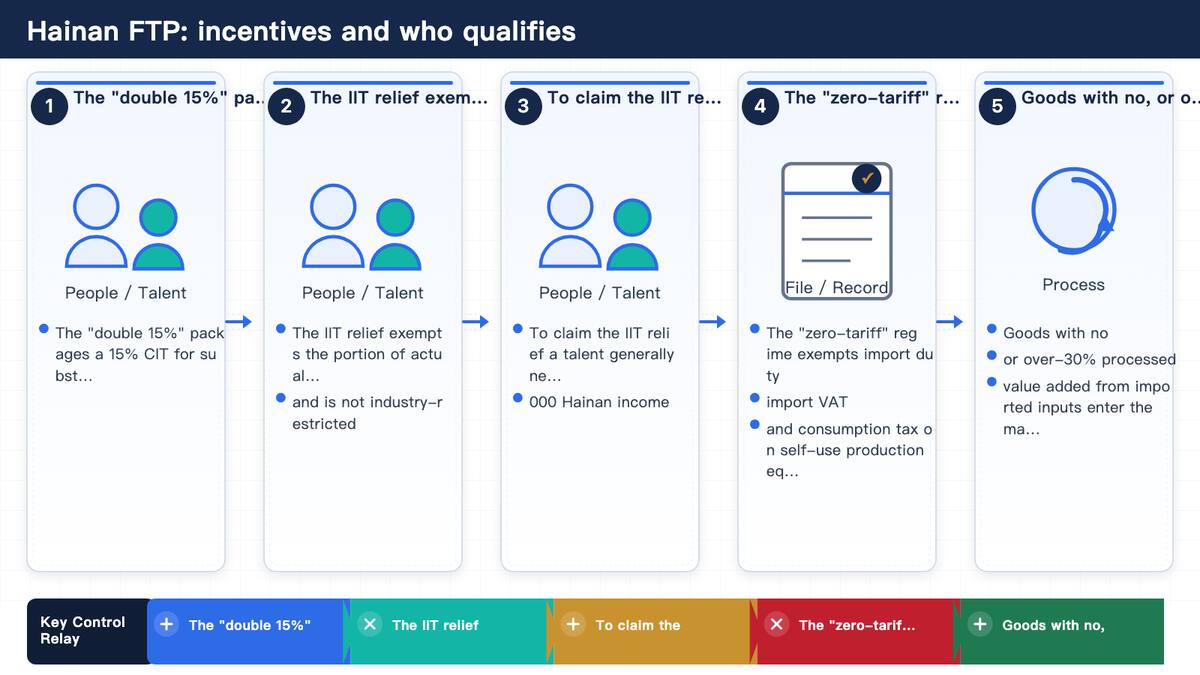
- The “double 15%” packages a 15% CIT for substantively-operating encouraged-industry enterprises with a 15% individual income tax (IIT) cap for qualifying talents.
双 15% 将由注册并实质性运营的鼓励类企业适用的 15% CIT,与面向符合条件人才的 15% 个人所得税(IIT)上限打包。- The IIT relief exempts the portion of actual tax burden above 15% for high-end/urgently-needed talents, and is not industry-restricted.
个税优惠对高端及紧缺人才实际税负超过 15% 的部分予以免征,且不设行业限制。- To claim the IIT relief a talent generally needs 183 cumulative Hainan residence days (with a 90-day actual minimum) plus recognition or over RMB 300,000 Hainan income.
享受个税优惠通常需海南年累计居住满 183 天(实际居住不少于 90 天),并获人才认定或海南年收入超 30 万元。- The “zero-tariff” regime exempts import duty, import VAT, and consumption tax on self-use production equipment, business vehicles/yachts, and raw materials.
零关税制度对自用生产设备、营运用交通工具及游艇、原辅料免征关税、进口增值税与消费税。- Goods with no, or over-30% processed, value added from imported inputs enter the mainland (“second line”) exempt from import duty (VAT/consumption tax still apply).
不含或含进口料件但在海南加工增值超 30% 的货物,经二线进入内地免征进口关税(进口增值税、消费税照征)。- The headline incentives (CIT/IIT relief, zero-tariff, ODI exemption) currently run through 31 December 2027, with a 3%/10%/15% IIT design contemplated from 2028.
标志性优惠(CIT/IIT 优惠、零关税、境外直接投资免税)目前执行至 2027 年 12 月 31 日,2028 年起拟实施 3%/10%/15% 三档个税。- Corporate preferences turn on Hainan registration plus substantive operation; a shell without real operations qualifies for none of them.
企业类优惠取决于海南注册加实质性运营;无真实运营的壳公司一概不符合条件。- The reliefs are self-assessed, not auto-granted—track each talent’s residence days and verify items against the latest customs zero-tariff list.
各项优惠为自行判别而非自动授予——须逐人跟踪居住天数,并对照海关最新零关税清单核验货物。
Hainan FTP: incentives and who qualifies | 海南自贸港:优惠与适用对象
Overview
Beyond the 15% corporate income tax (CIT) rate discussed in the companion article, the Hainan Free Trade Port (FTP) deploys a broader incentive package that is central to its pitch to foreign investors: a parallel 15% individual income tax (IIT) relief for qualifying talents, duty-free import of production equipment, transport vehicles, yachts, and raw materials, and a cluster of supporting preferences. Collectively marketed as the “double 15%” (双15%) plus “zero-tariff” (零关税) package, these measures are designed to lower both the corporate cost base and the personal tax burden of the people who run and staff an FTP operation. This article maps the package, who actually qualifies, and how the preferences fit together.
Like the CIT preference, the headline incentives are time-bound. The individual tax relief, the duty-free import lists, and the ODI-income exemption are presently structured to run through 31 December 2027; the FTP’s longer-term “low-rate, simplified-system” design—including a proposed three-bracket (3%/10%/15%) IIT regime from 2028—is still being shaped. Investors should therefore treat the current package as a defined window, and design structures that remain sensible if terms evolve.
The “double 15%” package at a glance
The “double 15%” refers to two distinct 15% reliefs. On the corporate side, encouraged-industry enterprises registered and substantively operating in the FTP pay CIT at 15% rather than 25% (see the companion article for the mechanics). On the personal side, the IIT relief targets the people a foreign business needs to attract and retain. Unlike the CIT relief, the IIT relief is not industry-restricted—qualified high-end and urgently-needed talents in any sector can benefit, which makes it relevant to headquarters, trading, services, and manufacturing operations alike.
The two reliefs are complementary: a foreign group can simultaneously lower its entity-level tax (CIT) and the take-home pay friction for expatriate and local senior staff (IIT). For talent-heavy or knowledge-intensive investors, the combined effect is often more material than either relief alone, because the IIT saving addresses the real cost of deploying people to Hainan.
Individual income tax relief for talents
For high-end and urgently-needed talents working in the FTP, the portion of individual income tax (IIT) actual tax burden exceeding 15% is exempted. The policy runs through 31 December 2027 and applies to comprehensive income and business-operation income sourced within the FTP. To qualify, a talent must generally meet two conditions: first, reside in the FTP for at least 183 cumulative days within a tax year (reasonable off-island business travel, leave, and training can count toward the cumulative total, but actual days physically present must not be fewer than 90); second, be recognised as a talent by a Hainan authority with talent-approval power, or earn more than RMB 300,000 within the FTP in the tax year. Certain sector-specific personnel (e.g., aerospace, shipping, offshore oil and gas exploration) who cannot meet the 183-day rule may still qualify if they meet the income condition and related social-insurance and employment-contract requirements.
The relief is valuable because China’s comprehensive IIT is progressive up to 45% and business-operation IIT up to 35%; the 15% effective cap materially narrows that gap for senior people. From 2028, under the FTP’s longer-term design, a three-bracket (3%/10%/15%) progressive IIT is contemplated for individuals meeting the residence condition, which would lock in a structurally lower personal tax environment.
Duty-free imports and the “zero-tariff” lists
The FTP’s “zero-tariff” (零关税) regime removes import duties and the import-stage value-added tax and consumption tax on specified imported goods used in the port. Three enterprise-facing lists are central: (i) self-use production equipment imported by enterprises is exempt from import duty, import VAT, and consumption tax; (ii) transport vehicles and yachts used for business operations are exempt; and (iii) raw and auxiliary materials used in production are exempt. In addition, island residents’ imported consumer goods are exempt under a positive list, and the离岛 (off-island) duty-free shopping allowance was raised to RMB 100,000 per person per year with an expanded product range.
Two mechanics extend the benefit. First, the “processing-value-added” rule: goods produced by encouraged-industry enterprises in the FTP that contain no imported inputs, or contain imported inputs processed in the FTP with value added of more than 30%, enter the Chinese mainland (across the “second line”) exempt from import duty (import VAT and consumption tax are still levied). Second, the zero-tariff scope is expected to widen over time as the “import-taxed goods catalogue” is adjusted. The practical saving is significant—industry estimates put the combined duty+VAT relief at roughly 20% of import cost for equipment, more where consumption tax also applies.
Who qualifies, and the post-2027 trajectory
Eligibility for the corporate preferences (15% CIT and zero-tariff) turns on Hainan registration plus substantive operation; the IIT relief turns on the talent’s residence and recognition/income conditions. The preferences are intentionally broad in sector coverage—the encouraged catalogue spans more than a thousand entries—but narrow in conduct: a shell without real operations qualifies for none of them, and the zero-tariff lists apply only to the specified goods used for the specified purposes.
Two trajectory points matter for planning. First, the current package is a defined window to 31 December 2027; the CIT and IIT reliefs are confirmed to continue to that date, and the post-2027 FTP tax system is being built toward a broadly-applied 15% CIT (for substantively-operating enterprises outside a negative list) and a three-bracket IIT. Second, the FTP’s “customs closure” (封关) changes how goods move between the island and the mainland (the “first line”/”second line” model), which affects supply-chain design for any enterprise relying on imported equipment or processing-value-added exports to the mainland. Foreign investors should model both the 2020–2027 window and the 2028+ regime before committing capital.
Worked examples and practical notes
Talent IIT in practice: a senior expatriate earning RMB 2m a year in comprehensive income would, under the standard progressive rates, face an effective rate well above 15%; under the FTP relief, only the portion of the effective burden above 15% is exempted, so take-home pay rises materially. The individual must still log 183 Hainan residence days (with a 90-day actual-minimum floor) and either hold a Hainan talent recognition or earn more than RMB 300,000 in Hainan. A group should track these conditions per person.
Zero-tariff in practice: a Hainan manufacturer imports a RMB 10m production line. Under the zero-tariff list, import duty (say 5–10%) and the 13% import VAT are waived, saving roughly RMB 1.8–2.3m at the border—capital that stays in the business. If it then processes imported inputs into finished goods with more than 30% value added and sells them into the mainland across the “second line,” import duty on the goods is also exempt (import VAT and consumption tax still apply). The supply-chain design determines the saving.
Combining the package: the same manufacturer could use the 15% CIT (if encouraged and substantive), zero-tariff imports, and the 15% IIT for its relocated specialists—three reliefs stacking. But each has its own conduct test; the group must operate genuinely in Hainan rather than merely route invoices through a shell.
Looking beyond 2027: the contemplated three-bracket IIT (3%/10%/15%) would lock in a structurally lower personal tax for residents meeting the 183-day rule, and the CIT is expected to broaden toward 15% for substantively-operating enterprises outside a negative list. Investors should therefore view the current window not as a one-off but as the first phase of a durable low-tax regime worth planning around.
A further point: the double 15% is self-assessed, not auto-granted. Talents must first obtain Hainan recognition or meet the income test before the employer can apply the relief at withholding; if residence days or status change mid-year, the relief can lapse for that individual. HR and tax should therefore maintain a live register of talent names, residence days, and income composition. Separately, the zero-tariff lists are dynamic—verify each item against the latest customs list and, for major equipment, seek an advance ruling before import—so the saving is locked in at the purchasing decision rather than lost at the border.
What to do next
- Decide early whether your China footprint should anchor in Hainan, weighing the 15% CIT, talent IIT relief, and zero-tariff imports against your sector and supply chain.
- For talent planning, track each qualifying individual’s Hainan residence days and recognition/income status so the IIT relief can be claimed cleanly.
- For imports, map which equipment, vehicles, yachts, and raw materials fall within the zero-tariff lists and structure procurement to use them.
- Consider the processing-value-added (30%) route if you intend to sell into the mainland, and model duty savings against the “second line” rules.
- Plan on the basis of the 2027 sunset and the 2028+ low-rate design; build substance in Hainan so you remain eligible under either regime.
Sources
- 海南自由贸易港官网: https://www.hnftp.gov.cn/
- 企航自贸港政策查询平台 (人才个税、零关税等): https://policy.hnftp.gov.cn/?ddtab=true
- 光明网 — 海南自贸港封关,如何影响你我他(双15%政策解读): https://news.gmw.cn/2025-12/24/content_38494826.htm
- 国家税务总局 (State Taxation Administration) official portal: https://www.chinatax.gov.cn/
Related reading
- see also: Hainan FTP preferential CIT: practice notes (16-hainan-ftp-preferential-cit)
- see also: Corporate income tax at a glance (15-corporate-income-tax-overview)
- see also: Small-scale taxpayer VAT relief (19-small-scale-taxpayer-vat-relief)
海南自贸港:优惠与适用对象
概述
除姊妹篇所述的 15% 企业所得税(CIT)外,海南自由贸易港还部署了一整套对外国投资者极具吸引力的激励组合:面向符合条件人才的、与之平行的 15% 个人所得税(IIT)优惠,以及生产设备、营运交通工具、游艇、原辅材料的免税进口,并辅以多项配套优惠。这一被统称为”双 15%”加”零关税”的政策包,旨在同时压降企业的成本底座与运营人才的个人税负。本文梳理该政策包、真正的适用对象,以及各项优惠如何协同。
与 CIT 优惠一样,这些标志性激励均有期限。个税优惠、免税进口清单与境外直接投资所得免税,目前均安排执行至 2027 年 12 月 31 日;自贸港”低税率、简税制”的长期设计——包括拟自 2028 年起实施的三档(3%/10%/15%)个税制度——仍在塑造之中。投资者应将当前政策包视为一个明确的窗口期,并设计即便条款演变仍合理的架构。
“双 15%”政策包一览
“双 15%”指两项独立的 15% 优惠。企业侧,注册并实质性运营于自贸港的鼓励类产业企业按 15% 而非 25% 缴纳 CIT(机制详见姊妹篇)。个人侧,个税优惠针对外资企业亟需引进与留住的人才。与 CIT 优惠不同,个税优惠不设行业限制——任何行业符合条件的”高端人才和紧缺人才”均可受益,因此对总部、贸易、服务与制造类运营同样 relevant。
两项优惠相互补强:外国集团可同时降低实体层面税负(CIT)与派驻海南的高管和本地核心人员的到手收入摩擦(IIT)。对人才密集或知识密集的投资者而言,二者叠加的效果往往超过单项,因为 IIT 优惠直击”派人来海南”的真实成本。
面向人才的个人所得税优惠
对在我自贸港工作的高端人才和紧缺人才,其个人所得税实际税负超过 15% 的部分予以免征。该政策执行至 2027 年 12 月 31 日,适用于来源于自贸港范围内的综合所得与经营所得。符合条件一般须同时满足两点:其一,一个纳税年度内在海南累计居住满 183 天(合理的离岛出差、休假、学习培训可计入累计天数,但实际居住天数不得少于 90 天);其二,由具有人才认定权限的海南部门认定为人才,或当一个纳税年度内在海南收入超过 30 万元人民币。对航空航天、航运、海洋油气勘探等特定行业、难以满足 183 天规则的人员,若满足收入条件并符合社保缴纳、劳动合同等要求,仍可享受。
该优惠价值显著,原因在于中国综合所得个税最高边际税率达 45%、经营所得达 35%;15% 的实际税负上限大幅缩小了高级人才的税负落差。自 2028 年起,按自贸港长期设计,拟对满足居住条件的个人实施 3%/10%/15% 三档超额累进个税,将结构性锁定更低的个人税制环境。
免税进口与”零关税”清单
自贸港”零关税”制度对岛内使用的特定进口货物免征关税及进口环节增值税、消费税。三项面向企业的清单是核心:一是企业进口自用生产设备免征关税、进口增值税与消费税;二是进口营运用交通工具及游艇免征;三是进口生产原辅料免征。此外,岛内居民购买的进境商品按正面清单免税,离岛免税购物额度上调至每人每年 10 万元并扩大品种。
两项机制延伸了优惠红利。其一,”加工增值”规则:鼓励类企业生产的、不含进口料件或含进口料件但在海南加工增值超过 30% 的货物,经”二线”进入内地时免征进口关税(进口增值税、消费税照章征收)。其二,随着”进口征税商品目录”动态调整,”零关税”范围预计持续扩大。其实际节省相当可观——业界估算设备进口环节关税+增值税合计约可降本 20%,涉及消费税的货品节省更高。
适用对象与 2027 年后走向
企业类优惠(15% CIT 与零关税)的资格取决于”海南注册 + 实质性运营”;个税优惠取决于人才的居住与认定/收入条件。优惠的行业覆盖面刻意宽泛——鼓励类目录逾千条——但行为要件严格:无真实运营的壳公司一概不符,零关税清单仅适用于”指定货物用于指定用途”。
两点走向对规划尤为关键。其一,当前政策包是至 2027-12-31 的明确窗口;CIT 与 IIT 优惠已确认延续至该日,2027 年后的自贸港税制正向”负面清单外实质性运营企业普遍 15% CIT”与三档个税方向构建。其二,自贸港”封关”改变了岛内与内地之间货物的流动方式(”一线””二线”模式),影响任何依赖进口设备或加工增值内销内地企业的供应链设计。外国投资者应在投入资本前,同时就 2020—2027 窗口与 2028+ 制度建模。
实务示例与操作要点
人才个税实务:一名年收入 200 万元的高级外籍员工,按标准超额累进税率实际税负远高于 15%;在自贸港优惠下,仅超过 15% 实际税负的部分免税,到手收入显著上升。该个人仍须满足海南居住 183 天(实际居住不少于 90 天的底线),并持有海南人才认定或海南年收入超过 30 万元。集团应逐人跟踪这些条件。
零关税实务:一家海南制造商进口价值 1,000 万元的生产线。依零关税清单,关税(约 5%–10%)与 13% 进口增值税获免,在口岸节省约 180–230 万元——资金留在企业内。若其将进口料件加工增值超过 30% 并制成产成品经”二线”销往内地,该货物进口关税亦免(进口增值税、消费税仍征)。供应链设计决定节省额。
组合运用:同一制造商可同时适用 15% CIT(若鼓励类且实质性)、零关税进口,以及为 relocated 专家适用的 15% 个税——三项叠加。但每项各有行为测试;集团须在海南真实运营,而非仅通过壳公司走账。
展望 2027 之后:拟议的三档个税(3%/10%/15%)将为满足 183 天居住规则的居民锁定结构性更低的个人税制,CIT 亦预计向”负面清单外实质性运营企业普遍 15%”拓宽。因此投资者应将当前窗口视为可长期规划的低税率制度的第一阶段,而非一次性优惠。
值得补充的是,双 15% 并非自动适用,而是”自行判别”。人才须先完成海南人才认定或满足收入标准,企业方能在代扣环节适用优惠;若个人居住天数或认定状态在中途变化,优惠可能中断。因此集团 HR 与税务应联动,将人才名单、居住天数、收入构成纳入常态化台账,避免个别人员条件缺失拖累整体享受。此外,零关税清单是动态调整的,企业不应假设某设备永久在列或永久不在列;进口前应以海关最新清单与商品税号为依据逐项核验,必要时申请预裁定。对依赖进口设备的制造企业,将”清单核验”前置到采购决策,可避免到货后被征关税与进口增值税、冲抵降本测算。整体看,海南优惠的”红利”来自多政策协同,单看任一项都不足以构成投资决定,须在商业模型中合并测算。
从投资落地节奏看,建议先以商业可行性判断行业是否落入鼓励类目录,再以人员与资产规划反推”实质性运营”的可达性,最后才谈优惠申领。顺序颠倒——先注册、后补运营——往往导致优惠落空。对于人才密集型企业,还应把个税优惠纳入薪酬包设计,使海南 offer 在总报酬上具备真实竞争力,而不仅是纸面税率低。
早规划、早举证,方能把纸面的政策红利稳稳变成企业的账面实惠,而不是停留在宣传口径。
下一步建议
- 尽早判断中国布局是否应以海南为锚点,综合权衡 15% CIT、人才 IIT 优惠与零关税进口相较于自身行业与供应链的优劣。
- 在人才规划上,逐人跟踪其在海南的居住天数及认定/收入状态,确保个税优惠可干净享受。
- 在进口方面,梳理哪些设备、车辆、游艇、原辅料落入零关税清单,并以此结构设计采购。
- 若拟销往内地,考虑加工增值(30%)路径,并对照”二线”规则测算关税节省。
- 以 2027 到期与 2028+ 低税率设计为规划基准;在海南建立实质性,确保两种制度下均符合资格。
来源
- 海南自由贸易港官网: https://www.hnftp.gov.cn/
- 企航自贸港政策查询平台(人才个税、零关税等): https://policy.hnftp.gov.cn/?ddtab=true
- 光明网 — 海南自贸港封关,如何影响你我他(双15%政策解读): https://news.gmw.cn/2025-12/24/content_38494826.htm
- 国家税务总局 (State Taxation Administration) 官方网站: https://www.chinatax.gov.cn/
相关阅读
- 见:海南自贸港企业所得税优惠实务要点(16-hainan-ftp-preferential-cit)
- 见:企业所得税概览(15-corporate-income-tax-overview)
- 见:小规模纳税人增值税优惠(19-small-scale-taxpayer-vat-relief)