
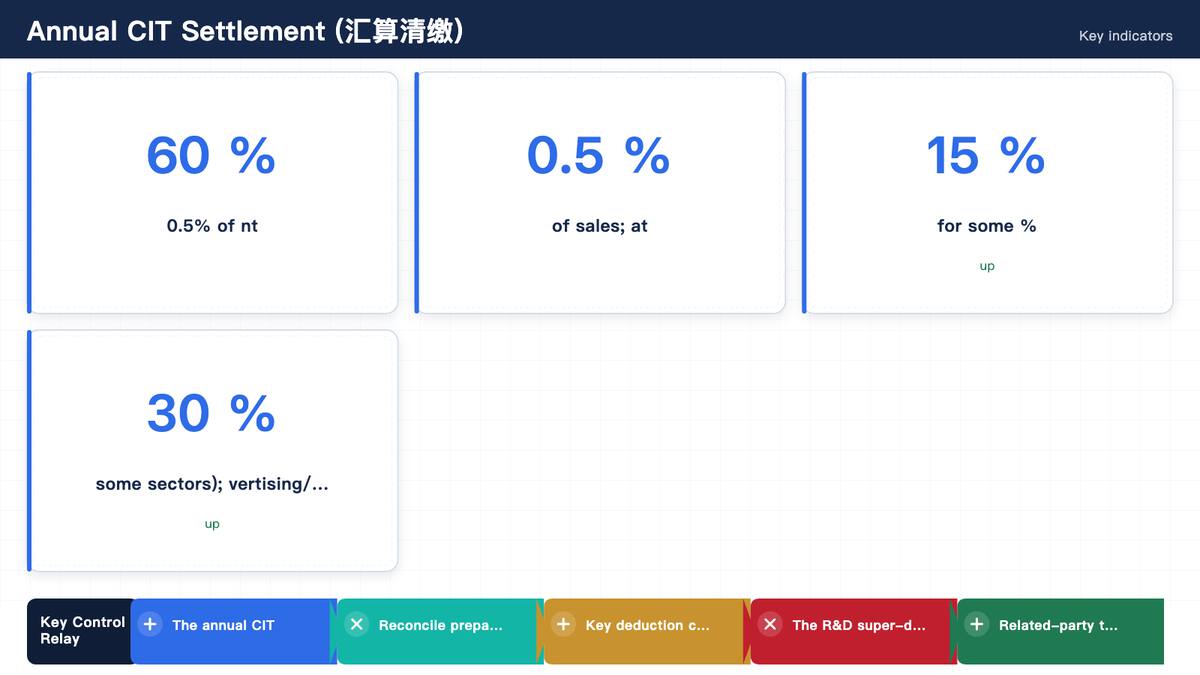
- The annual CIT settlement (汇算清缴) deadline is 31 May of the year following the tax year (e.g. the 2025 tax year by 31 May 2026) — statutory, not auto-extending, and you must file even with zero profit.
企业所得税汇算清缴截止日为次年 5 月 31 日(如 2025 税年于 2026-05-31 前);法定期限不可自动延期,即便零利润亦须申报。- Reconcile prepaid tax to the final liability on the tax-adjusted base; an overpayment is NOT auto-refunded — an explicit refund application is required, and recent rules no longer allow offset against next year’s prepayment.
应就税务调整基数对齐预缴与最终税额;多缴税款不自动退还——须 explicit 申请退税,且近期规则不再允许抵缴下年预缴。- Key deduction caps: entertainment expenses deductible at the lesser of 60% of the amount and 0.5% of sales; advertising/promotion up to 15% of sales (30% for some sectors); charitable donations capped at 12% of profit.
关键扣除限额:业务招待费按发生额 60% 与销售收入 0.5% 孰低;广告及业务宣传费不超销售收入 15%(部分行业 30%);公益性捐赠不超利润 12%。- The R&D super-deduction allows an extra 100% of qualified R&D spend, and losses carry forward five years (ten years for high-tech enterprises) to offset future taxable profit.
研发费用加计扣除可就合格研发支出再按 100% 加计扣除;亏损可向后结转五年弥补(高新技术企业十年)。- Related-party transactions must be disclosed via the affiliated report (关联申报) by 31 May across five types including non-cash/deemed transactions — any related-party deal triggers the filing even below documentation thresholds.
关联交易须于 5 月 31 日前通过关联报告披露五类交易(含非现金/视同交易);凡发生关联交易即须申报,即便未达资料阈值。- Contemporaneous-documentation thresholds: a Master File if group cross-border/total related-party deals exceed RMB 1 billion; a Local File if tangible transfers > RMB 200m, intangible > RMB 100m, or other related-party > RMB 40m (due 30 June next year).
同期资料阈值:集团跨境/关联总额超 10 亿元须主体文档;有形资产转让超 2 亿元、无形资产超 1 亿元或其他关联超 4000 万元须本地文档(次年 6 月 30 日前备妥)。- Keep the financial statements, annual CIT return and affiliated report telling the same story — mismatches trigger data-quality queries that stall the settlement and any refund.
财务报表、年度企业所得税申报表与关联报告须口径一致——不符会引发数据质量质疑,拖慢汇算乃至退税。
Annual CIT Settlement (汇算清缴) | 企业所得税汇算清缴
Overview
China’s corporate income tax (CIT, 企业所得税) is paid in monthly or quarterly instalments during the year, then trued-up once a year in the annual settlement (汇算清缴). For a WFOE this is the most important recurring compliance event: it reconciles the prepaid tax with the actual liability, finalises deductions, and — for any company with related parties — discloses those transactions and may require contemporaneous documentation. The statutory deadline is 31 May of the year following the tax year. This note explains the reconciliation, the related-party disclosure, the deadline and document set, and the practical traps.
The reconciliation mechanic
Throughout the year the company prepays CIT based on actual profit (按月/按季预缴). After the year-end, it files the annual CIT return and computes the final liability on the tax-adjusted basis: accounting profit is adjusted for non-deductible items, tax-exempt income, additional deductions (e.g. R&D super-deduction), and loss carry-forward. The result is compared with total prepayments: if prepaid exceeds the final tax, the company applies for a refund (no longer offset against next year’s tax, per recent rules); if final tax exceeds prepaid, it pays the balance by the deadline. The annual return must be filed even if the company made no profit, and the financial statements must be consistent with the tax filing.
Several itemised deductions are subject to statutory caps that repeatedly surprise first-time filers. Entertainment expenses (业务招待费) are deductible only to the lesser of 60% of the amount incurred and 0.5% of the year’s sales/revenue; advertising and promotion expenses (广告费和业务宣传费) are generally deductible up to 15% of sales (30% for cosmetics, pharmaceuticals, beverages, and certain other sectors), with the excess carried forward; charitable donations made through qualified channels are capped at 12% of the accounting profit. Conversely, the R&D super-deduction lets an eligible enterprise deduct an additional 100% of qualified R&D spend (and, in designated science-and-technology zones, more), while losses may be carried forward for five years — or ten years for high-tech enterprises — to offset future taxable profit. Building these caps and super-deductions into the reconciliation schedule early prevents the year-end scramble and avoids both over-payment and the late discovery of non-deductible items.
Related-party transaction disclosure (关联申报)
A resident enterprise under audit-collection (查账征收) that had related-party transactions during the year must, when filing the annual CIT return, also submit the Annual Affiliated Transactions Report (《中华人民共和国企业年度关联业务往来报告表(2016年版)》). The disclosure covers the five transaction types: tangible-asset transfers, financial-asset transfers, intangible-asset transfers, financing (including intra-group loans and guarantee fees), and service transactions. The threshold logic: a company with related-party dealings must file; a company with no related-party dealings and not required to file a Country-by-Country Report generally need not. The affiliated-report deadline aligns with the CIT settlement — 31 May.
The affiliated report is frequently under-filed because companies assume “no money crossed the border, so no transaction occurred.” The five categories capture non-cash and deemed transactions too: a cost-sharing arrangement, a royalty charged to the China entity by the parent, a guarantee fee, or even the China entity providing staff or services to a related party at no charge all count. The report also requires disclosure of the related parties, the pricing method, and the comparability-analysis basis — not merely the transaction amounts. Getting the legal-entity map and the intercompany-agreement inventory right before 31 May is therefore part of the compliance work, not an afterthought, and it is the foundation on which any contemporaneous documentation is built.
Contemporaneous documentation (同期资料)
Where related-party transaction amounts exceed statutory thresholds, the company must prepare contemporaneous documentation: a Master File (主体文档) for groups with cross-border related transactions or total related-party transactions over RMB 1 billion; a Local File (本地文档) when annual related-party amounts exceed set levels (e.g. tangible transfers over RMB 200 million, intangible transfers over RMB 100 million, or other related-party amounts over RMB 40 million); and a Special File for cost-sharing or thin-capitalisation cases. The Master File is due 12 months after the ultimate parent’s year-end; Local and Special Files by 30 June of the following year. Failure to maintain documentation exposes the company to transfer-pricing adjustments.
Threshold counting is where most groups go wrong. The Local File thresholds are not a single number but a per-category test: tangible-asset transfers over RMB 200 million, intangible-asset transfers over RMB 100 million, and other related-party transactions (including services and financing) over RMB 40 million each open a documentation obligation. A company can sit below every individual line and still need a Local File if the relevant category crosses its own threshold — and the test is applied per category, per year. Equally, a Master File is required where the group’s cross-border related transactions or total related-party transactions exceed RMB 1 billion, regardless of the China entity’s own size. Because the thresholds are assessed on the group’s consolidated related-party amounts, the China finance team must obtain the group intercompany schedule early rather than discovering the obligation in May.
Deadline and document set
The annual CIT settlement and the affiliated transaction report are both due by 31 May following the tax year (e.g. the 2025 tax year is settled by 31 May 2026). Filings are made through the provincial electronic tax bureau. The company should assemble: the annual CIT return and schedules, the financial statements (audit may be expected for certain FIEs and is good practice generally), the affiliated transactions report where applicable, the contemporaneous files where thresholds are met, and supporting vouchers for key adjustments (R&D, related-party charges, loss carry-forward). Corrections made within the settlement period that increase tax do not attract late-payment penalties; corrections after the period that require additional tax do.
A frequently overlooked practical point is the consistency chain across three documents: the audited (or management) financial statements, the annual CIT return, and the affiliated-transactions report must tell the same story. Tax authorities routinely cross-check the revenue, related-party balances, and expense lines across these filings, and any mismatch triggers a data-quality query that can stall the settlement and any refund. Companies should lock the year-end figures first, then populate the electronic forms from the same source data rather than re-keying from memory. Where the entity is part of a multinational group, the Master File due date (12 months after the ultimate parent’s year-end) often falls after the China settlement, so the China team should request the group’s transfer-pricing documentation early and confirm the local-file thresholds before 31 May.
Practical traps for a WFOE
- Treating the prepayment as the final obligation and skipping the settlement — late filing draws penalties.
- Related-party service fees (head-office allocations, royalties) booked without a benefit narrative or benchmarking — prime transfer-pricing risk.
- Inconsistent financial statements vs. tax return figures, which trigger queries.
- Missing the affiliated-report filing when related-party transactions occurred, even if below documentation thresholds.
- Assuming a refund is automatic — it requires an explicit application and may be netted only as the rules allow.
- Foreign-currency balances and the year-end CIT computation: translate at the appropriate rates and keep the FX trail clean.
Common pitfalls
- Treating 31 May as soft or self-extending. The deadline is statutory. An extension requires a filed application before the deadline; filing late — even by days — exposes the company to late-filing penalties and, on any additional tax, late-payment interest.
- Assuming the quarterly prepayment is the year-end obligation. The advance instalments are only a provisional payment. A separate annual return must be filed every year even with zero profit, or the company is treated as non-compliant.
- Booking intra-group service or royalty charges without a benefit test. Head-office allocations and IP fees are the top transfer-pricing risk. Without a documented benefit narrative and benchmarking, the tax authority can deny the deduction and re-price the transaction.
- Expecting the refund to arrive automatically. A CIT overpayment is not auto-refunded; the company must file an explicit refund application, and recent rules no longer allow automatic offset against next year’s prepayment.
- Conflating accounting profit with the tax-adjusted base. Failing to track non-deductible items, statutory deduction caps, super-deductions, and loss carry-forward at the ledger level produces an under- or over-stated settlement and downstream queries.
- Assuming no related-party transaction means no transfer-pricing exposure. Even where documentation thresholds are not met, any related-party transaction still triggers the affiliated-report filing; missing that filing is a standalone breach, independent of whether contemporaneous files are required.
What to do next
- Close the books early and reconcile accounting profit to the tax-adjusted base before 31 May.
- Screen every intercompany transaction for the affiliated-transaction report and the documentation thresholds.
- Prepare the Master/Local/Special files where thresholds are met, with a benefit narrative and benchmarking.
- File the annual CIT return and the affiliated report together through the electronic tax bureau by the deadline.
- Apply for any refund explicitly and keep the financial statements consistent with the filing.
Sources
- 国家税务总局 — 2025年度企业所得税汇算清缴有关事项通告(截止 2026-05-31):<http://qingdao.chinatax.gov.cn/xxgk2019/tztg/202603/t20260325_103321.html>
- 国家税务总局 — 完善关联申报和同期资料管理(2016年第42号公告):<http://hebei.chinatax.gov.cn/hbsw/xxgk/tzgg/202605/t20260506_3651276.html>
- 国家税务总局 — 非居民及跨境涉税业务办理(扣缴、对外支付备案):<https://www.chinatax.gov.cn/chinatax/c102449/c5244917/content.html>
- 国家税务总局 — 企业所得税税前扣除政策(业务招待费、广告费和业务宣传费、公益性捐赠等限额):<https://www.chinatax.gov.cn/> (official portal)
- 国家市场监督管理总局 (SAMR) — 企业信息公示与年报:<http://www.samr.gov.cn/> (official portal)
- 全国人民代表大会 — 《中华人民共和国企业所得税法》及实施条例:<http://www.npc.gov.cn/> (official portal)
Related reading
- see also: Cross-border service payments (12-cross-border-service-payments)
- see also: WFOE dissolution & deregistration (13-wfoe-dissolution-deregistration)
- see also: Registered capital under the new Company Law (10-registered-capital-new-company-law)
企业所得税汇算清缴
概述
中国企业所得税(CIT)按年分月或分季预缴,年终再进行一次汇算清繳以多退少补。对 WFOE 而言,这是最重要的周期性合规事项:它把预缴税款与最终应纳税额对齐、确定各项扣除,并对任何存在关联方的企业披露关联交易、可能需准备同期资料。法定截止日为次年 5 月 31 日。本文说明汇算机制、关联方披露、截止日与资料清单,以及实务陷阱。
汇算机制
年内企业按实际利润按月/按季预缴 CIT。年度终了后申报年度企业所得税并依税务调整口径计算最终税额:会计利润就不可扣除项、免税收入、加计扣除(如研发加计)及亏损弥补进行调整,再与全年预缴总额比较。预缴多于最终税的,申请退税(依近期规则不再抵缴下年);最终税多于预缴的,于截止日前补交。即便无利润亦须申报年度汇算,且财务报表须与申报一致。
若干按限额扣除的项目常令首次申报者措手不及。业务招待费仅按发生额的 60% 与当年销售(营业)收入的 0.5% 两者孰低扣除;广告费和业务宣传费一般按销售(营业)收入的 15% 扣除(化妆品、医药、饮料及部分行业为 30%),超限部分可结转以后年度;通过公益性社会组织或县级以上政府部门的公益性捐赠,限额为年度利润总额的 12%。反之,研发费用加计扣除允许符合条件的企业就符合条件的研发支出再按 100% 加计扣除(部分科创区域更高),亏损则可向以后年度结转五年弥补——高新技术企业可结转十年。在汇算工作表中提前纳入这些限额与加计扣除,可避免年终手忙脚乱,并规避既有的多缴与后期才发现不可扣除项的情形。
关联方交易披露(关联申报)
查账征收的居民企业,若年内发生关联交易,在报送年度企业所得税申报表时,须一并报送《中华人民共和国企业年度关联业务往来报告表(2016年版)》。披露涵盖五类交易:有形资产转让、金融资产转让、无形资产转让、资金融通(含集团内贷款与担保费)及劳务交易。阈值逻辑:有关联交易须申报;无关联交易且无须报送国别报告者一般免报。关联申报截止日与汇算清缴一致——5 月 31 日。
关联申报经常被漏报,原因在于企业误以为”没有资金跨境流动,就不存在交易”。五类交易同样涵盖非现金与视同交易:成本分摊安排、母公司向境内实体收取特许权使用费、担保费,甚至境内实体无偿向关联方提供人员或劳务,均计入其中。报告还要求披露关联方、定价方法以及可比性分析基础,而非仅列示交易金额。因此,在 5 月 31 日前厘清法律主体与关联交易协议图谱,是合规工作的一部分,而非事后补丁,它也是任何同期资料的构建基础。
同期资料
关联交易金额超过法定阈值的,须准备同期资料:主体文档(跨境关联交易或关联总额超 10 亿元);本地文档(年度关联额达标,如有形资产转让超 2 亿元、无形资产转让超 1 亿元、其他关联额超 4000 万元);以及成本分摊或资本弱化特殊事项文档。主体文档于最终母公司财年结束后 12 个月内备妥;本地与特殊文档于次年 6 月 30 日前备妥。未备资料将面临转让定价调整。
阈值统计是多数集团出错之处。本地文档阈值并非单一数字,而是分品类测试:有形资产转让超 2 亿元、无形资产转让超 1 亿元、其他关联交易(含服务与资金融通)超 4000 万元,各自触发资料义务。一家企业可能每项均低于阈值,但只要相关品类越过自身门槛仍需备本地文档——测试按品类、按年分别适用。同样,当集团跨境关联交易或关联总额超 10 亿元时即须备主体文档,与境内实体自身规模无关。由于阈值以集团合并关联交易额计,境内财务团队应尽早取得集团内部交易明细,而非到 5 月才发现义务。
截止日与资料清单
年度企业所得税汇算清缴与关联申报均于次年 5 月 31 日前完成(如 2025 税年于 2026-05-31 前汇算)。经省级电子税务局申报。企业应备:年度 CIT 申报表及附表、财务报表(部分外资企业宜审计,亦为良好实践)、适用的关联报告、达阈值时的同期资料,以及关键调整(研发、关联收费、亏损弥补)的凭证。汇算期内更正补税不加收滞纳金;期后更正需补税的则加收。
一个常被忽视的实务要点是三套文件之间的一致性链条:经审计(或管理)的财务报表、年度企业所得税申报表与关联报告必须口径一致。税务机关会常规交叉比对这三份文件的收入、关联方余额与费用科目,任何不符都会引发数据质量质疑,拖慢汇算乃至退税。企业应先锁定年末数字,再从同一数据源填报电子表单,而非凭记忆重新录入。若实体隶属跨国集团,主体文档的截止日(最终母公司财年结束后 12 个月)常在华汇算之后,故境内团队应尽早索取集团转让定价资料,并在 5 月 31 日前确认本地文档阈值。
WFOE 的实务陷阱
- 把预缴当作最终义务而跳过汇算——逾期申报受罚。
- 关联服务费(总部分摊、特许权)入账却无受益说明或基准比对——典型转让定价风险。
- 财务报表与申报表数据不一致,引发质疑。
- 发生关联交易却漏报关联报告,即便未达资料阈值。
- 以为退税自动到账——须 explicit 申请,且仅按规则允许方式处理。
- 外币余额与年末 CIT 计算:按适当汇率折算并保留干净外汇轨迹。
常见误读
- 把 5 月 31 日当作可柔性或自动延期。 该截止日为法定期限。延期须于截止日前提出已备案的申请;逾期申报哪怕数日,亦招致逾期申报处罚,并对应补税款加收滞纳金。
- 以为季度预缴即年度义务。 预缴仅为暂缴,即便零利润,每年仍须单独申报年度汇算,否则视为不合规。
- 关联服务费或特许权入账却无受益测试。 总部分摊与知识产权费是最高的转让定价风险。缺乏书面受益说明与基准比对,税务机关可否定扣除并重新定价。
- 期待退税自动到账。 多缴税款并不自动退还;企业须提出 explicit 退税申请,且近期规则不再允许自动抵缴下年预缴。
- 混淆会计利润与税务调整基数。 未在明细账层面跟踪不可扣除项、法定扣除上限、加计扣除与亏损弥补,会导致汇算多计或少计,并引发后续质疑。
- 以为无关联交易即无转让定价敞口。 即便未达同期资料阈值,凡发生关联交易即须关联申报;漏报关联报告本身即是独立违规,与是否备资料无关。
下一步建议
- 尽早结账,在 5 月 31 日前将会计利润调节至税务调整基数。
- 筛查每笔关联交易,判断是否触发关联申报与资料阈值。
- 达阈值时备妥主体/本地/特殊文档,附受益说明与基准比对。
- 经电子税务局于截止日前一并申报年度 CIT 与关联报告。
- explicit 申请任何退税,并保持财务报表与申报一致。
来源
- 国家税务总局 — 2025年度企业所得税汇算清缴有关事项通告(截止 2026-05-31):<http://qingdao.chinatax.gov.cn/xxgk2019/tztg/202603/t20260325_103321.html>
- 国家税务总局 — 完善关联申报和同期资料管理(2016年第42号公告):<http://hebei.chinatax.gov.cn/hbsw/xxgk/tzgg/202605/t20260506_3651276.html>
- 国家税务总局 — 非居民及跨境涉税业务办理(扣缴、对外支付备案):<https://www.chinatax.gov.cn/chinatax/c102449/c5244917/content.html>
- 国家税务总局 — 企业所得税税前扣除政策(业务招待费、广告费和业务宣传费、公益性捐赠等限额):<https://www.chinatax.gov.cn/>(官方门户)
- 国家市场监督管理总局(SAMR)— 企业信息公示与年报:<http://www.samr.gov.cn/>(官方门户)
- 全国人民代表大会 — 《中华人民共和国企业所得税法》及实施条例:<http://www.npc.gov.cn/>(官方门户)
相关阅读
- 见:跨境服务费支付(12-cross-border-service-payments)
- 见:外商独资企业的注销与清算(13-wfoe-dissolution-deregistration)
- 见:新《公司法》下的注册资本(10-registered-capital-new-company-law)