
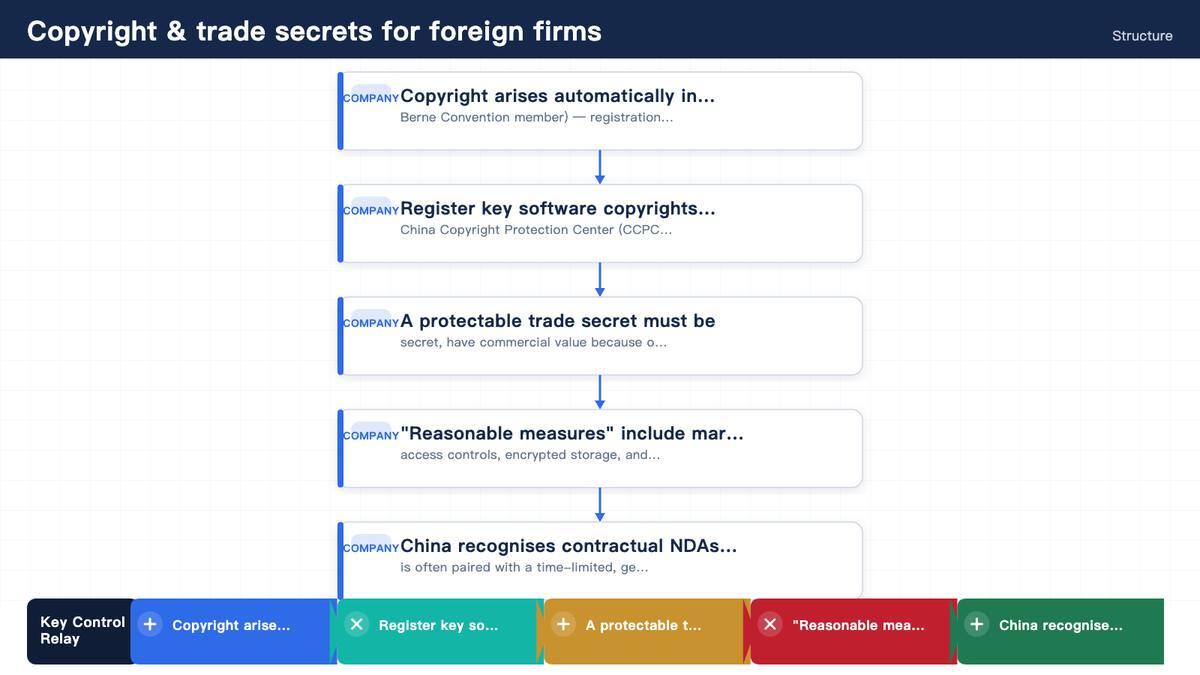
- Copyright arises automatically in China (a Berne Convention member) — registration is not required for protection, but is strongly recommended for software as prima facie evidence of ownership.
著作权在中国自动产生(中国系《伯尔尼公约》成员)——登记并非保护前提,但软件强烈建议登记,作为权属的初步证据。- Register key software copyrights with the China Copyright Protection Center (CCPC); the certificate is often required for enforcement, pre-installation filings, and SOE procurement or subsidies.
关键软件著作权应向中国版权保护中心(CCPC)登记;该证书在维权、软件预装备案及部分政府或国企采购与补贴中常被要求。- A protectable trade secret must be secret, have commercial value because of secrecy, AND be subject to reasonable confidentiality measures — without measures, a claim fails even if the information is genuinely valuable.
受保护的商业秘密须具备秘密性、因秘密而具商业价值,且权利人采取了相应保密措施——若无保密措施,即便信息确有价值,主张亦难成立。- “Reasonable measures” include marking documents confidential, access controls, encrypted storage, and confidentiality clauses in employment and supplier contracts.
“相应保密措施”包括标注机密、访问权限控制、加密存储,以及劳动与供货合同中的保密条款。- China recognises contractual NDAs; employee confidentiality is often paired with a time-limited, geographically scoped non-compete that requires compensation to be enforceable.
中国认可合同保密义务;员工保密常配合有期限、有地域限制且须支付补偿方可执行的竞业限制。- Trade-secret and copyright enforcement share three channels — administrative, civil (with punitive multiples), and criminal.
商业秘密与著作权的维权共享三条渠道——行政、民事(可适用惩罚性倍数)与刑事。- Trade-secret litigation is evidence-intensive, so invest in documentation and confidentiality controls upfront to make later enforcement possible.
商业秘密诉讼高度依赖证据,故应事前投入文档化与保密管控,方能为日后维权创造条件。
Copyright & trade secrets for foreign firms | 著作权与商业秘密
Overview
Not every valuable asset a foreign firm brings to China is a patent or a trademark. Source code, product designs, customer lists, pricing models, and manufacturing know-how are typically protected not by registration but by copyright (automatic, with optional registration) and by trade-secret law (protection by confidentiality, not registration). For software and technology companies in particular, these two pillars are often more important day-to-day than patents. This article explains software copyright registration in China, how trade-secret protection works under the *Anti-Unfair Competition Law*, and the confidentiality practices — including NDAs — that make the protection real.
As always, this is informational guidance, not legal advice; consult a qualified Chinese IP counsel for a tailored program.
Software copyright registration
Under China’s *Copyright Law*, copyright arises automatically when a work is created — registration is not a condition of protection. China is a member of the Berne Convention, so foreign works are protected without formalities. However, for software, voluntary registration at the China Copyright Protection Center (CCPC, 中国版权保护中心) is strongly recommended because the registration certificate serves as *prima facie* evidence of ownership in disputes and is frequently required for enforcing rights, for software pre-installation filings, and for certain government or SOE procurement and subsidies.
Key points for foreign firms:
- Who can file. The right-holder (the developer or its assignee) files through the CCPC online registration system. Foreign applicants may file directly or via a domestic agent.
- What is needed. Source code (typically a prescribed number of consecutive pages), documentation/manual, and identification of the right-holder. Electronic certificates are now issued and can be verified online.
- Timing and cost. Examination is generally faster than patent prosecution (commonly a few weeks to a few months depending on whether expedited handling is used). Fees were reduced after the State Council eliminated certain registration charges.
- Ownership. Where software is developed by an employee within the scope of employment, or primarily using the employer’s resources, the employer normally owns the copyright — but this should be confirmed by contract, especially for seconded or cross-border teams.
Registration does not examine novelty or creativity substantively; it confirms the particulars declared by the applicant. Its value is evidentiary and procedural, not a substantive right grant.
Trade-secret protection under the Anti-Unfair Competition Law
A trade secret in China is technical or business information that is (1) secret (not generally known or readily ascertainable), (2) has commercial value because it is secret, and (3) has been subject to reasonable confidentiality measures by the right-holder. This definition, in the *Anti-Unfair Competition Law* (substantively amended in 2019), covers customer lists, supply chains, algorithms, formulas, and manufacturing know-how.
Crucially, the third element — reasonable measures — is what separates a protectable trade secret from mere “information someone happens to know.” Chinese courts consistently hold that without demonstrable confidentiality measures, a claim fails even if the information is genuinely valuable and secret. Reasonable measures include: marking documents “confidential,” access controls, encrypted storage, confidentiality clauses in employment and supplier contracts, and tiered disclosure.
Misappropriation is prohibited and includes: obtaining secrets by theft, coercion, or electronic intrusion; using or disclosing secrets in breach of a confidentiality obligation or of a duty of good faith; and acquiring, using, or disclosing secrets while knowing (or should have known) they were obtained improperly. The law also reaches third parties who knowingly trade in misappropriated secrets.
Confidentiality practice: NDAs and beyond
For foreign firms, the practical programme that turns trade-secret law into real protection has several layers:
- NDAs / confidentiality agreements. A well-drafted confidentiality clause or standalone NDA should identify the confidential information, the permitted purpose, the recipients, the term, and the remedies. China recognises contractual confidentiality obligations; breach can support both a contract claim and a trade-secret claim. Note that for employees, confidentiality is often addressed in the labour contract and a separate confidentiality/non-compete arrangement (non-compete is time-limited, geographically scoped, and requires compensation).
- Internal controls. Document classification, need-to-know access, visitor/log policies, and training create the “reasonable measures” courts look for.
- Supply-chain and partner contracts. OEMs, distributors, and JV partners should be bound by confidentiality and IP-ownership clauses; IP created in the course of the engagement should be assigned back to the foreign parent.
- Cross-border flows. Where trade secrets or personal data accompany the secret (e.g., source code repositories, customer databases), combine trade-secret controls with data-compliance measures (see the cross-border data article).
Enforcement
Trade-secret and copyright enforcement share three channels:
- Administrative. Market-regulation authorities (SAMR and local equivalents) can investigate trade-secret misappropriation and order cessation and penalties; copyright administrative bodies can act against infringement.
- Civil. Courts can grant injunctions and damages; trade-secret damages may be calculated by the right-holder’s loss, the infringer’s gain, or a reasonable royalty, with punitive multiples for intentional, serious infringement.
- Criminal. Stealing or unlawfully disclosing trade secrets causing “major loss” is a crime; commercial-scale copyright infringement is also criminal.
Because trade-secret cases turn on proof that the information was secret and was protected, litigating them is evidence-intensive. The upfront investment in documentation is what makes later enforcement possible.
What to do next
- Register key software copyrights with the China Copyright Protection Center to obtain *prima facie* ownership evidence.
- Confirm software and work-product ownership in writing, especially for employees, contractors, and seconded staff.
- Implement “reasonable confidentiality measures”: document marking, access controls, encryption, and training.
- Use NDAs for employees, suppliers, OEMs, and partners, with clear definitions, purpose, term, and IP-assignment clauses.
- Keep a confidential-information inventory and restrict disclosure on a need-to-know basis.
- Combine trade-secret controls with data-export compliance where source code or databases cross borders.
Sources
- National Copyright Administration of China (国家版权局, official portal): https://www.ncac.gov.cn
- China Copyright Protection Center (中国版权保护中心) — software copyright registration guide: https://www.ccopyright.com/index.php?optionid=1033
- State Administration for Market Regulation (SAMR, 市场监管总局, official portal): https://www.samr.gov.cn
Related reading
- see also: Patent protection & IP enforcement / 专利保护与知识产权执法
- see also: Cross-border data transfer rules (PIPL) / 跨境数据传输规则(个保法)
著作权与商业秘密
概述
外资企业带入中国的宝贵资产,并不都是专利或商标。源代码、产品设计、客户名单、定价模型与制造工艺,通常既非靠注册、也非靠专利保护,而是靠著作权(自动产生,可自愿登记)与商业秘密法(以保密而非注册获得保护)。对软件与科技企业而言,这两根支柱日常往往比专利更重要。本文说明中国的软件著作权登记、商业秘密在《反不正当竞争法》下的保护机制,以及让保护”落地”的保密实务——包括保密协议(NDA)。
一如既往,本文为信息性指引,非法律意见;定制化方案请咨询合格的中国知识产权律师。
软件著作权登记
依中国《著作权法》,作品创作完成即自动享有著作权——登记并非保护的前提。中国系《伯尔尼公约》成员,外国作品无需手续即受保护。但对软件而言,强烈建议向中国版权保护中心(CCPC)自愿登记,因为登记证书在争议中可作为权属的初步证据,且在维权、软件预装备案、部分政府或国企采购与补贴中常被要求。
外国企业要点:
- 谁可申请。 权利人(开发者或其受让人)通过中国版权保护中心在线登记系统提交;外国申请人可直接或经国内代理提交。
- 所需材料。 源代码(通常为规定页数的连续页)、文档/说明书,以及权利人身份证明。现已核发电子证书并可在线验签。
- 周期与费用。 审查一般快于专利(视是否加急,通常数周至数月)。国务院取消部分登记收费后,费用已降低。
- 权属。 员工在职务范围内开发的软件,或主要利用雇主资源开发的,通常由雇主享有著作权——但应以合同确认,尤其对借调或跨境团队。
登记不对新颖性或创造性作实质审查,仅确认申请人所申报的事项。其价值在于证据与程序,而非实质授权。
商业秘密与反不正当竞争法
中国的商业秘密指技术信息或经营信息,须同时具备:(1) 秘密性(不为公众所知悉、不易获取);(2) 因秘密而具商业价值;(3) 权利人采取了相应的保密措施。该定义在《反不正当竞争法》(2019 年实质修正)中涵盖客户名单、供应链、算法、配方与制造工艺。
关键在于第三要件——相应保密措施——正是它区分了”受保护的商业秘密”与”某人碰巧知道的信息”。中国法院一贯认为,若无可证明的保密措施,即便信息确有价值且保密,主张亦难成立。相应措施包括:标注”机密”、访问权限控制、加密存储、在劳动与供货合同中约定保密条款,以及分级披露。
法律禁止侵犯商业秘密,包括:以盗窃、贿赂、欺诈、电子侵入等手段获取;违反保密义务或违背诚信原则使用、披露;以及明知(应知)系以不正当手段取得仍获取、使用、披露。该法亦及于明知而经营侵权商业秘密的第三人。
保密实务:不止于 NDA
对外国企业而言,让商业秘密法转化为真实保护的是分层的实务方案:
- 保密协议 / NDA。 措辞得当的保密条款或独立 NDA 应明确保密信息范围、允许目的、接收方、期限与救济。中国认可合同保密义务;违约既可支持合同之诉,亦可支持商业秘密之诉。对员工,保密常写入劳动合同并另订保密/竞业限制安排(竞业限制有期限、地域限制,且须支付补偿)。
- 内部管控。 文件分级、最小知悉访问、访客/日志制度与培训,构成法院所要求的”相应措施”。
- 供应链与合作伙伴合同。 OEM、经销商与合资伙伴应受保密与知识产权归属条款约束;合作中产生的 IP 应归属外国母公司。
- 跨境流动。 当商业秘密或个人数据随秘密一并转移(如源代码仓库、客户数据库),应将商业秘密管控与数据合规措施结合(见跨境数据专文)。
维权路径
商业秘密与著作权的维权共享三条渠道:
- 行政。 市场监管部门(SAMR 及地方对应机构)可查处商业秘密侵权,责令停侵并处罚;著作权行政主管机关可对侵权作出处理。
- 民事。 法院可发禁令并判赔;商业秘密损害赔偿可按权利人损失、侵权人获利或合理许可费计算,对故意、情节严重的可适用惩罚性倍数。
- 刑事。 盗窃或非法披露商业秘密致”重大损失”构成犯罪;商业规模的著作权侵权亦属刑事。
因商业秘密案件的关键在于证明信息”秘密且受保护”,诉讼高度依赖证据。事前的文档化投入,正是日后得以维权的基础。
下一步建议
- 向中国版权保护中心登记关键软件著作权,以取得权属初步证据。
- 以书面确认软件与工作成果的权属,尤其对员工、承揽人与借调人员。
- 落实”相应保密措施”:文件标注、访问管控、加密与培训。
- 对员工、供应商、OEM 与合作伙伴使用 NDA,明确定义、目的、期限与 IP 归属条款。
- 建立保密信息清单,按最小知悉原则限制披露。
- 当源代码或数据库跨境时,将商业秘密管控与数据出境合规结合。
来源
- 国家版权局(官网):https://www.ncac.gov.cn
- 中国版权保护中心——计算机软件著作权登记指南:https://www.ccopyright.com/index.php?optionid=1033
- 国家市场监督管理总局(SAMR,官网):https://www.samr.gov.cn
相关阅读
- see also: 专利保护与知识产权执法 / Patent protection & IP enforcement
- see also: 跨境数据传输规则(个保法)/ Cross-border data transfer rules (PIPL)