
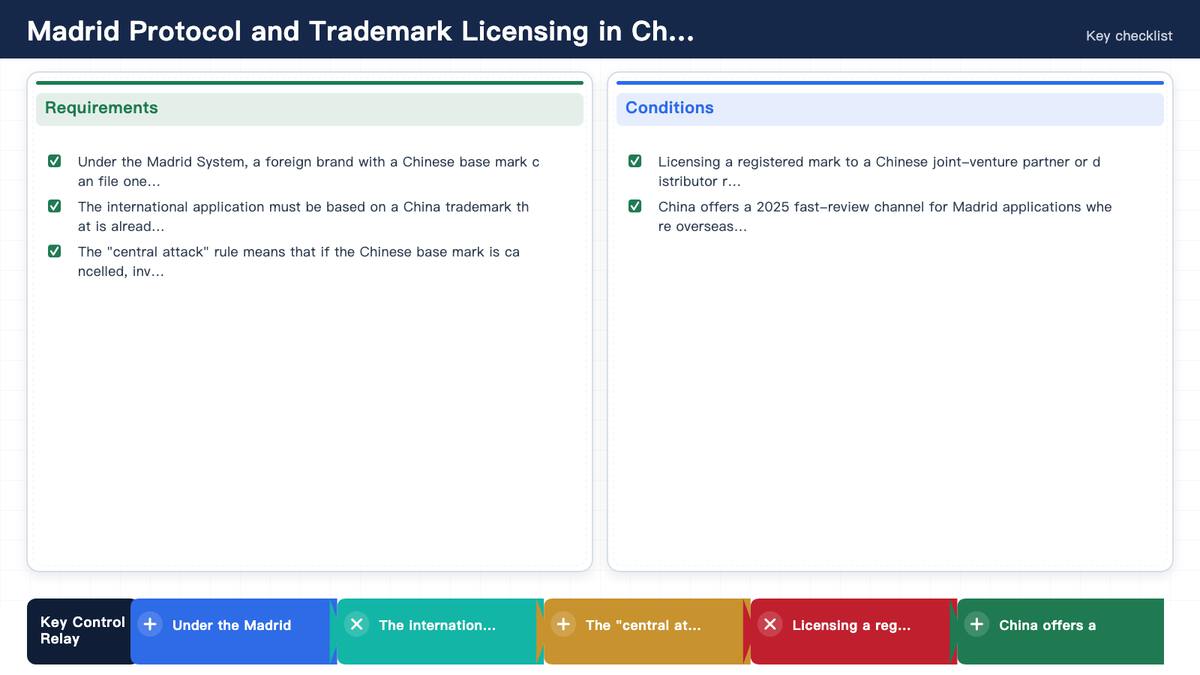
- Under the Madrid System, a foreign brand with a Chinese base mark can file one international application designating many members, instead of filing separately in each jurisdiction.
依马德里体系,在中国拥有基础商标的外国品牌可提交一件国际申请指定多个成员,无需在各法域分别申请。- The international application must be based on a China trademark that is already registered or at least applied for and accepted — and its scope cannot exceed the base mark’s goods and services.
国际申请须以已注册或至少已申请并获受理的中国商标为基础,且范围不得超出基础商标的指定商品/服务。- The “central attack” rule means that if the Chinese base mark is cancelled, invalidated or not renewed within five years, the entire international registration fails across all designated members.
“中心打击”原则意味着若中国基础商标在五年内被撤销、无效或未续展,其国际注册在所有指定成员一并失效。- Licensing a registered mark to a Chinese joint-venture partner or distributor requires a recordal with the trademark office to be enforceable against third parties.
将注册商标许可给中国合资伙伴或分销商须向商标主管机关备案,方可对抗第三人。- China offers a 2025 fast-review channel for Madrid applications where overseas signing, exhibition, brand licensing or overseas hijacking creates urgent need.
中国为因海外签约、参展、品牌授权或已遭海外抢注而确有急需的马德里申请提供 2025 年快速审查通道。
Madrid Protocol and Trademark Licensing in China: Protecting Foreign Brands | 马德里体系在华延伸与商标许可:外资品牌保护路径
Why this matters now
For a foreign brand entering China, trademark protection is the first line of defence against copycats, and increasingly against wholly-owned local imitators. Two instruments matter most: the Madrid System for building a multi-country portfolio efficiently, and the trademark licence recordal for controlling how a local partner uses the mark. Both are mediated in China by the China National Intellectual Property Administration (CNIPA), which administers the *Measures for the Implementation of Madrid International Registration of Marks* and the recordal of licence contracts. This article explains how a foreign brand should use each.
The Madrid System: one filing, many markets
The Madrid System — governed by the Madrid Agreement and the Madrid Protocol — lets a trademark owner in a member country file a single international application through its home IP office (in China, CNIPA) designating any number of member economies. For a foreign brand already operating in China, the practical route is usually the reverse: a China-incorporated entity uses its Chinese base mark as the foundation for an international registration that extends protection outward.
Key mechanics under CNIPA’s implementation measures:
- Eligibility. The applicant must have a genuine effective business establishment, domicile, or nationality in China. A foreign brand typically qualifies through its China subsidiary.
- Base-mark requirement. The international application must be based on a mark already registered with CNIPA or at least applied for and accepted. The goods/services of the international registration cannot exceed those of the base mark. If the base mark is cancelled within five years, the international registration is vulnerable — the “central attack” risk.
- Filing channels. Applications are submitted electronically via CNIPA’s online service system, which interfaces with WIPO; paper filing remains available. The applicant uploads the Chinese application form plus the English/French MM2 form, proof of eligibility, and the mark specimen.
- Substantive review by each member. Madrid streamlines the *filing*, not the *substance*: each designated member examines under its own law. A member has 12 months (Agreement) or 18 months (Protocol) to refuse; silence means protection is granted.
The central-attack risk and how to manage it
The “central attack” (中心打击) principle is the Madrid System’s defining weakness: if the base mark is cancelled, invalidated or not renewed within five years of the international registration, the international registration — and therefore protection in every designated member — lapses, unless converted into national applications in those members (possible within three months under the Protocol).
Mitigations for a foreign brand:
- Stabilise the base mark first. File and secure the China registration, ideally use it in commerce, and renew on time, before leaning heavily on Madrid extensions.
- Use the 2025 fast-review channel where there is urgent need — overseas signing, exhibition, brand licensing, or actual overseas hijacking. CNIPA’s *Guidance on Fast Review of Madrid International Registration Applications* lets the applicant file a paper request with evidence of the urgent reason.
- Keep a parallel national filing in the most critical markets as a fallback, so a base-mark problem does not collapse the whole portfolio.
Trademark licensing in China
Beyond registration, a foreign brand often needs a Chinese partner — a joint venture, manufacturer or distributor — to use the mark. Chinese trademark law treats the licensor’s recordal of the licence contract with CNIPA as the step that makes the licence effective against third parties.
What to know:
- Recordal is advisable, not optional in practice. An unrecorded licence is harder to enforce against infringers and complicates the licensee’s own defences. CNIPA maintains the recordal, and the *Measures* provide for it.
- Quality control is the licence’s lifeblood. Chinese law requires the licensor to supervise the licensee’s product quality; failure to exercise control can, in egregious cases, lead to cancellation of the registered mark on the ground of becoming a generic or non-used mark. The licence contract should build in audit rights.
- Scope and term. Define the licensed goods/services precisely (within the registration), the territory (typically mainland China), the term, royalties, and what happens on termination — including recall of labelled stock and destruction of tooling.
- Cross-border dimension. Where the licensee will export goods bearing the mark, coordinate the Madrid/ national registrations in the export markets so the licensee’s shipments do not infringe a third party or lapse for non-use.
Putting the two together
A disciplined foreign brand approach:
- Secure a solid China registration as the base mark (and use it).
- Extend outward via Madrid where multi-country coverage is needed, watching the five-year central-attack window.
- Where a local partner uses the mark, execute and record the licence, with quality-control and termination clauses.
- Align the licence’s export plans with the overseas registrations so the supply chain is clean end to end.
马德里体系在华延伸与商标许可:外资品牌保护路径
为何此刻值得关注
对外国品牌进入中国,商标保护是防御仿冒的第一道防线,且日益针对全资本地仿冒者。两类工具最为关键:马德里体系用于高效搭建多国组合,商标许可备案用于管控本地伙伴如何使用商标。两者在中国均由国家级知识产权主管部门(CNIPA,国家知识产权局)经办,其施行《马德里商标国际注册实施办法》并办理许可合同备案。本文解释外国品牌应如何运用二者。
马德里体系:一次申请,多个市场
马德里体系——由《马德里协定》与《马德里议定书》规范——允许成员国的商标权人在其本国 IP office(在中国为 CNIPA)提交一件国际申请,指定任意数量的成员经济体。对已在中国运营的外国品牌,实务路径通常相反:中国法人以其中国基础商标为根基,通过国际注册将保护向外延伸。
依 CNIPA 实施办法的关键机制:
- 资格。申请人须在中国有真实有效的工商营业场所、住所或国籍。外国品牌通常通过其在华子公司取得资格。
- 基础商标要求。国际申请须以已向 CNIPA 注册或至少已申请并获受理的商标为基础。国际注册的指定商品/服务不得超出基础商标范围。若基础商标在五年内被撤销,国际注册即面临风险——即”中心打击”风险。
- 申请渠道。申请经 CNIPA 网上服务系统提交,该系统与 WIPO 对接;仍可纸件申请。申请人上传中文申请书及英文/法文 MM2 表、资格证明与商标图样。
- 各成员实质审查。马德里简化的是*申请*而非*实质*:每个指定成员依本国法律审查。成员有 12 个月(协定)或 18 个月(议定书)予以驳回;沉默即视为给予保护。
中心打击风险及应对
“中心打击”(中心打击)原则是马德里体系的特征性弱点:若基础商标在国际注册之日起五年内被撤销、无效或未续展,该国际注册——亦即每个指定成员的保护——一并失效,除非在这些成员转为国家申请(议定书下三个月内可行)。
对外国品牌的缓释措施:
- 先稳定基础商标。在重度依赖马德里延伸前,先在中国注册并取得权利、尽量实际使用并按时续展。
- 利用 2025 年快速审查通道。确有急需——海外签约、参展、品牌授权或已遭海外抢注——时可用。CNIPA《马德里商标国际注册申请快速审查办理指南》允许申请人提交纸件请求并附加快审查事由证据。
- 在关键市场保留平行国家申请作为兜底,使基础商标问题不致拖垮整个组合。
中国的商标许可
除注册外,外国品牌常需中国伙伴——合资企业、制造方或分销商——使用其商标。中国商标法将许可人与商标主管机关备案许可合同视为使许可对抗第三人的步骤。
须知:
- 备案实为必要而非可选。未备案许可难以对抗侵权人,并使被许可人自身抗辩复杂化。CNIPA 办理备案,《实施办法》予以规定。
- 质量控制是许可的生命线。中国法律要求许可人监督被许可人产品质量;极端情况下疏于控制可致注册商标因泛化或未使用而被撤销。许可合同应嵌入审计权。
- 范围与期限。精确界定许可的商品/服务(在注册范围内)、地域(通常中国大陆)、期限、许可费及终止后安排——包括带标库存回收与模具销毁。
- 跨境维度。若被许可人将出口带标货物,须协调出口市场的马德里/国家注册,使被许可人出货不侵犯第三方或因不使用而失效。
二者结合
守纪的外国品牌路径:
- 取得稳固的中国注册作为基础商标(并实际使用)。
- 在需要多国覆盖时经马德里向外延伸,盯紧五年中心打击窗口。
- 本地伙伴使用商标时,签署并备案许可,含质量控制与终止条款。
- 将许可的出口计划与海外注册对齐,使供应链端到端干净。
Sources
- 马德里商标国际注册实施办法(国家知识产权局商标局):https://sbj.cnipa.gov.cn/sbj/zcwj/200904/t20090408_6471.html
- 马德里商标国际注册(国家知识产权局商标局):https://sbj.cnipa.gov.cn/sbj/gjzc/
- WIPO Madrid System Information Notice no. 1/2025 — China collective/certification marks requirements:https://www.wipo.int/documents/d/madrid-system/information-notices-en-2025-madrid_2025_1_e.pdf