
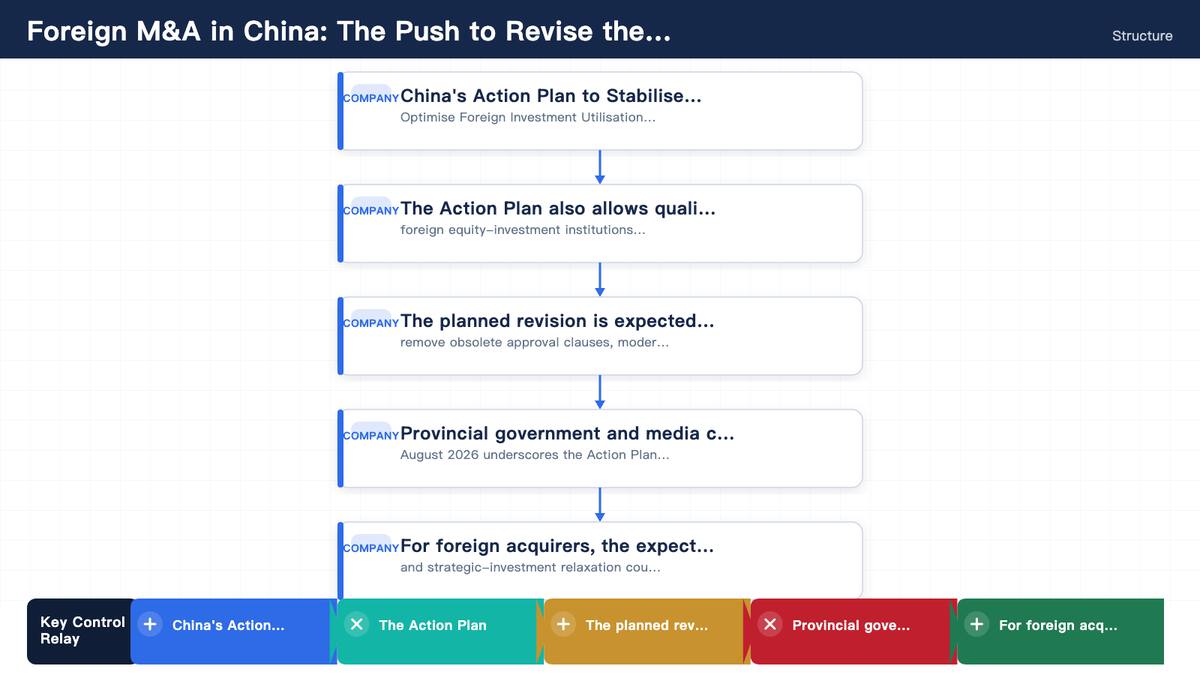
- China’s Action Plan to Stabilise and Optimise Foreign Investment Utilisation, issued on 16 June 2026, commits to accelerating the revision of the 2006 Measures on M&A of Domestic Enterprises by Foreign Investors (“the 10-Order”).
2026 年 6 月 16 日印发的《利用外资固稳促优行动方案》承诺加快修订 2006 年《关于外国投资者并购境内企业的规定》(”10 号令”)。
- The Action Plan also allows qualified foreign equity-investment institutions to participate as strategic investors in securities issuance of listed companies in non-related industries, widening foreign access to China’s A-share capital market.
行动方案允许符合条件的外资股权投资机构以战略投资者身份参与非相关行业上市公司证券发行,拓宽外资进入 A 股资本市场的路径。
- The planned revision is expected to remove obsolete approval clauses, modernise consideration and payment rules, and align cross-share-swap and strategic-investment frameworks with the Foreign Investment Law and the new strategic-investment measures.
修订预计将删除过时审批条款,现代化对价与支付规则,并使跨境换股、战投框架与《外商投资法》及新战投办法相衔接。
- Provincial government and media commentary in August 2026 underscores the Action Plan as a shift from “admission” to “post-admission operations” for foreign investment.
2026 年 8 月地方政府与媒体解读普遍强调,行动方案标志外资政策从”准入”转向”准营”。
- For foreign acquirers, the expected revision and strategic-investment relaxation could reduce transaction friction, but the current rules and mandatory filings remain fully applicable today.
对外国收购方,预期的修订与战投放宽可能降低交易摩擦,但现行规则与强制申报在当下完全适用。
Foreign M&A in China: The Push to Revise the 2006 M&A Measures and New Strategic-Investment Channels (2026) | 中国外资并购:修订 2006 年并购规定与新的战略投资通道(2026 年)
Why this matters now
The Action Plan to Stabilise and Optimise Foreign Investment Utilisation (《利用外资固稳促优行动方案》, Shang Zi Fa [2026] No. 97), issued on 16 June 2026 by the Ministry of Commerce, the National Development and Reform Commission and the Ministry of Finance with State Council approval, is the first comprehensive foreign-investment policy document of the “15th Five-Year Plan” period. Among its fifteen measures, two provisions speak directly to foreign M&A. First, the Action Plan commits to “accelerating the revision of the Measures on M&A of Domestic Enterprises by Foreign Investors and optimising the merger-control process and consideration-payment requirements”. Second, it allows qualified foreign equity-investment institutions to participate, as strategic investors, in securities issuance of listed companies in industries unrelated to their own, opening a broader channel for foreign capital into the A-share market. Analysts in August 2026 — including commentary published through the Shanghai municipal foreign-affairs weekly — read the Action Plan as marking the shift from “admission” to “post-admission operations” in China’s foreign-investment regime, with M&A modernisation at its centre.
The 2006 M&A Measures and why revision matters
The Measures on M&A of Domestic Enterprises by Foreign Investors (the “10-Order”, 2006, amended 2009) remain the most important ministerial regulation in foreign M&A, nearly two decades after issuance. Since the Foreign Investment Law took effect in 2020, the pre-approval clauses of the 10-Order that conflict with the new framework — including the approval of affiliated acquisitions — are no longer implemented, but other provisions on transaction-consideration pricing basis, payment deadlines, payment forms and valuation models remain effective. The revision is urgent on three levels. First, with pre-approval gone, the commercial department has fully exited ex-ante examination of foreign M&A, so the 10-Order’s approval provisions must be formally deleted. Second, the consideration and payment rules — pricing basis, payment period, payment form, valuation method — need to be re-expressed so they operate without an approval gateway. Third, the cross-share-swap and strategic-investment frameworks need to align with the Foreign Investment Law and the new strategic-investment measures, since the current text was written for a different regulatory era. The Action Plan’s commitment to “optimise merger-control process and consideration-payment requirements” is precisely the mandate for this modernisation.
Strategic investment by foreign equity-investment institutions
The second M&A-relevant measure — allowing qualified foreign equity-investment institutions to participate as strategic investors in securities issuance of listed companies in non-related industries — addresses a long-standing gap. The strategic-investment regime for foreign investors had historically been tied to related industries and controlled through specific approval and lock-up mechanics. Opening non-related-industry issuance to qualified foreign PE/VC institutions gives long-term foreign capital a clearer, more flexible path into A-share issuances, complementing the QFII and Stock Connect channels. For foreign institutional investors and for listed Chinese companies seeking strategic foreign capital, this is a structural widening of the market, provided the qualification criteria and lock-up rules are finalised in the implementing rules.
Practical implications for foreign acquirers
For foreign acquirers in 2026, the practical position is: the reform direction is clear, but the current rules govern today’s deals. Until the revised 10-Order is published, transactions must comply with the existing consideration, valuation and payment rules, and with the mandatory concentration-filing thresholds under the Anti-Monopoly Law for transactions that meet the notification standards. Companies should also note the interaction with the strategic-investment measures for listed-company deals, the security-review framework for transactions in sensitive sectors, and the data-export and PIPL implications for deals involving data-heavy targets. The August 2026 commentary consistently emphasises that the Action Plan’s benefit is predictability and the modernisation pipeline, not an immediate relaxation of today’s obligations.
Practical steps
- Treat current rules as the operative baseline. Structure 2026 deals under the existing 10-Order consideration, valuation and payment rules; do not rely on the expected revision.
- Assess concentration-filing exposure. Map the transaction against the turnover-based notification thresholds and, where the deal meets them, plan the mandatory prior filing.
- Screen for security review and sector restrictions. For sensitive sectors, run the national-security review assessment and confirm the negative-list treatment before committing.
- Prepare for strategic-investment opportunities. Institutional investors should monitor the implementing rules for the non-related-industry strategic-investment channel and position around the qualification and lock-up conditions.
- Model cross-share-swap structures. Where a share swap is contemplated, plan for the current foreign-exchange and securities-registration treatment, and revisit the structure once the revised measures issue.
- Coordinate with data and governance diligence. For targets holding personal information or important data, run data-export, PIPL and governance diligence alongside the legal merger work.
Compliance notes
Nothing in the Action Plan or the August 2026 commentary has changed the operative legal text: the 2006 M&A Measures, the Anti-Monopoly Law filing thresholds, the strategic-investment measures for listed companies and the security-review rules all remain in force. Foreign investors should not read the reform signals as a licence to adopt unapproved structures today. The revision timeline is not fixed, and its content may differ from expectations; M&A teams should build transactions that are robust under current law and adjustable if the new rules arrive before closing. As with all China cross-border M&A, document retention, valuation support and filing discipline remain the backbone of a defensible deal.
中国外资并购:修订 2006 年并购规定与新的战略投资通道(2026 年)/ Foreign M&A in China: The Push to Revise the 2006 M&A Measures and New Strategic-Investment Channels (2026)
为什么当下重要
2026 年 6 月 16 日,商务部、国家发展改革委、财政部经国务院同意联合印发《利用外资固稳促优行动方案》(商资发〔2026〕97 号),这是”十五五”开局之年外资领域的首份综合性政策文件。在 15 条举措中,有两条直接指向外资并购。其一,行动方案承诺”加快修订出台关于外国投资者并购境内企业的规定,优化并购管理流程和对价支付要求”。其二,允许符合条件的外资股权投资机构以战略投资者身份参与非相关行业上市公司证券发行,为外资进入 A 股资本市场开辟更宽通道。2026 年 8 月的分析(包括上海外办周报刊发的解读)普遍把行动方案视为外资政策从”准入”转向”准营”的标志,并购现代化居于中心。
2006 年并购规定及修订为何重要
《关于外国投资者并购境内企业的规定》(”10 号令”,2006 年发布、2009 年修订)在发布近二十年后仍是最重要的外资并购部门规章。2020 年《外商投资法》施行后,10 号令中与上位法冲突的事前审批条款(包括关联并购审批)已不再实施,但关于交易对价定价依据、支付期限、支付形式、评估模式等条款仍然有效。修订在三层意义上紧迫。其一,事前审批取消后,商务部门已全面退出外资并购的事前审查,10 号令的审批条款须明确删除。其二,对价与支付规则——定价依据、支付期限、支付形式、评估方式——需要重新表述,使其在无审批网关的情况下落地执行。其三,跨境换股与战略投资框架须与《外商投资法》及新战投办法衔接,因为现行文本写就于不同的监管时代。行动方案”优化并购管理流程和对价支付要求”的承诺,正是这一现代化的授权。
外资股权投资机构参与战略投资
第二项与并购相关的举措——允许符合条件的外资股权投资机构以战略投资者身份参与非相关行业上市公司证券发行——回应了一个长期空白。外国投资者的战投制度历史上与关联行业绑定,并受特定审批与锁定期机制控制。向符合条件的外资 PE/VC 开放非相关行业发行,为长期外资进入 A 股发行提供了更清晰、更灵活的路径,补充 QFII 与互联互通渠道。对外资机构投资者以及寻求战略外资的中国上市公司,这是市场结构的拓宽——前提是资格标准与锁定期规则在实施规则中最终明确。
对外国收购方的实操含义
对 2026 年的外国收购方,现实立场是:改革方向清晰,但现行规则支配当下的交易。在修订版 10 号令发布前,交易必须遵守现有的对价、估值与支付规则,并在交易达到申报标准时履行《反垄断法》下的强制集中申报。企业还应留意与上市公司交易战投办法的互动、敏感行业交易的安全审查框架,以及对持有大量个人数据或重要数据标的交易的数据出境与 PIPL 影响。2026 年 8 月的解读一致强调,行动方案的收益是可预期性与现代化管线,而非当下义务的立即放宽。
操作步骤
- 以现行规则为操作基准。 2026 年交易按现有 10 号令对价、估值与支付规则构架;不要依赖预期中的修订。
- 评估集中申报敞口。 将交易对照营业额申报门槛,达标的规划强制事先申报。
- 筛查安全审查与行业限制。 敏感行业在承诺前进行国家安全审查评估并确认负面清单待遇。
- 为战投机会做准备。 机构投资者应跟踪非相关行业战投通道的实施规则,并围绕资格与锁定期条件定位。
- 建模跨境换股结构。 若考虑换股,按现行外汇与证券登记待遇规划,并在修订版办法出台后重新审视结构。
- 与数据与治理尽调协同。 对持有个人信息或重要数据的标的,在法律并购工作之外同步开展数据出境、PIPL 与治理尽调。
合规提示
行动方案与 2026 年 8 月的解读均未改变现行法律文本:2006 年并购规定、《反垄断法》申报门槛、上市公司战投办法与安全审查规则全部仍然有效。外国投资者不应将改革信号解读为今天就可采用未经批准的结构。修订时间表未定,内容可能与预期不同;并购团队应构建在现行法律下稳健、若新规在交割前出台则可调整的交易。与所有中国跨境并购一样,文档留存、估值支撑与申报纪律仍是可辩护交易的主干。
Sources
- 新疆维吾尔自治区商务厅《商务部详解〈利用外资固稳促优行动方案〉》:https://swt.xinjiang.gov.cn/xjswt/c114330/202608/2e0e109ac5fe4f1a92e4cff45224d1df.shtml
- 上海市人民政府外事办公室《上海资讯周报》涉外资讯一站式服务(2026年8月第3期,总第155期):https://wsb.sh.gov.cn/ztzl/shzxzb/20260818/ce3cd5fcab334d1ea3a994e97d178583.html
- 上海市人民政府外事办公室《上海资讯周报》涉外资讯一站式服务(2026年8月第2期,总第154期):https://wsb.sh.gov.cn/ztzl/shzxzb/20260811/bd3b73a6e882435e92bd4f7213129b46.html
- 山西省民营经济发展局《外资企业可重点关注哪些扩大准入领域?》(2026-08-10):https://myj.shanxi.gov.cn/ztzl/bwbd/lywzgw/202608/t20260810_10196322.shtml