
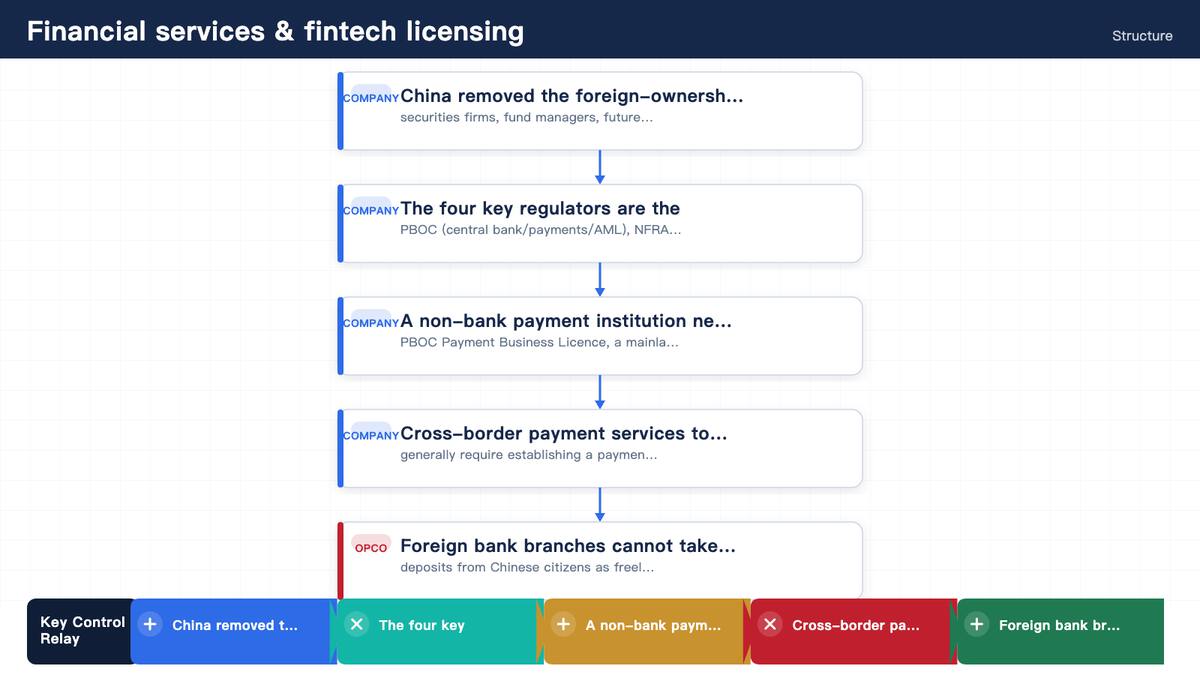
- China removed the foreign-ownership caps on securities firms, fund managers, futures companies, and life insurers in 2020, putting foreign banks and insurers on broadly the same footing as domestic institutions.
中国于2020年取消证券公司、基金管理人、期货公司与寿险公司的外资股比限制,使外资银行与保险公司大体上与内资机构同等待遇。- The four key regulators are the PBOC (central bank/payments/AML), NFRA (banking/insurance), CSRC (securities/futures), and SAFE (foreign exchange).
四大监管机构为人民银行(央行/支付/反洗钱)、国家金融监督管理总局(银行/保险)、证监会(证券/期货)与国家外汇管理局(外汇)。- A non-bank payment institution needs a PBOC Payment Business Licence, a mainland-incorporated entity, and minimum registered capital of RMB 100 million under State Council Decree No. 768 (effective 1 May 2024).
非银行支付机构须取得人民银行《支付业务许可证》、设立内地法人实体,并满足国务院768号令(2024年5月1日施行)下1亿元最低注册资本要求。- Cross-border payment services to mainland users generally require establishing a payment institution on the mainland, not servicing them from an offshore licence.
向内地用户提供跨境支付服务通常须在中国境内设立支付机构,不能以离岸牌照服务内地用户。- Foreign bank branches cannot take retail deposits from Chinese citizens as freely as locally incorporated banks, while foreign insurers may now hold 100% of a life insurer.
外资银行分行不能像本地法人银行那样自由吸收中国公民个人零售存款;外资现已可持有寿险公司100%股权。- Practical phased entry routes include PBOC/local innovation sandboxes, partnerships with licensed institutions, and financial pilot zones such as Lingang and Qianhai/Shekou.
务实的分阶段进入路径包括人民银行及地方创新沙盒、与持牌机构合作,以及临港与前海/蛇口等金融试点区域。
Financial services & fintech licensing | 金融服务与金融科技牌照
Overview
China has substantially opened its financial sector to foreign investors over the past decade. Caps on foreign ownership of securities firms, fund managers, futures companies, and life insurers were removed in 2020, and foreign banks and insurers can now operate on broadly the same footing as domestic institutions. Yet “open” does not mean “licence-free”: every activity — taking deposits, underwriting securities, selling insurance, moving money as a payment institution — requires a specific licence granted by a specific regulator.
This article outlines the regulatory perimeter for foreign financial institutions, the licensing paths for banking, securities, insurance, and fintech/payments, and the sandbox and pilot frameworks foreign entrants should know. It is informational; licensing strategy should be confirmed with qualified PRC legal and regulatory advisers.
The regulatory map
China’s financial regulators are: the People’s Bank of China (PBOC, the central bank), the National Financial Regulatory Administration (NFRA, banking and insurance), the China Securities Regulatory Commission (CSRC, securities and futures), and the State Administration of Foreign Exchange (SAFE, foreign exchange). The PBOC also leads payments, fintech, and anti-money-laundering supervision. A foreign group entering China typically needs a licence from one or more of these bodies, plus company registration with the SAMR and, for foreign-exchange matters, SAFE approval.
Banking and insurance access
Foreign banks may establish a representative office, a branch, or a locally incorporated foreign bank (a WFOE-style legal person). The NFRA approves the establishment and the scope of business; branches cannot take retail deposits from Chinese citizens in the same unrestricted way as locally incorporated banks. In insurance, the 2020 removal of the foreign-ownership cap on life insurers means a foreign insurer may now hold 100% of a life-insurance joint venture or set up a wholly foreign-owned insurer, subject to NFRA prudential approval. The same 2020 negative-list revision lifted caps on securities, fund-management, and futures companies.
Securities, asset management, and the 2020 opening
From 1 April 2020 the CSRC eliminated the foreign-ownership cap on securities companies; the 2020 negative list confirmed the removal of caps on securities firms, fund managers, and futures and life-insurance companies (effective 23 July 2020). Foreign-invested securities companies are governed by the CSRC’s Measures for the Administration of Foreign-invested Securities Companies. Wholly foreign-owned brokerages have since been approved (e.g., Standard Chartered Securities China was approved in 2023), and several global groups have taken full ownership of their China securities or fund ventures.
Fintech, payments, and the non-bank payment licence
Moving funds for others in China requires a Payment Business Licence from the PBOC. The Regulation on the Administration of Non-bank Payment Institutions (State Council Decree No. 768, effective 1 May 2024, with detailed implementing rules issued July 2024) is the governing framework. A non-bank payment institution must be a limited-liability or joint-stock company established in China, with a minimum registered capital of RMB 100 million (higher where it operates across more than 20 provincial regions), and its core business and technical services may not be outsourced. Cross-border payment services provided to mainland users generally require establishing a payment institution on the mainland.
Sandboxes, pilots, and innovation zones
Foreign fintechs rarely obtain a full banking or payment licence on day one. Practical entry routes include: participating in PBOC or local financial-regulator innovation sandboxes; partnering with licensed banks/insurers under open-banking and API frameworks; providing technology to licensed institutions (reg-tech, risk, data) without yourself holding customer funds; and locating in financial pilot zones such as the Lingang hub of the Shanghai FTZ or the Qianhai/Shekou area, which offer streamlined approvals for qualified foreign financial institutions.
What to do next
- Map the exact regulated activity you intend to perform; “fintech” spans payments, lending, advisory, and custody, each with a different licence.
- Confirm the lead regulator (PBOC for payments/AM, NFRA for banking/insurance, CSRC for securities/funds/futures, SAFE for FX) before filing.
- For payments, budget for the RMB 100m minimum capital and a mainland-incorporated entity; do not plan to service mainland users from an offshore licence.
- Use an innovation sandbox or a licensed-institution partnership as a phased entry before a full licence.
- Engage PRC regulatory and legal counsel early — prudential approvals turn on fit-and-proper and systemic-risk assessments, not just form.
- Register trademarks and reserve the Chinese brand name before approaching platforms and regulators.
Sources
- National Financial Regulatory Administration (NFRA) — official portal: https://www.nfra.gov.cn/
- PBOC / State Council — Regulation on the Administration of Non-bank Payment Institutions (Decree No. 768): http://big5.www.gov.cn/gate/big5/www.gov.cn/zhengce/content/202312/content_6920724.htm
- China Securities Regulatory Commission (CSRC) — removal of the foreign-ownership cap on securities firms: https://www.csrc.gov.cn/shenzhen/c105616/c1380084/content.shtml
- PBOC — detailed implementing rules for non-bank payment institutions (PDF): https://www.pbc.gov.cn/zhengwugongkai/resource/cms/2024/08/2024080215484432588.pdf
- NDRC/MOFCOM — negative list revision removing financial-sector ownership caps: https://en.ndrc.gov.cn/news/mediarusources/202112/t20211228_1310393.html
Related reading
- see also: E-commerce market entry for foreign brands (43-ecommerce-market-entry)
- see also: Healthcare & pharma market access (45-healthcare-pharma-market-access)
- see also: Renewable energy & green investment incentives (49-renewable-energy-green-investment)
金融服务与金融科技牌照
概述
过去十年,中国大幅开放了金融 sector 对外资的准入。2020 年,证券、基金管理、期货及寿险公司的外资股比限制被取消,外资银行与保险公司如今可在大体上同内资机构相同的 footing 上经营。但”开放”不等于”无需牌照”:吸收存款、承销证券、销售保险、作为支付机构划转资金——每一项活动都需要由特定监管机构发放的专门牌照。
本文勾勒外资金融机构的监管边界、银行/证券/保险及金融科技/支付的牌照路径,以及外资进入者应了解的沙盒与试点框架。本文仅为信息参考,牌照策略应经合格的中国法律与监管顾问确认。
监管版图
中国的金融监管机构包括:中国人民银行(PBOC,中央银行)、国家金融监督管理总局(NFRA,银行与保险)、中国证券监督管理委员会(CSRC,证券与期货),以及国家外汇管理局(SAFE,外汇)。人民银行还牵头支付、金融科技与反洗钱监管。外资集团进入中国通常需从一个或多个上述机构取得牌照,外加在市场监管总局(SAMR)完成公司登记,涉及外汇事项还须 SAFE 批准。
银行与保险准入
外资银行可设立代表处、分行,或本地法人的外资银行(类似 WFOE 的法人)。NFRA 审批其设立与业务范围;分行不能像本地法人银行那样不受限制地吸收中国公民个人零售存款。保险方面,2020 年取消寿险外资股比限制,意味着外资可持有寿险合资企业 100% 股权或设立外商独资保险人,但须经 NFRA 审慎审批。2020 年负面清单修订同样取消了证券、基金管理、期货公司的股比上限。
证券、资管与 2020 年开放
自 2020 年 4 月 1 日起,证监会取消证券公司外资股比限制;2020 年负面清单确认取消证券、基金、期货及寿险公司股比上限(2020 年 7 月 23 日生效)。外资证券公司受证监会《外商投资证券公司管理办法》规范。此后已核准外商独资券商(如渣打证券中国于 2023 年获批),多家全球集团也已取得其中国证券或基金合资企业的全资控股。
金融科技、支付与非银行支付牌照
在中国为他人划转资金须取得人民银行颁发的《支付业务许可证》。《非银行支付机构监督管理条例》(国务院令 768 号,2024 年 5 月 1 日施行,2024 年 7 月发布实施细则)是核心框架。非银行支付机构须为在中国设立的有限责任公司或股份公司,最低注册资本 1 亿元人民币(经营地域超过 20 个省级行政区者更高),且核心业务与技术服务不得外包。向内地用户提供跨境支付服务,通常须在中国境内设立支付机构。
沙盒、试点与创新区
外资金融科技公司极少能在第一天即取得完整银行或支付牌照。务实的进入路径包括:参与人民银行或地方金融监管部门的创新沙盒;在开放银行与 API 框架下与持牌银行/保险公司合作;向持牌机构提供技术(监管科技、风控、数据)而不自身持有客户资金;入驻上海自贸试验区临港新片区、前海/蛇口等金融试点区域,这些区域为符合条件的外资金融机构提供便利化审批。
下一步建议
- 先厘清你拟开展的具体受监管活动;”金融科技”横跨支付、借贷、投顾与托管,各自对应不同牌照。
- 在申报前确认牵头监管方(支付/反洗钱归 PBOC,银行/保险归 NFRA,证券/基金/期货归 CSRC,外汇归 SAFE)。
- 支付业务须准备 1 亿元最低注册资本及内地法人实体;不要计划以离岸牌照服务内地用户。
- 以创新沙盒或持牌机构合作作为过渡,先于完整牌照进入。
- 尽早聘请中国监管与法律顾问——审慎审批取决于适当性与系统性风险评估,而非仅看形式。
- 在接触平台与监管前注册中国商标并预留中文品牌名。
来源
- 国家金融监督管理总局(NFRA)——官方门户:https://www.nfra.gov.cn/
- 人民银行 / 国务院——《非银行支付机构监督管理条例》(国务院令 768 号):http://big5.www.gov.cn/gate/big5/www.gov.cn/zhengce/content/202312/content_6920724.htm
- 中国证监会(CSRC)——取消券商外资股比限制:https://www.csrc.gov.cn/shenzhen/c105616/c1380084/content.shtml
- 中国人民银行——非银行支付机构实施细则(PDF):https://www.pbc.gov.cn/zhengwugongkai/resource/cms/2024/08/2024080215484432588.pdf
- 发改委/商务部——取消金融领域股比限制的负面清单修订:https://en.ndrc.gov.cn/news/mediarusources/202112/t20211228_1310393.html
相关阅读
- 参见:外国品牌的电商入华(43-ecommerce-market-entry)
- 参见:医疗医药准入(45-healthcare-pharma-market-access)
- 参见:可再生能源与绿色投资激励(49-renewable-energy-green-investment)